
INDUSTRY GUIDES

Learn about the critical warehouse staffing challenges that arise during demand surges and how to mitigate legal exposure effectively.
Created by

Warehouse staffing challenges during demand surges are not simply an HR inconvenience: compressed hiring timelines produce measurable negligent hiring exposure, FCRA liability, and OSHA risk that can outlast the surge by years. This guide covers the legal obligations, compliance failure patterns, and pre-event program design that determine whether a surge hiring cycle creates liability or closes it.
Every peak season, the same crisis plays out across fulfillment centers nationwide. Volume projections spike, headcount gaps appear overnight, and hiring managers face pressure to onboard dozens or hundreds of workers in days instead of weeks. That pressure is the origin point of nearly every legal, safety, and quality failure warehouses experience during surge periods.
Warehouse staffing challenges during demand surges are not simply an HR inconvenience. They are a concentrated source of negligent hiring exposure, FCRA liability, and OSHA risk that can outlast the surge by years. This guide is built for operations directors, HR compliance officers, and legal counsel managing high-volume hiring in warehouse and fulfillment environments.
Warehouse staffing challenges during demand surges occur when compressed hiring timelines force volume hiring decisions that introduce measurable legal, safety, and operational risk. The core problem is time: roles that normally require two to three weeks to fill responsibly must be filled in two to three days, and every shortcut taken in that window creates downstream liability.
Demand surges in warehouse and fulfillment operations are structural features of modern logistics, not rare anomalies. E-commerce order volumes can increase significantly in the fourth quarter. Supply chain disruptions reroute freight in ways that require rapid capacity additions at specific nodes. Natural disasters, port backlogs, and large retail promotions all generate sudden labor needs that no static workforce plan can absorb without surge hiring protocols.
The injury data alone justifies treating surge hiring as a risk management event, not just a staffing exercise. When onboarding timelines collapse and screening steps are skipped or abbreviated, the workers entering high-hazard environments have not been properly vetted for the physical, behavioral, and legal requirements of the role. The consequences, including injuries, theft, negligent hiring claims, and FCRA class actions, arrive long after the surge has passed.
Yes. Warehouse workers are in persistently high demand. The labor market for warehouse and fulfillment workers is structurally tight in ways that compound every surge. It is not simply that demand spikes seasonally. Baseline demand has been permanently elevated by e-commerce infrastructure growth, and turnover rates ensure that warehouses are perpetually re-hiring even when overall headcount targets are met.
The majority of those annual openings result not from new positions but from the need to replace workers who leave. That distinction matters operationally: warehouses are not expanding their screening volume only during peaks. They are running high-volume hiring year-round, with surges layered on top.
Automation has not resolved this tension. Robotic picking systems and warehouse management software have changed the composition of warehouse labor, but they have not eliminated total headcount requirements in most large fulfillment centers. They have raised the stakes for individual hires. Workers who operate alongside automated systems, handle high-value goods, or interface with inventory management platforms carry more operational risk when improperly screened.
The demand picture creates a dangerous incentive: because qualified candidates are scarce and competition is intense, employers feel pressure to move candidates through the pipeline faster than a compliant screening process allows. That is exactly where legal risk enters the equation.
Staffing level decisions during a surge involve more variables than most operations plans acknowledge. The standard approach of looking at last year’s peak headcount and adding a percentage ignores the compliance layer that determines how quickly a candidate can legally be placed on the floor.
A responsible staffing methodology starts with historical volume analysis: not just total order volume, but pick-pack-ship steps per order, units per labor hour by role, and the relationship between volume and injury rates. That data produces a labor hours required figure, which translates into headcount by role category.
The onboarding and screening lead time calculation is critical. If a background check takes three to five business days to complete, and a drug test result requires one to three business days, and adverse action waiting periods apply to any candidate whose report raises concerns, the realistic timeline from application to floor-ready is seven to ten business days under normal conditions. Staffing plans that assume a two-day ramp are not just optimistic. They are legally dangerous, because they implicitly require skipping steps.
Staffing Level Warning: Understaffing and overstaffing both create compliance risk. Understaffing forces rushed screening and creates negligent hiring gaps. Overstaffing generates unnecessary consumer reports and increases EEOC exposure if blanket disqualification decisions are made across a large cohort without individualized assessment.
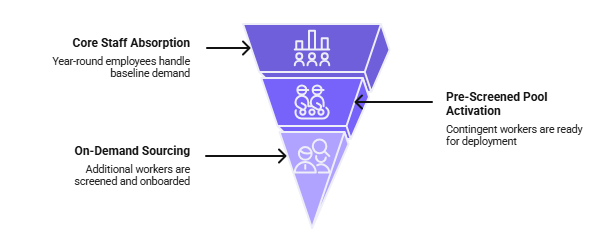
The compliance layer is not optional at any tier. The legal obligation to conduct a compliant background check does not diminish because a hire is urgent. Staffing level decisions directly determine how much time is allocated per candidate for screening, and building that time into the plan before the surge is the only way to meet both the operational and legal requirements simultaneously.
Understanding why warehouse workers leave is directly relevant to surge risk management. High turnover is the mechanism that converts a one-time surge hiring event into a recurring compliance liability.
The primary drivers of warehouse attrition are well documented. Physical demands, including repetitive lifting, extended standing, and temperature exposure, accumulate as injury and fatigue over time. Rotating shifts and overnight schedules disrupt routines in ways workers tolerate for a season but not a career. Wage competition from retail employers, delivery platforms, and gig economy options gives workers accessible alternatives.
What is less frequently discussed is the perception gap around safety investment. Workers who observe that their employer compresses onboarding, skips safety training, and fills roles with inadequately screened colleagues receive a clear signal about how much their wellbeing is valued. That perception accelerates turnover among exactly the workers an operation most wants to retain.
The financial stakes are significant. Industry research consistently places the cost of a bad hire in the range of 30 percent of first-year earnings. A warehouse operation cycling through dozens of replacements per month accumulates costs that dwarf the investment in a proper screening and onboarding program. Framing screening and onboarding as retention investments rather than compliance costs changes how operations directors allocate time and budget.
Many operations directors believe that routing a hire through a staffing agency insulates the employer from screening compliance obligations. That belief is incorrect, and it is expensive when tested.
The Department of Labor’s joint employer framework establishes that when a company controls the day-to-day work of a worker, it bears employer obligations regardless of the formal employment relationship. For warehouse operators directing the tasks, schedules, and safety protocols of temp workers, that standard is almost always met.
FCRA consumer report obligations, EEOC individualized assessment requirements, and OSHA safety duties all apply to the end-user employer. This means that a staffing agency’s defective FCRA disclosure does not immunize the warehouse operator from liability if the worker was placed at that facility. It also means that if a temp worker is injured because a drug test was skipped for speed, the operator faces the OSHA recordable event and the negligent hiring claim, not the agency.
Joint Employer Warning: The end-user employer is not insulated from joint employer liability simply because a staffing agency processed the hire. FCRA compliance, EEOC adherence, and workplace safety obligations attach to the entity that directs the work. For warehouse operators directing the tasks and schedules of temp workers, that standard is almost always met.
During warehouse demand surges, compliance and negligent hiring risk concentrates in five specific zones. Understanding each one precisely is the prerequisite to building a program that avoids them.
| Danger Zone | Risk Type | Primary Legal Exposure |
| 1. Compressed screening timelines | Skipped components (criminal, employment verification, drug) | Negligent hiring, OSHA, FCRA |
| 2. Batch hiring without individualized assessment | Blanket disqualification across large cohorts | EEOC disparate impact, Title VII |
| 3. Temp workers misclassified as FCRA-exempt | Consumer reports obtained without proper disclosure or authorization | FCRA, class action exposure |
| 4. Multi-state ban-the-box non-compliance | Criminal history inquiries made too early in hiring process | State fair chance law penalties |
| 5. Re-hires without updated screening | Treating prior background check as current despite time elapsed | Negligent hiring, FCRA |
When a hiring manager needs 50 workers in 48 hours, the instinct is to start people working while the background check is pending. The legal problem is not starting work conditionally, which can be done properly. The problem is skipping components entirely or failing to run the adverse action process when a report returns disqualifying information after the worker has already been on the floor.
EEOC guidance requires that criminal history be evaluated through an individualized assessment considering the nature of the offense, time elapsed, and relationship to the job. When a warehouse processes 200 applications simultaneously and makes blanket decisions, that process cannot satisfy individualized assessment requirements regardless of intent.
Temporary and seasonal workers are consumers under the FCRA. There is no seasonal exception. Every consumer report obtained on a temp worker requires a proper standalone disclosure, written authorization, and full adverse action compliance if the report is used to make an employment decision.
Employers operating fulfillment networks across multiple states and localities face a patchwork of criminal history inquiry restrictions. Fair chance hiring laws in a significant number of states and localities restrict when criminal background questions can be asked, creating compliance complexity for centralized HR teams managing surges across multiple locations. The applicable rules vary by jurisdiction and should be confirmed with legal counsel for each operating location.
A returning seasonal worker who was screened 11 months ago is not a screened worker for the purposes of the current hiring cycle. A background check is a point-in-time snapshot. Criminal incidents, license suspensions, or other disqualifying events may have occurred since the original check. Treating a prior report as current without re-screening creates negligent hiring exposure and may violate a written screening policy.
FCRA compliance obligations apply in full during warehouse surge hiring. The FCRA adverse action process is non-negotiable regardless of hiring volume or timeline pressure.
Legal Notice: FCRA willful violations carry statutory damages of $100 to $1,000 per violation, plus punitive damages and attorney fees under 15 U.S.C. § 1681n. At a warehouse operation processing hundreds of candidates per surge cycle, a single procedural defect in the disclosure form multiplies into class-wide liability.
Warehouse and fulfillment environments involve forklift operation, powered industrial trucks, conveyor systems, rack systems storing significant overhead weight, and physical throughput rates that demand sustained attention. OSHA formally designates warehousing as a high-hazard industry, and the injury rate data supports that designation.
Pre-employment drug testing in this environment is not a formality. A worker who begins operating heavy equipment while impaired, in a facility that also employs new surge hires still learning floor navigation protocols, creates a multi-victim injury scenario. The employer who waived the drug test to fill a shift faster faces OSHA recordable events, workers’ compensation claims, civil litigation, and a negligent hiring claim that a drug test result would have largely foreclosed.
Multi-State Marijuana Complexity: Employers operating fulfillment networks across multiple states must maintain location-specific drug testing policies. A number of states restrict or prohibit pre-employment marijuana testing for most roles. A blanket national drug testing policy that does not account for state law variation is legally deficient. Legal counsel review of drug testing policy by location is not optional for multi-state operators.
Post-incident testing is equally critical. When a workplace injury occurs during a surge period and the employer cannot produce documentation of a pre-employment drug test, the OSHA recordable event is compounded by the negligent hiring inference. Plaintiffs’ attorneys in warehouse injury litigation routinely request drug testing documentation as part of discovery. Its absence is treated as evidence of negligence, not simply an administrative gap.
The drug testing policy must also address post-accident protocols, reasonable suspicion testing criteria, and return-to-duty requirements. These policies should be written, location-specific where required by state law, and reviewed by legal counsel before the surge season begins.
A background check at hire is a point-in-time snapshot. A worker who clears a pre-employment background check in October may have a DUI arrest in December, a restraining order in February, or a license suspension in March. All of those events are directly relevant to their fitness for a warehouse role involving powered industrial vehicles or high-value inventory.
Continuous criminal record monitoring addresses this gap by generating alerts when a monitored employee has a new court record event. For warehouse operations, this is particularly relevant in three contexts: roles involving forklift or vehicle operation where license suspensions are directly relevant to safety; pharmaceutical and healthcare fulfillment where controlled substance access creates regulatory and safety considerations; and high-value inventory environments where theft risk is concentrated.
EEOC Note on Post-Hire Monitoring: The EEOC individualized assessment standard applies to post-hire monitoring programs just as it does to pre-employment screening. Automated termination workflows triggered by any new court record, without individualized review, create the same disparate impact exposure as blanket pre-employment disqualification policies.
The warehouses that handle surge hiring without creating legal exposure are the ones that built their screening infrastructure before the demand spike arrived. The warehouses that create liability are the ones treating screening as something to figure out after the volume forecast lands.
The warehouse staffing challenges created by demand surges present a false choice: move fast or move compliantly. That framing is wrong, and accepting it is how operations end up with FCRA class actions, OSHA recordable events, and negligent hiring claims that arrive long after the peak season revenue has been recognized.
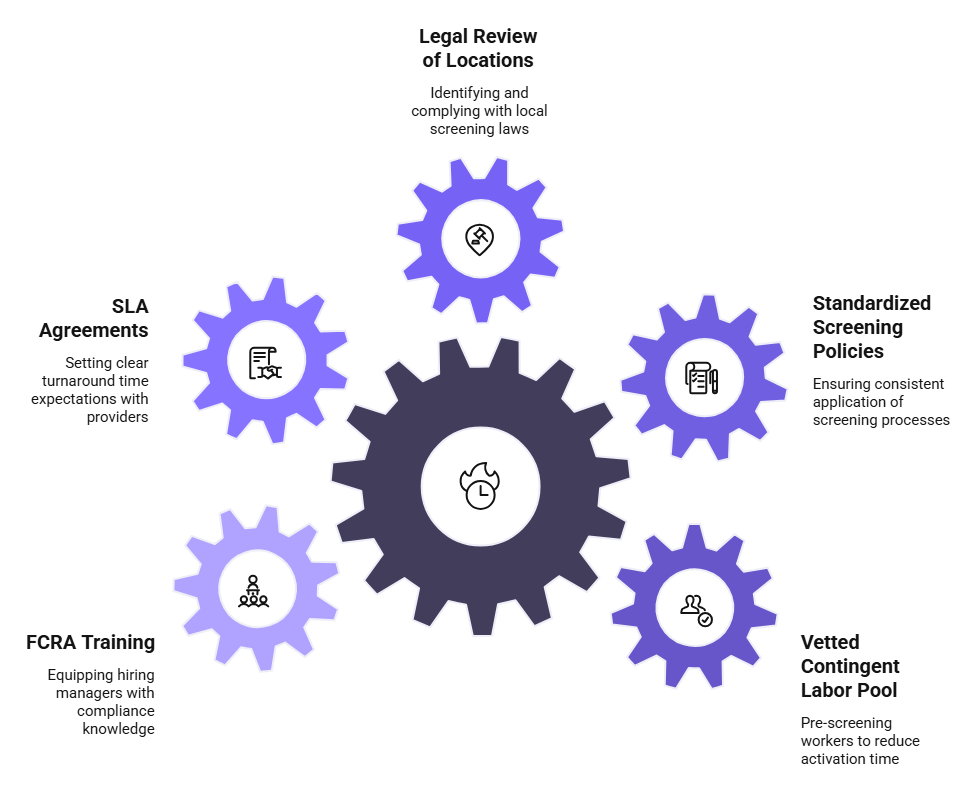
The risk during warehouse staffing challenges does not come from screening itself. It comes from screening without a system. A properly built screening program with a pre-vetted contingent labor pool assembled before the surge, standardized written policies by role type, legal review of every operating location, and trained hiring managers who can execute FCRA steps independently can match the operational pace of a surge without generating legal exposure. Speed is a product of preparation, not of shortcut.
Yes, fully. Temporary and seasonal warehouse workers are consumers under the FCRA, and there is no exception for short-duration placements. Any employer obtaining a consumer report on a temp worker must provide a standalone disclosure, obtain written authorization, and complete the full adverse action process if the report is used to make an employment decision. Staffing agency processing of the hire does not transfer or eliminate the end-user employer’s obligations.
A standard warehouse background check typically takes three to five business days under normal conditions. Complex reports involving multi-county criminal searches or employment verification at multiple prior employers can take longer. Drug test results add one to three business days. Surge hiring plans should build in a minimum of seven to ten business days from application to floor-ready status to allow for the background check, drug test, and any adverse action process that may be triggered.
Yes, conditional start is legally permissible, but it creates specific obligations that must be managed carefully. If a background report returns disqualifying information after the worker has already started, the employer must still complete the full FCRA adverse action process before taking any action. Failing to do so, for example by simply removing the worker from the schedule without providing pre-adverse action notice and a waiting period, is an FCRA violation even though the worker was hired on a conditional basis.
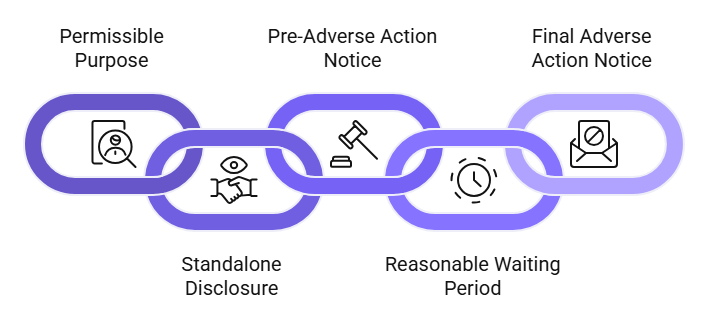
A compliant adverse action process requires five steps: obtaining the report under permissible purpose with written authorization; providing a standalone FCRA disclosure before ordering the report; issuing a pre-adverse action notice with a copy of the report and Summary of Rights before making a final decision; allowing a reasonable waiting period (courts generally recognize five business days as a minimum); and issuing a final adverse action notice if the employment decision proceeds. Skipping any step, even under time pressure, creates FCRA liability.
No. A background check conducted during a prior employment period is a point-in-time snapshot and does not constitute current screening. Criminal incidents, license suspensions, and other disqualifying events may have occurred since the prior check. Employers should treat returning seasonal workers as new applicants for screening purposes, with the full screening workflow applied at each re-hire.
The EEOC does not establish a universal list of disqualifying offenses. EEOC guidance requires employers to conduct an individualized assessment considering three factors: the nature and gravity of the offense, the time that has passed since the offense or completion of sentence, and the nature of the specific job. For warehouse roles, relevant considerations include theft convictions for roles with high-value inventory access, DUI or reckless driving records for forklift and vehicle operation roles, and drug convictions for roles in controlled substance fulfillment environments. Blanket disqualification policies that do not incorporate individualized assessment create disparate impact exposure under Title VII.
Fair chance hiring laws in a significant number of states and localities restrict when criminal history can be considered in the hiring process, typically prohibiting criminal history inquiries until after a conditional offer has been made. For warehouse operators managing surge hiring across multi-state fulfillment networks, a centralized application or interview process asking about criminal history early in the pipeline may be lawful in some locations and a civil violation in others. Location-specific policy variants and hiring manager training are necessary for any multi-state warehouse operation.
Recruiter & Editor
Charm Paz is an HR professional at GCheck, specializing in background screening, fair hiring, and regulatory compliance. She holds from the Professional Background Screening Association (PBSA) and helps organizations navigate employment regulations with clarity and confidence.
With a background in Industrial and Organizational Psychology, she translates policy into practice to build ethical, compliant, human-centered hiring systems that strengthen decision-making over time.

Contact us today for efficient, FCRA-compliant screening solutions
designed to keep your hiring process moving safely and smoothly.



LEGAL DISCLAIMER: The information provided in this article is for general informational and educational purposes only and should not be construed as legal advice or a substitute for consultation with qualified legal counsel. While we strive to ensure accuracy, employment screening laws and regulations—including but not limited to the Fair Credit Reporting Act (FCRA), Equal Employment Opportunity Commission (EEOC) guidelines, state and local ban-the-box laws, industry-specific requirements, and other applicable federal, state, and local statutes—are subject to frequent changes, varying interpretations, and jurisdiction-specific applications that may affect their implementation in your organization. Employers and screening decision-makers are solely responsible for ensuring their background check policies, procedures, and practices comply with all applicable laws and regulations relevant to their specific industry, location, and circumstances. We strongly recommend consulting with qualified employment law attorneys and compliance professionals before making hiring, tenant screening, or other decisions based on background check information.