Continuous monitoring and periodic rescreening are not competing tools. They are complementary mechanisms that cover different data sources, timelines, and risk profiles within a post-hire screening program. HR directors and compliance officers who treat them as substitutes will build programs with systematic coverage gaps; those who treat them as layered controls will build programs that match the risk architecture of their workforce.
Key Takeaways
- A point-in-time background check captures a snapshot of a candidate’s record at the moment of hire and provides no coverage for what develops afterward.
- The interval between checks, whether monthly, annual, or longer, is the primary source of post-hire workforce risk in any program that relies on rescreening alone.
- Periodic rescreening covers a broader geographic and jurisdictional scope than most continuous monitoring networks, making it the stronger tool for employees who have lived or worked in multiple states or countries.
- Continuous monitoring detects reportable records in near real time, but its coverage is constrained by the courts and jurisdictions within its network, which vary by provider and data type.
- Neither mechanism alone is sufficient for high-access, safety-sensitive, or vulnerable-population roles. Those segments require both, sequenced to close the gaps each leaves open.
- FCRA adverse action obligations apply equally to continuous monitoring alerts and periodic rescreen findings when a consumer reporting agency is involved and the result affects an employment decision.
- Regulated industries including healthcare, financial services, and transportation impose sector-specific rescreening mandates that set the compliance floor. The decision for those employers is what to layer on top, not whether to rescreen at all.
- A hybrid program does not require multiple platforms or vendors. It requires a sequencing design that assigns each mechanism to the risk profile it is best suited to address.
The Post-Hire Screening Gap: Why Initial Checks Are Not Enough
What a Point-in-Time Background Check Cannot Tell You About a Current Employee
A pre-employment background check is a record of what was knowable on a specific date. It captures criminal history, employment and education verification, and credential checks as they existed at the moment of inquiry. Once an employee passes through onboarding, however, that record begins to age. Arrests, convictions, license suspensions, financial crimes, and other reportable events that occur after the hire date will never appear in an initial check.
This limitation is not a flaw in background check methodology. It is a structural characteristic of point-in-time screening. The check answered the question it was designed to answer: whether this candidate presents an acceptable risk at the time of hire. It was never designed to answer the question that matters most once someone is already inside the organization, which is whether that employee’s risk profile has changed.
For roles with limited access, low autonomy, and minimal exposure to sensitive assets or vulnerable populations, that gap may be acceptable. For roles where an employee holds ongoing access to financial systems, patient data, controlled substances, children, or critical infrastructure, the gap between a hire-date check and the present moment is a program vulnerability, not a policy preference.
The Between-Check Gap as the Primary Source of Post-Hire Workforce Risk
Most workforce incidents involving current employees are not predictable from hire-date records. Instead, they involve events that occur after onboarding: a DUI in year two, a felony conviction in year four, a professional license suspension that never surfaces in routine HR communication. Without a systematic mechanism for detecting post-hire record changes, organizations fall back on self-disclosure, supervisor observation, or incident response rather than proactive compliance.
The between-check gap is the interval between the most recent background check and the present date. In a program that relies on initial-hire screening only, that gap equals the employee’s full tenure. In a program conducting annual rescreening, that gap reaches up to twelve months. By contrast, in a program with continuous monitoring, that gap measures in hours or days for records within the monitoring network’s coverage.
Critically, the gap is not uniform across employees, roles, or data types. It varies by how recently the employee was last screened, which record sources are active, and whether any monitoring mechanism runs at all. Understanding the gap, not the method, is therefore the correct starting point for post-hire screening program design.
Why the Post-Hire Screening Question Is a Program Design Problem, Not a Product Selection Problem
Many organizations approach post-hire screening as a vendor evaluation exercise. They compare continuous monitoring products against annual rescreening services on price, turnaround time, and feature lists. This framing produces the wrong outcome because it assumes the organization already knows what coverage it needs.
The more productive question is not which product covers more ground. Instead, it is: which risk profiles exist in the workforce, what record types are material to each, what detection timeline is acceptable for each risk category, and what regulatory obligations set the compliance floor? Those answers determine the program design. Product selection follows from the design, not the reverse.
Consider two scenarios: a compliance officer at a regional hospital network and a risk manager at a logistics company may both be evaluating continuous monitoring solutions. Their workforces have different access profiles, different regulatory environments, and different definitions of actionable risk. The right program for each looks different, not because the products differ, but because the workforce risk architectures differ.
What Periodic Rescreening Is and What It Covers
How Periodic Rescreening Works and What a Full Rescreen Includes
Periodic rescreening is a scheduled, comprehensive background check run on current employees at defined intervals. Depending on organizational policy and applicable regulatory requirements, those intervals may be annual, biennial, or tied to role changes, license renewals, or contract milestones. A full rescreen typically mirrors the scope of a pre-employment background check and commonly includes:

- Criminal history at the national, state, and county level
- Employment and education verification where relevant
- Credential and professional license verification
- Sex offender registry checks
- Role-specific searches such as motor vehicle records or healthcare sanction screenings
When a consumer reporting agency conducts the rescreen, the same FCRA obligations that applied at hire apply again. Specifically, that includes obtaining a permissible purpose, providing required disclosures, and following the adverse action process if the rescreen produces a result that prompts a negative employment decision.
The Geographic and Jurisdictional Scope Advantage Rescreening Has Over Continuous Monitoring
One of the most frequently underappreciated distinctions between periodic rescreening and continuous monitoring is jurisdictional coverage. A comprehensive rescreen draws on court records, databases, and verification sources across the full geographic history of the employee, including counties, states, and in some cases international jurisdictions where the employee has lived or worked.
Continuous monitoring, by contrast, operates through a network of courts and data sources that the monitoring provider actively accesses. That network is not uniform. Coverage varies by provider, by jurisdiction, and by record type. Some monitoring networks cover thousands of courts in near real time; others carry material gaps in coverage for rural counties, courts that do not participate in electronic reporting, and international jurisdictions.
For employees with multi-state residential histories, or for roles that operate in jurisdictions outside the monitoring network, periodic rescreening provides coverage that no monitoring product can replicate. In these scenarios, rescreening is not a fallback option. It is the mechanism that closes the geographic gap.
Where Periodic Rescreening Creates Blind Spots and What It Misses Between Cycles
The structural limitation of periodic rescreening is the interval it defines. An annual rescreen run in January produces no coverage for a conviction that occurs in March. As a result, an employee who receives a DUI in June, faces conviction in September, and reaches the next rescreen the following January represents a nine-month window during which the organization had no visibility into that record change.
For low-access roles, that window may be acceptable. For roles with daily access to vulnerable populations, controlled substances, or critical financial systems, however, a nine-month detection gap is a program failure, not a policy tradeoff. Periodic rescreening is also inherently backward-looking. It captures what exists at the time of the run; it does not generate alerts, flag developing situations, or notify HR teams of record changes as they occur. Consequently, an organization relying exclusively on periodic rescreening is always operating with information at least as old as the last scheduled rescreen cycle.
What Continuous Monitoring Is and What It Covers
How Continuous Monitoring Works and What Data Sources It Watches in Real Time
Continuous monitoring is an ongoing post-hire screening mechanism that checks enrolled employee records against a defined set of data sources on a recurring basis, typically daily or weekly, and generates alerts when it detects a reportable record change. Rather than running a comprehensive check at scheduled intervals, the system watches for new activity and surfaces it when it appears. Data sources vary by provider but typically include:
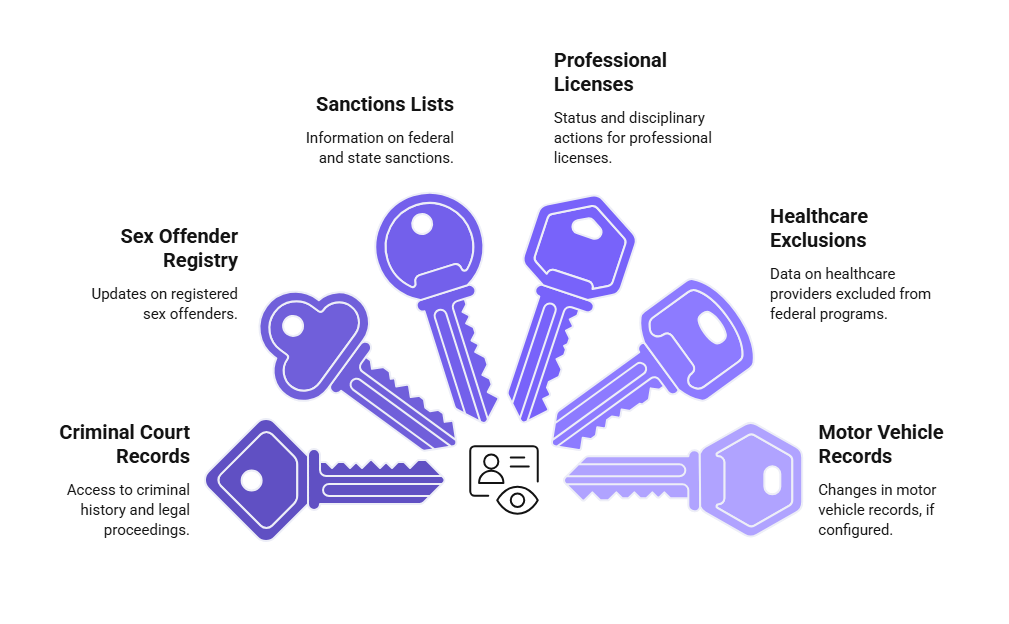
- Criminal court records in participating jurisdictions
- Sex offender registry updates
- Federal and state sanctions lists
- Professional license status and disciplinary actions
- Healthcare exclusion databases such as the OIG exclusion list
- Motor vehicle record changes, where configured
Because continuous monitoring runs as a subscription-based ongoing service, it requires a separately documented authorization process and its own FCRA compliance infrastructure, including procedures for receiving and acting on alerts. When an alert meets the threshold for adverse action, it triggers the same two-step pre-adverse and adverse action process that applies to any consumer report used in an employment decision.
The Time-Gap Advantage Continuous Monitoring Has Over Periodic Rescreening
The defining advantage of continuous monitoring is detection speed. For record types and jurisdictions within the monitoring network’s coverage, a new conviction, license suspension, or sanction can surface as an alert within days or weeks of the underlying event, rather than months later at the next scheduled rescreen.
For roles where the risk of a post-hire record change is material and the acceptable detection window is short, that speed difference is not a convenience feature. It is the central program requirement. A healthcare employer subject to OIG exclusion screening obligations, or a financial services firm managing employees with access to client accounts, simply cannot accept the detection timeline that annual rescreening produces.
It is important to note, however, that the time-gap advantage is bounded by the network. Continuous monitoring detects records faster than rescreening only for record types and jurisdictions within its coverage. For anything outside that network, continuous monitoring provides no coverage at all, regardless of how quickly the alert system operates.
Where Continuous Monitoring Creates Blind Spots and What It Misses Outside Its Coverage Network
Continuous monitoring networks are not comprehensive by default. Coverage gaps fall into several consistent categories:
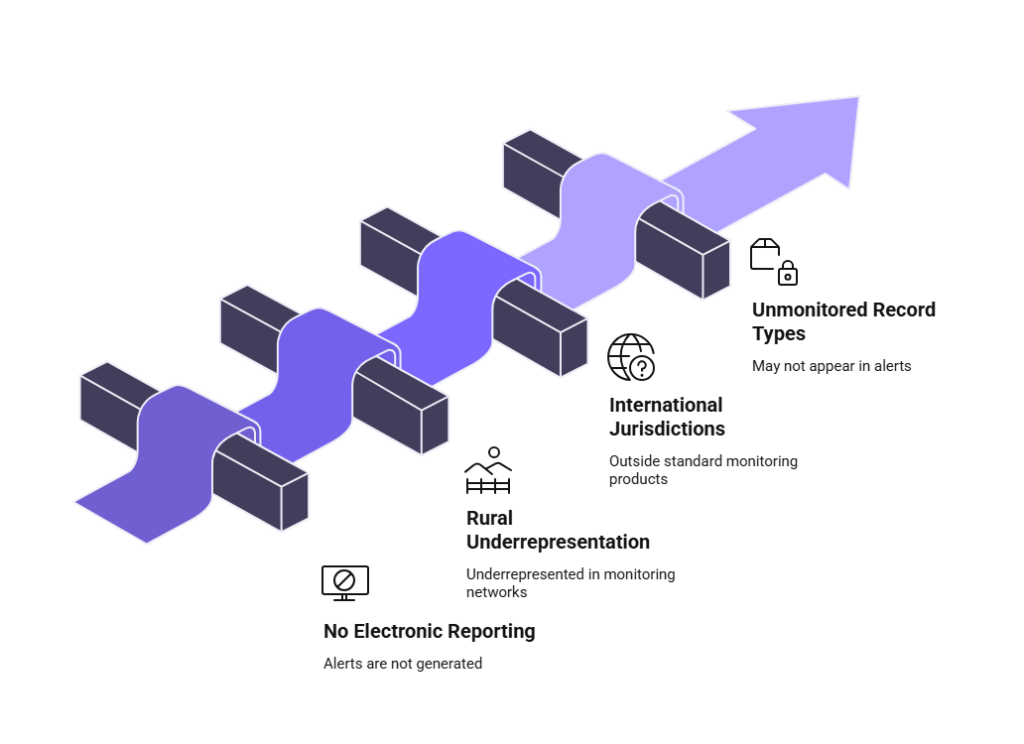
- Courts without electronic reporting, or those that do not participate in the monitoring provider’s network, will not generate alerts regardless of what activity occurs in them.
- Rural counties and courts with delayed reporting timelines are systematically underrepresented in most monitoring networks.
- International jurisdictions fall largely outside the scope of standard monitoring products. Employees who travel internationally for work, or who have residential history outside the United States, receive no coverage for foreign criminal records or credential actions.
- Record types outside monitored infrastructure, including certain civil judgments, some financial crimes, and records sealed or expunged under applicable state law, may not appear in monitoring alerts even when they exist.
In short, organizations that rely on continuous monitoring as their sole post-hire mechanism, without acknowledging these gaps, are not running a complete post-hire screening program.
Side-by-Side Comparison
Comparison Framework Across Six Dimensions
The table below compares periodic rescreening and continuous monitoring across six dimensions relevant to post-hire program design. It serves as a program design input, not a vendor selection tool.
| Dimension | Periodic Rescreening | Continuous Monitoring |
| Coverage Scope | Comprehensive; mirrors full pre-employment check across employee’s full geographic history | Limited to record types and jurisdictions within the monitoring provider’s network |
| Time Sensitivity | Detection lag equals the rescreen interval, up to 12 months or longer for annual programs | Detection lag measured in days to weeks for in-network records and jurisdictions |
| Data Sources | National, state, and county criminal records; verification sources; role-specific searches | Participating courts, sanction and exclusion databases, license monitoring, MVR where configured |
| FCRA Obligations | Full adverse action process required when CRA is used and result affects employment decision | Full adverse action process required when CRA is used and alert affects employment decision |
| Cost Profile | Per-check cost at defined intervals; total cost scales with rescreen frequency and employee population | Ongoing subscription cost; total cost scales with enrolled population size |
| Best-Fit Workforce Type | Employees with multi-jurisdictional history; roles with defined regulatory rescreen requirements; lower-access roles where detection lag is acceptable | High-access, safety-sensitive, or regulated roles requiring short detection windows; roles where sector-specific databases require ongoing monitoring |
What the Comparison Reveals About Why Neither Approach Alone Is Sufficient for High-Risk Workforce Segments
The table makes the core argument visible: periodic rescreening wins on scope and loses on speed, while continuous monitoring wins on speed and loses on scope. For lower-access roles where the detection lag of an annual rescreen is acceptable and the employee’s geographic history is well-defined, rescreening alone may be sufficient. For high-access roles in regulated industries, however, with employees who have multi-state histories and daily exposure to sensitive assets or populations, neither mechanism alone covers the full risk profile.
The comparison is therefore not a guide to choosing one or the other. Rather, it is a diagnostic for identifying which gaps each mechanism leaves open, and whether those gaps are acceptable for a given workforce segment.
How to Read the Comparison Table as a Program Design Input Rather Than a Vendor Selection Tool
The table should inform role-category decisions, not organizational preferences. The question for each workforce segment is not “which approach is better” but rather: what is the acceptable detection window for this role, what record types are material, and what geographic scope does the employee population require? Those answers will point toward rescreening, monitoring, or both for each segment. Cost and platform considerations follow only after the coverage design is complete.
Role-Based Decision Framework: Which Approach Fits Which Workforce Segment
Low-Access and Low-Risk Roles Where Periodic Rescreening on a Defined Cycle Is the Appropriate Primary Mechanism
Employees in roles with limited access to sensitive assets, limited autonomy over consequential decisions, and no direct exposure to vulnerable populations present a post-hire risk profile that periodic rescreening can address adequately. Administrative staff in back-office functions, contract employees in bounded project roles, and seasonal workers in low-access operational positions generally fall into this category.
For these workforce segments, the key design decisions are how frequently to rescreen, what scope to include, and whether any sector-specific requirement imposes a defined cycle. Where no regulatory mandate applies, a biennial rescreen schedule is common for lower-risk roles. In all cases, the appropriate interval should appear in the organization’s written screening policy and apply consistently across comparable roles.
High-Access, Safety-Sensitive, or Vulnerable-Population Roles Where Continuous Monitoring Is the Appropriate Primary Mechanism
Roles involving ongoing access to patient data, controlled substances, minor children, financial accounts, or critical infrastructure require a detection window that annual or biennial rescreening cannot provide. For these workforce segments, continuous monitoring against relevant databases is the appropriate primary mechanism, supplemented by periodic rescreening to cover the geographic and jurisdictional scope that monitoring networks do not reach.
The relevant monitoring databases differ by sector and are not interchangeable:
- Healthcare employers monitor against OIG exclusion lists, state Medicaid exclusion databases, and professional license tracking systems.
- Transportation employers monitor motor vehicle records.
- Financial services employers monitor securities industry databases and criminal records in participating jurisdictions.
For these roles, continuous monitoring is not a program enhancement. It is the mechanism that aligns the detection timeline with the access risk. Rescreening then complements it by closing the geographic gaps monitoring leaves open.
Regulated Roles With Sector-Specific Rescreening Mandates Where the Regulatory Requirement Sets the Baseline
Several industries impose mandatory rescreening or monitoring requirements that remove the interval decision from the employer’s discretion entirely. These requirements establish the compliance floor. Consequently, the program design question for regulated employers is not whether to rescreen or monitor, but what to layer on top of the existing regulatory baseline.
| Sector | Relevant Regulatory Framework |
| Healthcare | CMS conditions of participation, OIG exclusion screening requirements, applicable state health department rules |
| Financial Services | FINRA oversight, banking regulator requirements specifying timing and scope |
| Transportation | DOT background check and drug testing requirements for safety-sensitive roles |
| Energy | NERC CIP personnel risk assessment requirements for unescorted access to critical cyber assets |
For each of these regulated contexts, the regulatory obligation defines the minimum. The risk architecture of the specific workforce segment then determines whether monitoring, additional rescreening cycles, or both belong on top.
The Hybrid Model: How Continuous Monitoring and Rescreening Work Together
How to Sequence Continuous Monitoring and Periodic Rescreening So They Address Complementary Gaps Rather Than Duplicating Coverage
A hybrid program does not run both mechanisms on every employee at maximum frequency. Instead, it assigns each mechanism to the risk coverage gap it is best suited to close, sequenced so the two operate as complements rather than redundancies. The practical sequencing model for most organizations starts with role segmentation:
- High-access and regulated roles enroll in continuous monitoring for the record types and databases relevant to their access profile. Those roles also receive periodic rescreening, typically annually or as required by applicable regulation, to provide comprehensive geographic coverage for record types or jurisdictions outside the monitoring network.
- Lower-access roles receive periodic rescreening on a defined cycle without monitoring enrollment, unless organizational policy or a specific incident trigger warrants otherwise.
For applicable roles, monitoring enrollment should begin in accordance with the timeline any relevant regulatory obligation requires or, where no mandate applies, at or before the individual’s start date. Periodic rescreening then schedules according to the applicable regulatory requirement or organizational policy cycle. When a monitoring alert fires, it triggers an individualized review and, where applicable, the FCRA adverse action process.
The FCRA Compliance Requirements That Apply to Both Mechanisms and How to Satisfy Them in a Combined Program
FCRA obligations do not differ between continuous monitoring and periodic rescreening when a consumer reporting agency is involved. Both require a permissible purpose, a clear written disclosure to the individual, and a written authorization obtained before the report is procured. Both also trigger the two-step pre-adverse and adverse action process when the result affects an employment decision.
In a combined program, the organization must therefore maintain two parallel compliance workflows: one for handling monitoring alerts that meet the actionable threshold, and one for handling rescreen findings that prompt a review. Many organizations route both through a single adverse action workflow, which simplifies the operational footprint but requires that the workflow handles both input types. Additionally, individuals enrolling in a continuous monitoring program must receive a written disclosure and provide written authorization before monitoring begins. For existing employees added to a monitoring program after initial hire, a standalone disclosure and authorization document is required before enrollment.
Building a Hybrid Post-Hire Screening Program That Scales Across a Multi-Tier Workforce Without Requiring Different Platforms for Each Mechanism
A common objection to hybrid program design is operational complexity. Organizations with multi-tier workforces, including full-time employees, part-time staff, contractors, per diem workers, and vendor personnel, often assume that layering rescreening and monitoring requires separate platforms, separate vendor relationships, and separate compliance workflows for each population. In practice, that assumption does not hold for most current screening program architectures.
Many background screening providers offer both periodic rescreening and continuous monitoring as components of a single post-hire program, with a unified adverse action workflow, shared authorization infrastructure, and role-based configuration. The guiding design principle is segmentation, not multiplication. Define the workforce tiers, assign the appropriate mechanism or combination of mechanisms to each tier based on access profile and regulatory obligation, and configure the program to apply those assignments consistently. The platform question is always secondary to the coverage design question.
Conclusion
Continuous monitoring and periodic rescreening are not alternatives. They are mechanisms that close different gaps in the same post-hire risk coverage problem. Organizations that design their post-hire programs around that distinction, assigning each mechanism to the workforce segments and record types it is best suited to address, build programs that deliver systematic coverage rather than systematic blind spots. The decision framework is not monitoring versus rescreening; it is which combination, in which sequence, for which workforce segment.
Frequently Asked Questions
What is the difference between continuous monitoring and rescreening employees?
Periodic rescreening is a comprehensive background check run at scheduled intervals, covering the employee’s full geographic and jurisdictional record history at the time of the run. Continuous monitoring is an ongoing service that watches enrolled employee records against a defined set of data sources and generates alerts when it detects a reportable change. The two differ in detection speed, geographic scope, and the record types each can surface.
How often should employers rescreen employees?
Rescreening frequency depends on role access profile, applicable regulatory requirements, and organizational risk policy. Some regulated industries specify mandatory rescreening intervals. For roles without a regulatory mandate, many organizations apply annual rescreening to high-access positions and biennial rescreening to lower-access roles. The appropriate interval should appear in a written screening policy and apply consistently across comparable roles.
Does FCRA apply to continuous employee monitoring programs?
Yes. When a consumer reporting agency conducts continuous monitoring, FCRA obligations apply in full. Individuals must receive a clear written disclosure and provide written authorization before monitoring begins. If a monitoring alert results in an adverse employment action, the employer must follow the two-step pre-adverse and adverse action process, including providing a copy of the report and a summary of rights before the decision is finalized.
Is continuous monitoring better than annual background checks for employees?
Neither is categorically better. Continuous monitoring detects in-network record changes faster than annual rescreening but covers a narrower geographic and data scope. Annual rescreening provides comprehensive jurisdictional coverage but introduces a detection lag of up to twelve months. For high-access or safety-sensitive roles, continuous monitoring is typically the appropriate primary mechanism, with periodic rescreening closing the geographic coverage gaps that monitoring networks do not reach.
What roles require continuous background monitoring rather than periodic rescreening?
Roles with ongoing access to vulnerable populations, controlled substances, patient data, financial accounts, or critical infrastructure generally require continuous monitoring as part of the post-hire program. Healthcare workers, licensed drivers in transportation roles, financial services employees with account access, and employees in child-serving organizations are common examples. Applicable regulatory requirements for each sector may also specify which databases employers must monitor on an ongoing basis.
Can an employer use continuous monitoring instead of annual rescreening?
Continuous monitoring alone is not a complete substitute for periodic rescreening in most programs. Monitoring networks carry geographic and data source limitations that rescreening covers. For employees with multi-state residential or work history, periodic rescreening addresses jurisdictions and record types that fall outside the monitoring network. A program design using both mechanisms, sequenced to address complementary gaps, provides more complete post-hire coverage than either approach alone.
Does FCRA adverse action apply the same way to monitoring alerts as to rescreen findings?
Yes. When a consumer reporting agency is involved and the result prompts a negative employment decision, the two-step adverse action process applies whether the trigger was a monitoring alert or a rescreen finding. The employer must provide a pre-adverse action notice with a copy of the report and a summary of rights, allow a reasonable opportunity to respond before the final decision is made, and then issue a final adverse action notice if the decision stands.
What is an individualized assessment and when does it apply in a post-hire screening program?
An individualized assessment is a structured evaluation of whether a flagged record is directly relevant to the specific role in question. It takes into account the nature and gravity of the offense, the time elapsed, and evidence of rehabilitation or changed circumstances. It applies when a rescreen finding or monitoring alert is under consideration as the basis for an adverse employment action, consistent with EEOC guidance on employment decisions involving criminal records.
Additional Resources
- Background Checks: What Employers Need to Know (FTC / EEOC Joint Guidance)
https://www.ftc.gov/tips-advice/business-center/guidance/background-checks-what-employers-need-know - Consideration of Arrest and Conviction Records in Employment Decisions Under Title VII (EEOC Guidance)
https://www.eeoc.gov/laws/guidance/enforcement-guidance-consideration-arrest-and-conviction-records-employment-decisions - OIG List of Excluded Individuals and Entities (LEIE)
https://oig.hhs.gov/exclusions/ - DOT Drug and Alcohol Testing Regulations Overview (FMCSA)
https://www.fmcsa.dot.gov/regulations/drug-alcohol-testing/overview-drug-and-alcohol-rules - NERC CIP-004-7: Personnel and Training Standards for Critical Infrastructure Protection
https://www.nerc.com/pa/Stand/Pages/CIPStandards.aspx - FINRA Background Check Requirements for Securities Industry Personnel
https://www.finra.org/rules-guidance/rulebooks/finra-rules/3110

ABOUT THE CREATOR
Charm Paz, CHRP
Recruiter & Editor
Charm Paz is an HR professional at GCheck, specializing in background screening, fair hiring, and regulatory compliance. She holds from the Professional Background Screening Association (PBSA) and helps organizations navigate employment regulations with clarity and confidence.
With a background in Industrial and Organizational Psychology, she translates policy into practice to build ethical, compliant, human-centered hiring systems that strengthen decision-making over time.