

Post-hire screening is not a single product but a program design decision, and continuous background monitoring is one mechanism within it, not a replacement for the initial check or for periodic rescreening. This article gives HR managers and compliance officers a structured framework for determining which roles in their workforce warrant continuous monitoring, which are adequately served by rescreening cycles, and what FCRA requires when monitoring is part of the program.
Key Takeaways
- An initial background check is a point-in-time snapshot. It captures a candidate’s record as of the hire date and provides no coverage for events that occur after employment begins.
- Post-hire screening is the set of mechanisms organizations use to extend screening beyond the hire date, including periodic rescreening, continuous monitoring, and sector-specific exclusion checks.
- Continuous background monitoring watches enrolled employee records against defined databases on a recurring basis and generates alerts when new reportable activity appears, typically within days of a filing rather than months later.
- Continuous monitoring has coverage limitations. It watches the databases it has access to, and records in jurisdictions or data sources outside its network will not generate alerts regardless of their severity.
- The between-check gap in annual rescreening cycles, up to twelve months during which a new event goes undetected, is the primary source of post-hire workforce risk for organizations that rely on rescreening alone.
- High-access, safety-sensitive, and vulnerable-population-contact roles generally warrant continuous monitoring because the detection window in a rescreening-only program is too long to be acceptable given the access risk of the role.
- FCRA disclosure for ongoing monitoring must specifically cover post-hire monitoring at the time of initial authorization. A standard pre-employment disclosure that does not reference ongoing monitoring does not satisfy this requirement.
- When a monitoring alert leads to an employment decision, the FCRA two-step adverse action process applies. The employee is entitled to notice, a copy of the report, and a waiting period before any final decision is made.
What Post-Hire Screening Is and Why the Initial Check Is Not the End of the Program
The Point-in-Time Limitation of an Initial Background Check and What It Leaves Unmonitored
A pre-employment background check answers one question: does this candidate’s record, as of today, meet the organization’s hiring standards? It captures criminal history, employment verification, education verification, and any other components the organization includes, as they exist at the moment the check runs. Once the candidate is hired and the check is filed, that record begins to age.
Every day that passes after hire is a day during which a new arrest could be filed, a professional license could be suspended, a restraining order could be entered, or a regulatory exclusion could be added to a federal database. None of those events would appear in the initial check, because they did not exist at the time it was conducted. The initial check has no mechanism for detecting post-hire events. It was not designed to.
For roles where post-hire record changes are unlikely to affect the employee’s ability to perform the job safely and legally, that limitation may be acceptable. For roles where a post-hire conviction, license action, or regulatory exclusion would make the employee ineligible to continue in the role, the limitation creates a compliance gap that grows with every day the employee remains unscreened.
Post-Hire Screening Defined: The Range of Mechanisms That Extend Screening Beyond the Hire Date
Post-hire screening is the set of processes an organization uses to monitor workforce risk after the initial background check. It is not a single product or a single vendor category. It includes periodic rescreening, which runs a full or partial background check on enrolled employees at defined intervals, typically annual or biennial. It also includes continuous monitoring, which watches specified databases on a recurring basis and generates alerts when new reportable activity appears. Additionally, it includes sector-specific ongoing checks, such as monthly OIG exclusion screening for healthcare organizations and MVR monitoring for transportation roles, that regulatory frameworks effectively require.
These mechanisms are not interchangeable. Each addresses a different aspect of post-hire risk, operates on a different timeline, and covers different data sources. A complete post-hire screening program for a given organization depends on its workforce composition, the access profiles of its roles, its regulatory obligations, and the detection timelines that are acceptable given those obligations.
Where Continuous Monitoring Fits Within the Broader Post-Hire Screening Framework
Continuous monitoring occupies a specific position in the post-hire screening framework: it is the mechanism that compresses the detection timeline for new events in enrolled employee records to days rather than months. It does not replace the initial background check, which establishes the baseline record at hire. It does not replace periodic rescreening, which provides a comprehensive geographic scope that monitoring networks may not fully cover. It addresses the between-check gap, the period during which new events occur and go undetected because no check has been run.
For organizations building or evaluating a post-hire screening program, the relevant question is not whether continuous monitoring is better than rescreening. It is whether the between-check gap in a rescreening-only program is acceptable for a given role, given that role’s access to sensitive assets, vulnerable populations, or regulated activities. Continuous monitoring belongs in the program when the answer to that question is no.
What Continuous Background Monitoring Does and Does Not Do
How Continuous Monitoring Works and What Record Types It Watches in Real Time
Continuous background monitoring works by enrolling the employee’s identifying information, typically name, date of birth, and Social Security number, against a defined set of data sources that the monitoring service watches on a recurring basis. The service compares current records against what was present at enrollment and generates an alert when something new appears. The alert fires not because of what happened in the world but because of what entered a monitored database, usually within days or weeks of the underlying event being recorded.
The record types most commonly covered by continuous monitoring include:
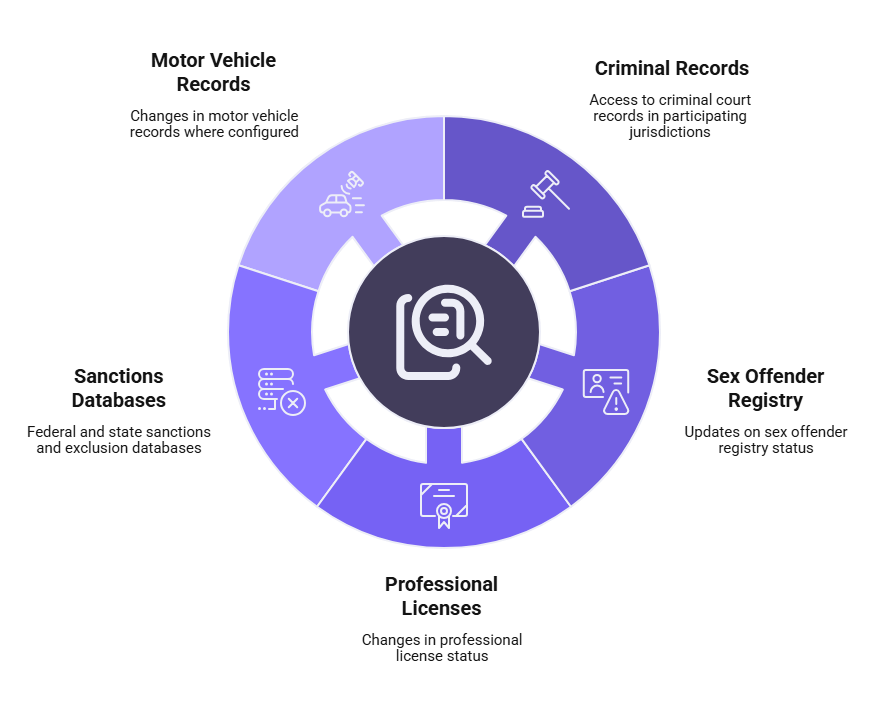
- Criminal court records in participating jurisdictions
- Sex offender registry updates
- Professional license status changes
- Federal and state sanctions and exclusion databases, such as the OIG exclusion list
- Motor vehicle record changes, where configured
The specific coverage varies by provider and by what the employer has configured as part of the monitoring program.
The Coverage Limitations of Continuous Monitoring and What It Does Not Replace
Continuous monitoring watches the databases it has access to. Records in courts or jurisdictions outside the monitoring network will not generate alerts, regardless of the severity of the event. Rural counties with limited electronic reporting, tribal court systems, and international jurisdictions are common coverage gaps. A monitoring service that covers thousands of courts still has a network boundary, and events on the other side of that boundary are invisible to the monitoring program.
This is why continuous monitoring does not replace periodic rescreening for roles where comprehensive geographic coverage matters. A lateral hire with residential history across five states, two of which fall outside the monitoring network, needs both mechanisms: monitoring to compress the detection timeline for in-network events, and rescreening to provide the jurisdictional depth that monitoring cannot match.
How Monitoring Alert Timelines Compare to the Between-Check Gap in Periodic Rescreening Cycles
The practical difference between continuous monitoring and annual rescreening is the size of the undetected window. In an annual rescreening program, a new event that occurs the day after a completed rescreening will not be detected for up to twelve months. In a continuous monitoring program, the same event generates an alert within days or weeks of appearing in a monitored database.
For roles where a twelve-month detection gap is operationally acceptable given the role’s access profile, annual rescreening may be the appropriate primary mechanism. For roles where a twelve-month gap is not acceptable, including roles with access to vulnerable populations, financial systems, or safety-critical infrastructure, the monitoring timeline is not a convenience feature. It is the core compliance argument for including monitoring in the program.
When Continuous Monitoring Is the Right Primary Mechanism
High-Access and Safety-Sensitive Roles Where the Between-Check Gap Creates the Most Exposure

The roles that most clearly warrant continuous monitoring are those where a new post-hire event would make the employee ineligible to continue in the role and where the consequences of delayed detection are most severe. A security officer with unrestricted access to a corporate campus, a software engineer with administrative access to production databases containing customer data, and a caregiver in a residential treatment facility all share a common characteristic: the access the employee holds daily is the mechanism through which a post-hire disqualifying event becomes an organizational liability.
For these roles, the question is not whether post-hire monitoring is warranted. It is what the acceptable detection window is. Annual rescreening accepts up to a twelve-month window. Continuous monitoring compresses that window to days. The appropriate choice depends on the severity of the potential harm during the undetected window.
Regulated Industries and Sector-Specific Obligations That Effectively Mandate Monitoring as a Program Component
Several regulatory frameworks either explicitly require or effectively create an obligation for ongoing workforce screening that goes beyond the initial check. The specific mechanism varies by sector, but the common thread is that a point-in-time hire check is not sufficient to meet the ongoing screening expectation the framework creates. Examples of sector-specific obligations that function this way include:
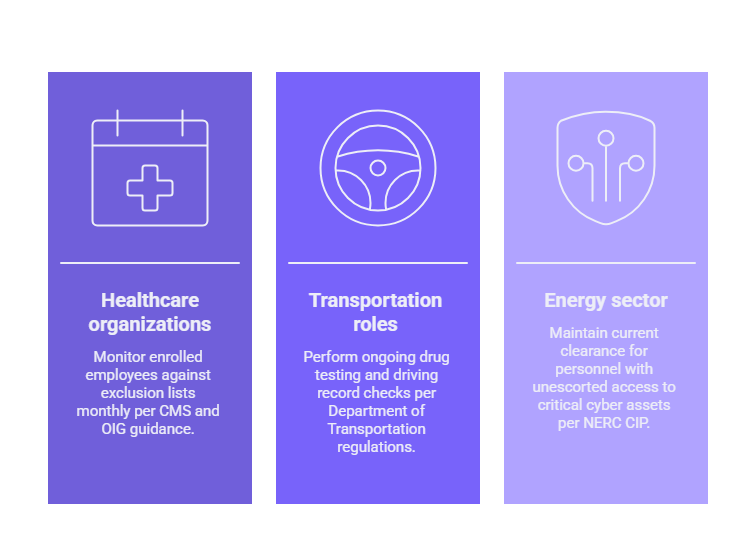
- Healthcare organizations subject to CMS Conditions of Participation and OIG guidance are expected to monitor enrolled employees against exclusion lists monthly, not just at hire.
- Department of Transportation regulations for safety-sensitive transportation roles impose ongoing drug testing and driving record requirements that function as a form of continuous monitoring.
- NERC CIP standards for energy sector employers require personnel risk assessments for individuals with unescorted access to critical cyber assets, creating an obligation to maintain current clearance rather than relying on a point-in-time hire check.
For employers in these sectors, monitoring is not an elective program enhancement. The regulatory framework sets the compliance floor, and the design question is not whether to monitor but what to add on top of the regulatory baseline to address the workforce risk profile that the sector-specific requirement does not fully cover.
Vulnerable Population Contact Roles Where the Standard of Care Requires Real-Time Visibility Rather Than Annual Clearance
Roles that involve direct, ongoing contact with children, elderly individuals, patients, or other vulnerable populations represent a category where the standard of care expected by licensing bodies, accreditors, and the communities these organizations serve is higher than what annual rescreening alone can provide. A new disqualifying event in the record of a nurse with daily patient contact, a teacher with a classroom of children, or a home health aide operating in a client’s private residence has consequences that are not confined to paperwork.
The standard of care argument for continuous monitoring in these roles is not primarily regulatory. It is operational and ethical. Organizations serving vulnerable populations are expected to know, on an ongoing basis, whether the people they have placed in positions of trust continue to meet the standards for that trust. Annual rescreening does not provide that assurance. Continuous monitoring moves materially closer to it.
When Periodic Rescreening Is Sufficient and When It Is Not
Low-Access and Low-Risk Roles Where a Defined Rescreening Cycle Is the Appropriate Primary Mechanism
Not all roles warrant continuous monitoring, and applying monitoring across an entire workforce without regard to access profile or role risk is neither operationally necessary nor appropriate. For roles with limited access to sensitive assets, no direct contact with vulnerable populations, and no regulatory obligation for ongoing screening, a defined periodic rescreening cycle is typically the appropriate primary mechanism. Administrative roles in back-office functions, remote contractors with bounded access to internal systems, and temporary employees in low-access operational positions generally fall into this category.
For these populations, a biennial or annual rescreen provides adequate coverage relative to the access risk of the role. The additional detection benefit of continuous monitoring does not offset the administrative and compliance overhead of enrollment and alert management for these groups.
The Elapsed-Time and Role-Change Triggers That Convert a Rescreening-Sufficient Role Into a Monitoring-Appropriate One
A role that was appropriate for periodic rescreening at hire may become appropriate for monitoring as the employee’s tenure and access profile evolve. Two categories of triggers are most common. The first is elapsed time: an employee who has not been rescreened in three or more years has a growing undetected window that may begin to exceed what is acceptable given their current access. The second is role change: a promotion, a transfer, or a project assignment that increases the employee’s access to sensitive systems, customer data, or vulnerable populations changes the risk profile of the role and may make monitoring appropriate where it was not before.
Access-level promotions, security clearance upgrades, and new client-facing responsibilities are all role-change triggers that warrant a review of whether the existing screening mechanism still matches the role’s risk profile. A practical post-hire screening program treats role changes as screening triggers, not just as HR events.
Why Relying on Rescreening Alone for High-Access Roles Creates a Documented and Foreseeable Liability Gap
The argument for monitoring over rescreening alone for high-access roles is not speculative. It is structural. An organization that knows a high-access employee’s record could change at any time, that knows annual rescreening creates a twelve-month detection gap, and that continues to rely on annual rescreening alone for that employee has made a documented decision to accept that gap. In the event of an incident during the undetected window, the organization’s own screening program records may indicate that the gap was foreseeable and that available tools existed to reduce it.
This is a risk management framing, not a prediction of legal outcomes, but a description of the information an organization holds about its own program design choices. Organizations that work through this framing and identify high-access roles for which the detection gap is not acceptable are identifying the candidates for monitoring enrollment that their own risk assessment produces.
FCRA Compliance in a Continuous Monitoring Program
The Disclosure Requirement That Must Cover Ongoing Monitoring at the Time of Initial Authorization
FCRA requires that employees receive a clear and conspicuous disclosure before a consumer reporting agency obtains a consumer report on their behalf. For ongoing monitoring programs, this requirement extends beyond the pre-employment disclosure. The disclosure must specifically cover ongoing monitoring at the time of initial authorization. A standard pre-employment disclosure that authorizes a background check for hiring purposes does not, on its own, authorize a consumer reporting agency to conduct ongoing monitoring throughout employment.
The practical implication is that employers who enroll new hires in monitoring at onboarding must include the ongoing monitoring scope in the disclosure and authorization documents provided at that stage. Employers who enroll existing employees in monitoring after hire should provide a new disclosure and obtain fresh authorization before enrollment begins, consistent with FCRA’s requirements for ongoing consumer reporting. The disclosure must be a standalone document, separate from the employment agreement and other onboarding materials.
The Adverse Action Process That Applies When a Monitoring Alert Leads to an Employment Decision
When a monitoring alert generates a finding that the employer is considering as the basis for an adverse employment decision, including termination, demotion, reassignment, or suspension, the FCRA two-step adverse action process applies. A monitoring alert does not automatically require immediate adverse action. The employee is entitled to notice and an opportunity to respond before any final decision is made.
The required steps are:
- Provide a pre-adverse action notice including a copy of the consumer report, a copy of the CFPB Summary of Rights under FCRA, and a statement that adverse action may be taken based on the report.
- Allow a reasonable waiting period, recognized as a minimum of five business days in most practice contexts.
- Issue a final adverse action notice identifying the consumer reporting agency, stating that the agency did not make the employment decision, and providing the employee’s right to dispute the report’s accuracy.
How to Structure the Monitoring Authorization and Alert-Response Workflow to Satisfy FCRA at Each Stage
A monitoring program that satisfies FCRA at each stage requires documented procedures for three points in the process: authorization, alert receipt, and adverse action. At authorization, the documentation should confirm that the employee received a standalone disclosure covering ongoing monitoring, that authorization was obtained before enrollment, and that the authorization record is maintained in a retrievable format.
At alert receipt, the workflow should include a review step before any employment decision is made, a record of the review, and a determination of whether the alert meets the organization’s criteria for further action. At adverse action, the workflow should generate the required pre-adverse notice, track the waiting period, and produce the final adverse action notice only after the waiting period has elapsed and the decision has been confirmed. Each step in this workflow should be documented, because that documentation is the evidence that the program operated lawfully when an alert produced an employment consequence.
Building the When-to-Use Decision Framework for Your Organization
The Three Variables That Determine Whether Continuous Monitoring Belongs in a Role’s Screening Program
The decision to include continuous monitoring in a role’s screening program can be organized around three variables: access profile, regulatory obligation, and detection window tolerance. The table below illustrates how these variables interact to produce a monitoring determination.
| Variable | Low | Moderate | High |
| Access profile | Back-office, no sensitive data or vulnerable population contact | Some client contact, limited system access | Privileged system access, vulnerable population contact, safety-critical role |
| Regulatory obligation | No sector-specific ongoing screening requirement | Some periodic reporting obligations | Explicit ongoing monitoring expectation (healthcare OIG, DOT, NERC CIP) |
| Detection window tolerance | Annual gap acceptable given access risk | Gap tolerable with defined rescreening cycle | Any gap beyond days or weeks creates unacceptable exposure |
| Recommended mechanism | Periodic rescreening | Rescreening plus trigger-based review | Continuous monitoring, supplemented by rescreening for jurisdictional coverage |
A role that scores high on all three variables is a clear candidate for monitoring enrollment. A role that scores low across the board is a candidate for periodic rescreening. Roles in between represent the design challenge, and the framework provides structure for working through them consistently.
Applying the Framework Across a Multi-Tier Workforce With Different Access Profiles and Regulatory Obligations
Most organizations have a workforce that spans multiple access tiers, and a defensible post-hire screening program applies different mechanisms to different tiers rather than treating the entire workforce as a single population. A common tiering approach assigns continuous monitoring to roles with the highest access profiles or regulatory obligations, periodic rescreening to roles with moderate access, and event-triggered rescreening to roles with the lowest access profiles.
The tiering decision should be documented in a written screening policy that defines which roles belong in which tier, what the screening mechanism is for each tier, what triggers a tier reassignment, and how alerts are reviewed and acted upon. A written policy converts the decision framework from an internal discussion into an auditable record that demonstrates the organization applied consistent, risk-based criteria to its post-hire screening program design.
Documentation Requirements for the Monitoring Enrollment Decision and the Alert Review Process
Two documentation requirements are particularly important for organizations operating continuous monitoring programs. The first is the enrollment record: documentation that the employee received and authorized the monitoring disclosure before enrollment, that the disclosure covered ongoing monitoring specifically, and that the enrollment was processed in accordance with the organization’s written screening policy.
The second is the alert review record: documentation that each alert was reviewed by a qualified person, that the review considered the nature of the record, the relevance to the employee’s role, and any applicable individualized assessment criteria, and that the review resulted in a documented determination. Both sets of documentation serve the same function: demonstrating that the program operated intentionally and lawfully, with each step recorded in a format that can be produced if the decision is later examined.
Conclusion
Post-hire screening is a program design question, and continuous background monitoring is one answer to one part of it, the part concerned with detecting new events quickly rather than comprehensively. The when-to-use decision belongs to the organization, informed by the access profiles of its roles, its regulatory obligations, and its honest assessment of which detection windows are acceptable and which are not. Organizations that work through that framework systematically will identify where monitoring belongs in their program and where periodic rescreening remains the right tool.
Frequently Asked Questions
What is continuous background monitoring for employees?
Continuous background monitoring is a post-hire screening mechanism that watches enrolled employee records against defined databases on a recurring basis and generates alerts when new reportable activity appears. It detects events that occur after the initial hire check, including new criminal filings, license changes, and regulatory exclusions, typically within days of the event entering a monitored database.
How is continuous monitoring different from a background check?
A background check is a point-in-time snapshot run at a specific moment, typically at hire. Continuous monitoring is an ongoing watch that operates throughout employment and generates alerts when new records appear. The two serve different purposes and operate on different timelines. Neither substitutes for the other in a complete post-hire screening program.
When should an employer use continuous background monitoring?
Continuous monitoring is most appropriate for roles with high access to sensitive systems, vulnerable populations, or safety-critical infrastructure where a twelve-month detection gap in annual rescreening is unacceptable. It is also appropriate where sector-specific regulatory frameworks create an expectation of ongoing screening, including healthcare, financial services, and transportation.
Does FCRA apply to continuous employee monitoring programs?
Yes. When a consumer reporting agency conducts ongoing monitoring, FCRA applies. The initial disclosure must specifically cover ongoing monitoring, not just the pre-employment check. When a monitoring alert leads to an employment decision, the two-step adverse action process applies, including a pre-adverse notice, a waiting period, and a final adverse action notice.
What roles require continuous background monitoring?
Roles that typically warrant monitoring include those with direct contact with vulnerable populations such as children, patients, or elderly individuals, roles with privileged access to financial systems or safety-critical infrastructure, and roles in regulated industries where sector-specific frameworks create ongoing screening expectations. The appropriate mechanism for any specific role depends on its access profile and the organization’s regulatory context.
How do employers respond to a continuous monitoring alert?
When an alert is received, the employer should conduct a documented review before making any employment decision. FCRA requires a pre-adverse action notice including a copy of the report and Summary of Rights before any adverse action is taken, followed by a waiting period and a final adverse action notice if the decision proceeds. A monitoring alert does not require or authorize immediate termination.
Is continuous monitoring a substitute for periodic rescreening?
No. Continuous monitoring compresses the detection timeline for events in monitored databases but has coverage limitations. Periodic rescreening provides broader geographic scope and verifies records in jurisdictions that monitoring networks may not cover. A complete post-hire screening program for high-risk roles typically includes both mechanisms to address the gaps that each leaves on its own.
What happens if a monitoring alert involves a record that is inaccurate?
The employee has the right to dispute the accuracy of information in a consumer report under FCRA. If the employer provides a pre-adverse action notice and the employee disputes the record during the waiting period, the employer should pause the decision process and allow the consumer reporting agency time to investigate before proceeding.
Additional Resources
- Background Checks: What Employers Need to Know (FTC / EEOC Joint Guidance)
https://www.ftc.gov/tips-advice/business-center/guidance/background-checks-what-employers-need-know - EEOC Enforcement Guidance: Consideration of Arrest and Conviction Records in Employment Decisions
https://www.eeoc.gov/laws/guidance/enforcement-guidance-consideration-arrest-and-conviction-records-employment-decisions - OIG Compliance Guidance for Healthcare Organizations
https://oig.hhs.gov/compliance/compliance-guidance/index.asp - FMCSA Drug and Alcohol Clearinghouse
https://clearinghouse.fmcsa.dot.gov - NERC CIP Standards: Personnel and Training (CIP-004)
https://www.nerc.com/pa/Stand/Pages/CIPStandards.aspx - FINRA Rule 3110: Supervision
https://www.finra.org/rules-guidance/rulebooks/finra-rules/3110

ABOUT THE CREATOR
Charm Paz, CHRP
Recruiter & Editor
Charm Paz is an HR professional at GCheck, specializing in background screening, fair hiring, and regulatory compliance. She holds from the Professional Background Screening Association (PBSA) and helps organizations navigate employment regulations with clarity and confidence.
With a background in Industrial and Organizational Psychology, she translates policy into practice to build ethical, compliant, human-centered hiring systems that strengthen decision-making over time.