

Are background checks legal in all 50 states?
Yes. Employment background checks are legal in all 50 states. Joint guidance from the Equal Employment Opportunity Commission and the Federal Trade Commission confirms that employers may ask about a candidate’s background and may require a background check, as long as the employer complies with federal nondiscrimination laws and the Fair Credit Reporting Act.
One clarification helps route the question correctly. This article covers employment background checks run by employers through a consumer reporting agency with the candidate’s written consent. Firearm purchase background checks are governed by entirely different federal and state laws and are outside this article’s scope. Tenant screening by landlords follows its own rules as well.
Now the part that matters for anyone building a hiring program. Background checks are legal in every state, but they are uniform in almost none. As of July 2026, 37 states and more than 150 cities and counties have layered fair chance hiring rules on top of the federal floor, according to the National Employment Law Project’s state and local tracker. The question that actually protects an employer is not “is this legal.” The question is “which rules apply to this hire.”
What federal laws govern background checks in every state?
Three federal frameworks apply to employment screening in all 50 states. Together they form the national floor. State and local law can add protections on top of that floor, but no state can subtract from it.
- The Fair Credit Reporting Act governs the process. Whenever an employer orders a background check through a third-party consumer reporting agency, the FCRA requires a standalone disclosure, the candidate’s written authorization, and a two-step adverse action sequence before any final decision based on the report. The FTC’s employer guidance walks through each obligation. For the full step-by-step walkthrough, see our employer guide to adverse action requirements.
- Title VII and EEOC guidance govern the decision. Screening policies must not create unjustified disparate impact on protected groups. The EEOC recommends individualized assessment, which means evaluating the nature of an offense, the time elapsed, and the relevance to the specific role rather than applying blanket exclusions.
- The federal Fair Chance to Compete for Jobs Act governs federal hiring. Since 2021, federal agencies and federal contractors may not ask about criminal history until after a conditional offer.
The federal floor is, at its core, a disclosure and process regime. That aligns with what workers themselves ask for. In the GCheck 2026 Trust in Hiring Report, a survey of 1,500 U.S. workers, 82 percent said a clear explanation of what is being checked and why is important to them. Transparent Compliance starts where federal law starts: telling people what is happening and following a fair process.
How do background check laws differ from state to state?
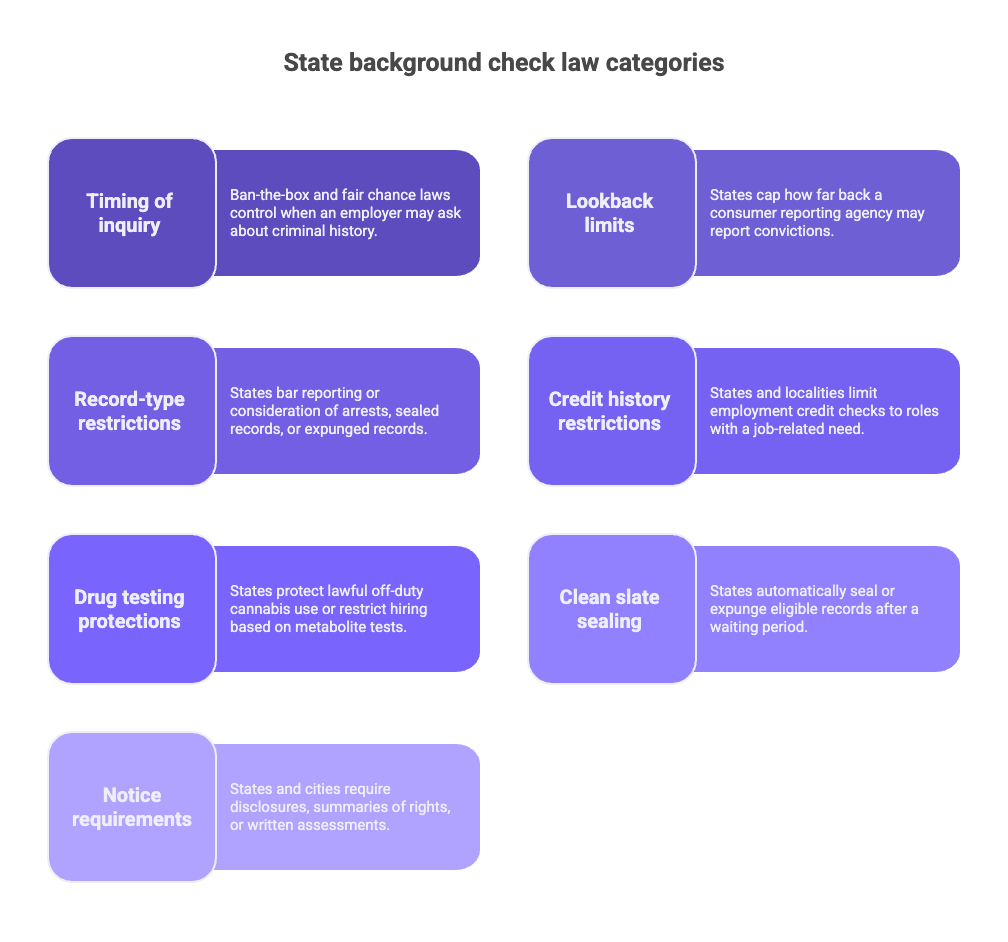
State background check laws diverge in seven main categories. Learning the categories is faster and more durable than memorizing 50 state profiles, because every new law that passes falls into one of these buckets.
- Timing of criminal history inquiry. Ban-the-box and fair chance laws control when an employer may ask about criminal history, most often delaying the question until after an interview or a conditional offer.
- Lookback limits. Roughly a dozen states cap how far back a consumer reporting agency may report convictions, usually at seven years, often with salary-based exceptions.
- Record-type restrictions. Some states bar reporting or consideration of arrests that did not lead to conviction, sealed records, or expunged records.
- Credit history restrictions. About a dozen states, plus localities including New York City and Chicago, limit employment credit checks to roles with a demonstrable job-related need.
- Drug testing and marijuana protections. A growing set of states protects lawful off-duty cannabis use or restricts hiring decisions based on non-psychoactive metabolite tests.
- Clean slate automatic sealing. More than a dozen states plus the District of Columbia now automatically seal or expunge eligible records after a waiting period, which changes what a report may lawfully contain.
- Notice and form requirements. Several states and cities require their own disclosures, summaries of rights, or written assessments layered onto the federal FCRA paperwork.
Each category gets its own section below. The pattern across all seven is worth naming up front: these laws are standards, and most of them institutionalize a specific worker expectation about fair treatment.
What are ban-the-box and fair chance hiring laws, and which states have them?
Ban-the-box laws remove criminal history questions from initial job applications and delay the inquiry until later in the hiring process. Fair chance laws often go further and regulate how criminal history may be considered once it is lawfully obtained.
The scale is national. As of July 2026, 37 states and more than 150 cities and counties have adopted some form of these protections, and the covered jurisdictions include well over three-quarters of the U.S. population. The practical way to sort them is by trigger point rather than by alphabet:
- Application-stage rules remove the checkbox from the application but allow inquiry afterward.
- Post-interview rules delay the inquiry until the employer has interviewed the candidate or found them otherwise qualified.
- Post-conditional-offer rules are the most protective. The employer may not ask about or check criminal history until a conditional offer is on the table.
The strongest regimes go beyond timing. California, New York City, Illinois, and Washington also mandate individualized assessment and, in several cases, a written analysis before any decision based on a record. Washington’s amended Fair Chance Act, effective July 1, 2026 for employers with 15 or more employees, moved the state into the post-conditional-offer tier and added documentation and notice obligations enforced by the state Attorney General.
One development worth stating precisely, because much of the industry coverage got it wrong. Texas considered a statewide ban-the-box bill, House Bill 2466, in its 2025 legislative session. The bill was referred to a House subcommittee in March 2025 and died when the legislature adjourned. As of July 2026, Texas has no statewide ban-the-box law, and the Texas Legislature Online record confirms the bill never advanced. Employers who updated their Texas policies based on early reports of a September 2025 effective date should revisit that decision with counsel.
The brand of these laws matters less than what they encode. Fair chance rules give a person the opportunity to be seen as a qualified candidate before being seen as a record. Workers consistently say this is what fairness looks like: in the GCheck 2026 Trust in Hiring Report, 75 percent of workers said they want consistent screening standards applied to every candidate, and 77 percent said they want a clear path to review or dispute findings. Fair Compliance treats those expectations as the design brief, not as constraints.
How far back can a background check go, and does it differ by state?
The honest answer has two layers, and both matter.
The federal layer. The FCRA bars consumer reporting agencies from reporting most negative non-conviction information older than seven years. That includes arrests that did not lead to conviction, civil suits and judgments, and collections. Bankruptcies may be reported for ten years. The FCRA places no age limit on criminal convictions, and the seven-year limits fall away for positions with an annual salary of 75,000 dollars or more. The governing statute is 15 U.S.C. 1681c.
The state layer. Roughly a dozen states cap conviction reporting at seven years regardless of the federal allowance, several with their own salary-threshold exceptions. California, Massachusetts, New York, Texas, and Washington are among the long-established examples, and New York adds its own required analysis under Article 23-A of the Correction Law before a conviction can justify denial. Cities can tighten the window further: Philadelphia’s amended ordinance, effective January 6, 2026, reduced the lookback for misdemeanor convictions to four years while keeping seven years for felonies.
The takeaway for a multi-state program is that lookback is a per-jurisdiction setting, not a national default. A screening configuration built on one uniform seven-year window quietly overreports in restrictive jurisdictions, and every overreported record is both a compliance exposure and an unfair mark against a candidate.
For candidates reading this, the reassurance is real: reporting limits exist so that old history does not define you indefinitely, and they apply automatically whether or not you know to ask.
What are clean slate laws, and how do they change background checks?
Clean slate laws automatically seal or expunge eligible criminal records after a waiting period, with no petition required from the individual. More than a dozen states plus the District of Columbia have enacted them as of mid-2026, with counts varying slightly by tracker because each state’s scope differs.
New York is the marquee example, and its details show how these laws work in practice:
- The New York Clean Slate Act took effect November 16, 2024.
- Eligible misdemeanors are sealed three years after sentencing or release, and eligible felonies after eight years, provided no new convictions or pending charges intervene.
- The state court system has until November 16, 2027 to seal all existing eligible convictions, so records are disappearing from reports in waves throughout the rollout.
- Employers may not ask about or act on sealed convictions. Employers required by law to run fingerprint-based checks, such as those in childcare, eldercare, and disability care, retain access.
- New York paired the restriction with an employer protection: a compliant employer has an affirmative defense against negligent hiring claims when a sealed record did not appear in a lawful check.
The 2025 and 2026 wave extended the model. Minnesota’s automatic sealing went live in January 2025. The District of Columbia’s Second Chance Amendment Act began automatic expungement of eligible records on January 1, 2026. Virginia’s Clean Slate sealing took effect July 1, 2026, with the first automatic sealings covering more than 100,000 records and a staged rollout following.
Two practical implications follow for employers:
- Stale data is now a liability. A record that was lawfully reportable last year may be off-limits today. Cached reports, old spreadsheets of past results, and databases that refresh slowly all create risk.
- A lawful “no” is the law working. In clean slate states, a candidate may truthfully answer “no” when asked about a sealed conviction. If a sealed record surfaces anyway and conflicts with the candidate’s answer, the failure sits with the data, not with the person. Treating that moment with dignity is Fair Compliance; filtering the record out before it ever reaches a decision-maker is Protective Compliance.
Which state’s laws apply when hiring remote or multi-state employees?
The laws of the state, and often the city or county, where the employee will physically work govern the screening process. The employer’s headquarters location does not control. This single rule drives more multi-state compliance outcomes than any other.
A concrete example makes it real. A company headquartered in Florida hires a remote analyst who works from Los Angeles. That hire must follow the California Fair Chance Act process, including post-conditional-offer timing and individualized assessment, plus any applicable Los Angeles ordinance. Florida’s comparatively permissive rules never enter the picture.
Two layering rules complete the map:
- Localities can exceed state law. Cities and counties such as New York City and Philadelphia impose requirements stricter than their states, and employers must satisfy both layers.
- One remote hire imports a whole regime. A single employee in California, New York, Illinois, or Washington brings that jurisdiction’s full rulebook into your program, including notice contents, waiting periods, and record restrictions.
The operational instruction is to key the screening workflow to the candidate’s work location at the moment the requisition or order is created, not at some later review step. Jurisdiction assignment is the first decision in a compliant check, and it is a workflow capability by nature, which is why it belongs in the screening platform rather than in a spreadsheet or in institutional memory.
Can an employer use one background check policy for all 50 states?
Yes in architecture, no in mechanics. That distinction is the strategic center of the whole multi-state question.
What can and should be national:
- Inquiry timing set to the most protective standard, which means waiting until after a conditional offer
- Individualized assessment for every record, in every state, whether or not local law requires it
- A real path for candidates to review, explain, or dispute findings
- Consistent adjudication criteria applied to every candidate for the same role
- Documentation of every decision and the reasoning behind it
What cannot be national:
- Notice contents, forms, and state-specific summaries of rights
- Waiting periods between pre-adverse and final notices
- Lookback configurations and salary thresholds
- Reportable record types, including arrest and non-conviction rules
- Sealed and expunged record filtering, which now changes month to month in clean slate states
The most-protective-baseline strategy deserves a fair hearing. Setting the whole program to the strictest standard is simpler to train, more consistent to audit, and inherently fairer to candidates. It also matches the direction of travel of the law itself, so it ages well. Its cost is flexibility: an employer forgoes earlier inquiry in states that would allow it.
The synthesis that holds up in practice is to standardize the fairness architecture nationally and automate the jurisdictional mechanics locally. Consistency is not only operationally cleaner. It is what candidates say fairness looks like, with 75 percent of workers in the GCheck 2026 Trust in Hiring Report asking for consistent screening standards, and it is what makes decisions defensible under disparate-treatment scrutiny. Individualization and consistency are complements: the standard is applied to everyone, and every person is assessed as an individual within it. This is the point where Compliance for Good® stops being a stance and becomes a policy blueprint.
Which states restrict credit checks for employment?
About a dozen states restrict employer use of credit history to roles with a demonstrable job-related need, such as fiduciary or financial-access positions. As of mid-2026, the group includes California, Colorado, Connecticut, Delaware, Hawaii, Illinois, Maryland, Nevada, Oregon, Vermont, and Washington, and the District of Columbia, New York City, and Chicago impose their own restrictions. Additional states have pending bills, which signals where the category is heading.
The compliance rule of thumb is straightforward:
- Do not run blanket credit checks across all roles.
- Document the job-related justification for each role where credit history is checked.
- Tell the candidate what is being checked and why, in plain language.
Scope discipline is Transparent Compliance in practice. Check what the job requires, explain the reason, and check nothing more.
Do states regulate drug testing and marijuana screening differently?
Yes, and the marijuana layer is the fastest-moving part of the category. Several states now protect lawful off-duty cannabis use or bar hiring decisions based on tests that detect only non-psychoactive metabolites, which indicate past use rather than impairment. California and Washington anchor this group, with California’s protections in effect since 2024 and Washington’s rules covering pre-employment testing.
The counterweights are stable. Safety-sensitive roles and federally regulated positions, including those governed by Department of Transportation rules, remain testable everywhere. The practical instruction is to key drug panels to the role and the jurisdiction rather than running one national panel, exactly as with lookbacks and notices.
Can employers consider arrests that did not lead to a conviction?
Federal law and state law answer this differently, and the gap is where employers get hurt.
Federally, the FCRA permits consumer reporting agencies to report non-conviction arrests for seven years. But EEOC guidance is clear that an arrest alone does not establish that criminal conduct occurred, and an arrest by itself should not justify excluding a candidate. Several states go further and bar reporting or consideration of non-conviction records outright, and Washington’s amended Fair Chance Act now prohibits adverse action based on arrest records and juvenile records in most circumstances.
The distinction to internalize is that reportable is not the same as usable. A record can lawfully appear on a report and still be off-limits as a basis for decision, and the reverse can also be true. Programs that draw this line role by role and jurisdiction by jurisdiction survive compliance review. Programs that treat everything on the report as fair game do not.
The people these rules protect are candidates who were arrested and never convicted. The presumption of innocence does not expire at the job application, and screening built on Fair Compliance reflects that.
What happens if an employer violates state background check laws?
The exposure stacks in three layers, and stating them factually is more useful than dramatizing them.
- Federal FCRA liability. Willful violations carry statutory damages of 100 to 1,000 dollars per violation, plus actual damages, punitive damages, and attorney’s fees under 15 U.S.C. 1681n. Because screening errors tend to be systemic, these claims multiply across applicant classes in class actions. One law firm analysis of a ten-year period found employers paid more than 150 million dollars across roughly 150 FCRA class actions.
- State and local penalties. Fair chance regimes carry their own penalty schedules, and several include private rights of action. Washington’s amended act escalates penalties per aggrieved applicant for repeat violations, enforced by the state Attorney General. Philadelphia’s amended ordinance adds a rebuttable presumption of retaliation for adverse action taken within 90 days of a person asserting their rights.
- Sealed-record liability. Clean slate states have created a newer exposure: acting on a record that should have been filtered out. New York’s framework imposes duties on anyone receiving sealed conviction information and creates a cause of action for unlawful disclosure.
The reframe that matters for program design is this: most violations are process failures rather than bad intent. They happen when a uniform process meets non-uniform law. That is an argument for building jurisdiction logic into the screening workflow itself, where it updates continuously, instead of into memos and institutional memory, where it decays.
What changed in background check laws in 2025 and 2026?
This changelog is current as of July 2026. GCheck reviews and refreshes it at least quarterly, and immediately upon major effective dates.
- January 1, 2026, District of Columbia. Automatic expungement of eligible records began under the Second Chance Amendment Act, with older cases processed on a schedule running into 2027.
- January 6, 2026, Philadelphia. Amendments to the Fair Criminal Record Screening Standards Ordinance took effect. The misdemeanor lookback dropped from seven years to four, summary offenses may no longer be considered, gig and contract workers gained coverage, and pre-decision notice and response requirements expanded. The Philadelphia Commission on Human Relations published initial compliance guidance in April 2026.
- July 1, 2026, Washington. The amended Fair Chance Act took effect for employers with 15 or more employees. Criminal history inquiry now waits until after a conditional offer, arrest and juvenile records are largely off-limits, individualized assessment and written decisions are required, and coverage extends to current employees and internal moves. Employers with fewer than 15 employees have until January 1, 2027.
- July 1, 2026, Virginia. Clean Slate sealing went live, automatically sealing more than 100,000 records in its first wave, opening petition-based sealing for many more, and barring most employers from asking about sealed records.
- In progress, New York. The Clean Slate Act rollout continues, with all existing eligible convictions to be sealed by November 16, 2027. Records are being sealed in waves, so reports on the same person can change between checks during the rollout.
- Did not pass, Texas. House Bill 2466, a statewide ban-the-box proposal, died in subcommittee during the 2025 session. Texas remains without a statewide fair chance law as of July 2026, despite widespread coverage suggesting otherwise.
The pattern matters more than the list. Every change in this wave moved in the same direction: later inquiry, shorter lookbacks, more sealing, and more individualized assessment. A screening policy built to the fairness standard ages well because the law keeps moving toward it. A policy built to the permissive minimum ages badly because every legislative session erodes its assumptions.
What should HR ask a screening vendor about multi-state compliance?
The landscape above converts directly into evaluation criteria. These eight questions belong in any screening RFP or vendor review:
- How does the platform determine which jurisdiction’s rules apply to each candidate, and is that logic keyed to work location at the moment of order?
- How are state and local law changes monitored, and how quickly are changes like Philadelphia’s January 2026 amendments or Washington’s July 2026 amendments reflected in live workflows and notices?
- How are sealed, expunged, and clean-slate records filtered out of reports, and what is the update cadence as rollouts like New York’s proceed through 2027?
- Are lookback windows and reportable record types configured per jurisdiction and salary threshold automatically, rather than manually per order?
- Are state-specific notices, forms, and summaries of rights maintained inside the adverse action workflow?
- For any past decision, what documentation shows which rule set governed it at the time? This is the audit question, and it is the one a compliance officer will press hardest.
- Where does human review sit in the process? In the GCheck 2026 Trust in Hiring Report, 81 percent of workers said human review of findings is important to them.
- Does the candidate see what is being checked and why, in plain language, in every state? Eighty-two percent of workers in the same survey said a clear explanation matters to them.
A vendor that answers these eight questions specifically, with dates and mechanisms rather than assurances, is describing a compliance-managed platform. A vendor that cannot is describing a data pipe with a compliance disclaimer.
Do candidates have the same rights in every state?
Every candidate in every state holds the same federal baseline of rights, and candidates in stricter jurisdictions hold more.
Rights that exist everywhere under the FCRA:
- The right to consent in writing before an employment background check is run
- The right to receive a copy of the report and a summary of rights before any adverse decision based on it
- The right to dispute inaccurate or incomplete information with the reporting agency
- The right to a two-step adverse action process with time to respond
Rights added in stricter jurisdictions:
- Individualized assessment of any record against the specific job
- A written analysis explaining the employer’s reasoning
- Longer response windows, such as Philadelphia’s ten business days
- Protection of sealed and expunged records from inquiry and use
The employer-side standard and the candidate-side experience are the same system seen from two sides. For the full picture of what candidates should expect from a fair screening process, see our guide to the candidate experience in background screening, and for the dispute mechanics, see our adverse action walkthrough.
References
Equal Employment Opportunity Commission and Federal Trade Commission. Background Checks: What Employers Need to Know. https://www.eeoc.gov/laws/guidance/background-checks-what-employers-need-know
Equal Employment Opportunity Commission and Federal Trade Commission. Background Checks: What Job Applicants and Employees Should Know. https://www.eeoc.gov/laws/guidance/background-checks-what-job-applicants-and-employees-should-know
Federal Trade Commission. Background Checks: What Employers Need to Know. https://www.ftc.gov/business-guidance/resources/background-checks-what-employers-need-know
Fair Credit Reporting Act, 15 U.S.C. 1681c (reporting limits). https://www.law.cornell.edu/uscode/text/15/1681c
Fair Credit Reporting Act, 15 U.S.C. 1681n (civil liability for willful noncompliance). https://www.law.cornell.edu/uscode/text/15/1681n
New York State Unified Court System. New York State’s Clean Slate Act. https://www.nycourts.gov/criminal-history-record-search/new-york-states-clean-slate-act
SHRM. New York State Clean Slate Act Has Taken Effect. https://www.shrm.org/topics-tools/employment-law-compliance/new-york-state-clean-slate-act-has-taken-effect
Washington State Office of the Attorney General. Fair Chance Act. https://www.atg.wa.gov/fair-chance-act
Texas Legislature Online. House Bill 2466, 89th Regular Session (2025), bill history. https://capitol.texas.gov/BillLookup/History.aspx?LegSess=89R&Bill=HB2466
National Employment Law Project. Ban the Box: Fair Chance Hiring State and Local Guide. https://www.nelp.org/insights-research/ban-the-box-fair-chance-hiring-state-and-local-guide/
GCheck. 2026 Trust in Hiring Report. https://gcheck.com/whitepapers/trust-in-hiring-report/

ABOUT THE CREATOR
Charm Paz, CHRP
Recruiter & Editor
Charm Paz is an HR professional at GCheck, specializing in background screening, fair hiring, and regulatory compliance. She holds from the Professional Background Screening Association (PBSA) and helps organizations navigate employment regulations with clarity and confidence.
With a background in Industrial and Organizational Psychology, she translates policy into practice to build ethical, compliant, human-centered hiring systems that strengthen decision-making over time.