

Identity fraud in school hiring happens when someone other than the verified applicant is the person who actually gets hired: a proxy who sat an exam, a stolen identity used to pass a records check, a substitution at the one moment nobody was checking. A criminal record search confirms a name has no disqualifying history. It does not confirm the person standing in a classroom is that name. That distinction has already put unqualified and, in at least one documented case, criminally disqualified individuals in front of students.
Key Takeaways
- Identity fraud is a different failure than credential fraud. Credential fraud means a real person misrepresented what they earned. Identity fraud means the person who cleared screening and the person who shows up for work are not the same human being.
- A 2024 Texas case involving a teacher certification exam proxy ring shows this is not a hypothetical. Harris County prosecutors say the scheme certified roughly 200 unqualified individuals, and that two of them were later charged with crimes against minors.
- Standard education screening (fingerprinting, state criminal registries, abuse registry checks, license verification) confirms facts tied to a name. None of it confirms that the name and the physical person are the same.
- The FBI has published a public advisory recommending identity verification throughout hiring, not just at the point of application, specifically because stolen and substituted identities are defeating conventional screening.
- Layered identity verification, confirming identity before any check runs and confirming physical presence at interview or exam, closes a gap that criminal background checks were never built to close.
What Identity Fraud Looks Like in a Hiring or Credentialing Process
Identity fraud in hiring takes a few recurring forms, and none of them require a fabricated criminal record. The record can be entirely clean. What’s false is the link between the record and the person actually doing the work.
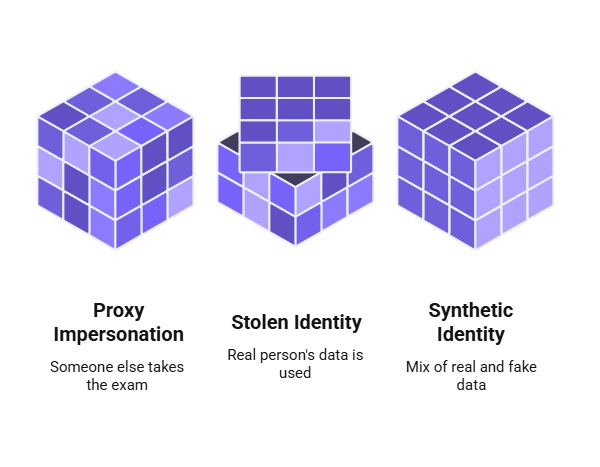
- Proxy impersonation. Someone other than the real candidate sits an exam, attends an interview, or completes a screening step on the candidate’s behalf. It does not require sophisticated technology, only two people willing to swap places and a process that never confirms which one showed up.
- Stolen identity. A real, unconnected person’s name, Social Security number, or credential is used to pass a background check or licensing requirement. The record that comes back is genuinely clean, because it belongs to someone who has nothing to do with the actual applicant.
- Synthetic identity. A persona is assembled from a mix of real and fabricated data rather than borrowed from a single real identity outright. The Federal Bureau of Investigation has warned that this pattern, alongside stolen identities and AI-assisted impersonation, is increasingly used to defeat conventional hiring verification (FBI, Public Service Announcement I-012325-PSA, updated January 27, 2026). The advisory recommends identity verification “during interviewing, onboarding, and throughout the employment” of anyone hired remotely, and notes that operatives have reused the same phone numbers and email addresses across resumes submitted under different names.
All three mechanisms share the same structural weakness: they exploit the gap between confirming a name has no disqualifying record and confirming that name belongs to the person in the room.
This gap is not evenly distributed across an education workforce. Full-time teachers and administrators typically go through the most complete hiring workflow a district runs. Substitutes, tutors, contractors, and volunteers often move through a lighter version of the same process, sometimes administered by a third-party staffing agency rather than the district itself, and reviewed less consistently precisely because the relationship is shorter or less visible. An identity substituted at intake is easiest to miss in exactly the populations that already receive the least scrutiny, even though they hold the same access to students as full-time staff.
| Role type | Typical screening rigor | Access to students |
| Full-time teachers and administrators | Most complete workflow a district runs | Ongoing, direct |
| Substitutes and tutors | Often lighter, sometimes agency-administered | Equivalent to full-time staff |
| Contractors and vendors | Varies by contract terms, inconsistently audited | Frequently unsupervised |
| Volunteers | Often the least consistently reviewed | Direct, sometimes unsupervised |
Why a Clean Background Check Doesn’t Rule This Out
A criminal background check, an abuse registry search, and a professional license verification are each built to answer a specific question about a specific name. They are not built to answer whether the person supplying that name is telling the truth about who they are. That is a separate verification step, and in most hiring workflows, it either happens informally (a hiring manager glances at an ID during onboarding) or does not happen with any real rigor at all. Neither approach withstands a determined attempt at substitution, because neither is designed to.
The table below makes the distinction concrete. Each of these checks does real, necessary work. None of them, alone or combined, confirms identity.
| Check | What it confirms | What it does not confirm |
| State and county criminal records | Whether a specific name has a disqualifying criminal history in that jurisdiction | Whether the applicant is that name |
| Sex offender and abuse registry checks | Whether a specific name appears in state or national safeguarding registries | Whether the applicant is that name |
| Professional license verification | Whether a license tied to a specific name is active, expired, or disciplined | Whether the applicant holds that license, rather than someone else |
| Identity verification (document and biometric) | Whether the person present matches the identity document and biometric data supplied | The applicant’s criminal history, licensure, or education, which still require separate checks |
Read individually, each row looks complete. Read together, the pattern is clear: every check in education screening today assumes the identity attached to the paperwork is accurate, and almost none of them test that assumption directly.
A Documented Case: The Texas Teacher Certification Scheme
This is not a theoretical gap. In October 2024, Harris County, Texas prosecutors filed charges in a scheme in which a Houston-area coach organized a network that let aspiring teachers pay roughly $2,500 to have a proxy sit their state certification exam in their place, with a test proctor bribed to allow the substitution (Texas Tribune, October 29, 2024). Prosecutors estimated that around 400 exams were fraudulently completed this way and that approximately 200 individuals were falsely certified since 2020, with some of them still working in classrooms when charges were announced.
Harris County District Attorney Kim Ogg said two of the individuals who obtained certification through the scheme were subsequently charged with crimes against minors, and stated plainly that it was the false certification’s access to a classroom, not a fabricated credential in isolation, that let them reach students. That is the exact distinction this article is drawing. The academic content of the certification exam was not the vulnerability. The identity of the person taking it was.
No comparably documented case involving AI-generated identity fraud has yet been reported in K-12, higher education, or childcare hiring specifically. The FBI’s active caseload on AI-assisted and stolen-identity hiring fraud is concentrated in remote technology roles. The Houston case matters because it proves the mechanism, identity substitution at a verification checkpoint, already works in education without any AI involved at all, which is reason enough to take the gap seriously regardless of which tool eventually gets used to exploit it.
The scale of the Houston case is also worth sitting with. Two hundred falsely certified individuals across multiple districts is not an isolated incident. It is a functioning market for identity and verification substitution that operated for roughly four years before it was uncovered, which suggests the underlying gap is durable rather than a one-time lapse a single district happened to miss.
Identity Fraud Is a Different Problem Than Credential Fraud
It is easy to blur these two categories, and doing so leads to the wrong fix. Credential fraud is when a real, verifiable person misrepresents what they earned: an inflated degree, a forged license, a certification that was never actually completed. GCheck’s education and degree verification and professional license verification services address exactly that problem, by confirming credentials directly with the issuing institution or licensing board rather than trusting the document a candidate supplies.
Identity fraud is a different failure entirely. The credential in question might be completely real. The problem is that it belongs to someone other than the person now doing the job. Fixing credential fraud means verifying claims against an authoritative source. Fixing identity fraud means confirming, independently of any claim the candidate makes, that the person present is who the paperwork says they are. An education employer that only solves the first problem has not solved the second one, and the Houston case shows why that distinction has real consequences rather than academic ones.
A useful way to keep the two separate is to ask what each check is actually answering, and who is answering it.
| What it asks | Who or what answers | |
| Credential verification | Is this claimed degree, certification, or license genuine? | The issuing institution or licensing board |
| Identity verification | Is this person actually who the documents say they are? | The applicant’s own documents and physical presence |
Both are necessary. Neither answers the other’s question, and a screening program that runs one well while assuming the other is someone else’s problem still has an open gap.
What a Layered Identity Verification Program Looks Like
Closing this gap requires confirming identity before the rest of the screening workflow runs, not after. A background check that returns a clean result for the wrong person has told an employer nothing useful, and by the time that becomes apparent, the person has often already started work.
A layered approach generally combines a few distinct steps, each addressing a different part of the substitution problem:
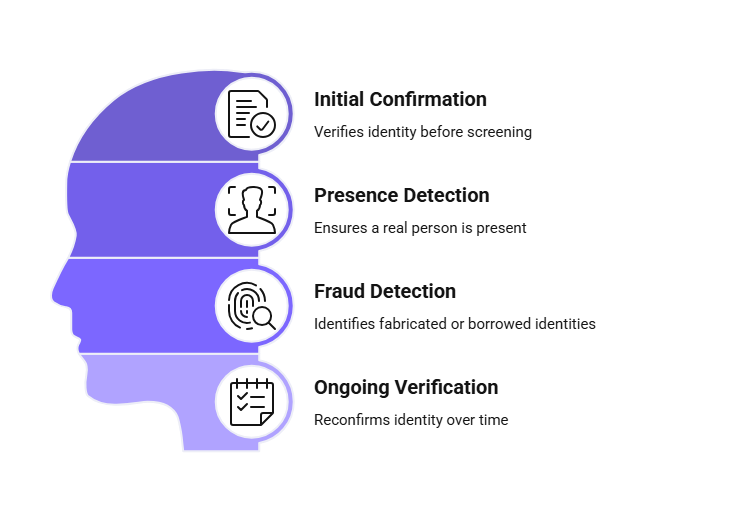
- Identity confirmation before screening begins. Document forensics and government-backed data matching confirm the applicant’s stated identity is real and consistent before any criminal, registry, or license check is run against that name.
- Presence confirmation at the moment it matters. Biometric liveness detection confirms that a real, physically present person, rather than a photo, a recording, or a stand-in, is the one completing identity verification, closing the exact gap a proxy exam-taker or proxy interviewee is built to exploit.
- Detection of fabricated or borrowed identities. A synthetic identity fraud check cross-references applicant data for signs that an identity was assembled from stolen or fabricated information rather than belonging to one real, consistent person.
- Ongoing verification, not a single moment. Identity confirmation at the point of hire does not account for staffing changes, contractor rotation, or long employment tenures. Institutions with sustained access to students benefit from revisiting identity assurance at meaningful points across the employment lifecycle, not only at the first day.
GCheck built its Verified Entry® checkpoint around this exact sequencing: identity is confirmed first, using document authenticity analysis, biometric matching, and liveness detection, and every subsequent background check runs against a confirmed identity rather than an unverified claim. GCheck’s 2026 partnership with identity verification company Cerebrum embedded this checkpoint directly into GCheck’s screening workflow, describing it as particularly relevant for organizations serving vulnerable populations that require a higher standard of identity assurance, and naming youth sports specifically among the settings where this kind of verification is already in use.
Detecting manipulated audio or video during a remote interview is a related but narrower layer, useful specifically where interviews happen on camera and identity has not already been confirmed through a document- and biometric-based checkpoint earlier in the process. It is one tool among several, not a substitute for confirming identity up front.
This sequencing is the practical expression of Protective Compliance under GCheck’s Compliance for Good® framework: verification built to safeguard the people most exposed to risk, students in this case, by treating identity assurance as a prerequisite rather than an afterthought. It works alongside Transparent Compliance rather than against it. Identity confirmation applied consistently to every applicant, and explained clearly as a standard step rather than a targeted suspicion, protects legitimate candidates from being impersonated or wrongly doubted just as much as it protects the institution running the check.
What This Means for Negligent Hiring Exposure
Negligent hiring liability in education is well established for the traditional fact pattern: a school fails to run an adequate background check, and an employee with a disqualifying history goes on to harm a student. A California appellate court confirmed that school districts are not automatically shielded from this kind of claim in Virginia G. v. ABC Unified School Dist., 15 Cal. App. 4th 1848 (1993), reversing a trial court’s dismissal and allowing a negligent hiring and supervision claim to proceed against a district that had hired a teacher despite his documented prior termination from another school for sexual misconduct toward students. The court did not find the district liable outright; it held that the claim could go forward because district employees responsible for hiring may have known or should have known of the risk, which is enough to defeat a school district’s claim of blanket immunity at the pleading stage.
What existing case law does not yet address directly is the identity-substitution fact pattern: a background check that was run correctly, and returned a genuinely clean result, but against the wrong person’s identity. Negligent hiring doctrine generally turns on whether an employer knew or should have known of a risk at the time of hire. Given a public FBI advisory recommending identity verification specifically because stolen and substituted identities are defeating standard hiring checks, an education employer that takes no steps toward identity verification going forward may have a harder time arguing that the risk was not foreseeable. This is a reasonable extension of existing doctrine, not a decided legal outcome, and any institution weighing exposure on this specific point should raise it with counsel rather than treat it as settled.
Regardless of how that legal question eventually settles, the practical protection available now is the same one that supports any negligent hiring defense: a documented, consistently applied process. An institution that can show identity verification ran the same way for every hire, substitute, and contractor, with records of what was checked and when, is in a materially stronger position than one that added the step informally, inconsistently, or only after a specific concern arose. Consistency and documentation are what make a verification program defensible, not the technology alone.
Frequently Asked Questions
Is identity fraud the same thing as someone lying on a resume?
No. Resume embellishment involves a real, verifiable person overstating their own experience or skills. Identity fraud means the person completing the hiring process is not the person whose name, records, and credentials are actually being checked. The two require different fixes: fact-checking claims against a source for the first, and confirming physical identity for the second.
Does a criminal background check identify a stolen or substituted identity?
Not directly. A criminal background check confirms whether a specific name has a disqualifying record in the jurisdictions searched. It does not confirm that the person who applied, interviewed, or was hired is actually that name. Identifying identity substitution requires a separate identity verification step, typically document and biometric matching, run before the background check itself.
Has AI-driven identity fraud actually reached school hiring yet?
No documented case involving AI-generated deepfakes or synthetic identities has been reported in K-12, higher education, or childcare hiring specifically as of this writing. The clearest documented case of identity substitution reaching an education setting, the 2024 Houston-area teacher certification scheme, did not involve AI at all; it involved a human proxy sitting an exam in place of the real candidate. That case is reason enough to treat the underlying gap seriously regardless of which method eventually gets used to exploit it.
What is the difference between identity verification and credential verification?
Credential verification confirms that a real person’s claimed degree, certification, or license is genuine, typically by contacting the issuing institution or licensing board directly. Identity verification confirms that the person present is actually the individual named on the application and the documents supplied. An institution needs both; neither substitutes for the other.
Do volunteers, substitutes, and contractors face the same identity fraud risk as full-time staff?
Yes, and in practice they are often more exposed rather than less. Full-time hires typically go through an institution’s most complete screening workflow. Substitutes, tutors, contracted service providers, and volunteers frequently move through a lighter or less consistently supervised process, sometimes run by a third-party staffing agency, even though they hold the same access to students as full-time employees. Any identity verification program built for an education workforce needs to cover these populations with the same rigor as full-time staff, not a reduced version of it.
What should a school district or childcare center do first if it wants to close this gap?
Confirm identity before running the rest of the screening workflow, not after. A background check result is only meaningful if it is checked against a confirmed identity. Adding document forensics and biometric confirmation at the front of the hiring process, before criminal, registry, and license checks run, closes the specific gap that a proxy or substituted identity is built to exploit.
Sources cited
- Federal Bureau of Investigation. “North Korean IT Workers Conducting Data Extortion.” Public Service Announcement I-012325-PSA, published January 23, 2025, updated January 27, 2026. https://www.fbi.gov/investigate/cyber/alerts/2025/north-korean-it-workers-conducting-data-extortion
- Texas Tribune. “Hundreds illegally got Texas teacher licenses through cheating ring, Harris County prosecutors say.” October 29, 2024. https://www.texastribune.org/2024/10/29/texas-harris-county-teacher-certification-cheating-ring/
- NBC News. “Over 200 unqualified Texas educators had someone else take their exams in cheating scandal, officials say.” October 2024. https://www.nbcnews.com/news/us-news/200-unqualified-texas-educators-someone-else-take-exam-cheating-scanda-rcna177984
- Virginia G. v. ABC Unified School Dist., 15 Cal. App. 4th 1848 (1993). Full opinion: https://law.justia.com/cases/california/court-of-appeal/4th/15/1848.html
- GCheck. “GCheck Partners with Cerebrum to Defend Against Deepfakes and Hiring Fraud.” March 3, 2026. https://gcheck.com/blog/gcheck-partners-with-cerebrum/

ABOUT THE CREATOR
Charm Paz, CHRP
Recruiter & Editor
Charm Paz is an HR professional at GCheck, specializing in background screening, fair hiring, and regulatory compliance. She holds from the Professional Background Screening Association (PBSA) and helps organizations navigate employment regulations with clarity and confidence.
With a background in Industrial and Organizational Psychology, she translates policy into practice to build ethical, compliant, human-centered hiring systems that strengthen decision-making over time.