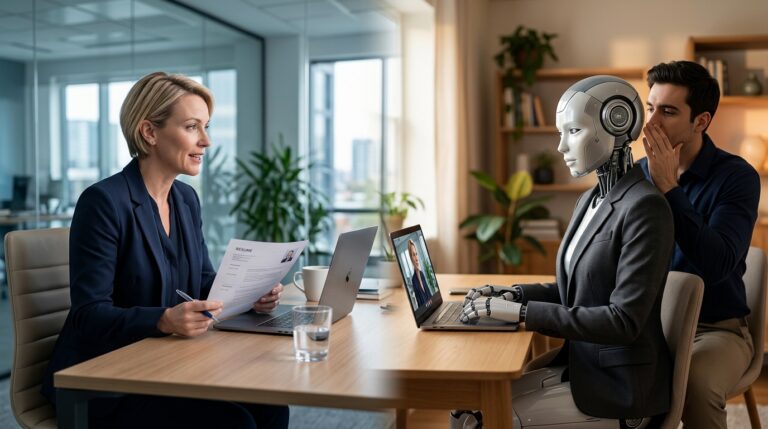

GCheck’s 2026 Trust in Hiring Report found that 50% of job seekers used AI to tailor a resume to a role without actually meeting its requirements, and 43% used AI to generate overstated resume bullets (both INCIDENCE, n=1,500). Neither figure means what a quick read suggests. Some of this is ordinary drafting help. Some of it is fabrication with better grammar. Telling the two apart is the actual work.
Key Takeaways
- GCheck’s Trust in Hiring Report found 50% used AI to tailor a resume without meeting the role’s requirements, and 43% used AI to generate overstated resume bullets (both INCIDENCE, n=1,500).
- The nine behaviors span a wide range, from drafting help that asserts nothing false to behaviors that substitute AI output for the candidate’s own answers in real time.
- Verifying an AI-assisted claim requires the same method as verifying any other claim: confirming the underlying fact, not judging the drafting tool.
- No current EEOC guidance or state AI-hiring law treats candidate-side AI use in drafting application materials as its own regulated category; existing rules address employer-side screening tools instead.
- If a verified discrepancy traces back to an AI-assisted claim and the finding came from a consumer report, the FCRA’s standard adverse action sequence applies exactly as it would to any other discrepancy.
- Using AI to help produce an application is a different question from whether a specific claim in it is accurate; the drafting method and the claim’s truth are not the same thing.
Assistance, Not the Same as a Claim
Using AI to help write an application is not the same question as whether a specific claim in that application is true. A candidate can use AI to write a polished, entirely accurate cover letter. A candidate can also use AI to write a fluent, entirely fabricated accomplishment. The tool is the same. The two outcomes are not.
That distinction is what the rest of this piece works through: not whether AI was involved, but what a hiring team should actually verify once it is.
The Report’s Own Data
What the Data Actually Shows
GCheck’s Trust in Hiring Report devotes a section specifically to this question, titled “AI as Accomplice: Technology Is Blurring Preparation and Deception.” The underlying chart, “AI in the Job Search: From Assistance to Impersonation,” reports nine distinct behaviors, each measured as a self-reported incidence rather than a stated preference, meaning every figure below describes something respondents say they actually did during a real job search, not something they said they might do or would consider doing.
| Behavior (all INCIDENCE, n=1,500) | Figure |
| Practiced interview answers with AI until they sounded more impressive than authentic | 61% |
| Wrote a cover letter with AI | 54% |
| Tailored a resume with AI without meeting the role’s requirements | 50% |
| Completed a take-home assignment with AI | 48% |
| Generated overstated resume bullets with AI | 43% |
| Wrote untrue application answers with AI | 42% |
| Communicated with hiring managers using AI | 36% |
| Used AI during a live interview for real-time answers | 27% |
| Used an AI avatar of themselves in a virtual meeting | 25% |
The Distinction That Actually Matters for Verification
What separates these nine behaviors from each other is not how much AI was involved. Several of the highest-incidence behaviors above involve just as much AI-generated content as the lowest-incidence ones. The distinction that matters for a hiring team is narrower and more practical: does the behavior produce a specific, checkable claim about the candidate, or does it describe how something was drafted without asserting anything false on its own.
That distinction should shape how a hiring team responds to this data. Grouping every behavior above into a single “AI use” category and applying one blanket policy to all of it misses the point the data itself makes: some of these behaviors assert nothing false, some produce a claim that verification can directly confirm or contradict, and some substitute AI output for the candidate’s own presence or answers in a way that is harder to verify after the fact. A reviewer should weigh each specific behavior on its own terms, the same individualized approach this pipeline has applied to every other verification question, rather than treat the presence of AI as a single, undifferentiated signal.
Behaviors That Describe Drafting Help, Not a False Claim
The two highest-incidence behaviors, practicing interview answers (61%) and writing a cover letter (54%) with AI, describe how something was produced rather than what it says. Neither behavior asserts a false fact about the candidate’s history, skills, or qualifications. A cover letter written with AI assistance can be entirely accurate about the candidate’s actual experience; it is a drafting method, not a claim. The same is true of practicing interview answers: rehearsing a response until it sounds more polished does not, by itself, make the content of that response untrue.
This matters because treating any AI involvement as inherently suspect would put a hiring team at odds with how a majority of candidates now actually work. A policy that penalizes AI-assisted cover letters the same way it penalizes fabricated credentials collapses a real distinction the data itself preserves. A screening process built around suspicion of the tool, rather than verification of the claim, would end up scrutinizing the majority behavior most candidates already engage in, while surfacing no more of the minority of claims that are actually false.
Behaviors That Produce a Specific, Checkable Claim
Where This Shows Up
Tailoring a resume without meeting requirements (50%), completing take-home assignments with AI (48%), and generating overstated resume bullets (43%) are where the real verification work sits. Each behavior can involve AI producing content that asserts something specific about the candidate, a qualification, a completed piece of work, an outcome, without that content necessarily being false.
Tailoring a resume to a role without meeting its requirements, for instance, could mean a candidate used AI to reframe genuine experience in the language of a job posting, a common and largely defensible practice, or it could mean AI generated language implying qualifications the candidate does not have. The behavior as measured cannot distinguish between these two cases; only verification against the underlying facts can.
Why This Group Requires the Most Verification Effort
This is where a hiring team’s verification effort should concentrate, precisely because the behavior itself is ambiguous. A résumé bullet claiming a specific, checkable outcome, a percentage improvement, a project scope, a completed certification, can be confirmed or contradicted by employment verification regardless of whether AI helped phrase it. The ambiguity lives in the behavior category, not in whether the underlying claim turns out to be true, which is exactly why a blanket policy toward this group would waste effort on the wrong target: the goal is not fewer AI-assisted resumes, it is more accurately verified ones.
Behaviors That Substitute AI for the Candidate’s Own Presence or Answers

Writing untrue application answers (42%), using AI to communicate with hiring managers in ways the candidate implies are their own words (36%), using AI in real time during a live interview (27%), and using an AI avatar of oneself in a virtual meeting (25%) all involve AI producing something false about who the candidate is or what they can do, not merely how something was phrased.
The distinction from the previous group is not that these behaviors involve more AI. Several behaviors above involve just as much AI-generated content. The distinction is that these behaviors assert something specifically untrue: an answer that isn’t accurate, a real-time interview response the candidate could not have produced independently, an identity presented as something other than what it is. Verification here is less about confirming a specific fact and more about confirming that the person presented during the process is the person actually being hired, the same identity-persistence question this pipeline has addressed in other contexts.
Verifying the Claim, Not the Drafting Method
What Stays the Same
Regardless of which group a behavior falls into, the actual verification question stays constant: does the specific claim hold up against an independent source. Employment verification confirms roles, dates, and responsibilities whether a resume was drafted by hand or with AI assistance. Reference checks confirm a supervisor’s account of actual performance the same way regardless of how a candidate’s application materials were produced. The drafting method is not the thing being verified. The claim is.
The verification method itself does not change based on how a claim was drafted; it changes based on what kind of claim it is.
| What the claim asserts | How it’s verified | Whether AI involvement changes the method |
| A specific role, title, or employment date | Employment verification with the named employer | No |
| A quantified outcome or metric (a percentage improvement, a completed project) | Employment verification or reference check confirming the specific detail | No |
| A completed degree, certification, or credential | Education or credential verification with the issuing institution | No |
| A skill or proficiency level | Reference check speaking to demonstrated use, or a skills assessment where one exists | No |
| An answer given during a live interview or take-home assignment | Follow-up questioning that requires the candidate to explain their own submitted work | No, though follow-up questioning becomes a more important step |
Where the Method Needs to Adjust Slightly

That last row is worth naming directly. A take-home assignment or interview answer produced substantially by AI is harder to verify through a document check alone, since there is no third-party record to confirm or contradict it the way an employer or a registrar can confirm a role or a degree. The practical response is not a new verification category, but a familiar one: asking a candidate to walk through their own submitted work in more depth than the original assignment required, the same follow-up-questioning approach recommended elsewhere in this pipeline for verifying reference claims that seem rehearsed rather than authentic.
Applying That Scrutiny for the Right Reason
That follow-up needs to be applied for the right reason. Some candidates rely on AI tools for legitimate accessibility needs, including documented conditions that affect writing or processing speed, or because English is not their first language. Applying heavier scrutiny to AI-assisted content generally, rather than to a specific claim that fails verification, risks disproportionately burdening these candidates without justification, an ADA or national-origin exposure distinct from the disparate-impact concern that applies to standardized testing tools. The safeguard is the one this piece has already recommended: scrutinize the claim that doesn’t hold up, not the fact that AI was involved in producing it.
A short checklist keeps this consistent when a specific AI-assisted claim comes under review:
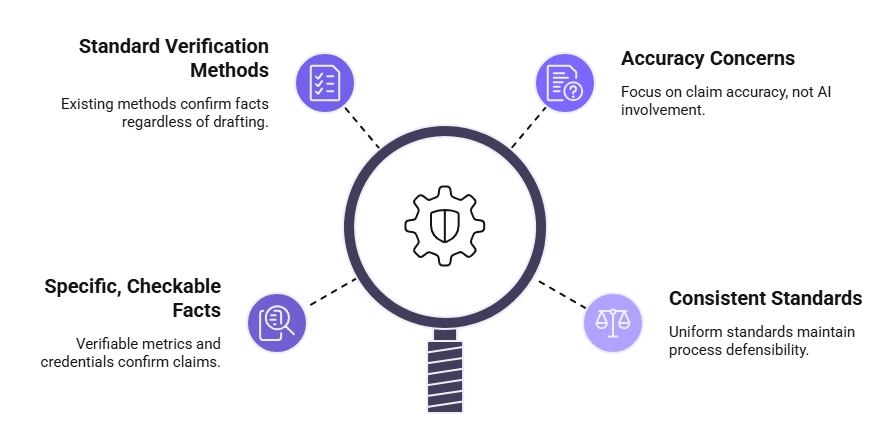
- Is there a specific, checkable fact in the claim (a metric, a role, a credential), or is the claim a general characterization that isn’t independently verifiable either way? Only the former can actually be confirmed or contradicted.
- Does the verification method already used for non-AI-assisted claims apply here without modification? In most cases, yes: employment verification, education verification, and reference checks confirm the same underlying facts regardless of drafting method.
- Is the concern about the accuracy of a claim, or about the fact that AI was involved in producing it? Only the first is a legitimate basis for further scrutiny. AI involvement alone, per the report’s own data, describes a majority behavior, not an anomaly.
- Has this standard been applied the same way regardless of which behavior prompted the review? A consistent verification standard, applied without regard to how confidently or fluently a claim was phrased, is what keeps the process defensible.
What the FCRA Requires When a Verified Claim Doesn’t Hold Up
If verification confirms that a specific AI-assisted claim, an overstated resume bullet, an inaccurate application answer, does not hold up, and that information came from a consumer report obtained through a background screening company, declining to hire or reversing an offer based on that finding is an adverse action under the Fair Credit Reporting Act. The same sequence applies here as it does to any other consumer-report-based finding: a pre-adverse action notice with a copy of the report and the Summary of Rights, a reasonable window for the candidate to respond, and a final adverse action notice if the employer proceeds.
Nothing about the claim having been AI-assisted changes this sequence. A resume bullet generated with AI help that turns out to be false is, procedurally, no different from a hand-written resume bullet that turns out to be false, once a consumer report is the source of the finding. The drafting tool is not a separate legal category; the underlying misrepresentation is what the process responds to.
Why No Regulation Treats This as Its Own Category
Current EEOC guidance, New York City’s Local Law 144, Illinois’s AI Video Interview Act, and similar state-level rules all address the employer’s side of AI in hiring, tools used to screen, score, or evaluate candidates. None of them address the candidate’s side: AI used to draft or shape application materials. This is a genuinely open area, not a gap in this piece’s research; a direct review of current federal and state guidance found no rule that treats an AI-assisted resume claim as a distinct regulated category, separate from the underlying claim itself.
That absence is itself a useful context for a hiring team. There is no separate compliance framework to learn here, no new disclosure requirement specific to AI-assisted resumes, and no indication in current guidance that one is imminent. The discipline that already governs every other verification question, confirm the claim, apply the standard consistently, and follow the FCRA’s sequence when a report-based finding affects a decision, covers this case too, without needing a new rule built around the specific tool a candidate happened to use.
Fair Compliance and Transparent Compliance, Applied to AI-Assisted Claims
Fair Compliance means applying the same verification standard to an AI-assisted claim that would apply to any other claim, rather than treating the presence of AI itself as a reason for heightened suspicion. Sixty-one percent of candidates used AI to practice interview answers; treating that majority behavior as inherently disqualifying would apply scrutiny unevenly, based on a drafting method rather than the accuracy of what was actually claimed. Both sit inside Compliance for Good™, the operating standard this pipeline has applied to every finding drawn from GCheck’s own research.
Transparent Compliance is a natural extension, though a narrower one here than in pieces built around a specific disclosure finding: telling candidates that claims will be verified against independent sources, regardless of how those claims were drafted, sets an expectation that holds up whether or not AI was involved in producing the application. The standard does not need to name AI specifically to apply to it.
Frequently Asked Questions
What did GCheck’s research find about AI use in job applications?
The 2026 Trust in Hiring Report found that 50% of job seekers used AI to tailor a resume to a role without actually meeting its requirements, and 43% used AI to generate overstated resume bullets, both self-reported behaviors from a survey of 1,500 U.S. adults employed full-time who had applied for a job in the past 18 months.
Is using AI to write a resume or cover letter the same as lying on a resume?
No. The report’s own data shows AI use spanning a wide range of behaviors, and using AI to draft a cover letter or practice interview answers sits closest to ordinary assistance, since neither behavior asserts a false fact. Whether a specific claim is accurate is a separate question from whether AI helped produce it.
How should employers verify a resume that was written or tailored with AI?
The same way any resume claim is verified: through employment verification, education verification, and reference checks that confirm the underlying fact, not the drafting method. AI involvement in producing a claim does not change what needs to be confirmed.
Does the FCRA treat AI-assisted misrepresentation differently from other misrepresentation?
No. If a verified discrepancy traced to an AI-assisted claim leads to declining a candidate or reversing an offer, and the finding came from a consumer report, the same pre-adverse action notice, opportunity to respond, and final adverse action notice sequence applies as it would to any other consumer-report-based finding.
Could scrutinizing AI-assisted applications create discrimination risk?
Yes, if the scrutiny targets AI use itself rather than a specific claim that fails verification. Some candidates rely on AI tools for legitimate accessibility needs or because English is not their first language. Applying heavier review to any AI-assisted submission, rather than to a claim that doesn’t hold up under verification, risks disproportionately burdening these candidates without justification.
Are there specific laws governing AI-written resumes?
Not currently. Existing EEOC guidance and state laws like New York City’s Local Law 144 address employer-side AI tools used to screen or evaluate candidates, not candidate-side AI use in drafting application materials. This remains an open area without a dedicated regulatory framework.
Sources cited
- GCheck. (2026). The 2026 Trust in Hiring Report. Proprietary survey of 1,500 U.S. adults employed full-time who actively applied for at least one job in the past 18 months, fielded February 14-22, 2026. “AI as Accomplice: Technology Is Blurring Preparation and Deception” section.
- Fair Credit Reporting Act, 15 U.S.C. § 1681b(b)(3) (adverse action notice requirement)
- U.S. Equal Employment Opportunity Commission, Assessing Adverse Impact in Software, Algorithms, and Artificial Intelligence Used in Employment Selection Procedures Under Title VII (technical assistance document, referenced for the regulatory-scope discussion)
- Americans with Disabilities Act, 42 U.S.C. § 12112 (reasonable accommodation principle, referenced by analogy for the accessibility-scrutiny caution added in this review)
- New York City Local Law 144 (Automated Employment Decision Tools, referenced for the regulatory-scope discussion)

ABOUT THE CREATOR
Charm Paz, CHRP
Recruiter & Editor
Charm Paz is an HR professional at GCheck, specializing in background screening, fair hiring, and regulatory compliance. She holds from the Professional Background Screening Association (PBSA) and helps organizations navigate employment regulations with clarity and confidence.
With a background in Industrial and Organizational Psychology, she translates policy into practice to build ethical, compliant, human-centered hiring systems that strengthen decision-making over time.