

A driver staffing agency is already an “employer” under DOT drug and alcohol testing rules the moment it employs a CDL driver, whether or not it ever runs its own testing program. What’s actually optional is whether the agency operationalizes that responsibility itself, or leaves the motor carrier client to cover it entirely before the driver ever gets behind the wheel.
Key Takeaways
- Under 49 CFR 382.107, “employer” already includes driver staffing agencies by definition; FMCSA has jurisdiction over them as employers the moment they employ and pay a CDL driver, no special election required for that status.
- What is genuinely elective is whether the staffing agency establishes and runs its own DOT drug and alcohol testing program. If it doesn’t, the motor carrier is solely responsible for full compliance before the driver performs any safety-sensitive function.
- FMCSA treats a driver leased for less than 30 consecutive days as “casual, intermittent, or occasional,” a specific regulatory classification with its own verification requirements distinct from a driver leased for longer.
- A motor carrier that wants to rely on a staffing agency’s existing program has to formally adopt that program as its own by contract or consortium agreement, and remains responsible for the agency’s noncompliance even after doing so.
- If the staffing agency hasn’t conducted the required testing, the motor carrier must treat the driver as a brand-new employee and run the full pre-employment sequence before any safety-sensitive work begins.
- The FMCSA Drug & Alcohol Clearinghouse’s employer-versus-C/TPA registration choice is a separate, later administrative layer that operationalizes this same underlying responsibility question, not a substitute for it.
Why FMCSA Issued Guidance Specifically for Staffing Agencies
FMCSA’s enforcement guidance on this topic, Notice 2016-30991, published December 23, 2016, exists because the commercial driver staffing industry doesn’t fit neatly into the assumption most of Part 382 was written around: one driver, one employer, one testing program. Staffing agencies supply motor carriers with drivers on short notice, sometimes for a single trip, sometimes for months, while the agency itself remains the driver’s actual employer of record throughout. A motor carrier facing an unexpected capacity gap, a driver out sick, a new route added on short notice, a seasonal freight surge, often doesn’t have the lead time to run a full pre-employment testing cycle before a truck needs to move, which is exactly the operational pressure this guidance was written to address without compromising the underlying safety rule.
The jurisdictional basis is straightforward once stated directly, building on the general DOT drug testing framework that applies to any regulated employer. Under 49 CFR 382.107, “employer” encompasses any person or entity employing someone subject to DOT drug and alcohol program requirements, and 382.103(a) confirms the regulations apply to employers of anyone operating a commercial motor vehicle under CDL requirements. A staffing agency that directly employs the driver and pays wages and employment taxes meets that definition automatically. FMCSA’s guidance notes this plainly: staffing agencies are employers under Part 382 “as employers of persons,” which is why they’re required to make records available for inspection the same as any other regulated employer, whether or not they’ve built out a full testing program of their own.
What’s Actually Elective: Running the Program vs. Bearing the Responsibility
The employer designation isn’t a choice, but what a staffing agency does with it is. FMCSA’s guidance states that staffing agencies “if they choose, may be responsible for ensuring compliance with all of the DOT drug and alcohol testing program requirements” for their drivers, covering testing, driver education, record retention, and requesting drug and alcohol history from previous employers. That’s a real election with a real fallback attached to it.
If the agency chooses not to establish its own program, the consequence isn’t ambiguous: the motor carrier becomes solely responsible for complying with Part 382 before allowing the driver to perform any safety-sensitive function. There’s no middle ground where responsibility simply goes unassigned. Either the staffing agency has a compliant program the motor carrier can rely on, or the motor carrier has to build the entire compliance picture itself, pre-employment testing, education materials, random pool inclusion, before the driver’s first shift.
The 30-Day Threshold: Casual, Intermittent, or Occasional Drivers
FMCSA draws a specific line for drivers leased on a short-term basis, and the line is precise rather than approximate. A “casual, intermittent, or occasional” driver, per FMCSA’s interpretation of 49 CFR 382.301(c)(2), is one who works for another employer for any period of less than 30 consecutive days. That interpretation traces back to a 1997 guidance document and hasn’t shifted since. The distinction breaks down into two clear scenarios:
- Under 30 consecutive days: the motor carrier must verify the driver’s participation in a compliant DOT drug and alcohol testing program every six months, and keep records of that verification under the retention requirements in 382.401. The staffing agency can keep the driver in its own random testing pool, or remove them, based on a reasonable expectation of whether the driver will return to its employment.
- Past 30 consecutive days with the same motor carrier: that flexibility ends. The driver should be moved into the motor carrier’s own random testing pool, and the motor carrier assumes full responsibility for that driver under its own program, the same as it would for any direct hire.
This isn’t a rule that resets every time a driver returns for a new short assignment either. If the same driver keeps coming back to the same motor carrier on a recurring basis, the six-month verification requirement still applies for each period under 30 days, but a motor carrier relying on repeat placements of the same driver should track the pattern carefully, since a string of technically-separate short assignments that functions as ongoing employment is exactly the kind of arrangement FMCSA’s guidance was written to prevent from becoming a loophole.
Adopting Another Employer’s Program Is a Real Contractual Act
A motor carrier can’t simply assume a staffing agency has things handled and move on. To rely on the agency’s program for a leased driver, FMCSA requires the motor carrier to formally make that program its own, by contract, consortium agreement, or other documented arrangement, and that formal step is what separates a defensible arrangement from an informal assumption that happens to be correct until the day it isn’t.
That arrangement has specific content, not just a general understanding between the two businesses:
- The motor carrier must be held responsible for the staffing agency’s program compliance, not just the driver’s individual results
- Records must be forwarded to the motor carrier’s principal place of business within two days of a request
- The motor carrier must be notified of, and act on, any positive test result
None of this shifts risk away from the motor carrier the way it might sound. FMCSA states directly that “the motor carrier remains responsible for any non-compliance by the driver staffing agency.” Adopting the agency’s program as the motor carrier’s own doesn’t transfer exposure to the agency; it layers the agency’s compliance record onto the motor carrier’s own regulatory standing. A motor carrier relying on this arrangement has a real reason to confirm, before the first leased driver ever gets behind the wheel, that the staffing agency’s program is actually compliant and that records can genuinely move within that 48-hour window if requested.
If Nothing Was Done, the Fallback Is a Full Reset, Not a Shortcut
When a staffing agency hasn’t conducted the required testing and no contractual adoption arrangement exists, the motor carrier doesn’t get a reduced or expedited version of compliance. FMCSA’s guidance is explicit: the motor carrier must treat the leased driver as a new employee and complete every part of the standard pre-employment process before the driver performs a safety-sensitive function. That means the required background inquiries, providing the drug and alcohol policy and educational materials, a pre-employment drug test with a verified result, placement in the random testing pool, and the full range of other recordkeeping and testing requirements under Parts 382 and 390.
In practice, this makes the “do nothing and hope the staffing agency handled it” approach the most expensive and slowest path available, precisely the outcome a motor carrier is usually trying to avoid by leasing a driver on short notice in the first place. Confirming which arrangement is actually in place, the agency’s own program, a formally adopted version of it, or neither, before the driver arrives is what determines whether a short-notice placement stays fast or turns into a full onboarding cycle anyway.
The Drug & Alcohol Clearinghouse Layer
FMCSA’s 2016 enforcement guidance predates the Drug & Alcohol Clearinghouse, which became operational in January 2020. The Clearinghouse didn’t change the underlying responsibility rules described above; it added a specific, practical mechanism for operationalizing and reporting them. Under the Clearinghouse’s own framework, a driver staffing agency registers as an “employer” if it maintains its own DOT drug and alcohol testing program and is responsible for compliance. It registers instead as a “C/TPA,” a consortium or third-party administrator, if the motor carrier holds the underlying responsibility but has designated the agency to perform specific functions, querying, reporting, and similar tasks, on the motor carrier’s behalf. A staffing agency performing both roles for different clients needs separate accounts for each, since the Clearinghouse treats the two roles as distinct even when the same organization is behind both.
That distinction matters because service agents, the FMCSA’s own term covering C/TPAs among others, are explicitly not employers for purposes of Part 382. A staffing agency registered purely as a C/TPA hasn’t taken on the employer’s substantive compliance responsibility described earlier in this piece; it’s performing administrative functions the motor carrier remains accountable for. Confusing Clearinghouse registration type with the underlying Part 382 responsibility question is an easy mistake, and one worth avoiding given how much rides on knowing which side of the relationship actually owns compliance for a given driver. A staffing agency that registers as a C/TPA out of administrative habit, without a documented arrangement establishing that the motor carrier actually holds responsibility, can end up in a position where neither party’s paperwork matches what either side assumed was true.
Comparing the Scenarios
| Scenario | Who’s responsible for the testing program | What the other party must still do |
| Staffing agency runs its own compliant program, driver leased under 30 consecutive days | Staffing agency | Motor carrier verifies participation every six months and keeps records |
| Staffing agency runs its own compliant program, driver leased over 30 consecutive days | Motor carrier (driver moves into its own random pool) | Staffing agency’s prior program no longer covers this driver for this placement |
| Motor carrier formally adopts the staffing agency’s program by contract or consortium agreement | Motor carrier, but remains liable for the agency’s noncompliance | Records must move within 48 hours; positive results must trigger action |
| Staffing agency has no program and none was adopted | Motor carrier, entirely | Full pre-employment sequence before any safety-sensitive function |
| Motor carrier assumes the agency “must have handled it” without confirming or documenting anything | Neither party has clearly assumed responsibility | Functionally the same as having no program at all; FMCSA doesn’t recognize an assumption as compliance |
| Staffing agency registers as C/TPA in the Clearinghouse while believing it holds Part 382 responsibility | Motor carrier, regardless of the agency’s own understanding | The registration type has to match the actual contractual arrangement, not just administrative convenience |
Everything described in this piece applies to drivers operating in interstate commerce under the federal Part 382 framework, which covers the large majority of CDL placements a staffing agency is likely to make. A driver operating exclusively intrastate can fall under a state-administered program instead, with its own rules that may or may not mirror the federal framework, so confirming whether a specific placement is interstate or purely intrastate is a real first step, not an assumption to skip.
Building a Compliant Arrangement for Both Sides
A staffing agency and a motor carrier client that want this relationship to actually hold up under an FMCSA audit need to settle a short list of questions before the first driver is placed, not after:
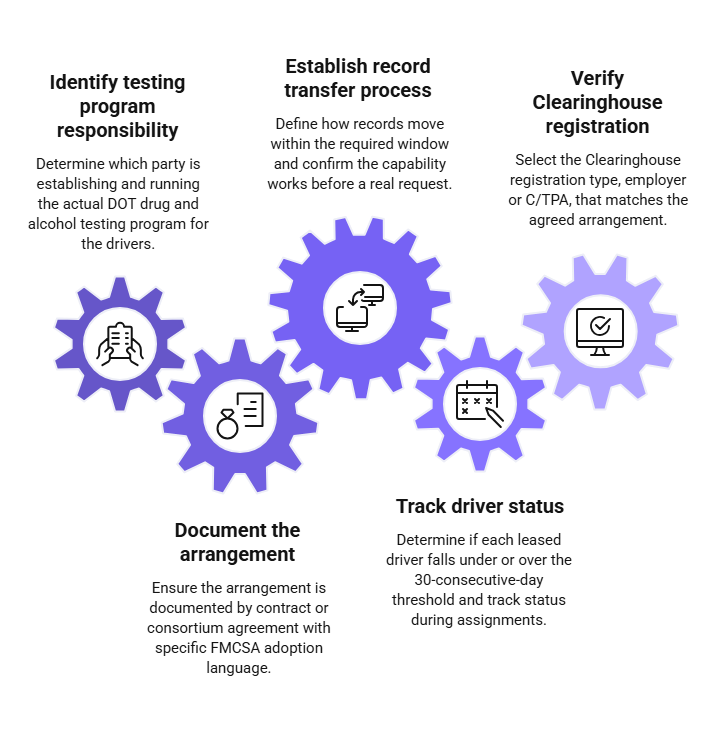
- Which party is establishing and running the actual DOT drug and alcohol testing program for the drivers in question
- Whether that arrangement is documented by contract or consortium agreement, with the specific adoption language FMCSA’s guidance requires, not just a verbal understanding
- How records will move within the required window if requested, and who is responsible for confirming that capability actually works before it’s tested by a real request
- Whether each leased driver falls under or over the 30-consecutive-day threshold, and how that status gets tracked as an assignment continues
- Which Clearinghouse registration type, employer or C/TPA, matches what the parties actually agreed to, rather than defaulting to whichever seems administratively simpler
None of this needs to slow down a legitimate short-notice placement. It does need to happen before the driver’s first safety-sensitive function, since every fallback FMCSA describes for an unaddressed gap is slower and more expensive than settling the question up front. This is Protective Compliance in a genuinely literal sense here: the entire structure exists to make sure a driver operating a commercial motor vehicle, whoever technically employs them, is actually covered by a real testing program rather than falling into a gap between two businesses each assuming the other has it handled. It’s also where Transparent Compliance does real work, since a documented, specific arrangement is what actually protects both the staffing agency and the motor carrier if FMCSA ever asks who was responsible for a given driver on a given day.
Frequently Asked Questions
Is a driver staffing agency automatically considered an “employer” under DOT drug testing rules?
Yes. Under 49 CFR 382.107, “employer” already encompasses any entity that employs someone subject to DOT drug and alcohol program requirements, and a staffing agency that directly employs a CDL driver and pays their wages meets that definition automatically, without any special registration or election.
Does a staffing agency have to run its own DOT drug and alcohol testing program?
No. Establishing its own program is elective. If the staffing agency chooses not to, the motor carrier client becomes solely responsible for full Part 382 compliance before the driver can perform any safety-sensitive function.
What counts as a “casual, intermittent, or occasional” driver for DOT purposes?
FMCSA interprets this as a driver who works for another employer for any period of less than 30 consecutive days. A motor carrier using such a driver must verify their participation in a compliant testing program every six months. Past 30 consecutive days with the same motor carrier, the driver should move into that motor carrier’s own random testing pool.
If a motor carrier relies on a staffing agency’s drug testing program, does that remove the motor carrier’s liability?
No. FMCSA states directly that a motor carrier adopting a staffing agency’s program as its own remains responsible for the staffing agency’s noncompliance. The arrangement has to include specific terms, such as records moving within 48 hours and notification of positive results, but it doesn’t transfer regulatory risk away from the motor carrier.
What happens if a staffing agency hasn’t done any drug testing on a leased driver?
The motor carrier must treat the driver as a brand-new employee and complete the full pre-employment process, background inquiries, policy materials, a verified pre-employment drug test, and random pool placement, before the driver performs any safety-sensitive function.
Is registering in the FMCSA Drug & Alcohol Clearinghouse the same as taking on employer responsibility under Part 382?
Not necessarily. A staffing agency registers as an “employer” in the Clearinghouse if it holds the substantive Part 382 responsibility. It registers as a “C/TPA” if the motor carrier holds that responsibility and has simply designated the agency to perform specific administrative functions on its behalf. The two registration types reflect different underlying responsibility arrangements.
Does the 30-day threshold reset if the same driver returns to the same motor carrier repeatedly?
FMCSA’s guidance addresses individual periods of less than 30 consecutive days, and the six-month verification requirement applies to each such period. A pattern of repeated short placements with the same motor carrier is worth tracking carefully, since a series of technically-separate short assignments that functions as ongoing employment is precisely the kind of arrangement the underlying rule is meant to cover, not a way around the 30-day threshold.

ABOUT THE CREATOR
Charm Paz, CHRP
Recruiter & Editor
Charm Paz is an HR professional at GCheck, specializing in background screening, fair hiring, and regulatory compliance. She holds from the Professional Background Screening Association (PBSA) and helps organizations navigate employment regulations with clarity and confidence.
With a background in Industrial and Organizational Psychology, she translates policy into practice to build ethical, compliant, human-centered hiring systems that strengthen decision-making over time.