

A staffing agency’s top biller can be the hardest person in the building to hold accountable, because the number is loud and the complaint is quiet. GCheck’s The Consequence Gap Report found that workers left the job before a toxic coworker did at 40% where the coworker was rewarded or protected, versus 10% where the organization acted.
Key Takeaways
- GCheck’s The Consequence Gap Report found that 40% of workers left while the toxic coworker stayed where the coworker was rewarded or protected, 24% where nothing happened, and 10% where the coworker was removed. The report calls this a pattern, not proof of cause.
- The report measured no staffing, recruiter, billing, or commission outcomes, so the link to placement-based incentives is this article’s own reasoning and is stated conditionally throughout.
- 44% of workers believe the best or healthiest people leave first when a toxic coworker goes unaddressed, but among the 630 workers whose exposure is behind them, the toxic coworker more often left first (57%).
- Managers and senior leaders whose behavior made coworkers’ work harder were rewarded or protected in 36% of cases and removed in 21% (a smaller group of 119 cases that the report asks readers to treat as directional); junior coworkers faced the reverse pattern, 24% and 41%.
- The Society for Human Resource Management estimated that culture-driven turnover cost US organizations as much as $223 billion over five years (SHRM, 2019). No verified per-agency or per-recruiter figure exists in the sources used here, so none is given.
- The fix is structural: conduct named in written, prospective incentive and recognition terms; reviews outside the biller’s reporting line; a reporting route that bypasses the biller’s desk; and report-back to the team.
What the Report Shows About Who Leaves
The Turnover Pattern
GCheck’s The Consequence Gap Report asked workers who have had a toxic coworker whether they left the job while that coworker stayed, and split the answers by what the organization did about the coworker:
| What happened to the toxic coworker | Share of workers who left while the coworker stayed |
| Rewarded or protected (283 workers) | 40% |
| Nothing happened (477 workers) | 24% |
| Removed (476 workers) | 10% |
The report’s own reading is that exits track what the organization did more than what the coworker did. It also labels the comparison a pattern, not proof of cause: the three groups differ, the survey can’t isolate the reason anyone left, and nothing here shows that a particular response made a particular person stay or go. What the figures do establish is that departures were four times as common where the organization rewarded or protected the coworker as where it acted.
What Workers Believe, and What the Record Shows
The Consequence Gap Report also asked what workers believe about who leaves. 44% say the best or healthiest people leave first when a toxic coworker goes unaddressed, a belief about how these situations unfold, not a measurement. The lived record is more mixed: among the 630 workers whose exposure is behind them, the toxic coworker more often left first (57%). Both can be true at once. Many toxic coworkers eventually go, and where the organization protects them instead, the departures shift toward everyone else. Among the 1,272 workers who have had a toxic coworker, nothing happened to the coworker in 38% of cases, the coworker was rewarded, promoted, or protected in 23%, and only 36% eventually left or were removed.
One worker’s reason for leaving fits that reading closely: “The manager not taking discipline action against them so I left.” It is a single account and isn’t evidence for any percentage, but it describes the decision the data points to, a departure that followed what the organization did.
The middle row of the table deserves attention too. Where nothing happened to the toxic coworker, 24% of workers left first, more than twice the 10% where the coworker was removed. Inaction can feel like the neutral choice, particularly while a concern is being weighed against a strong quarter. In the report’s numbers it is not neutral: a response that never comes appears to carry a cost of its own.
Why Placement-Based Incentives Can Pull Toward Protection
Output That Belongs to One Person
The Consequence Gap Report had no staffing breakout and measured no recruiter, billing, or commission outcomes, so what follows is reasoning, not a finding. Where an agency ties pay, promotion, or recognition to placements or billings, a recruiter’s or account manager’s output is individually attributable, counted on a regular cycle, and connected to revenue in a way that few other jobs make so direct. A number that is clear is hard to weigh against a complaint, which is private, difficult to quantify, and describes something that happened to someone else. Recruiter conduct also reaches candidates and clients; this article stays with the internal team, where the retention cost lands.
Replacement cost can add to the pull. A high biller may hold candidate relationships and client contacts that would need to be reassigned if they left, and that cost is immediate and countable. The cost of keeping them is spread across other people’s morale, health, and eventual departures, which nobody counts on a weekly board.
Processes can widen the gap. A compensation conversation and a conduct concern can sit in separate processes, owned by different people, and nothing forces the two to meet. The biller’s results reach the people deciding about incentives every period, while the conduct concern may reach nobody with the standing to weigh it against those results, which leaves the number to make the case alone.
When the Complaint Competes With a Number

The Consequence Gap Report’s rank finding is the closest match to this situation. Managers and senior leaders whose behavior consistently made coworkers’ work harder were rewarded or protected in 36% of cases and removed in 21%, while junior coworkers were protected in 24% and removed in 41%. The manager figures rest on 119 cases, a smaller group the report asks readers to treat as directional. The report measured rank, not billings, so the application is this article’s inference: a top biller may be treated as senior or hard to replace whatever their title says, and the rank pattern describes how such coworkers can be treated.
The reward-status comparison adds a second link. Where the toxic coworker was rewarded or protected, 36% of exposed workers began adopting the behavior themselves, against 14% where the coworker was removed. In an agency that celebrates billings in a regular forum, a visible reward for someone whose conduct the team already knows about gives everyone present the same information about what the firm values.
Who decides matters as well. A leader whose own results depend on the biller’s has a stake in the outcome, and if the firm recruited the biller away from a competitor, acting on a complaint can feel like a verdict on that hire. Neither is a character flaw. Both are ordinary reasons a review that is meant to be about conduct can drift toward the number.
What the Departures Cost
The Aggregate Bill
The Society for Human Resource Management estimated that culture-driven turnover cost US organizations as much as $223 billion over five years (SHRM, 2019), and the report presents its turnover comparison as one way that bill gets run up, one team at a time. That figure covers organizations broadly, not staffing agencies, and no approved source supplies a per-departure cost for recruiters or account teams, so this article doesn’t invent one.
The occupation’s footprint is worth noting. The U.S. Bureau of Labor Statistics counted about 939,700 human resources specialists in 2025, a group that includes recruitment specialists who find, screen, and interview applicants, and employment services was one of the largest employers, at 13%. For an agency, recruiters sit close to the core of what the firm sells, so losing them is not the loss of a support function.
An agency can build its own figure from data it already holds: voluntary departures by team, the time a replacement takes to reach full productivity, and the open requisitions or candidate relationships carried by others in the meantime. A number built that way describes the firm’s own situation, which no industry estimate can.
The Team That Stays
Few employers are better placed to count the mechanics of a replacement hire than a staffing firm, which performs them for clients: sourcing, screening, onboarding, and the weeks before a new person is productive. When someone leaves a team around a protected biller, coordinators and junior recruiters may also inherit open requisitions and candidate relationships in the meantime. Those are plausible costs, not measured ones, and they are the kind an agency is well placed to price.
The pattern also carries a message beyond the departures. One worker described leaving this way: “Yes, I left a job because of a terrible boss that HR refused to do anything about.” As with the earlier account, it is one person’s reason, but it matches what the report says plainly: people’s exits follow what the organization did.
The report’s other outcome measures point the same way for the people who remain. Among exposed workers, 42% said the experience changed them for the worse where the coworker was rewarded or protected, against 20% where the coworker was removed, and 28% came through unchanged against 55%. A team that stays around a protected biller is, in these numbers, more likely to carry the effects than to escape them.
How It Can Look From the Inside
Consider a hypothetical, built only to show how the pieces above can combine. An account manager has led a branch’s billings board for six quarters. Over the same stretch, three coordinators on the team have left, and the exit conversations name schedules and growth opportunities. Each concern about how the account manager treats the team was raised once, privately, and handled as a personality difference. The billings board is reviewed every period. The departures are reviewed by no one, because each one looks like ordinary movement when viewed alone.
No one in that picture decided that conduct doesn’t matter. The incentive review looks at the number, the conduct concerns go to a manager whose own results depend on the branch, and the departures never reach anyone who can see them as a group. The report’s pattern says what that arrangement can cost: where a toxic coworker is rewarded or protected, workers leave first at 40% against 10% where the organization acts. The hypothetical is invented, and the pattern is the report’s.
What an Agency Can Do
Four Changes
Each change keeps pay tied to placements and adds conduct to what the firm measures alongside the number:
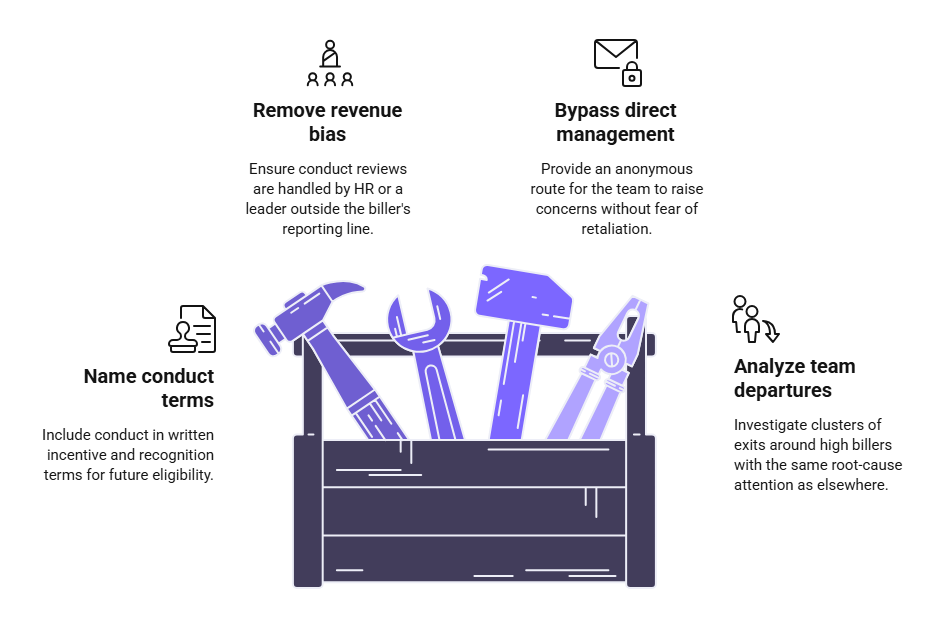
- Name conduct in the written incentive and recognition terms, going forward. Eligibility for discretionary incentives, awards, and promotion consideration can depend on there being no active, unresolved conduct concern, with the review handled by someone outside the biller’s reporting line. Commission and bonus rules vary by plan and by state, so the change belongs in the plan’s written terms prospectively and is reviewed with counsel first. Whether and when commissions already earned can be affected is a legal question for counsel, and the aim here is not to withhold pay.
- Take the review out of the revenue line. A leader whose own results depend on the biller’s is a poor sole reviewer of that biller’s conduct. HR, or a second leader without that stake, can hold the review.
- Give the team a route that bypasses the biller’s desk and manager. An anonymous option, and a plain statement that raising a concern will not be held against anyone, lower the cost of speaking up.
- Read departures around a high biller’s team the same way as anywhere else. If exits cluster around one person, that is information, and it should get the same root-cause attention as a cluster anywhere else in the firm.
A manager should also separate interpersonal conduct from legally protected activity. Complaints about commissions, pay, or conditions can be protected, and anything involving a protected characteristic or a harassment complaint belongs with HR or counsel before any coaching. This is a practice guide, not legal advice.
Where Screening Fits
Staffing firms know consistent standards from the inside. A background check does necessary, effective work at the front door, applied within the federal, state, and local rules that govern what can be considered, when, and how. When a firm applies the same screening package to every candidate for an assignment, however strong the résumé looks, it is applying the principle this article asks of internal conduct: the standard doesn’t move because the person looks impressive.
A background check is not built to follow how someone treats a team once they are in the job. When an agency hires an established high biller from another firm, the useful step is a reference conversation, held with the candidate’s knowledge and consent, with people who worked alongside them, asking about conduct directly, which can surface red flags that no record will. Professional Reference Checks can support that conversation, and when a third-party provider assembles the report, the Fair Credit Reporting Act’s disclosure and written-authorization requirements can apply.
The same logic extends to the first ninety days after any hire. A short conversation with the new recruiter’s closest teammates, held by someone outside their reporting line, gives a firm an early read on how the person works with others at the point where expectations are still being set. For the candidate side of screening, GCheck’s background check checklist for staffing agencies goes into more detail.
What This Isn’t Arguing
High billing is not a warning sign. Many top billers are excellent to work around, and a placement-based incentive is a legitimate way to pay for results. The question is narrower: whether conduct is part of what the agency measures, so that a strong month is never the only thing the firm knows about a person.
It also isn’t a claim about recruiters as a profession, or about any firm. The report offers a general pattern and this article reasons from it, one step at a time, to a structure many agencies may recognize and others may not.
Nor does it call for slowing placements or burying desks in process. Each change can be added at the next incentive review: the first is a sentence in the plan, the second a named reviewer, the third a reporting channel, and the fourth a standing item in an existing meeting.
What This Means for Compliance
Fair Compliance, applied to a staffing agency, means the conduct standard is the same for the desk with the highest billings and the desk with the lowest. A test any firm can run this quarter: if the same concern had been raised about a coordinator on the lowest-billing team, would it have moved through the same process at the same speed? If not, the standard has a billing threshold in it, whatever the handbook says.
Transparent Compliance supplies the other half: expectations about conduct written down where people can read them, reviews that follow a visible process, and a team that hears, in general terms, that concerns were taken seriously. Together they make accountability something a team can observe, which is the signal the turnover data suggests people are watching for.
The first step takes an afternoon. Pull the last few conduct concerns raised about billers and the last few raised about staff in non-billing roles, and compare how long each took, who reviewed it, and what the team was told. Gaps in that comparison show where the standard bends, and they are easier to close before another departure than after.
Frequently Asked Questions
How do staffing agencies hold a toxic top biller accountable?
Name conduct in the written incentive and recognition terms going forward, with counsel review, and hold the review outside the biller’s reporting line. Give the team a reporting route that bypasses the biller’s desk, tell the team in general terms that concerns were heard, and apply the same standard and process used for any other desk. Involve HR first for protected characteristics or complaints.
Why can staffing agencies struggle with toxic recruiter accountability?
The research behind this article didn’t measure staffing, so this is reasoning. Where pay or recognition tracks placements or billings, a biller’s output is individually attributable and highly visible, while a conduct complaint is private and hard to count. Replacement cost can add to the pull toward leaving the behavior unaddressed.
Does a toxic coworker’s protection cause more people to leave?
GCheck’s The Consequence Gap Report found that 40% of workers left while the toxic coworker stayed where the coworker was rewarded or protected, 24% where nothing happened, and 10% where the coworker was removed. It labels this a pattern, not proof of cause, and it didn’t study staffing agencies or recruiters specifically.
How much does turnover caused by toxic behavior cost?
SHRM estimated that culture-driven turnover cost US organizations as much as $223 billion over five years (2019). That figure covers organizations broadly. No approved source gives a per-recruiter or per-agency cost, so any single-departure figure should be built from an agency’s own recruiting, onboarding, and productivity data.
Do the best people leave first when a toxic coworker is protected?
Workers believe so: 44% say the best or healthiest people leave first. The lived record is mixed, though. Among the 630 workers whose exposure is behind them, the toxic coworker more often left first (57%). The accurate reading is that where coworkers are protected, departures shift toward others.

ABOUT THE CREATOR
Charm Paz, CHRP
Recruiter & Editor
Charm Paz is an HR professional at GCheck, specializing in background screening, fair hiring, and regulatory compliance. She holds from the Professional Background Screening Association (PBSA) and helps organizations navigate employment regulations with clarity and confidence.
With a background in Industrial and Organizational Psychology, she translates policy into practice to build ethical, compliant, human-centered hiring systems that strengthen decision-making over time.