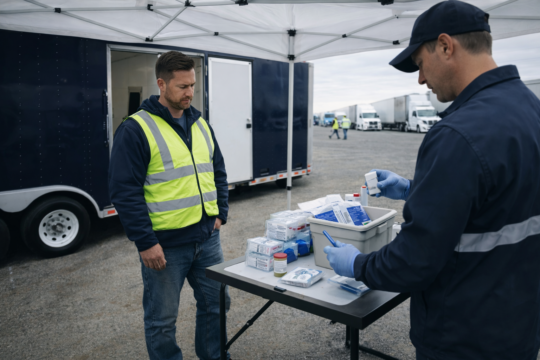

Employers subject to DOT drug testing requirements in 2026 face a compliance landscape shaped by a significant procedural update, persistent marijuana confusion, and annual random testing rate obligations that demand current-year verification. This article serves as an operational reference for DOT-regulated employers auditing or building a compliant testing program right now.
Key Takeaways
- DOT drug testing requirements apply across six modal agencies, with FMCSA-regulated motor carriers representing the largest covered employer population.
- Five testing circumstances are federally mandatory: pre-employment, random, post-accident, reasonable suspicion, and return-to-duty.
- Random testing rates vary by modal agency and are set annually. Employers must verify and apply the current 2026 rates for their workforce.
- The DOT authorized oral fluid as an alternative specimen type. Laboratory availability continues to define whether this option is practical for employers in 2026.
- State marijuana legalization does not exempt safety-sensitive employees from DOT drug testing under current federal requirements. A positive result carries full consequences regardless of state law.
- The FMCSA Drug and Alcohol Clearinghouse is a distinct obligation from the testing program itself, and employers must satisfy both independently.
- A compliant DOT program requires more than drug tests. It requires a designated employer representative, a written policy, an MRO relationship, and complete recordkeeping.
- Missed random selections, delayed post-accident testing, and incomplete Clearinghouse queries are the most common audit findings in DOT-regulated employer programs.
Who Is Covered: Safety-Sensitive Employees and Regulated Employers
Which Employers Have DOT Drug Testing Obligations
Not every employer that operates commercial vehicles falls under DOT drug testing requirements. The obligation attaches to employers whose operations fall within the jurisdiction of one of six DOT modal agencies: the Federal Motor Carrier Safety Administration, the Federal Aviation Administration, the Federal Railroad Administration, the Federal Transit Administration, the Pipeline and Hazardous Materials Safety Administration, and the United States Coast Guard. Each agency administers its own regulations within the framework of 49 CFR Part 40.
For most employers arriving at this topic in 2026, FMCSA is the relevant agency. Motor carriers that employ or contract with CDL holders operating commercial motor vehicles in interstate commerce must maintain a compliant drug and alcohol testing program. This includes large fleets, small carriers, and owner-operators who lease to regulated carriers. The obligation activates before the first safety-sensitive drive, not after a grace period.
Which Employee Roles Trigger the Testing Obligation
The testing obligation attaches to employees in safety-sensitive functions, not to all employees of a regulated employer. The covered populations vary by agency:
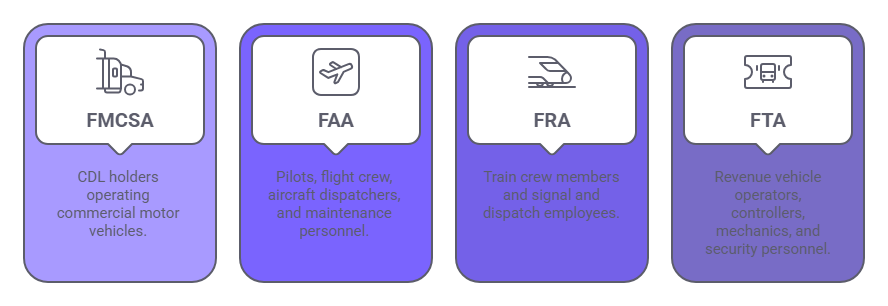
- FMCSA: CDL holders operating commercial motor vehicles as defined under 49 CFR Part 383.
- FAA: Pilots, flight crew, aircraft dispatchers, and certain maintenance personnel.
- FRA: Train crew members and certain signal and dispatch employees.
- FTA: Revenue vehicle operators, controllers, mechanics, and armed security personnel on transit systems.
Employers with workers across multiple modal categories should confirm which agency’s regulations apply to each role. In some cases, a single employer may have safety-sensitive employees that two or more modal agencies govern, each with its own testing rate and procedural requirements. Qualified legal or compliance counsel can help clarify these obligations.
Small Carriers and Owner-Operators
Small motor carriers and owner-operators carry the same testing obligations as large fleets. They often lack the internal administrative infrastructure to manage them, however. An owner-operator who leases to a regulated motor carrier may fall under the carrier’s testing program during the lease period. An owner-operator who operates under their own authority must maintain their own compliant program or join a consortium. Failing to understand this distinction is one of the most common threshold compliance errors among small operators.
When the company sees drug testing more as something to be done once rather than a continuous business process, DOT compliance will become very difficult. When you operate in a safety critical environment, even minor flaws in your process, documentation, and timing could result in major non-compliance issues. Some of the most effective programs are those that are consistent and make everyone accountable in all aspects of the process. In highly regulated industries, compliance is not just about passing an audit. It is about building systems that hold up under pressure. �
The Five Mandatory Testing Circumstances
Pre-Employment and Random Testing
Before allowing a safety-sensitive employee to perform a safety-sensitive function for the first time, the employer must conduct a drug test and receive a verified negative result. Under FMCSA, this applies to CDL drivers before their first drive. The employer must also run a pre-employment full query of the FMCSA Drug and Alcohol Clearinghouse as a separate but concurrent obligation. The most common pre-employment failure is allowing a driver to begin operating before the verified negative result arrives, often due to pressure to fill a position quickly.
Random testing requires employers to select safety-sensitive employees for unannounced drug and alcohol testing at federally specified rates throughout the calendar year. Each covered employee must have an equal chance of selection in each draw, using a scientifically valid method. The most common random testing failures include selecting fewer employees than the required rate demands, allowing advance notice to reach a selected employee, and failing to test within the required timeframe after notification.
Post-Accident and Reasonable Suspicion Testing
Following a qualifying accident under 49 CFR Part 382.303, the employer must test the involved safety-sensitive employee within defined timeframes. The regulation defines the specific circumstances that trigger mandatory post-accident testing, including fatalities, citations, and disabling damage criteria. Under FMCSA, the employer must complete a post-accident drug test as soon as practicable and administer an alcohol test within eight hours of the qualifying event. If the eight-hour window closes without a completed alcohol test, the employer must document the reason and stop further attempts. For drug testing, the employer must keep attempting until 32 hours have passed. Employers should confirm triggering criteria with qualified compliance counsel and maintain a documented response protocol before any accident occurs.
When a trained supervisor observes specific, contemporaneous, articulable signs of drug or alcohol use, the employer must send that employee to test. The supervisor must hold training in the signs and symptoms of drug and alcohol use under 49 CFR Part 382. The supervisor must also document observations in writing as soon as practicable. The most common failure here is the absence of trained supervisors. Employers who have never formally trained supervisory staff cannot correctly execute this testing trigger, regardless of intent.
Return-to-Duty Testing
An employee who has violated DOT drug or alcohol regulations must complete a structured return-to-duty process before resuming safety-sensitive duties. That process includes:
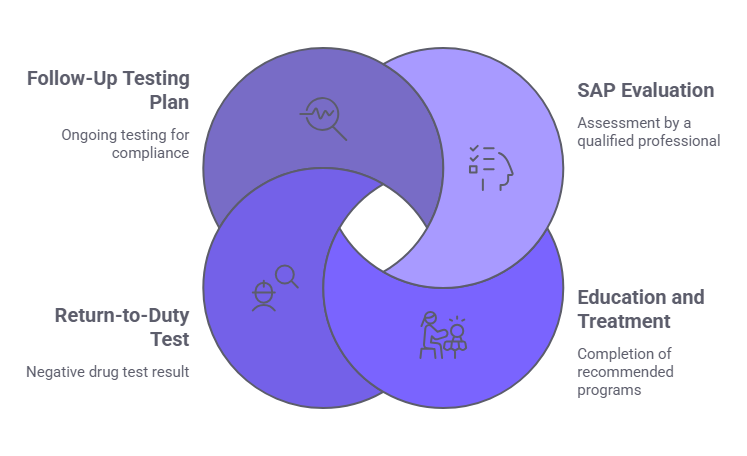
- Evaluation by a DOT-qualified Substance Abuse Professional.
- Completion of any recommended education or treatment.
- A return-to-duty drug test with a verified negative result.
- A follow-up testing plan covering at least six unannounced tests in the first 12 months, with the SAP retaining discretion to extend the period for up to 60 months.
The employer must fully document and execute the SAP’s recommendations and the complete follow-up testing plan. Incomplete return-to-duty documentation is a frequent audit finding and among the more serious, because it may indicate the employee resumed safety-sensitive duties without satisfying all program requirements.
2026 Random Testing Rates by Modal Agency
Current Minimum Rates and How to Apply Them
Random testing rates set the minimum percentage of a covered employer’s average annual safety-sensitive workforce that must undergo drug and alcohol testing each calendar year. Each modal agency sets its own rates, and employers must apply the rates in effect for the current year. The table below reflects rates in effect as of 2026. Employers should verify these figures directly with the applicable agency or through Federal Register publications, as agencies review rates annually and may adjust them after this article’s publication.
| Modal Agency | Drug Testing Rate | Alcohol Testing Rate |
| FMCSA | 50% | 10% |
| FAA | 25% | 10% |
| FRA (Covered Service) | 25% | 10% |
| FTA | 50% | 10% |
| PHMSA | 50% | Not required |
| USCG | 50% | Not specified federally |
Employers should confirm these figures against current agency publications before using them for program planning.
How Random Rates Work in Practice
The rate applies to the employer’s average number of safety-sensitive employees across the full calendar year, not to the count on a single date. Employers who experience significant workforce fluctuations, such as seasonal carriers or growing fleets, must calculate their testing obligation against that annual average. Consortium members pool their safety-sensitive employees into a larger random selection group, which affects how many tests a small employer receives in a given year. Any employer whose program produces fewer tests than the required rate is out of compliance, regardless of the reason.
Consequences of Rate Non-Compliance
Failing to meet the required random testing rate is one of the most direct and documentable violations in a DOT audit. Auditors verify rates by reviewing selection records, test results, and employee counts. An employer who completed 30% random drug tests in a year when 50% was required cannot correct that shortfall retroactively. The violation attaches to the calendar year in which it occurred. Employers should therefore track their testing rate throughout the year, not only at year-end.
Oral Fluid Testing: What the 2024 Rule Means for Employers in 2026
What the Rule Authorized
In May 2023, the DOT published a final rule amending 49 CFR Part 40 to authorize oral fluid as an alternative specimen type, with the rule effective June 1, 2023. This built on HHS Mandatory Guidelines that previously recognized oral fluid as an accepted testing method. Practical use of oral fluid testing requires HHS-certified laboratories with specific oral fluid certification, and employers should confirm current laboratory availability before implementing this option. Direct observation of oral fluid collection also reduces adulteration and substitution risk and eliminates the need for restroom facilities.
What “Available in 2026” Actually Means
Authorization and availability are not the same thing. For oral fluid testing to satisfy a DOT-mandated program, specimens must go to an HHS-certified laboratory that holds specific oral fluid certification. As of 2026, far fewer laboratories hold that certification compared to those certified for urine testing. Employers considering a transition should check the HHS-published certified laboratory list before making any program changes. Sending oral fluid specimens to a laboratory without oral fluid certification does not satisfy 49 CFR Part 40.
Practical Guidance for Employers in 2026
Employers have three practical positions relative to oral fluid testing in 2026:
- Continue urine testing exclusively, which remains fully compliant and operationally well-supported.
- Adopt oral fluid testing as an alternative for some or all testing circumstances, provided a certified collector and certified laboratory are used.
- Use both specimen types under a program that specifies when each applies.
Any program change must appear in the employer’s written drug and alcohol testing policy before implementation. Employers should also confirm that their Medical Review Officer can review oral fluid results, since MRO procedures for oral fluid differ from urine procedures in certain respects.
Marijuana, State Law, and Federal Preemption: The 2026 Employer Position
Federal Classification and Pending Regulatory Developments
As of the date of this article, federal authorities are conducting ongoing regulatory review of marijuana’s scheduling classification. Employers should confirm the current federal scheduling status with qualified legal counsel, as DOT testing obligations for marijuana connect directly to federal controlled substance classifications and may change if rescheduling occurs. Under the requirements in effect at publication, DOT drug testing panels test for marijuana metabolites, and a verified positive result triggers the same consequences as any other positive in a DOT-mandated program. No state marijuana legalization law, recreational or medical, changes this outcome under current federal rules.
What Employers Cannot Do
Employers subject to DOT testing requirements face clear prohibitions when a positive marijuana result occurs. Specifically, they cannot:
- Excuse a positive marijuana result because the employee holds a valid state medical marijuana card.
- Decline to report a verified positive marijuana result to the Clearinghouse.
- Allow an employee with a verified positive result to return to safety-sensitive duty without completing the full return-to-duty process.
Under current federal requirements, any internal policy that creates a marijuana exception for safety-sensitive roles conflicts with DOT obligations and generates significant employer liability exposure. Employers should monitor federal marijuana scheduling developments and confirm with qualified legal counsel how any rescheduling action may affect their testing obligations.
The Confusion Risk for Employers in 2026
The gap between state law permissiveness and federal obligation continues to widen as more states legalize marijuana. This creates a specific confusion risk, particularly for employers operating across multiple states or hiring in markets where marijuana use is culturally normalized. The employer’s obligation does not shift based on where the employee lives, where the test occurs, or what the employee believed about their state’s laws. Employers should address this directly in new hire orientation, driver policy acknowledgments, and supervisor training.
FMCSA Drug and Alcohol Clearinghouse: Employer Obligations in 2026
The Clearinghouse Is a Separate Obligation
The FMCSA Drug and Alcohol Clearinghouse is a federally maintained database that records drug and alcohol program violations by CDL holders, including verified positive test results, refusals to test, and return-to-duty completions. It is not a component of the drug testing process. Rather, it is a parallel reporting and query obligation that FMCSA-regulated employers must satisfy independently of their testing program. Refusals to test carry the same regulatory consequences as positive results and require reporting with the same timeliness. Employers who satisfy their testing obligations but overlook Clearinghouse obligations remain only partially compliant.
Query and Reporting Requirements
Employers must satisfy three distinct Clearinghouse obligations:
- Pre-employment full query: Required before every prospective CDL driver performs a safety-sensitive function. A full query requires the driver’s electronic consent and returns complete violation history.
- Annual limited query: Required for all current CDL drivers at least once per calendar year. Returns a pass or refer result. A refer result requires a follow-up full query.
- Violation reporting: All violations, including verified positive test results, refusals to test, and return-to-duty completions, must be reported within specified timeframes.
Each employer must run its own queries. A prior employer’s query does not satisfy the new employer’s obligation.
Common Clearinghouse Failures
The most frequent Clearinghouse compliance failures follow a consistent pattern. First, employers skip the pre-employment full query before a driver’s first safety-sensitive trip. Second, employers miss annual limited queries on current drivers. Third, employers fail to report violations, including refusals to test, within required timeframes. Refusals are sometimes overlooked as a separately reportable event, which creates an additional exposure point. Relying on a prior employer’s query rather than running an independent one is a secondary failure mode. Each of these failures is independently auditable and documentable as a violation.
Program Administration: What Employers Must Have in Place
Structural Requirements and Consortium Enrollment
Running drug tests is not the same as running a compliant DOT drug and alcohol testing program. A compliant program requires several administrative components that exist independently of the tests themselves. Employers must designate a Designated Employer Representative to serve as the primary point of contact for program administration and regulatory inquiries. The DER must understand DOT testing requirements well enough to make real-time decisions, including whether a post-accident testing obligation has triggered or whether a reasonable suspicion observation meets the required threshold.
Smaller employers and owner-operators typically cannot run a compliant random testing program independently. A single employee cannot generate a statistically valid random selection pool. These employers must join a consortium or retain a third-party administrator to manage random testing pool participation. TPA enrollment does not transfer compliance responsibility. The employer remains accountable for ensuring the TPA executes the program correctly and maintains records properly.
MRO, Written Policy, and Recordkeeping
Every DOT-regulated employer must maintain three additional program components. First, the employer must retain a qualified Medical Review Officer who reviews all laboratory results before the program reports them to the employer. The MRO determines whether a non-negative result has a legitimate medical explanation or confirms a violation. Second, the employer must maintain a written drug and alcohol testing policy that covers program scope, testing circumstances, consequences of violations, and employee assistance resources. Third, the employer must keep testing records for the periods the applicable agency regulations specify, which vary by record type but can extend up to five years for certain documents.
Common Audit Findings and Employer Liability Exposure
Where Programs Break Down
DOT compliance audits consistently surface a recognizable set of program failures. Missed random selections occur when records show fewer tests than the required rate supports. This often happens because selected employees received advance notice, delayed testing, or fell through administrative gaps. Post-accident testing delays occur when employers fail to initiate testing promptly after a qualifying accident, either because supervisors lacked training on triggering criteria or because no response protocol existed. Clearinghouse failures occur when employers skip pre-employment queries, miss annual limited queries, or fail to report violations, including refusals, within required timeframes.
Liability Exposure from Program Defects
An employer with program defects faces liability exposure that extends beyond regulatory penalties. If a safety-sensitive employee whom the employer did not properly test causes an accident, the compliance failure becomes a central issue in any resulting litigation. Plaintiffs’ counsel routinely request drug and alcohol testing program records during post-accident discovery. Gaps in random testing records and missing Clearinghouse query documentation create significant audit and litigation exposure. An incomplete return-to-duty file is more serious still: allowing a safety-sensitive employee with an unresolved violation to operate a commercial motor vehicle is an independent regulatory violation under FMCSA rules, with potential civil penalty, out-of-service, and operational consequences.
When to Conduct a Program Self-Audit
Employers should run a formal self-audit at least annually and whenever operational changes could affect program scope. Triggers for an immediate review include:
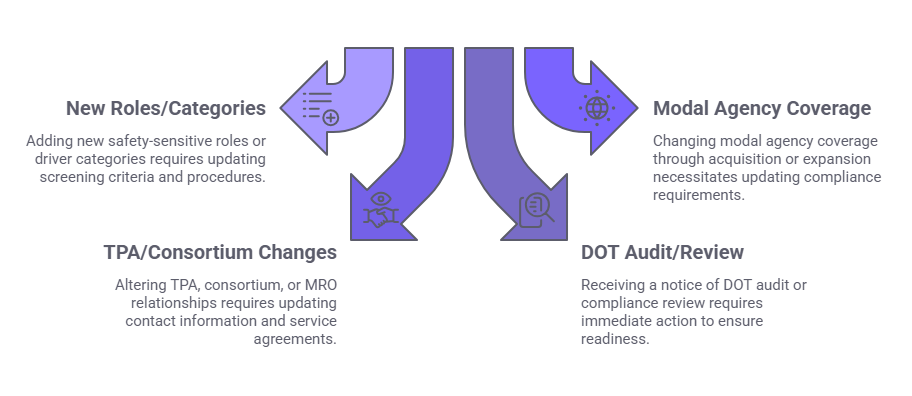
- Adding new safety-sensitive roles or driver categories.
- Changing modal agency coverage through acquisition or operational expansion.
- Changing TPA, consortium, or MRO relationships.
- Receiving a notice of DOT audit or compliance review.
A self-audit should cover random testing rates, Clearinghouse query and reporting records, MRO documentation, return-to-duty files, and written policy currency. Waiting for an external audit to surface deficiencies costs significantly more than proactive review.
Conclusion
DOT drug testing requirements in 2026 reflect a program that is both well-established in its core structure and actively evolving in its procedural options and enforcement environment. Employers who treat compliance as an annual audit exercise rather than an ongoing operational discipline consistently produce the deficiencies that auditors find most often. The oral fluid option, the Clearinghouse, and the federal marijuana position each require employer attention that goes beyond initial awareness. Current requirements should be verified with qualified legal or compliance counsel before the employer implements any program changes.
Frequently Asked Questions
Below are some of the most frequently asked questions regarding compliance issues that arise within a company’s DOT drug and alcohol testing program. In such an environment, there are many procedural, time-related, and other important issues associated with safety-sensitive positions, which is why even slight procedural inconsistencies can result in major problems. The following are meant to provide insight on how to conduct a more compliant testing program.
Who is required to follow DOT drug testing requirements as an employer?
Employers whose operations fall under one of six DOT modal agencies must maintain a compliant drug and alcohol testing program for their safety-sensitive employees. FMCSA-regulated motor carriers represent the largest covered group, but FAA, FRA, FTA, PHMSA, and USCG employers are also covered. The obligation applies regardless of employer size. Small carriers and owner-operators under their own authority carry the same requirements as large fleets and must enroll in a consortium if they cannot maintain an independent random pool.
What are the five mandatory DOT drug testing circumstances?
The five federally required testing triggers under 49 CFR Part 40 are pre-employment, random, post-accident, reasonable suspicion, and return-to-duty. Each trigger carries specific procedural requirements, including timing windows and documentation obligations. An employer who conducts pre-employment and random testing but lacks a post-accident response protocol or trained supervisors for reasonable suspicion testing is not running a fully compliant program.
What are the 2026 random drug testing rates for FMCSA-regulated employers?
FMCSA sets the minimum random drug testing rate at 50% of the average annual safety-sensitive workforce, and the minimum random alcohol testing rate at 10%. Agencies review these rates annually and may adjust them. Employers should verify current rates through official FMCSA publications or the Federal Register before finalizing their program calendar.
Can employers use oral fluid testing for DOT-mandated drug tests in 2026?
Yes, oral fluid is an authorized alternative specimen type under 49 CFR Part 40 following the DOT’s 2023 final rule. However, employers may only use oral fluid testing if specimens go to an HHS-certified laboratory with specific oral fluid certification. The number of such laboratories remains limited in 2026. Employers should confirm current laboratory availability through the HHS-published list before changing their collection procedures.
Does state marijuana legalization affect DOT drug testing obligations?
Under current federal requirements, state marijuana laws do not override DOT drug testing obligations. A verified positive marijuana result carries full consequences, including removal from safety-sensitive duty and completion of the return-to-duty process, regardless of the employee’s state of residence or medical authorization status. Employers should confirm the current federal scheduling status of marijuana with qualified legal counsel, as DOT testing obligations connect to federal controlled substance classifications.
What is the FMCSA Drug and Alcohol Clearinghouse, and how does it differ from the drug testing program?
The Clearinghouse is a federally maintained database that records drug and alcohol program violations by CDL holders, including positive test results, refusals to test, and return-to-duty completions. It is a separate reporting and query obligation, not part of the drug test itself. Employers must conduct a full pre-employment query, run annual limited queries on current drivers, and report all violations, including refusals, within required timeframes.
What happens if an employer misses the required random testing rate?
Missing the required random testing rate is a direct compliance violation that auditors verify through selection and testing records. Employers cannot correct a prior-year shortfall retroactively, and the violation attaches to the year it occurred. Regulatory penalties may follow. Employers should track their testing rate throughout the year, not only at year-end.
What does a compliant DOT drug and alcohol testing program require beyond the tests themselves?
A compliant program requires a Designated Employer Representative, a written policy, a Medical Review Officer relationship, consortium or TPA enrollment where needed, Clearinghouse compliance, and agency-specific recordkeeping. Employers who run tests without the surrounding administrative framework are not operating a compliant program, even if every test result is negative.
Additional Resources
- 49 CFR Part 40: Procedures for Transportation Workplace Drug and Alcohol Testing Programs
https://www.ecfr.gov/current/title-49/subtitle-A/part-40 - FMCSA Drug and Alcohol Testing Program Overview
https://www.fmcsa.dot.gov/regulations/drug-alcohol-testing/overview-drug-alcohol-rules - FMCSA Drug and Alcohol Clearinghouse
https://clearinghouse.fmcsa.dot.gov - DOT Office of Drug and Alcohol Policy and Compliance
https://www.transportation.gov/odapc - HHS Mandatory Guidelines for Federal Workplace Drug Testing Programs
https://www.samhsa.gov/workplace/mandatory-guidelines - HHS-Certified Laboratory List
https://www.samhsa.gov/workplace/certified-laboratories

ABOUT THE CREATOR
Charm Paz, CHRP
Recruiter & Editor
Charm Paz is an HR professional at GCheck, specializing in background screening, fair hiring, and regulatory compliance. She holds from the Professional Background Screening Association (PBSA) and helps organizations navigate employment regulations with clarity and confidence.
With a background in Industrial and Organizational Psychology, she translates policy into practice to build ethical, compliant, human-centered hiring systems that strengthen decision-making over time.