

The cost of continuous monitoring is typically a small, recurring per-employee fee rather than the price of a full background check repeated on a schedule. For most employers, the more expensive option is the one that feels free: doing nothing between hire and the next scheduled rescreen. This article breaks down what continuous monitoring actually costs, what the compliance gap costs when it goes unaddressed, and how GCheck’s pricing works if you decide to close it.
Key Takeaways
- Continuous monitoring is typically priced as a low, recurring per-employee fee, while periodic rescreening means paying for a full report every time the cycle comes around.
- Only 4% of employers ran continuous, rolling background checks as of SHRM’s 2018 survey, even though most already had a formal screening policy (SHRM, 2019).
- The FCRA treats consumer reports used for retention decisions the same as reports used for hiring decisions, and it requires clear, specific authorization if you want that consent to cover checks run throughout employment (FTC, 2016).
- The EEOC has documented negligent hiring liability as one of the reasons employers give for screening at all, which makes the visibility gap between hire and rescreen a real, acknowledged exposure, not a hypothetical one (EEOC, 2012).
What continuous monitoring is, and what it costs compared to a repeated full check
Continuous monitoring is an ongoing check that scans criminal, driving, licensing, or sanctions databases at a set interval or in near real time and alerts an employer when something changes on an existing employee’s record. It differs from periodic rescreening, which repeats a full background check at a fixed calendar interval, such as every one or two years.
The cost difference between the two approaches is structural, not incidental. A full rescreen means paying for a complete report every time the cycle comes around, for every employee enrolled, whether or not anything has changed. Continuous monitoring is typically priced as a low, recurring per-employee subscription that scans for new activity and only surfaces a report when there’s something to report. For a workforce of any size, that difference compounds: the rescreen model charges you for confirming that nothing happened, while the monitoring model charges you to find out when something did.
How many employers actually monitor continuously
SHRM’s 2018 survey of 6,500 HR professionals found that only 4% of organizations ran continuous, rolling background checks, even though 92% of organizations screened at all and 74% had a formal background check policy (SHRM, 2019). Of the organizations that did some form of post-hire screening, 15% rescreened annually, 13% rescreened when triggered by a specific event, and 10% rescreened at promotion or a change in role (SHRM, 2019). Transportation employers reported the highest frequency of rolling checks, which tracks with how much post-hire risk that industry carries on the road every day (SHRM, 2019).
That gap between having a policy and having a post-hire process is worth sitting with. Nearly three out of four organizations in the survey had gone to the trouble of writing a formal background check policy, and only about 3.5% of those policies said anything about what happens after the day someone is hired (SHRM, 2019). The policy work was there. The post-hire piece of the program mostly wasn’t, which suggests the gap isn’t a lack of compliance discipline so much as a gap in what “screening” was assumed to mean.
Where the administrative cost really lives
The administrative cost of the calendar-based model is the coordination itself: tracking which employees are due for a rescreen, running the report, processing the result, and doing it again on schedule for every person enrolled. Whoever owns that process has to know when each employee’s window opens, chase down the ones who fall through the cracks, and repeat the cycle indefinitely across every location and every role.
A monitoring subscription replaces that recurring administrative cycle with a standing scan and an alert only when it matters, which is a large part of why the per-employee cost tends to run lower even before counting the value of surfacing an issue sooner. The coordination work shifts from “who is due for a check this month” to “did anything change,” which is a smaller, steadier task than re-running an entire screening cycle by hand.
What it costs to skip continuous monitoring
A background check completed at hire describes the person who applied for the job. It says nothing about what happens afterward: a license can lapse, a new charge can be filed, a driving record can change, and none of it surfaces until the next scheduled check, if there is one. Here’s what that gap actually costs.
| The cost | What it means |
| Negligent hiring and retention liability | The EEOC’s own enforcement guidance names potential liability for negligent hiring as a documented reason employers screen at all, and in the underlying SHRM survey the EEOC cites, 55% of employers said reducing that liability was a specific reason they ran criminal background checks (EEOC, 2012). This isn’t a hypothetical risk; a federal agency has already put it on the record as a common one. |
| The compliance obligation doesn’t disappear, it just arrives later | An alert is information, not a decision. Any employment decision based on criminal history still requires the same individualized assessment (nature of the offense, time elapsed, relevance to the job) whether it happens at hire or years into an unmonitored gap (EEOC, 2012). Skipping monitoring doesn’t remove that obligation, it just means finding out later, after more has potentially gone wrong. |
| Eligibility, contracts, and accreditation exposure | Organizations in regulated sectors often hold a contract, license, or accreditation conditional on maintaining a compliant screening posture. An undetected lapse means the organization was out of compliance with that standing the entire time it didn’t know, a cost that shows up on the credentialing or contracting side of the ledger, not just the courtroom side. |
That third row is the core of the Protective Compliance case for monitoring: the potential harm from an undetected change, whether to the workforce or to the organization’s own standing, is what continuous visibility is priced against.
The compliance rules that make monitoring different from a one-time check
Continuous monitoring isn’t a technology add-on you can bolt onto an existing screening program without touching the paperwork. The detail that matters most: an employer’s authorization to obtain a consumer report has to say clearly and conspicuously if it’s meant to cover reports obtained throughout the person’s employment, not only at the point of hire (FTC, 2016). A disclosure written for a single pre-employment check doesn’t automatically extend to ongoing checks, and the same before-and-after adverse action sequence that governs a pre-hire decision governs a decision made off a monitoring alert: a copy of the report and a summary of rights before any action, then notice of the action itself after (FTC, 2016; FCRA §604(b), 15 U.S.C. §1681b(b); §615(a), 15 U.S.C. §1681m(a)).
State and local law adds another layer on top of that federal baseline, and it doesn’t apply the same way everywhere, so multi-state employers should confirm jurisdiction-specific requirements before rolling continuous monitoring out company-wide. The full disclosure language, alert-review workflow, and adverse action sequence for a monitoring program deserve more room than a pricing article can give them; see how to structure a compliant post-hire screening program for the complete framework.
What continuous monitoring typically covers
Not every role needs every type of monitoring, and a program built around the actual risk profile of a role costs less and holds up better than one built to check every box available. Continuous monitoring is usually sold and priced as a set of discrete modules rather than one flat product, which means the components chosen for a given role drive the cost as much as the vendor’s pricing model does. Common components include:
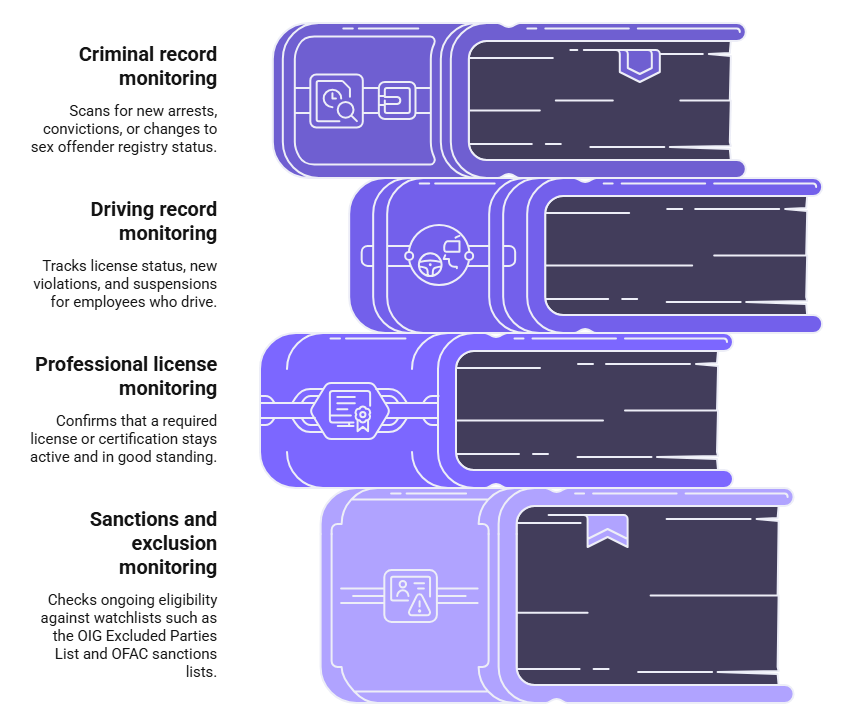
- Criminal record monitoring, which scans for new arrests, convictions, or changes to sex offender registry status, and is the component most GCheck monitoring programs are built around first.
- Driving record monitoring, which tracks license status, new violations, and suspensions for employees who drive as part of the job, priced separately from criminal monitoring since it queries a different set of state databases.
- Professional license monitoring, which confirms that a required license or certification stays active and in good standing, relevant anywhere a lapsed credential would make someone ineligible to keep doing their job.
- Sanctions and exclusion monitoring, which checks ongoing eligibility against watchlists such as the OIG Excluded Parties List and OFAC sanctions lists, and is often a contractual or regulatory requirement rather than a discretionary add-on.
Matching the monitoring components to the role is also a cost lever. A desk-based role with no driving responsibility and no license requirement has no reason to carry driving or license monitoring, and narrowing the scope to what the role actually needs keeps the per-employee cost proportional to the risk being managed rather than paying for coverage a given role will never trigger.
How GCheck prices continuous monitoring
GCheck prices background checks and monitoring per screen, not through a bundled quote that hides the number until a sales call. The three standard packages are:
| Package | Price per background check* | What’s included |
| Basic | $24.95 | Biometric identity verification, SSN trace and address history, national criminal database search, sex offender registry search, OIG excluded parties list, OFAC and global watchlist search, county criminal search in the candidate’s current county of residence |
| Standard | $44.95 | Everything in Basic, plus county criminal search across the candidate’s full address history |
| Advanced | $64.95 | Everything in Standard, plus federal criminal search across all federal districts of residence |
*Additional third-party fees may apply to some products and are passed through with no markup.
There are no setup fees, no minimums, and no long-term contracts on any package, so an organization can start with pre-employment screening and layer in continuous monitoring, such as MVR monitoring or professional license monitoring, as the workforce and the risk profile grow. Organizations running more than 50 background checks a year can request a custom quote that adds volume pricing, FCRA-compliant workflows, and ATS or HRIS integrations. GCheck also offers merit-based nonprofit discounts for qualifying organizations.
These per-screen prices also give the cost comparison from earlier in this article a real number to work against. An organization that rescreens annually with the Advanced package pays $64.95 per enrolled employee every twelve months, whether or not anything changed in that window. That’s the direct cost baseline a monitoring subscription should be measured against for any given role: if the monitoring fee for that role comes in under the annualized cost of repeating a full Advanced check, and the role’s risk profile calls for faster detection than an annual cycle provides, monitoring is doing more for less.
Building a continuous monitoring program without adding risk
A monitoring program is a risk management discipline, not a set-it-and-forget-it subscription. A few practices keep it defensible as it scales:

- Write the disclosure and authorization to cover ongoing checks explicitly, in language a candidate or employee can actually understand, rather than relying on the original hiring paperwork to stretch to cover something it didn’t describe.
- Scope monitoring to the role. Drivers get driving record monitoring, licensed professionals get license monitoring, and roles without that specific risk don’t carry cost or scrutiny they don’t need.
- Apply the same individualized assessment to an alert that you’d apply to a pre-hire finding: the nature of the issue, how long ago it occurred, and how it relates to the job.
- Communicate the program plainly. Employees who understand what’s being checked and why are less likely to experience monitoring as surveillance and more likely to see it as a standard, evenly applied part of how the organization operates.
- Document the process. The same records that support a defensible hiring decision (what was checked, what the policy says, how the decision was made) support a defensible retention decision.
- Budget for monitoring as a recurring per-employee line item tied to headcount in monitored roles, not as a one-time project cost. The per-employee fee is small, but it scales with enrollment, and forecasting it against expected hiring and turnover keeps the program’s cost predictable rather than a surprise at renewal.
None of these practices are expensive on their own. They’re mostly a matter of writing the program down clearly before turning it on, rather than adding monitoring to an existing screening stack and assuming the original paperwork already covers it. The organizations that get the most value out of continuous monitoring tend to be the ones that treated the compliance groundwork, and the budgeting, as part of the cost from the start, not as a cleanup task or a line-item surprise for later.
Frequently asked questions
How much does continuous employee monitoring cost?
Continuous monitoring is typically priced as a low, recurring per-employee fee rather than the cost of a full background check. GCheck’s background checks start at $24.95 per screen, with volume pricing available for organizations running checks or monitoring across a larger workforce.
Is continuous monitoring cheaper than rescreening employees every year or two?
Usually, yes, on a per-employee basis, because a full rescreen charges for a complete report at every cycle regardless of whether anything changed, while monitoring charges a standing fee and only surfaces a report when new activity appears.
Do I need new consent to run continuous monitoring on current employees?
The FCRA allows the original disclosure and authorization to cover reports obtained throughout employment, but only if that authorization says so clearly and conspicuously. A disclosure written only for a pre-employment check should be updated before monitoring begins.
What happens if continuous monitoring turns up something on an existing employee?
An alert is information, not a decision. Employers should apply an individualized assessment, considering the nature of the issue, the time elapsed, and its relevance to the role, and follow the same pre-adverse and adverse action notice process required for any FCRA-covered decision.
How do I compare the cost of monitoring against the cost of an annual rescreen?
Compare the monitoring subscription’s per-employee annual cost against the price of repeating a full background check for that same employee every year. With GCheck’s Advanced package at $64.95 per screen, that’s the annual rescreen baseline; if the monitoring fee for a given role comes in below that and the role needs faster detection than a once-a-year check provides, monitoring is the better value for that role.
Does GCheck offer discounted pricing for nonprofits?
Yes. GCheck offers merit-based nonprofit discounts alongside its standard per-screen pricing and volume pricing for organizations running continuous monitoring or high-volume screening.
Does every employee need continuous monitoring, or only some roles?
Not every employee necessarily needs continuous monitoring. It is generally most relevant for roles involving professional licenses, driving duties, sanctions eligibility, safety-sensitive work, fiduciary responsibility, or other risks that can change after hire. Lower-risk positions may be adequately covered by periodic rescreening instead.
Sources cited
- Federal Trade Commission. (2016). Using consumer reports: What employers need to know. https://www.ftc.gov/tips-advice/business-center/guidance/using-consumer-reports-what-employers-need-know
- U.S. Equal Employment Opportunity Commission. (2012). Enforcement guidance on the consideration of arrest and conviction records in employment decisions under Title VII of the Civil Rights Act of 1964. https://www.eeoc.gov/laws/guidance/enforcement-guidance-consideration-arrest-and-conviction-records-employment-decisions
- Society for Human Resource Management. (2019). SHRM: Employers slow to pick up trend of continuous screening. https://www.shrm.org/topics-tools/news/talent-acquisition/shrm-employers-slow-to-pick-trend-continuous-screening
- Fair Credit Reporting Act, 15 U.S.C. §1681b(b), §1681m(a).

ABOUT THE CREATOR
Charm Paz, CHRP
Recruiter & Editor
Charm Paz is an HR professional at GCheck, specializing in background screening, fair hiring, and regulatory compliance. She holds from the Professional Background Screening Association (PBSA) and helps organizations navigate employment regulations with clarity and confidence.
With a background in Industrial and Organizational Psychology, she translates policy into practice to build ethical, compliant, human-centered hiring systems that strengthen decision-making over time.