


For many youth sports administrators, fingerprint checks and database checks have always been interchangeable terms for “background check.” They are not. A fingerprint check submits biometric data to state and FBI repositories for a search of official government records. A database check queries aggregated commercial records compiled from secondary sources. Both search criminal history, but they differ in coverage, accuracy, access requirements, and the legal mandates that govern when each is required. This article explains what each check type actually searches, where each has structural limitations, and when fingerprint-based access is legally required or operationally warranted.
Key Takeaways
- A commercial database check searches aggregated secondary records, not primary government repositories.
- A fingerprint check accesses state criminal justice agency and FBI records directly, providing broader and more accurate results.
- Commercial criminal databases have documented coverage limitations. A significant percentage of U.S. counties do not report into commercial databases, creating structural coverage gaps in database-only programs.
- Several states, including Florida, have enacted laws requiring fingerprint-based checks for youth sports roles. Database checks do not satisfy these mandates. Organizations should confirm the applicable requirement in their state with qualified legal counsel.
- Organizations outside states with a specific mandate can access the FBI’s fingerprint repository through the VECHS program under the National Child Protection Act.
- Implementing fingerprint checks for a volunteer program requires VECHS qualified entity status and a livescan provider relationship.
What a Commercial Database Background Check Actually Searches
The most common misconception to correct first: a “national background check” is not what it sounds like. It does not search a government database, and it does not access FBI records. Instead, it queries a commercial aggregated database assembled by a consumer reporting agency from secondary sources, including state repositories, department of corrections records, some county court records, and administrative data compiled and indexed by the vendor.
Three structural limitations matter specifically for youth sports organizations:
- Coverage gaps are significant and predictable. Commercial criminal databases have documented coverage limitations. A significant percentage of U.S. counties do not report into commercial databases, though specific estimates vary by source. A coach who committed an offense in a non-reporting county may return a clean result on a database check. California’s records are held across 58 counties, with only a fraction reporting to national databases. New York does not report to these databases at all.
- Data is secondary, not primary. Records in a commercial database were accurate when sourced, but sourcing intervals vary. Some jurisdictions update daily; others update semi-annually. A recent conviction, a new sex offender registry listing, or an updated case disposition may not yet appear in the database. The county courthouse record is always more current.
- A database hit requires county-level verification before reporting. Under FCRA, a CRA must verify a national database hit against the originating jurisdiction before reporting it. This means the database functions as a pointer, flagging jurisdictions to check, not as a definitive result. Organizations that treat a clean database result as a comprehensive check are misunderstanding how the product works.
Commercial database checks serve an important function: casting a wide geographic net to surface potential records in jurisdictions outside a coach’s current address history. The problem is treating them as sufficient on their own for roles involving repeated unsupervised contact with minors.
What a Fingerprint Background Check Actually Searches
A fingerprint-based background check submits a set of biometric fingerprints, collected via livescan or ink-rolled card, to a state criminal justice agency. That agency then queries both the state repository and the FBI’s Next Generation Identification system. The NGI is the federal government’s official criminal history database, maintained by the FBI, containing records contributed by law enforcement agencies across all 50 states. In practice, the search is not limited by what commercial vendors have aggregated. It goes directly to the primary source, the same system law enforcement uses.
For youth sports purposes, this is the relevant distinction. A fingerprint check can surface a record that a commercial database check would completely miss, not because the offense is old or obscure, but simply because the county where it occurred does not share data with private CRAs. A fingerprint check through a state agency and the FBI system returns the following:
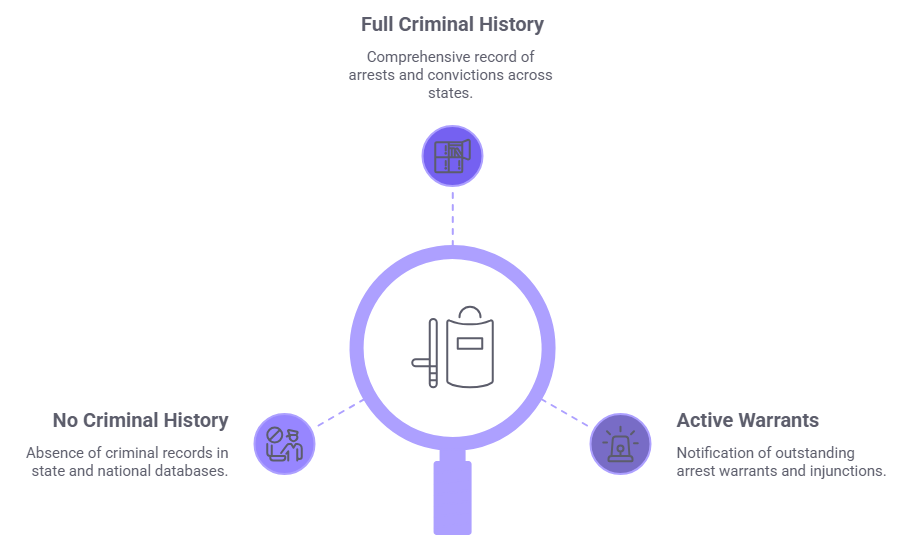
- An indication of no criminal history if none exists in state or national repositories.
- The full criminal history record showing arrests and convictions in the submitting state and other states.
- Notification of active warrants or domestic violence injunctions where the state program provides for it.
It does not return records that were sealed or expunged in the relevant jurisdiction, juvenile records protected by state law, or arrests without disposition in some jurisdictions.
Side-by-Side Comparison
These two check types are not interchangeable, and the differences matter most precisely where accuracy is highest stakes: screening adults for regular contact with children.
| Dimension | Database Check | Fingerprint Check |
| Source | Commercial aggregated database (secondary) | State criminal justice agency and FBI NGI (primary government records) |
| County coverage | Significant percentage of U.S. counties do not report in | All records submitted to state and FBI repositories |
| Data currency | Varies; some sources update semi-annually | Current as of state and FBI last update |
| What it searches | Multi-jurisdictional secondary records | State criminal history plus full FBI rap sheet |
| Access requirements | Any FCRA-compliant CRA can order | Requires VECHS qualified entity status or statutory mandate |
| Satisfies a fingerprint mandate | No | Yes |
For organizations without a statutory mandate, the choice between check types is a risk-tolerance decision. For organizations subject to a state or governing body fingerprint requirement, it is not a choice. The applicable mandate specifies fingerprint-based screening.
The quality of a screening program is not measured by how fast it is completed, but by how well it protects the people involved. Organizations that take time to understand those differences are better positioned to make informed and responsible decisions. Strong safeguarding practices start with knowing exactly what your process is designed to catch and where additional layers may still be needed. �
When Each Check Type Is Legally Required for Youth Coaches
States With Fingerprint Mandates
Several states have enacted fingerprint requirements for youth sports coaching roles. Florida has enacted requirements for fingerprint-based Level 2 background screening for certain youth-serving roles under Chapter 435 of the Florida Statutes. Pennsylvania’s Act 153 requires FBI fingerprint clearance, in addition to two other clearances, for volunteers with unsupervised contact with children, which includes most youth sports coaching roles. California’s AB 506 requires background checks including DOJ fingerprint submission for youth sports organizations receiving public funding or using public facilities. Organizations should confirm the specific requirements, covered role definitions, and re-screening cadence applicable to their program with qualified legal counsel in their state.
National Governing Bodies
The United States Olympic and Paralympic Committee’s SafeSport framework requires fingerprint-based checks for certain credentialed roles. Some governing bodies permit CRA-based checks as an alternative to direct VECHS submission, but require the check to include search components equivalent to what a fingerprint submission would surface.
Organizations Without a Specific Mandate
For youth sports organizations in states without a fingerprint mandate and without governing body requirements specifying fingerprint checks, the legal minimum may be satisfied by a CRA-ordered criminal background check with county-level verification. However, a best-practice program for any role involving regular unsupervised contact with minors should treat fingerprint-level search depth as the standard, not the exception. The coverage gap in commercial databases is a known structural limitation, not a theoretical risk.
Do Database Background Checks Satisfy a Fingerprint Mandate?
No. Where a state or governing body requires fingerprint-based screening, a commercial database check does not meet that standard regardless of how comprehensively the vendor describes it. The distinction is structural: a database check queries secondary aggregated records, not the government repositories that a fingerprint mandate requires.
How the VECHS Program Works and How to Get Your Organization Qualified
What VECHS Is
The Volunteer and Employee Criminal History System is a federal program established under the National Child Protection Act of 1993 and implemented at the state level. It gives qualified nonprofit and youth-serving organizations access to fingerprint-based state and FBI criminal history records for screening volunteers and employees. This access is otherwise restricted to law enforcement and credentialed government agencies. Each state operates its own VECHS program through its state criminal justice agency. Florida organizations apply through FDLE. Organizations in other states should identify their state’s VECHS administrator and confirm the current application process directly with that agency.
Eligibility Requirements
To become a VECHS qualified entity, an organization must provide care or care placement services to children, the elderly, or individuals with disabilities. Youth sports organizations that work with minors qualify. The program is open to public, private, for-profit, nonprofit, and voluntary organizations. A 501(c)(3) designation is not a requirement. Organizations already required by statute to obtain fingerprint checks on specific staff categories must use those statutory pathways for those roles. VECHS covers the remaining staff and volunteers not already covered by a specific mandate.
The VECHS Application Process: General Steps
The following steps describe the general process for organizations seeking VECHS access. Each state administers its own VECHS program, and specific steps, forms, and timelines vary by state. Organizations should confirm the current process with their state’s VECHS administrator before beginning.
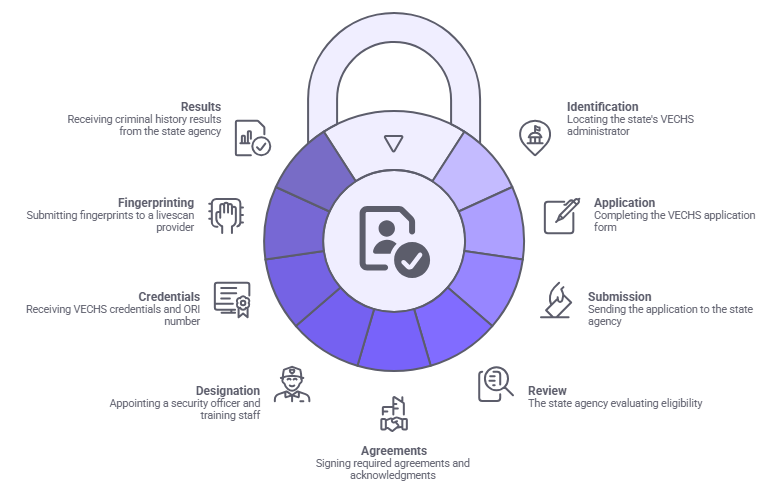
- Identify your state’s VECHS administrator, typically the state criminal justice agency or department of law enforcement.
- Obtain and complete the VECHS application for your state. The application asks what care services the organization provides to children, elderly, or disabled individuals.
- Submit the completed application to the state VECHS administrator per their current submission instructions.
- The state agency reviews eligibility. Review timelines vary by state.
- If approved, the organization completes required agreements and acknowledgments. The entity head typically signs these documents.
- The organization designates a security officer or authorized contact. That person completes any required training. Staff with access to criminal justice information complete training at their level.
- On approval and training completion, the organization receives VECHS credentials and an ORI number.
- Coaches and volunteers present to a state-approved livescan provider with the organization’s ORI number, complete the required consent form, and submit fingerprints electronically.
- The state agency, with FBI assistance, returns results: either a no-criminal-history indication or the relevant criminal history record.
VECHS programs charge fees for fingerprint submissions. Current fee schedules should be confirmed directly with the applicable state VECHS administrator before communicating costs to volunteers or coaches, as fees are subject to change.
Livescan Submission Logistics for Volunteer Programs
Livescan is the electronic fingerprint submission method. Coaches and volunteers visit a state-approved livescan service provider, present the organization’s ORI number, complete the required consent form, and have fingerprints captured digitally. The capture takes 10 to 15 minutes. Results typically return within 24 to 72 hours depending on processing volume, though timelines vary by state. For organizations needing to fingerprint multiple coaches at once, some livescan providers offer mobile fingerprinting services that bring a livescan unit to the organization’s location, which is practical for programs with 20 or more coaches needing clearance before a season opens.
What This Means for Organizations Outside States With a Mandate
The VECHS program is available in most states, not only those with a specific youth sports fingerprint mandate. Any youth-serving organization that qualifies under the NCPA definition can apply to their state’s VECHS program for access to FBI fingerprint records, regardless of whether their state has enacted a specific youth sports statute. For organizations in states without a fingerprint mandate, the practical question is whether the coverage limitations of a commercial database check are acceptable given the access level of the coaches being screened. The documented gaps, a significant percentage of counties not reporting to commercial databases, data currency lags, and no direct FBI access, exist regardless of state law.
Organizations affiliated with national governing bodies should verify whether their governing body requires fingerprint-level access specifically. Little League permits FCRA-compliant CRA checks as an alternative to VECHS, but the check must include county-level searches at current and prior-seven-year addresses plus sex offender registry. Pop Warner and AAU each have their own check specifications. The governing body requirement is the floor. An organization can always exceed it.
Implementing a Compliant Fingerprint Check Program
FCRA Applies to CRA-Based Checks
Commercial database checks ordered through a CRA trigger the full FCRA framework, including standalone disclosure, written authorization, and adverse action requirements. VECHS submissions go directly to the state criminal justice agency rather than through a CRA. Whether and how FCRA obligations apply to decisions based on VECHS results should be confirmed with qualified legal counsel before implementing a VECHS-based program. For commercial CRA checks, the requirements include standalone written disclosure, written authorization, and the full adverse action process for any denial.
Documentation and Re-Screening
Organizations should maintain records of what was checked, when, and what the result was, regardless of whether a state mandate specifies a retention period. Where a state mandate does specify a retention period, that requirement governs. This documentation serves as both a compliance record and a negligent hiring defense. Organizations should confirm applicable retention obligations with qualified legal counsel.
Periodic re-screening, whether annual or on another cadence, creates a gap between checks. A coach arrested between scheduled screens will not surface until the next re-screen cycle. Organizations should confirm the re-screening cadence required by their applicable state mandate or governing body requirement and build a tracking system that triggers re-screening before the deadline, not after.
Continuous Monitoring as a Supplement
Continuous criminal monitoring provides real-time alerts when a new criminal record appears for a previously cleared individual, closing the between-check window without requiring a full re-fingerprint cycle. For programs with coaches in recurring unsupervised contact with minors, continuous monitoring is a meaningful supplement to periodic re-screening regardless of the mandated cadence.
Conclusion
The distinction between a fingerprint check and a database check is not a technicality. It reflects a fundamental difference in what is actually being searched and how current that information is. For organizations subject to a state or governing body fingerprint mandate, the fingerprint check is the legal standard. For organizations elsewhere, it remains a best-practice consideration for any program that places adults in regular unsupervised contact with children.
The VECHS pathway makes fingerprint-level access available to qualifying organizations without law enforcement credentials. The process involves more setup than ordering a CRA database check, but the coverage and reliability difference is material. For programs where child safety is the explicit purpose, that difference matters.
Frequently Asked Questions
What is the difference between a fingerprint background check and a database background check?
A fingerprint check submits biometric data to state and FBI repositories, accessing primary government criminal history records. A database check queries a commercial aggregated database compiled from secondary sources. Fingerprint checks have broader coverage and greater accuracy. Database checks are faster and available through any CRA without VECHS qualification.
Does a database background check satisfy a state fingerprint mandate for youth coaches?
No. Where a state or governing body requires fingerprint-based screening, a commercial database check does not meet that standard. The distinction is structural: a database check queries secondary aggregated records, not the government repositories that a fingerprint mandate requires. Confirm the applicable mandate in your state with qualified legal counsel.
How do I get my organization set up for VECHS fingerprint checks?
Identify your state’s VECHS administrator, typically the state criminal justice agency. Submit a completed VECHS application and await eligibility review. If approved, complete required agreements and training, receive an ORI number, and direct coaches to a state-approved livescan provider with that ORI to submit fingerprints electronically.
How long does a VECHS fingerprint check take?
The fingerprint capture takes 10 to 15 minutes at a livescan provider. Results typically return within 24 to 72 hours depending on state processing volume. Results come back as either a no-criminal-history indication or the relevant criminal history record.
Can organizations outside states with a fingerprint mandate use fingerprint-based checks for youth coaches?
Yes. The VECHS program is available in most states under the National Child Protection Act. Any qualifying youth-serving organization can apply to their state’s VECHS program for FBI fingerprint access, regardless of whether a state youth sports mandate exists.
Is a fingerprint background check more accurate than a database check?
For coverage and currency, yes. Fingerprint checks access the FBI’s NGI system directly. Commercial databases have documented coverage limitations, with a significant percentage of U.S. counties not reporting into commercial databases and variable data update schedules. Records in non-reporting jurisdictions will not appear in a database check but can surface in a fingerprint search.
Additional Resources
- FBI Next Generation Identification (NGI) System Overview
https://www.fbi.gov/services/cjis/fingerprints-and-other-biometrics/ngi - National Child Protection Act and NCPA Amendments (DOJ)
https://www.ojp.gov/ncjrs/virtual-library/abstracts/national-child-protection-act-1993 - Florida Department of Law Enforcement: VECHS Program
https://www.fdle.state.fl.us/Criminal-History-Records/VECHS.aspx - Florida Statutes Chapter 435: Employment Screening
https://www.leg.state.fl.us/Statutes/index.cfm?App_mode=Display_Statute&URL=0400-0499/0435/0435ContentsIndex.htm - Pennsylvania Act 153: Child Protective Services Law Clearances
https://www.dhs.pa.gov/KeepKidsSafe/Clearances/Pages/Pennsylvania-Background-Checks.aspx - FTC: Using Consumer Reports for Employment Purposes
https://www.ftc.gov/business-guidance/resources/using-consumer-reports-employment-purposes

ABOUT THE CREATOR
Charm Paz, CHRP
Recruiter & Editor
Charm Paz is an HR professional at GCheck, specializing in background screening, fair hiring, and regulatory compliance. She holds from the Professional Background Screening Association (PBSA) and helps organizations navigate employment regulations with clarity and confidence.
With a background in Industrial and Organizational Psychology, she translates policy into practice to build ethical, compliant, human-centered hiring systems that strengthen decision-making over time.