



Security guard background check requirements vary significantly across states, with distinctions based on whether guards are armed or unarmed, work for contract agencies or in-house teams, and operate in regulated industries. Employers must navigate a layered compliance landscape that includes state licensing mandates, federal Fair Credit Reporting Act obligations, and industry-specific screening standards to build effective risk management frameworks.
Key Takeaways
- State licensing requirements for security guards create baseline screening mandates that vary by jurisdiction, with some states requiring fingerprint-based FBI checks while others accept name-based criminal searches.
- Armed security personnel typically face more rigorous background screening than unarmed guards, including mental health evaluations and extended lookback periods in many states.
- Contract security agencies and direct employers often operate under different regulatory frameworks, affecting who conducts screenings and maintains ongoing compliance documentation.
- Drug testing requirements for security personnel exist in some states as licensing prerequisites, while in others they remain optional best practices rather than legal mandates.
- Continuous monitoring practices supplement initial background checks but raise distinct legal and privacy considerations that require careful implementation.
- Multi-state security operations must satisfy the most stringent requirements across all jurisdictions where personnel are deployed, not just where the company is headquartered.
- Industry-specific contexts such as healthcare facilities, schools, or financial institutions may impose screening requirements beyond general state licensing rules.
- A maturity model approach helps organizations progress from minimum compliance to risk-proportionate screening that aligns with operational needs and threat environments.
Understanding the Regulatory Foundation for Security Personnel Screening
Security guard background check requirements by state reflect a complex regulatory environment shaped by occupational licensing laws, public safety priorities, and the unique nature of security work. Unlike many employment sectors where screening remains largely discretionary, security personnel often operate under mandatory state licensing regimes that prescribe minimum investigation standards before individuals can legally work in protective roles.
Guard classification creates substantial variation in the regulatory foundation. States typically distinguish between armed and unarmed security personnel, with armed guards universally subject to more intensive screening. Additional distinctions emerge between proprietary security employees who work directly for a single organization and contract security personnel employed by agencies that provide guards to multiple clients.
Federal law establishes a compliance floor through the Fair Credit Reporting Act, which governs how employers obtain and use background check information regardless of state requirements. Before getting consumer reports, employers must obtain written authorization under the FCRA. When considering negative employment decisions based on background check information, employers must provide a pre-adverse action process that includes a copy of the consumer report, a Summary of Rights under the FCRA, and reasonable time for the applicant to respond before taking final action. Final adverse action notices must identify the consumer reporting agency, explain the agency did not make the decision, and inform the individual of their right to dispute report accuracy.
State Licensing Models and Their Screening Implications
States employ diverse licensing models that directly impact background screening practices:
| Licensing Model | Screening Authority | Employer Responsibilities |
| Individual guard licensing | State agency or police department conducts checks | Verify license validity and maintain copies |
| Company-level licensing | Employer conducts checks per regulatory standards | Implement compliant protocols and document results |
| Minimal regulation states | Employer discretion within FCRA boundaries | Develop risk-appropriate screening programs |
Individual licensing states typically embed background check requirements within the licensing process itself. Applicants must undergo prescribed screenings before receiving credentials authorizing security work. Company licensing models place compliance responsibility differently, with security agencies obtaining business licenses contingent on demonstrating adequate employee screening protocols.
In security hiring, a background check is not merely a personnel management requirement, but a reflection of the public trust that is placed in security personnel every day. This is why effective security screening is about more than merely understanding state licensing laws, federal FCRA laws, and the particular risks of a given security position. Whether a position is armed or unarmed, a contracting firm or internal staff, and/or if they are deployed in one, several, or all states, effective security screening is about more than a singular approach. �
Criminal History Screening Depth and Scope Variations
Criminal history requirements represent the most universal component of security guard background check requirements by state, but the depth and scope of mandated searches vary considerably. Jurisdictions differ in whether they require statewide, multi-state, or national criminal database searches, and whether fingerprint-based FBI checks are mandatory or optional.
Fingerprint-based checks access the FBI’s criminal history database and provide the most comprehensive national coverage, capturing records from jurisdictions that may not report to commercial databases. Many states require fingerprint submissions for armed security licenses but accept name-based searches for unarmed personnel.
Lookback periods vary by state and offense type:
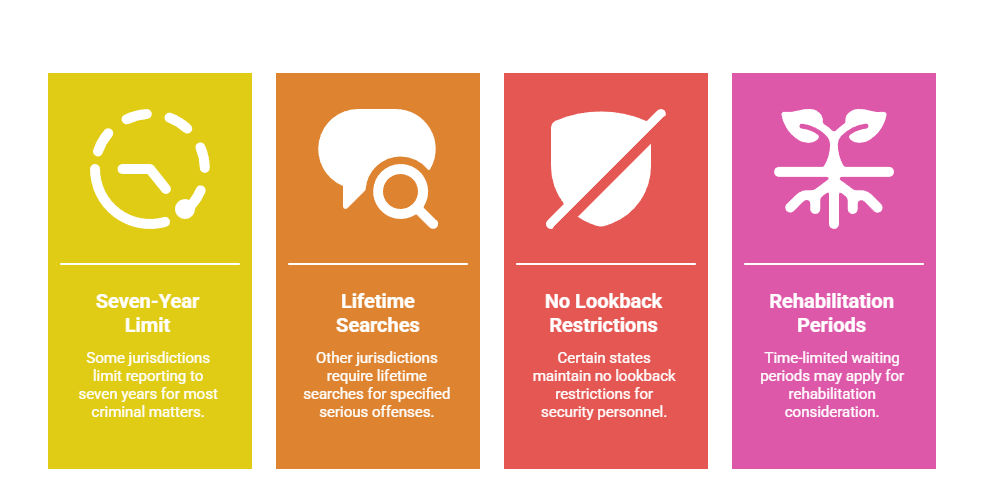
- Some jurisdictions impose seven-year reporting limits for most criminal matters
- Others require lifetime searches for specified serious offenses
- Certain states maintain no lookback restrictions for security personnel
- Time-limited waiting periods may apply for rehabilitation consideration
Disqualifying offenses differ across jurisdictions, and many states require individualized assessments rather than blanket exclusions. While violent crimes, weapons offenses, and crimes of dishonesty are commonly considered in security personnel decisions, employers must often evaluate factors including the nature and gravity of the offense, time elapsed since conviction, and the relationship between the offense and job duties. Some states prohibit permanent bars and require consideration of rehabilitation evidence after specified periods.
Armed vs. Unarmed Security Personnel: Differential Screening Standards

The distinction between armed and unarmed security roles creates perhaps the most significant variation in background screening intensity. Armed security personnel carry lethal force capability, elevating public safety stakes and justifying enhanced screening under most state regulatory frameworks.
Armed guard licensing typically requires all components mandated for unarmed personnel plus additional screenings:
| Screening Component | Unarmed Guards | Armed Guards |
| Criminal history check | Required in most states | Required in all regulated states |
| FBI fingerprint check | Some states | Most states |
| Mental health evaluation | Rarely required | Common requirement |
| Firearms qualification | Not applicable | Required with ongoing recertification |
| Domestic violence screening | Standard criminal check | Enhanced scrutiny due to federal law |
Enhanced Criminal History Standards for Armed Personnel
Criminal history screening for armed security personnel often involves more stringent standards than unarmed roles. States may require FBI fingerprint checks for armed guards even when accepting name-based searches for unarmed personnel. Disqualifying offense lists typically expand for armed positions, with some jurisdictions barring armed licensure for any felony conviction while allowing unarmed security work after rehabilitation periods.
Domestic violence convictions receive particular attention in armed security contexts due to federal firearms prohibitions. The Lautenberg Amendment prohibits firearm possession by individuals convicted of misdemeanor crimes of domestic violence that involved use or attempted use of physical force or threatened use of a deadly weapon and were committed against specified domestic relationship victims. Not all state-law domestic violence convictions meet the federal definition, and some qualifying convictions may not be obviously labeled. When screening armed security candidates, employers should implement procedures to identify convictions that trigger federal firearms prohibitions based on offense elements and victim relationship, not solely on charge titles.
Unarmed Security Baseline Requirements
Unarmed security positions generally face less intensive mandatory screening, though significant requirements still apply in regulated states:
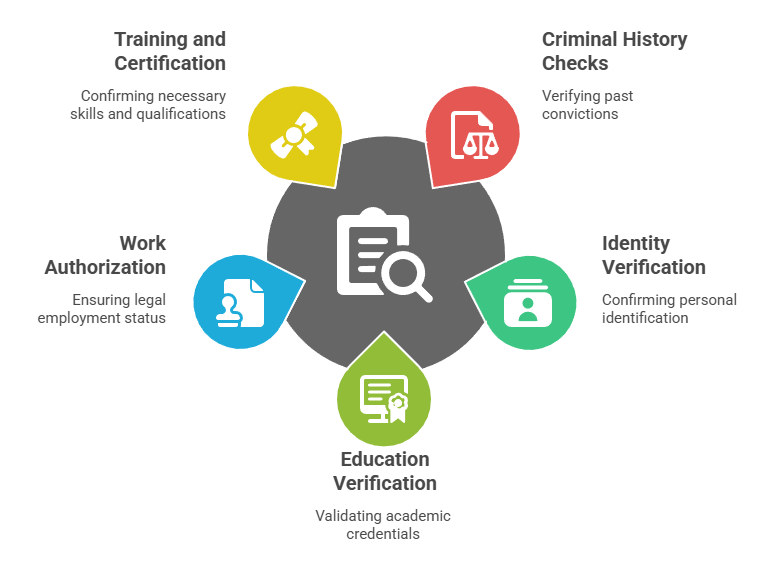
- Criminal history checks focusing on felony convictions and relevant misdemeanors
- Identity verification through government-issued identification
- Education verification where state mandates exist
- Work authorization confirmation
- Required training and certification validation
Drug testing occupies unclear regulatory space for unarmed security personnel. While some states incorporate drug screening into licensing requirements, many treat it as an optional employer practice rather than a legal mandate.
Contract vs. In-House Security: Compliance Responsibility Allocation
The employment structure for security personnel creates important variations in how background screening obligations are allocated and documented. Contract security agencies that supply guards to client organizations face different compliance frameworks than companies that employ proprietary security staff directly.
Contract security agencies typically bear primary responsibility for conducting background checks and maintaining licensing compliance for guards they employ. Client organizations that engage contract security services retain backup responsibility for verifying that agencies perform required screenings through due diligence practices.
Direct Employment Screening Obligations
Organizations that employ security personnel directly assume full responsibility for conducting and documenting background checks. Proprietary security operations may face less intensive state regulation in some jurisdictions, with certain states focusing licensing mandates primarily on contract security agencies while imposing fewer requirements on companies employing guards for their own premises.
Record retention obligations for direct employers vary by state but generally require maintenance of background check documentation throughout employment and for specified periods after separation, typically ranging from three to seven years post-employment.
Service Agreement Screening Provisions
When engaging contract security providers, organizations should incorporate specific screening provisions into service agreements. These contractual terms clarify expectations, allocate compliance responsibilities, and create documentation trails demonstrating client due diligence.
Well-drafted provisions address which screening components the agency will perform, documentation the agency will provide to verify compliance, the timing for delivering verification materials, and remedies for screening failures. Penalty clauses addressing screening failures appear in many security service contracts, allocating financial responsibility if inadequate background checks lead to incidents, regulatory violations, or litigation.
State-Specific Requirement Variations: Regional Compliance Considerations
Security guard background check requirements by state demonstrate significant regional variation that complicates multi-jurisdictional operations. While some common elements appear across most licensing regimes, the specific mandates, procedures, and disqualification standards differ enough that employers cannot assume compliance in one state satisfies requirements in another.
States with comprehensive licensing systems typically specify detailed screening mandates:
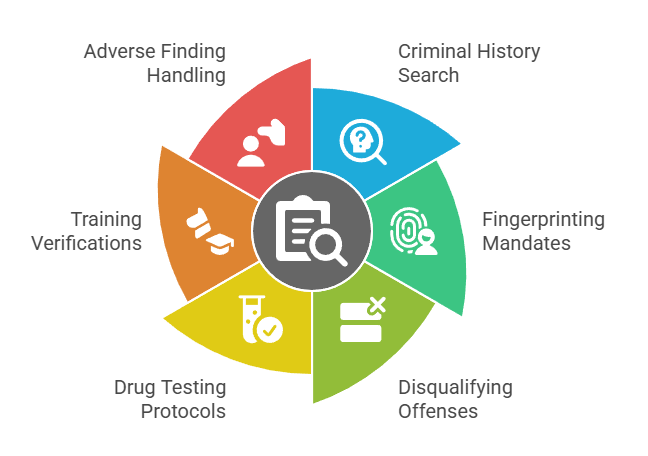
- Criminal history search scope and methodology
- Fingerprinting mandates and submission procedures
- Disqualifying offense lists with time limits
- Drug testing protocols and acceptable substances
- Training verifications and certification requirements
- Procedures for handling adverse findings
Less regulated states may impose minimal statutory requirements while leaving screening decisions primarily to employer discretion within FCRA boundaries.
Multi-State Operations Compliance Strategies
Organizations deploying security personnel across multiple states face compound compliance obligations. For multi-state operations, compliance strategies typically adopt maximum-standard approaches. Rather than maintaining jurisdiction-specific screening protocols that risk cross-state errors, many organizations implement baseline screening programs meeting or exceeding the most intensive state requirements in their operational footprint.
Licensing reciprocity arrangements between states can reduce administrative burdens for multi-state operations, though reciprocity remains limited in the security industry.
Industry-Specific Layering on State Requirements
Certain industries and facility types impose background screening requirements for security personnel that exceed general state licensing mandates:
| Industry Context | Additional Screening Requirements | Regulatory Source |
| Healthcare facilities | Abuse registry searches, exclusion list checks, vulnerable adult offense reviews | Facility licensing, accreditation standards |
| Educational institutions | Child abuse registry checks, sex offender verifications, enhanced disqualifications | School access regulations, state education codes |
| Financial services | Credit history checks, fraud offense reviews, bonding requirements | Industry regulations, client mandates |
| Critical infrastructure | Security clearances, enhanced criminal history, continuous monitoring | Federal contracts, facility security plans |
Healthcare facility security personnel may require background checks that address patient safety concerns, while educational institution security faces similar layering with school access requirements potentially mandating child abuse registry checks and sex offender registry verifications.
Building a Screening Maturity Model: From Compliance to Best Practice
Effective security personnel screening programs evolve beyond minimum compliance toward risk-balanced practices that address organizational threat environments and operational contexts:
| Maturity Level | Characteristics | Screening Approach |
| Level 1: Basic Compliance | Meets minimum regulatory requirements | Mandated checks at hire and renewal only |
| Level 2: Industry Standard | Exceeds regulatory minimums | Multi-state searches, employment verification, quality assurance |
| Level 3: Risk-Based Enhancement | Role-specific protocols | Different screening by assignment risk and access level |
| Level 4: Advanced Monitoring | Continuous surveillance | Ongoing database monitoring, real-time alerts, proactive risk management |
Level one maturity represents basic compliance with applicable state licensing requirements. At level two maturity, organizations incorporate industry-standard practices that exceed minimum regulatory requirements. Level three maturity implements risk-based screening variations tailored to specific security roles and assignments.
Advanced Screening Practices and Continuous Monitoring
Continuous monitoring represents an advanced practice gaining adoption in security personnel management. Rather than relying solely on point-in-time background checks at hire and license renewal, continuous monitoring involves ongoing surveillance of criminal databases, sex offender registries, and other information sources to identify relevant events during employment.
Implementation of continuous monitoring raises distinct legal and operational considerations including FCRA compliance for ongoing consumer report procurement, which may include clear disclosure of ongoing monitoring scope and periodic consent renewal depending on program design and state law.
Technology-Assisted Screening Approaches
Modern credential verification technologies offer supplemental screening capabilities that complement traditional background checks. Automated monitoring of professional licenses and certifications can supplement manual verification practices, reducing administrative burden while improving compliance assurance.
Artificial intelligence applications in background screening continue to evolve, with potential uses in pattern recognition, risk assessment, and decision support. However, AI-assisted screening tools require careful evaluation for accuracy, bias, legal compliance, and appropriateness for employment contexts. Some jurisdictions now mandate bias audits, candidate notification, or consent procedures for AI-based employment decision tools.
Drug Testing Integration in Security Personnel Screening
Security guard drug testing requirements occupy a complex position within broader background screening frameworks. Unlike criminal history checks that appear in nearly all state licensing schemes, drug testing mandates for security personnel vary substantially by jurisdiction, role type, and employment context.
States that incorporate drug testing into security guard licensing typically specify testing timing, procedures, and substances. Pre-employment testing before initial license issuance is the most common mandate, with some jurisdictions requiring additional testing at license renewal intervals.
Drug Testing Legal and Procedural Considerations
Drug testing implementation must comply with various legal frameworks beyond security licensing regulations. State marijuana legalization creates complexity, as some jurisdictions maintain marijuana screening requirements for security personnel despite broader adult-use legalization, while others have restricted or eliminated marijuana testing mandates. Additionally, some states prohibit employment discrimination based on off-duty marijuana use or positive pre-employment marijuana tests, with varying definitions of safety-sensitive positions that may or may not include security roles.
Privacy protections vary by state, with some jurisdictions restricting the circumstances under which employers may conduct drug testing or the consequences they may impose for positive results. Collection procedures and chain of custody protocols significantly impact drug testing reliability and legal defensibility.
Testing Timing and Ongoing Monitoring Options
Pre-employment drug testing represents the most common approach, occurring after conditional job offers but before employment begins. This timing aligns with FCRA requirements for authorization and notice, allows offer withdrawal based on positive results without terminating existing employment, and addresses Americans with Disabilities Act considerations by testing post-offer.
Ongoing drug testing during employment varies widely in prevalence and legal requirements. Random testing programs exist in some security contexts, particularly for armed personnel or sensitive assignments. Reasonable suspicion testing based on observed behavior provides another basis for mid-employment screening.
Developing Role-Specific Screening Frameworks
The diversity of security roles within organizations justifies different screening approaches that match investigation intensity to position-specific risks and responsibilities. High-risk security roles typically include armed personnel, supervisors with authority over other guards, personnel with master key or system administrator access, cash-in-transit guards, executive protection specialists, and security staff in sensitive industries.
Standard-risk security positions such as unarmed access control officers, patrol guards in low-sensitivity environments, and event security personnel might receive baseline screening that satisfies applicable licensing requirements without additional enhancement.
Assignment-Specific Screening Enhancements
Certain security assignments within an organization may trigger additional screening requirements regardless of the guard’s general classification. Client-mandated screening requirements frequently appear in contract security operations, with government contracts often imposing federal background check standards through facility access requirements, security clearances, or contract performance specifications.
Screening Protocol Documentation and Review
Formalized screening protocols benefit from written policies that specify which background check components apply to each security role category, procedures for conducting investigations, documentation requirements and retention periods, and decision-making criteria for adverse findings.
Periodic protocol reviews ensure screening frameworks remain aligned with evolving legal requirements, emerging threats, and organizational risk profiles. Quality assurance mechanisms help identify and correct screening gaps, procedural errors, or documentation deficiencies.
Conclusion
Security guard background check requirements by state create complex compliance landscapes that vary by jurisdiction, role type, and industry context. Employers must navigate mandatory licensing requirements, federal FCRA procedures, and risk-based best practices to build screening programs that satisfy legal obligations while addressing organizational security needs. A thoughtfully designed screening framework goes beyond regulatory requirements by emphasizing accountability, a safe environment, and the legitimacy of the security function for the organizations it supports.
Frequently Asked Questions
What background checks are legally required for security guards in most states?
Most states with security guard licensing requirements mandate criminal history checks as baseline screening, though the scope varies from statewide name-based searches to FBI fingerprint checks. Many jurisdictions also require identity verification, work authorization confirmation, and validation of required training certifications.
Do armed security guards face more intensive background screening than unarmed personnel?
Armed security personnel typically undergo more thorough background investigations than unarmed guards in virtually all regulated jurisdictions. Enhanced requirements often include FBI fingerprint-based criminal checks, mental health or psychological evaluations, firearms training verification, expanded disqualifying offense lists, and longer lookback periods.
How do security guard drug testing requirements vary by state?
Drug testing mandates for security personnel vary substantially across states. Some jurisdictions incorporate pre-employment drug screening into licensing requirements with specified testing procedures and substances. Other states treat drug testing as an optional employer practice rather than a legal mandate.
What is the difference in background check responsibility between contract security agencies and direct employers?
Contract security agencies typically bear primary responsibility for conducting background checks on guards they employ and must demonstrate adequate screening protocols to maintain business licenses. Client organizations retain backup responsibility for verifying that agencies perform required screenings through due diligence practices.
Can security companies use continuous monitoring instead of periodic background rechecks?
Continuous monitoring can supplement but typically does not replace required periodic background rechecks at license renewal intervals mandated by state regulations. While continuous database monitoring provides ongoing surveillance for criminal activity or license status changes, licensing authorities often require point-in-time investigations at specified renewal periods.
Do security guards working across multiple states need background checks in each jurisdiction?
Security personnel working in multiple states generally must satisfy licensing requirements in each jurisdiction where they perform security functions. This typically requires separate license applications and background checks for each state unless reciprocity agreements exist that recognize licenses issued by partner jurisdictions.
What screening enhancements apply to security personnel in sensitive industries like healthcare or education?
Security guards in healthcare facilities may face additional screening requirements including abuse registry checks, federal healthcare program exclusion list searches, and expanded criminal history reviews for offenses against vulnerable adults. Educational institution security personnel often require child abuse registry checks and sex offender registry verifications.
How long must employers retain security guard background check records?
Record retention requirements for security guard background checks vary by state but typically mandate maintenance of screening documentation throughout employment and for specified periods after separation. Retention periods commonly range from three to seven years post-employment, though some jurisdictions or industry contexts require longer retention.
Additional Resources
- Fair Credit Reporting Act (FCRA) Summary
https://www.ftc.gov/legal-library/browse/statutes/fair-credit-reporting-act - U.S. Equal Employment Opportunity Commission: Background Checks Guidance
https://www.eeoc.gov/laws/guidance/background-checks-what-employers-need-know - FBI Criminal Justice Information Services Division
https://www.fbi.gov/services/cjis - Americans with Disabilities Act: Employment Provisions
https://www.ada.gov/topics/employment/ - National Conference of State Legislatures: Background Checks for Employment
https://www.ncsl.org/labor-and-employment/background-checks-and-employment

ABOUT THE CREATOR
GCheck Editorial Team
Meet the GCheck Editorial Team, your trusted source for insightful and up-to-date information in the world of employment background checks. Committed to delivering the latest trends, best practices, and industry insights, our team is dedicated to keeping you informed.
With a passion for ensuring accuracy, compliance, and efficiency in background screening, we are your go-to experts in the field. Stay tuned for our comprehensive articles, guides, and analysis, designed to empower businesses and individuals with the knowledge they need to make informed decisions.
At GCheck, we're here to guide you through the complexities of background checks, every step of the way.