

Zero tolerance policies don’t work as intended when enforcement depends on who is involved. GCheck’s The Consequence Gap Report found that only 36% of difficult coworkers eventually left or were removed, and that managers and senior leaders were protected at a higher rate than junior coworkers. This article explains how that gap opens and how to audit enforcement.
Key Takeaways
- GCheck’s survey of 1,500 US adults employed full time found that, among the 1,272 workers who had worked closely with a coworker whose behavior consistently made work life worse, nothing happened to the coworker in 38% of cases, the coworker was rewarded, promoted, or protected in 23%, and only 36% eventually left or were removed.
- Rank mattered. Managers and senior leaders were rewarded or protected in 36% of cases and removed in 21% (a smaller group of 119 cases that the survey treats as directional), against 24% and 41% for junior coworkers.
- The co-chairs of the EEOC‘s 2016 harassment task force cautioned that the term “zero tolerance” can convey one identical outcome for every case and may contribute to under-reporting, and they urged discipline that is prompt, proportionate, and consistent.
- A written policy is a promise, and what employees see enforced is the evidence. This article reasons that a policy can fall short when the same conduct leads to different outcomes depending on who is involved.
- Consistent enforcement means comparable conduct goes through the same process and leads to proportionate outcomes. It does not mean identical outcomes for every case.
- An enforcement audit compares stated consequences with actual outcomes by rank and by results, tests the reporting system, and checks what happened to the people who raised concerns, ideally directed by counsel and reported in aggregate.
What the Survey Found About Enforcement
What Happened to the Difficult Coworker
GCheck’s survey of 1,500 US adults employed full time asked about a coworker whose behavior consistently made their job harder. Among the 1,272 workers who had worked closely with such a coworker, nothing happened to the coworker in 38% of cases, the coworker was rewarded, promoted, or protected in 23%, and only 36% eventually left or were removed.
Put another way, in more than six in ten of those cases, nothing happened to the coworker or something good did. The figures describe what workers reported seeing happen, which is the part of a policy that employees can observe.
How Outcomes Differed by Rank
The same survey split outcomes by the coworker’s rank:
| Coworker’s rank | Rewarded or protected | Removed or left |
| Manager or senior leader | 36% | 21% |
| Peer | 20% | 37% |
| Junior coworker | 24% | 41% |
Managers and senior leaders were protected at one and a half times the rate of junior coworkers and removed at about half the rate. The manager figures rest on 119 cases, a smaller group the survey asks readers to treat as directional, and the peer and junior figures rest on 603 and 342 cases. Peers were the difficult coworker in 47% of cases and a manager or a leader above the worker in 10%, so the rank gap sits alongside a much larger set of peer cases. A written policy applies to all three groups on paper, and the table shows how outcomes differed by rank.
Why Policy Language Can Mislead
What the EEOC Task Force Co-Chairs Said About the Label
In 2016, the two co-chairs of the EEOC’s Select Task Force on the Study of Harassment in the Workplace published a report on preventing harassment. It is the co-chairs’ report, not a consensus statement of the task force or agency guidance, and the EEOC now lists it as archived content. Its reasoning about policy wording is still useful for thinking about any conduct policy, though the report itself addresses harassment.
The co-chairs wrote that they had heard from several witnesses that the term “zero tolerance” is “misleading and potentially counterproductive.” Accountability, they said, requires discipline proportionate to the conduct. Their illustrations ran from presumptive termination for sexual assault or a demand for sexual favors in exchange for a promotion, to a possible suspension for repeated derogatory language after a warning, to a possible warning for a first sexist joke. The label can convey a one-size-fits-all approach in which every instance brings the same discipline, and the co-chairs wrote that this may contribute to under-reporting when employees don’t want a coworker to lose a job over relatively minor behavior and simply want it to stop. They did not endorse the term, while stating that it remains important to communicate that no harassment will be permitted.
The same report also emphasizes enforcement. Weak sanctions teach employees that harassment is tolerated, whatever the organization says or spends to the contrary, and if high-ranking or highly valued employees are not dealt with severely, that sends a clear message to everyone else. The co-chairs recommended discipline that is prompt, proportionate, and consistent, and that does not give, or appear to give, undue favor to any employee. They also recommended holding mid-level managers and supervisors accountable for preventing and responding to harassment, including through metrics and performance reviews.
When the Standard Reads One Way and Applies Another
A written policy sets the standard employees read, and enforcement sets the standard they learn. Where the same conduct leads to different outcomes depending on who is involved, workers may see the difference, and this article reasons that they then treat the unwritten rule as the real one. One worker, describing a peer who faced no consequences, put it this way: “The last straw was disrespect and nothing was done and it was brushed under the rug.”
Rigid rule language can also supply material for the behavior it is meant to stop. Workers could name more than one behavior, and escalating minor issues or weaponizing rules was named by 51%, second on the survey’s list behind constant complaining and draining negativity at 59%. A policy promising one identical consequence can be invoked over a minor lapse by someone who knows it will bite, while the same policy bends for someone whose results are valued. That is a reason to write proportionality into the policy, and it is not a reason to discount a concern because of who raised it. A different worker, describing a junior coworker the manager protected, wrote of “being written up when they were the ones to have caused issues in the first place and the manager siding with her.” Each account is a single voice and isn’t evidence for any percentage, and the connection to policy wording is this article’s reasoning.
What workers expect to happen shapes whether they speak at all. The co-chairs’ report summarizes research finding that roughly three out of four people who experienced harassment never talked to a supervisor, manager, or union representative about it, and that employees who stay silent cite fear of disbelief, inaction, blame, or retaliation. In this article’s reasoning, visible outcomes feed those expectations: a worker who has watched a protected coworker keep a job after a complaint has evidence about what a report is likely to do.
What Consistent Enforcement Means
Consistent enforcement means that comparable conduct goes through the same process and leads to proportionate outcomes, whoever is involved. It does not mean identical outcomes for every case. The co-chairs’ own examples run from a warning to termination depending on the conduct, which is proportionality, and consistency is the requirement that the person’s rank, results, or relationships don’t move the outcome. In practice, consistency rests on elements an employee can observe or be told, which is how a standard can become credible:
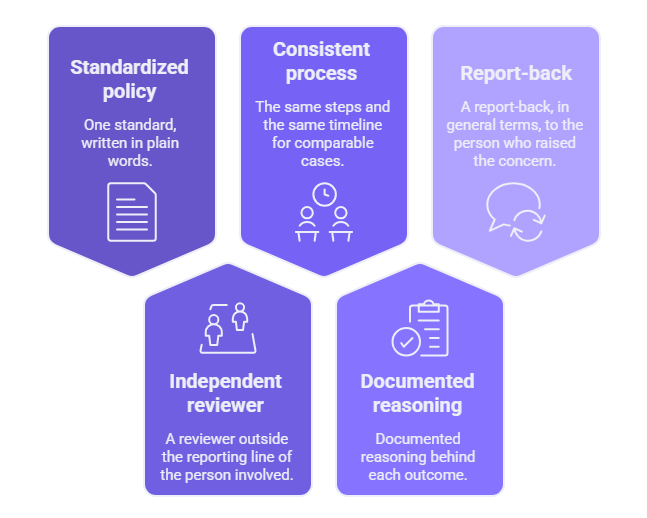
- One standard, written in plain words.
- A reviewer outside the reporting line of the person involved.
- The same steps and the same timeline for comparable cases.
- Documented reasoning behind each outcome.
- A report-back, in general terms, to the person who raised the concern.
Consistency and individualized assessment work together. The standard stays the same for everyone while the facts of each case are weighed, including severity, history, and context. A useful habit is to ask, for each outcome, which comparable case it should be consistent with, and to write that comparison into the file. A label that implies one fixed outcome can look like a substitute for that judgment, which is the co-chairs’ concern. A policy that states the standard firmly and describes proportionate consequences keeps the firmness without the problem.
How to Audit Enforcement, Not Just Policy Language
The Audit Checklist
Reading a policy tells an organization what it intends. An audit of enforcement tells it what employees can see. Workers surveyed ranked managers addressing problems early (61%) and consequences that hold regardless of performance (52%) as the top two fixes, and nothing on the list asked for softer standards. An enforcement audit can test both: whether concerns are addressed early, and whether the consequence depends on the person.
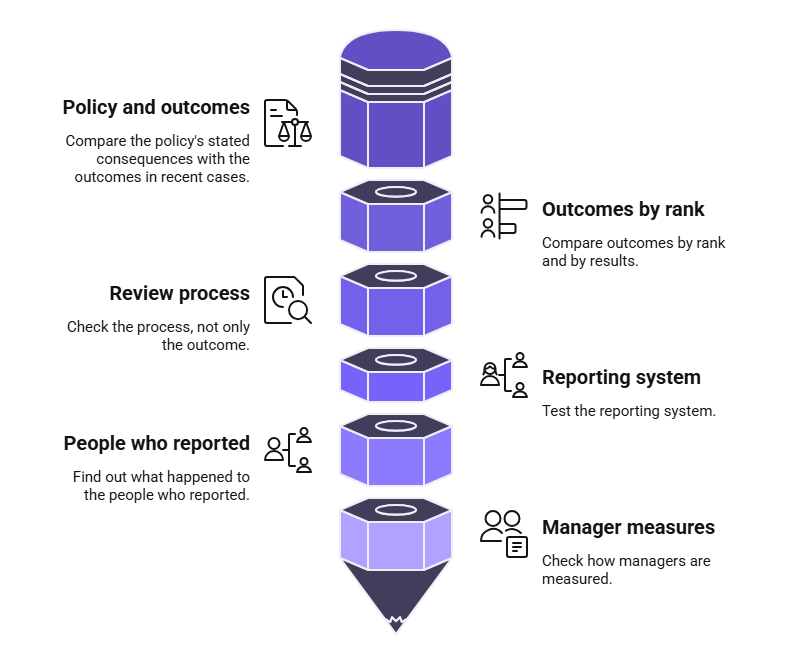
- Compare the policy’s stated consequences with the outcomes in recent cases. Pull cases from a defined period and set each outcome beside what the policy says, noting where the policy says “will” and practice looked like “may.”
- Compare outcomes by rank and by results. Sort cases by the person’s level and, where the organization has it, by performance or revenue standing, and look for patterns in which similar conduct led to different outcomes.
- Check the process, not only the outcome. Note who reviewed each case, how long it took, whether the reviewer was independent of the person’s reporting line, and whether the same steps were followed.
- Test the reporting system. Walk through each reporting route as an employee would, and record the response time and what the person was told. The co-chairs recommended that employers periodically test their reporting systems.
- Find out what happened to the people who reported. Look, in aggregate, for changes in assignments, reviews, or departures after a report was made.
- Check how managers are measured. Ask whether handling conduct concerns appears in manager reviews, and whether the metric rewards raising concerns or suppressing them. The co-chairs cautioned that rewarding managers for the fewest complaints can discourage reporting, and that a rise in complaints can reflect trust in the system.
A pattern across several cases is a reason to look, not a finding about any person, and the comparison matters more than any single case. Repeating the audit on a schedule shows whether a standard that was held last year is drifting.
Cautions Before You Start
Ask counsel to direct or review the audit. Case files contain sensitive information, and whether privilege applies to the work is a legal question. Keep the findings in confidence and report them in aggregate, so no individual can be identified, particularly in a smaller organization, collect only the case details the comparison needs, and limit who can see them.
Review the policy’s wording as well as its enforcement. The National Labor Relations Board states that employees, in union and non-union workplaces alike, may talk with coworkers about wages and working conditions and can’t be disciplined or coercively questioned for it. Language aimed at “negativity” or “complaining” can sweep in that kind of protected activity, whether the Act covers a particular employee depends on the person’s role, and the co-chairs themselves recommended that the EEOC and the NLRB clarify how the National Labor Relations Act interacts with workplace civility codes and the confidentiality of investigations. Wording like that deserves counsel’s review. Where employees are represented by a union, the collective bargaining agreement and bargaining obligations may also shape discipline policies and how they change, which is a question for counsel.
Conduct that involves a protected characteristic, harassment, discrimination, or retaliation belongs with HR or counsel before any review, and no one who raised a concern should be penalized for it. Anyone whose case appears in the audit deserves the same fair process as anyone else. This is a practice guide, not legal advice, and the rules that apply vary by jurisdiction and by the facts of each case.
Where Screening and Drug-Policy Consistency Fit
A background check does necessary, effective work at the point of hire, applied within the federal, state, and local rules that govern what can be considered, when, and how. How a policy operates once people are working together is a different kind of record: red flags in enforcement show up in outcomes, which appear only after a team has been working together for a while.
Zero tolerance language also appears in drug and alcohol policies, where the consistency question is the same. Federal drug-free workplace guidance from the Substance Abuse and Mental Health Services Administration says that no individual employee or group of employees should receive special treatment, and that inconsistencies in enforcement could be considered discrimination. An employer that runs employee drug testing, including through GCheck’s Employee Drug Testing, can build the same audit into the program, and state laws vary in what they permit.
The same principle applies at hire. A written screening standard applied the same way to every candidate in comparable roles, with an individualized look at what a record means in context, is the hiring-side version of consistent enforcement. When a decision rests on a consumer report, the Fair Credit Reporting Act’s notice and review steps apply.
What This Isn’t Arguing
Nothing here argues for softer standards. Strong written standards matter, and some conduct warrants termination on a first instance, as the co-chairs’ own examples show. Workers surveyed asked for consequences that hold regardless of performance, and nothing on their list asked for gentler rules. The point is narrower: that the label and the wording should not promise one identical outcome, and that the outcomes employees can see should match the standard employees can read.
Nor does it say that zero tolerance policies always fall short, or that any employer is failing. The survey describes what workers reported seeing, and this article applies it to policy design as reasoning.
It also isn’t a case for monitoring employees. An enforcement audit looks at records of how concerns were handled and at the process, and it needs no watching of people.
What This Means for Compliance
Fair Compliance, applied to conduct policies, means the same standard and the same process for the manager with the strongest results and the junior coworker with the weakest. A test any employer can run this quarter: if the same conduct had been reported about a junior coworker with weaker results, would it have moved through the same process, at the same speed, to the same outcome? If not, the standard has a rank or results threshold in it, whatever the handbook says.
Transparent Compliance supplies the other half: the standard written in plain words, a process employees can see, a report-back that tells people their concern was heard, and aggregate information about how concerns are resolved. Together they let employees observe that the standard holds, which is the signal the survey’s findings suggest workers are watching for.
The first step takes an afternoon. Take the last few conduct cases and set each stated consequence beside the actual outcome, noting the rank of the person involved, the time taken, and who reviewed it. Keep the comparison in confidence and share it only in aggregate. Gaps in it show where the standard bends, and they are easier to close before the next case than during it. Repeating the comparison each quarter, and after any case involving a senior person, keeps it current.
Frequently Asked Questions
Why don’t zero tolerance policies work?
Zero tolerance policies can fall short when enforcement depends on who is involved. GCheck’s The Consequence Gap Report found that nothing happened to a difficult coworker in 38% of cases and the coworker was rewarded or protected in 23%, with only 36% eventually leaving or removed. The co-chairs of the EEOC’s 2016 harassment task force also cautioned that the label can imply one identical outcome and may discourage reporting.
What does consistent enforcement mean?
Consistent enforcement means comparable conduct goes through the same process and leads to proportionate outcomes, whoever is involved. It does not mean identical outcomes for every case. A first minor lapse may warrant a warning and serious misconduct may warrant termination, but the person’s rank, results, or relationships should not change the outcome.
What did the EEOC task force say about zero tolerance policies?
The co-chairs of the EEOC’s Select Task Force on the Study of Harassment in the Workplace wrote in 2016 that the term “zero tolerance” may convey a one-size-fits-all approach and may contribute to under-reporting. They did not endorse the term, while saying it is important to communicate that no harassment will be permitted. It is the co-chairs’ report, not agency guidance, and it addresses harassment policies.
How do you audit whether a policy is actually enforced?
Compare the policy’s stated consequences with outcomes in recent cases, sorted by the person’s rank and results. Check who reviewed each case and how long it took, test each reporting route as an employee would, and look in aggregate at what happened to people who reported. Ask counsel to direct the audit and keep the findings in confidence.
Should employers drop zero tolerance policies?
Not necessarily. The EEOC co-chairs did not suggest weakening standards. They suggested communicating that no harassment will be permitted without a label implying identical discipline, and applying discipline that is prompt, proportionate, and consistent. An employer reviewing its policy wording should do so with counsel, since rules vary by jurisdiction and by policy type.

ABOUT THE CREATOR
GCheck Editorial Team
Meet the GCheck Editorial Team, your trusted source for insightful and up-to-date information in the world of employment background checks. Committed to delivering the latest trends, best practices, and industry insights, our team is dedicated to keeping you informed.
With a passion for ensuring accuracy, compliance, and efficiency in background screening, we are your go-to experts in the field. Stay tuned for our comprehensive articles, guides, and analysis, designed to empower businesses and individuals with the knowledge they need to make informed decisions.
At GCheck, we're here to guide you through the complexities of background checks, every step of the way.