
INDUSTRY GUIDES

Budget effectively for nonprofit background check cost. Explore how different checks can lead to varied expenses.
Created by

Nonprofit background check cost is driven primarily by search depth, not vendor markup: a basic name-based criminal database search costs far less than a fingerprint-based check with county and federal court records added. Federal grant rules generally treat background checks as an ordinary, allowable recruiting cost, and at least one major federal program, AmeriCorps, makes the check mandatory rather than optional. Nonprofits that budget around these facts, instead of around a single per-check price, end up with more defensible programs and fewer surprises.
The sticker price on a background check reflects what is being searched, not just which vendor is running it. A name-based national criminal database search is inexpensive because it queries existing records without a physical identity match. A fingerprint-based check costs more because it routes through a government agency, typically the FBI or a state repository, for a biometric match against official criminal history records.
Adding registries adds cost in smaller increments. A sex offender registry search, a state child abuse and neglect registry check, and a federal criminal court search are each their own line item. A package covering a candidate’s full multi-state address history costs more than one limited to the current county of residence, because each additional jurisdiction is a separate court or repository query. This is why two nonprofits screening the same type of role can report very different costs on paper: one is buying a basic package for a low-contact volunteer role, and the other is buying a comprehensive package for a role with direct access to children or vulnerable adults. Renewal cadence compounds the base cost over time: a role covered by the Child Care and Development Block Grant Act’s background check requirements renews at least every five years, while a role covered by AmeriCorps’s National Service Criminal History Check requirements gets a fresh check before every new covered person starts, with no multi-year grace period.
The table below breaks down the main cost drivers by search type, since budgeting accurately starts with knowing which components a given role actually requires.
| Search component | What it covers | Relative cost impact |
| National criminal database search | Name-based search of a multi-source aggregated database | Low; baseline component in most packages |
| Sex offender registry search | National and state sex offender registries | Low; typically bundled into base pricing |
| County criminal search | Felony and misdemeanor court records for counties of residence | Moderate; cost rises with number of counties covered |
| Federal criminal search | U.S. federal district court records | Moderate to high; often priced per district |
| Fingerprint-based check | Biometric match against FBI or state repository records | High; requires a separate collection step and government processing fee |
| Motor vehicle record | State DMV driving history | Moderate; priced separately from criminal search components |
A nonprofit screening a low-contact administrative volunteer typically needs only the top two rows. A nonprofit screening a direct-care role working with children or vulnerable adults typically needs everything in the table, plus a fingerprint-based component where state law requires it. Matching the package to the role, rather than defaulting to the same package for every position, is the single biggest lever a nonprofit has over its total annual screening spend.

Nonprofits often assume federal law settles this question. It does not. The Fair Credit Reporting Act governs how a background check must be disclosed, authorized, and acted on. It says nothing about who has to pay for it. A nonprofit that wants to charge an applicant or volunteer an administrative fee for a background check is not violating FCRA by doing so.
The real restriction comes from state law, and it applies in a specific, limited set of states rather than everywhere. California’s Labor Code prohibits an employer from compelling an applicant or employee “to patronize his or her employer, or any other person, in the purchase of anything of value,” a provision that has been applied to background check fees charged to applicants. Vermont’s statute is even more direct: it states that employers “shall not require an applicant to obtain, submit personally, or pay for a copy of his or her criminal conviction record,” specifically covering searches from the Vermont Crime Information Center. Because state legislatures add and amend these restrictions regularly, a nonprofit should confirm its own state’s current rule directly with counsel or its screening provider rather than rely on any fixed list, including this one.
For volunteer roles specifically, most nonprofits absorb the cost as a program expense rather than charging the volunteer, both because FCRA already requires treating volunteer screening with the same disclosure and adverse action rigor as employee screening, and because charging an unpaid volunteer to volunteer tends to work against recruitment and retention goals a nonprofit is otherwise trying to protect. Some organizations offset this cost by building a dedicated screening line item into program budgets or grant proposals from the start, rather than treating it as an unbudgeted expense that surfaces only once a volunteer program is already underway.
A nonprofit funded partly or entirely through federal grants faces a second cost question on top of the vendor invoice: is this an allowable use of grant funds at all? The answer depends on which grant program is paying, and the two patterns below point in opposite directions.
Under the Uniform Guidance at 2 CFR Part 200, which governs cost principles for federal awards, background check costs are not singled out as a restricted or disallowed category. They fall under the standard treatment for recruiting and personnel administration costs. Section 200.463 (Recruiting costs) allows costs of operating an employment office, testing programs, and standard recruitment activities, provided the cost is incurred under the recipient’s normal recruitment program. Every cost, including this one, still has to clear the general four-part test at Sections 200.403 through 200.405: it must be allowable, allocable to the specific award, reasonable, and applied consistently across the organization’s funding sources.
A nonprofit without a federally negotiated indirect cost rate can also elect to recover a share of its overhead, which may include the administrative cost of running a screening program, using a de minimis rate of up to 15% of Modified Total Direct Costs under Section 200.414(f); the recipient determines the specific rate up to that ceiling. That ceiling was raised from 10% in the 2024 revision to the Uniform Guidance. Organizations spending under $1,000,000 in total federal funds in a fiscal year are also now exempt from the full Single Audit requirement, a threshold raised from $750,000 in that same 2024 revision.
A direct cost is one that can be tied specifically to a funded project or position, such as the background check run on a person hired specifically to staff that grant-funded program. An indirect cost is a shared organizational expense, such as the administrative time an HR coordinator spends managing the screening system across every program the nonprofit runs, that benefits multiple funding sources at once and gets allocated through the indirect cost rate rather than billed to one grant directly.
In practice, most nonprofits treat the per-check fee for a grant-specific hire as a direct cost on that grant, and treat the broader cost of maintaining a screening policy, vendor relationship, and compliance tracking system as an indirect cost recovered through the organization’s negotiated or de minimis rate. Getting this split wrong, charging the same type of cost as direct on one grant and indirect on another without a documented reason, is one of the more common audit findings under the Uniform Guidance’s consistency requirement.
Not every federal dollar treats background checks as an incidental recruiting cost. The Centers for Medicare & Medicaid Services previously ran a National Background Check Program specifically to fund state-level background check infrastructure for long-term care facilities, offering federal matching grants of up to $3 million per funding cycle and requiring states to provide a 25% non-federal match. Programs like this show that background check spending can be its own dedicated funding category rather than something a nonprofit has to fit inside a general recruiting line item, though this type of dedicated funding is the exception rather than the rule.
AmeriCorps is the clearest example of a federal program that does not just permit background check spending, it requires it and financially penalizes getting it wrong. Under the National and Community Service Act of 1990, as amended by the Serve America Act, and its implementing regulations at 45 CFR Sections 2540.200 through 2540.207, AmeriCorps grant recipients and subrecipients must run a National Service Criminal History Check on every covered position before that person starts. The check has three required components: a National Sex Offender Public Website search, a state criminal history check for the person’s state of residence and state of service, and an FBI fingerprint-based check.
AmeriCorps’s own grantee guidance states that the standard enforcement action for missing or late National Service Criminal History Checks is cost disallowance: the agency can require the grantee to repay grant funds tied to the noncompliant position. This reframes the budgeting question entirely for AmeriCorps-funded programs. The check is not a discretionary line item competing with other priorities. It is a condition of keeping the money already awarded, and skipping it or rushing it to save cost creates a larger financial liability than the check itself would have cost.
The nonprofits that manage this well tend to do the same few things consistently, and none of them require a large compliance staff to execute. Applying the same tiering logic and the same documentation standard to every role and every program, regardless of which funder is paying or how tight the budget is that year, is the practical shape Fair Compliance takes in a budgeting conversation.
A basic package covering identity verification, a national criminal database search, and a sex offender registry check is appropriate for a low-contact administrative volunteer. A role with direct, unsupervised access to children or vulnerable adults warrants the fuller package, including county and federal court records, even though it costs more per check. Tiering is not corner-cutting when it is documented and tied to an actual, written risk assessment; it is the difference between a defensible screening policy and an arbitrary one that a funder’s auditor or a plaintiff’s attorney can pick apart after the fact. Matching screening depth to actual risk, rather than cutting depth to save money on the roles that matter most, is what Protective Compliance looks like in a budget line item.
Nonprofits routinely budget accurately for the initial screening cost and then treat the renewal cycle as a surprise expense two, three, or five years later. Building the recurring cost into the same grant line item or operating budget line that funded the original screening avoids that gap. A simple practice that works well: note each covered person’s renewal due date at the moment the first check clears, rather than trying to reconstruct that timeline later from HR records.
A quick budgeting checklist that applies across most small and mid-size nonprofits:
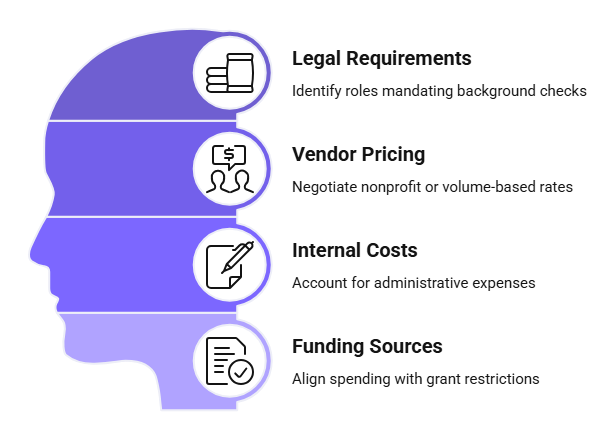
Screening vendors commonly structure pricing to reward higher volume, and several extend that further with pricing specifically built around nonprofit budget realities. GCheck, for example, publishes per-check pricing starting at $19.95 for its base package, and offers custom volume pricing with merit-based nonprofit discounts for organizations running more than 50 checks a year, alongside its broader Compliance for Good® approach to screening that stays transparent about what is being checked and why. A nonprofit running background checks across multiple programs, or coordinating checks for both paid staff and volunteers, is usually a strong candidate for that kind of custom arrangement rather than paying standalone per-check rates indefinitely.
Cost depends on scope. A basic package covering a national criminal database search, identity verification, and a sex offender registry check typically starts in the mid-$20s per check. A comprehensive package adding county, state, and federal court records, or fingerprint-based components, costs more, commonly reaching $50 to $65 depending on the vendor and the roles being screened. GCheck’s own pricing starts at $19.95 per check, with volume pricing and merit-based nonprofit discounts available for organizations running more than 50 checks a year.
Federal law does not prohibit it. FCRA regulates disclosure, authorization, and adverse action, not who pays. A small number of states, including California and Vermont, restrict charging applicants for background check costs under their own labor or consumer protection statutes, so nonprofits should confirm their specific state’s rule. Most nonprofits absorb volunteer screening costs as a program expense rather than charging volunteers directly.
Generally, yes. Under the Uniform Guidance (2 CFR Part 200), background checks are treated as an ordinary recruiting cost under Section 200.463, subject to the same allowability, allocability, reasonableness, and consistency test that applies to any other grant expense. Some specific federal programs go further and require the check as a mandatory grant condition rather than leaving it discretionary.
It depends on what the check is for. A check run specifically for a person hired to staff a particular grant-funded program is typically treated as a direct cost of that grant. The broader administrative cost of running a screening program across the whole organization, covering multiple funding sources at once, is typically treated as an indirect cost recovered through the organization’s negotiated or de minimis indirect cost rate. The key requirement is consistency: the same type of cost should be classified the same way across every grant, not direct on one and indirect on another without a documented reason.
It depends on the funder, but AmeriCorps is a clear example of real financial consequences: its guidance states that the standard enforcement action for a missing or late National Service Criminal History Check is cost disallowance, meaning the agency can require repayment of grant funds tied to that position. Treating the check as optional or delayable on an AmeriCorps-funded program creates real budget risk.
Tiering screening depth to the actual risk of each role is the most common and most defensible method. Beyond that, negotiating volume pricing, budgeting for renewal cycles in advance rather than treating them as surprise costs, and asking screening vendors directly about nonprofit-specific pricing arrangements are the practical levers most organizations use.
Recruiter & Editor
Charm Paz is an HR professional at GCheck, specializing in background screening, fair hiring, and regulatory compliance. She holds from the Professional Background Screening Association (PBSA) and helps organizations navigate employment regulations with clarity and confidence.
With a background in Industrial and Organizational Psychology, she translates policy into practice to build ethical, compliant, human-centered hiring systems that strengthen decision-making over time.

Contact us today for efficient, FCRA-compliant screening solutions
designed to keep your hiring process moving safely and smoothly.



LEGAL DISCLAIMER: The information provided in this article is for general informational and educational purposes only and should not be construed as legal advice or a substitute for consultation with qualified legal counsel. While we strive to ensure accuracy, employment screening laws and regulations—including but not limited to the Fair Credit Reporting Act (FCRA), Equal Employment Opportunity Commission (EEOC) guidelines, state and local ban-the-box laws, industry-specific requirements, and other applicable federal, state, and local statutes—are subject to frequent changes, varying interpretations, and jurisdiction-specific applications that may affect their implementation in your organization. Employers and screening decision-makers are solely responsible for ensuring their background check policies, procedures, and practices comply with all applicable laws and regulations relevant to their specific industry, location, and circumstances. We strongly recommend consulting with qualified employment law attorneys and compliance professionals before making hiring, tenant screening, or other decisions based on background check information.