

A hotel general manager or restaurant director background check goes beyond a standard criminal search to include employment credit checks, civil court records, and deeper reference checks, scoped to the financial and supervisory authority the role actually carries. This is an expression of Protective Compliance: matching screening depth to real exposure, not treating management candidates as more suspect than frontline ones. It is also not the same as executive or board-level due diligence, which applies to a narrower group of corporate and portfolio roles above the property level.
Key Takeaways
- Management-tier screening depth is justified by actual authority (budget, hiring, vendor contracts, financial systems), not by job title alone
- Employment credit checks are restricted in 11 states, and the exemptions that let a GM role qualify are not the same everywhere. California’s is broader than New York’s newly expanded statewide law
- Civil court records are useful for financial and contract-related judgments, but an unscoped pull risks sweeping in personal matters like divorce or custody disputes that have no bearing on the job
- Reference checks at this tier should probe management style and financial decision-making, not just confirm dates and titles
- A single-property GM is not the same as a regional VP, portfolio director, or corporate officer; true board-level executive due diligence belongs to that smaller group, not to property-level management
- The FCRA disclosure and adverse action sequence is identical regardless of seniority. Deeper screening does not mean fewer procedural protections
What Changes When the Role Is a Hotel GM or Restaurant Director
A hotel general manager or restaurant director typically holds a specific set of authorities that a frontline hire does not:

- P&L and budget authority for the property or unit
- Hiring and firing authority over department heads and staff
- Vendor selection and contract authority
- Access to the property’s financial systems, revenue reporting, and often payroll
- Authority to represent the property or brand to corporate leadership, ownership, and sometimes the press
That authority profile, not the title on the org chart, is what justifies a deeper screening package than a frontline hire would get. A “manager” title on a shift lead who has none of these authorities doesn’t automatically earn the same screening depth as a GM who has all of them.
The table below lines up three tiers of hospitality screening by what’s added at each level.
| Tier | Typical roles | What’s added |
| Frontline | Housekeeping, front desk, servers, kitchen staff | Criminal history, identity verification, employment verification |
| Management | Hotel GM, restaurant director, department heads with budget authority | Employment credit check, civil court records, extended reference checks |
| Executive / board-adjacent | Regional VP, multi-property portfolio director, corporate officer | Reputation intelligence, governance-focused due diligence, ongoing monitoring |
Most hospitality screening guidance treats management as one line inside a broader checklist. Treating it as its own tier matters because the components that get added, credit and civil records specifically, carry their own state-by-state legal limits and their own risk of overreach if they’re not scoped to the role’s actual financial exposure.
Why This Layer Gets Skipped, and What It Costs
Hospitality groups that run rigorous frontline screening sometimes wave management-tier candidates through with only a criminal check, on the theory that someone interviewed by ownership or a regional VP has already been vetted informally. That assumption doesn’t hold up against how much damage a single bad management hire can do compared to a single bad frontline hire.
A dishonest GM has authority a dishonest housekeeper doesn’t: signatory power over accounts, control over vendor contracts, and the ability to hire and supervise the entire staff underneath them. That authority changes what a bad hire actually costs:
- Financial misconduct at this level tends to run longer before discovery, since the person doing it also controls much of the oversight that would normally surface it
- The exposure extends past the property’s finances into its public reputation, since a GM is the face of the property to guests, staff, and often local press
- A single bad management hire can undermine hiring and supervision decisions the GM made for an entire staff underneath them, not just their own conduct
None of this means management candidates deserve more suspicion. It means the financial and reputational exposure the role carries is real, and screening depth that matches it is a reasonable, defensible standard rather than an invasive one.
The Screening Components That Actually Change
Three components separate a defensible management-tier package from a frontline one:
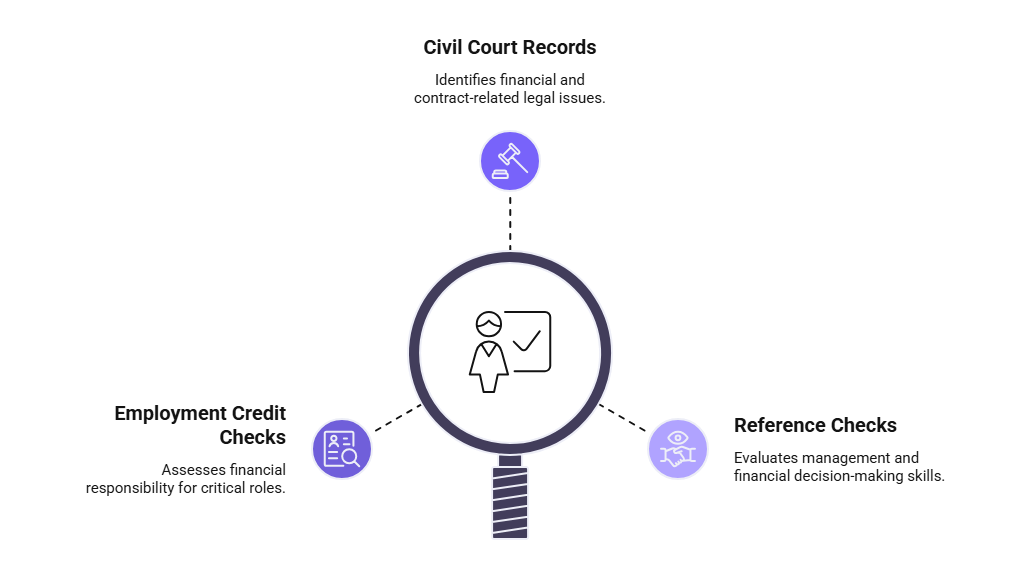
- Employment credit checks, scoped to roles with real financial or signatory authority
- Civil court records, scoped to financial and contract-related judgments rather than a blanket pull of every civil case on record
- Reference checks that probe management style, financial decision-making, and reasons for separation, not just employment dates
None of these should be treated as a default addition once someone has “manager” in their title. Each one needs its own job-relatedness justification, the same way a criminal check needs to be tied to the access a role carries.
Employment Credit Checks: What Changes by State
Eleven states now restrict how employers can use consumer credit history in employment decisions: California, Colorado, Connecticut, Hawaii, Illinois, Maryland, Nevada, Oregon, Vermont, Washington, and, as of April 18, 2026, New York, whose new statewide law extended a restriction that had previously applied only in New York City. A GM role does not automatically clear the bar in every one of these states the same way.
| State | Exemption a hotel GM would need to meet |
| California | Qualifies as a “managerial position” under the executive exemption in the state’s wage orders, among other listed exemptions |
| Colorado, Connecticut | A “substantially related” test: the employer must show credit and financial responsibility are relevant to the specific position, commonly satisfied by genuine managerial or fiduciary duties |
| New York | Narrower: must have signatory authority over transactions of $10,000 or more, require security clearance or bonding, or have regular access to trade secrets or sensitive systems. There is no blanket managerial exemption |
California’s law treats management itself as an exempt category. Colorado and Connecticut ask the employer to affirmatively show the connection rather than assuming it from the title. New York’s newly expanded statewide law, in effect since earlier this year, goes further still: a GM there needs to actually hold signatory or sensitive-access authority, not just carry the title, before a credit check is permissible. Multi-property operators running the same screening policy across these states need three different answers to the same question, not one.
Wherever a credit check is permissible, the same Fair Credit Reporting Act disclosure and authorization rules apply as any other consumer report: a standalone disclosure, written consent, and the same adverse action sequence if the result affects the hiring decision. None of that changes based on which state’s exemption the role happens to qualify under.
Extended Criminal Lookback: Why It’s Treated Differently at This Tier
Frontline hospitality screening commonly applies a lookback period to non-conviction records, and many states restrict how far back an employer can look at all. The FCRA itself treats convictions and non-conviction records differently.
| Record type | FCRA treatment |
| Criminal convictions | No federal time limit on reporting |
| Non-conviction records (arrests without disposition) | Generally limited to seven years when reported by a consumer reporting agency, with some states imposing stricter limits |
Management-tier screening doesn’t get a different set of rules here. What changes is the practical case for looking further back, and across more jurisdictions, than a frontline check would. A GM candidate has often worked in multiple states or multiple properties over a longer career, and financial or fraud-related offenses relevant to a management role are less likely to be uncovered by a single-county search than a violent offense would be for a guest-facing frontline role. The lookback rules are identical. The thoroughness of where and how far the search actually looks is what a defensible management-tier package pays more attention to.
The seven-year figure above is a reporting limit under the FCRA, not a use limit. Several states go further and restrict an employer’s ability to consider arrest-only records in an employment decision at all, regardless of how recent the arrest is. Falling inside the seven-year reporting window doesn’t automatically mean a record is fair game to weigh; state-specific use restrictions still apply on top of it, for a GM candidate the same as for anyone else.
Civil Court Records: Useful for Financial Judgment, Not a Character Audit
Civil court records surface non-criminal disputes: breach of contract, fraud allegations, tax liens, and judgments tied to financial or business conduct. For a GM with budget authority and vendor relationships, that’s genuinely relevant information a criminal check won’t show.
The risk is scope. An unscoped civil court records pull also surfaces divorce proceedings, child custody disputes, and landlord-tenant cases, none of which say anything useful about someone’s fitness to run a hotel or restaurant. Pulling that information anyway, and letting it influence a hiring decision, creates exposure with little upside: it’s personal information with no job-relatedness, and using it invites the same individualized-assessment scrutiny that applies to criminal history.
The defensible approach scopes the search to case types that are actually informative for the role:
- Included: breach of contract, fraud or embezzlement-related judgments, tax liens tied to business or financial conduct
- Excluded: divorce, child custody, and landlord-tenant disputes, which carry no job-relevant signal for a hospitality management role
A property that can explain exactly why it looks at civil records, and exactly what it ignores, is in a much stronger position than one running an unscoped search and hoping nothing irrelevant comes back.
Reference Checks Go Deeper at the Management Tier
A frontline reference check confirms dates, titles, and eligibility for rehire. A management-tier reference check asks more:
- How did this person manage a budget or handle a financial shortfall
- How did they lead a team through a difficult season, a staffing crisis, or a guest incident
- Why did they actually leave the role, beyond the dates on a resume
Former supervisors, ownership groups, or regional leadership are more useful references at this level than HR departments that can only confirm employment dates.
This is where the depth difference between tiers is most visible to candidates themselves. A GM candidate should expect more probing reference conversations than a server candidate would, and a property that explains this upfront, rather than treating it as a hidden extra step, keeps the process consistent with Transparent Compliance.
Where Property-Level Management Ends and Executive Screening Begins
A single-property GM reports to a regional vice president, corporate office, or ownership group. They hold real operational and financial authority over one property, but they typically don’t sit on a governing board or carry fiduciary duty to shareholders or investors. That distinction matters for how far screening should go.
| Attribute | Property-level GM or director | Regional VP, portfolio director, corporate officer |
| Scope of authority | Single property or unit | Multiple properties or an entire portfolio |
| Reports to | Regional VP, corporate office, or ownership | Board, investors, or ownership directly |
| Fiduciary duty | Generally none | Often yes, particularly at publicly traded or investor-owned groups |
| Appropriate screening depth | Management-tier: credit, civil records, deeper references | Executive-tier: reputation intelligence, governance-focused due diligence |
The roles where genuine board-level due diligence, reputation intelligence, and governance-focused screening apply sit above the property level, particularly at publicly traded or investor-owned hospitality groups, where the person may carry actual board exposure or fiduciary responsibility. For a single-property GM, that framing overstates the role. The management-tier components above (credit, civil records, deeper references) are the appropriate depth; reputation intelligence built around board governance and stakeholder confidence is a different tool for a different tier.
Multi-property groups making this call should draw the line at actual authority, not job title: a “director of operations” who oversees one property is management-tier; a portfolio director overseeing a dozen properties and reporting into a board-level structure is a different conversation.
The Adverse Action Process Doesn’t Change Because the Role Is Senior
Adverse action is the formal notice process an employer must follow whenever a background check finding, criminal, credit, or civil, is going to be used against a candidate in a hiring decision. Nothing about that process changes based on seniority. A GM candidate is entitled to the same pre-adverse action notice, copy of the report, Summary of Rights, response window, and final notice as a frontline candidate.
This is worth stating directly because it’s easy to assume higher stakes justify a shorter process. They don’t. FCRA doesn’t carve out an exception for management or executive roles, and the individualized assessment principle, weighing whether a specific finding is actually job-related, applies just as much to a civil judgment or a credit history flag as it does to a criminal record. That’s Fair Compliance at this tier: deeper screening components don’t come with a shortcut around the same case-by-case review every candidate is entitled to, regardless of how senior the role is or how much authority it carries.
What a Defensible Management-Tier Screening Program Looks Like
A hospitality group building a GM or director-tier screening policy should be able to answer these before rolling it out:

- Which components (credit, civil records, extended reference checks) are added at this tier, and what specific authority justifies each one
- Which states the group hires GMs in, and whether each state’s credit check exemptions actually cover the role as structured, not just as titled
- What case types a civil court records search is scoped to, and what it’s explicitly excluded from
- Who conducts management-tier reference checks, and what questions go beyond date and title verification
- Where the line sits between property-level management and true executive or board-adjacent roles within the organization
- Whether the same disclosure, consent, and adverse action sequence used for other roles is documented and applied here without shortcuts
- Whether credit reports and civil records are stored securely, with access limited to those who need them for the hiring decision, separate from general personnel files
None of this requires treating a GM candidate with more suspicion than a frontline one. It requires matching screening depth to the actual financial and supervisory authority the role carries, and being able to explain that match if it’s ever questioned.
| If the question is… | The answer should point to… |
| Why does this role get a credit check and that one doesn’t | The specific signatory or financial authority the role holds, checked against that state’s exemption |
| Why does this role get a civil records search | The role’s contract or vendor authority, and the scoped case types the search actually covers |
| Why does this candidate get a deeper reference check | The supervisory and budget authority the role carries, not the candidate’s seniority alone |
Frequently Asked Questions
What is included in a hotel general manager background check?
Beyond the standard criminal history and employment verification used for frontline hires, a GM-tier background check typically adds an employment credit check, civil court records scoped to financial and contract disputes, and deeper reference checks that probe management performance rather than just confirming dates.
Can hotels run a credit check on general manager candidates?
In most states, yes, since management roles commonly qualify under a state’s managerial or financial-authority exemption. It depends on the state: California’s exemption covers management broadly, while New York’s newly expanded statewide law requires the specific role to have signatory authority over transactions of $10,000 or more, or similar sensitive access, rather than qualifying by title alone.
Do civil court records matter for a hotel or restaurant management hire?
They can, particularly financial judgments, fraud allegations, or contract disputes relevant to someone who will hold budget and vendor authority. An unscoped civil records search that also surfaces divorce or custody cases adds risk without adding job-relevant information, so the search should be scoped to financially relevant case types.
Is a hotel general manager considered an “executive” for background screening purposes?
Generally no. A single-property GM holds real operational and financial authority but typically doesn’t carry board-level fiduciary duty. True executive or board-governance screening tools are better suited to regional vice presidents, portfolio directors, or corporate officers above the property level.
Does the adverse action process work differently for management-level hires?
No. The same FCRA disclosure, authorization, and two-step adverse action sequence, pre-adverse notice with the report and a Summary of Rights, a response window, then a final notice, applies regardless of the role’s seniority.
How far back does a criminal background check go for a hotel GM?
Criminal convictions carry no federal time limit under the FCRA, so they can appear regardless of age. Non-conviction records, like arrests without a disposition, are generally limited to seven years when reported by a consumer reporting agency, with some states imposing stricter limits. These rules are the same for management and frontline roles; what changes at the management tier is the number of states and counties a thorough search typically covers.
Sources cited
- Fair Credit Reporting Act, 15 U.S.C. §1681 et seq.
- California Labor Code §1024.5
- Colorado Revised Statutes §8-2-126
- Connecticut Public Act No. 11-223
- New York General Business Law §380 et seq., as amended by S3072 (effective April 18, 2026)

ABOUT THE CREATOR
Charm Paz, CHRP
Recruiter & Editor
Charm Paz is an HR professional at GCheck, specializing in background screening, fair hiring, and regulatory compliance. She holds from the Professional Background Screening Association (PBSA) and helps organizations navigate employment regulations with clarity and confidence.
With a background in Industrial and Organizational Psychology, she translates policy into practice to build ethical, compliant, human-centered hiring systems that strengthen decision-making over time.