


Event staff background checks for summer hiring should include an access-tiered verification framework covering paid staff, contractors, security personnel, and volunteers under a single documented program, FCRA-compliant disclosure and authorization for every worker screened through a consumer reporting agency regardless of pay status, and a role-stratified screening queue designed to process high-volume hiring without creating the bottlenecks that lose candidates or the shortcuts that become post-incident liability. The worker classification is not the variable that determines screening depth. Access level is.
Key Takeaways
- Event staff screening gaps create liability not during policy reviews but after incidents, when an organizer cannot demonstrate that the person involved was screened, screened compliantly, or screened at the right depth for their access level.
- Access tier, not worker classification, should determine screening depth. A paid parking attendant and an unpaid volunteer with backstage access carry materially different risk profiles that a classification-based screening approach misses.
- FCRA applies to volunteer background checks when a consumer reporting agency conducts the screening. Volunteer or unpaid status does not create a FCRA exemption.
- Returning seasonal event staff require new background checks. Prior season authorization does not carry forward to a new season, and prior clearances do not substitute for current checks.
- Event security staff are the most systematically under-screened worker category in large-scale event environments. Security staffing agency substitution gaps and dual-accountability assumptions are the two most common failure modes.
- Children’s programming areas require elevated screening standards regardless of whether the event is structured as a camp or a one-day festival.
- The conditional offer must precede background check initiation in ban-the-box jurisdictions that include major event markets.
Why Event Staffing Background Check Programs Break Under Summer Volume
Event organizers run background check programs that work adequately for the two or three full-time hires they make each year. Those programs collapse when summer season requires screening 50 to 150 workers across paid, contractor, volunteer, and agency-placed categories in a compressed window before the first event date. Three structural failures drive this pattern specifically in the event context.
The Multi-Worker-Type Problem
A single large outdoor summer festival may simultaneously employ W-2 paid staff in operations and production roles, 1099 independent contractors for technical and vendor services, agency-placed security and crowd management personnel, and several hundred volunteers across general assistance, children’s programming, and wayfinding roles. Each worker type carries different FCRA obligations, different access profiles, and different negligent hiring exposure if an incident occurs. Most event organizations apply a single ad-hoc screening approach to all of them or, more commonly, apply formal screening only to paid staff and assume volunteers and contractors are handled elsewhere. This assumption creates two independent liability risks: negligent hiring exposure if an unscreened worker causes harm, and FCRA violations if an organization uses a CRA to screen volunteers or contractors without the required standalone disclosure, authorization, and adverse action process.
The Returning Worker Assumption
Event organizations with recurring annual programming frequently re-engage volunteers and seasonal contractors from the prior year without running new background checks. The prior season authorization is treated as carrying forward. It does not. A volunteer who cleared a check for last summer’s event is presenting a clearance that may be eleven or twelve months old. Additionally, when an organization runs a new check for a returning worker, it must obtain a new standalone FCRA disclosure and new written authorization before initiating that check. The prior season’s authorization does not cover a new screening event. Treating it otherwise creates exactly the history gap that a current check is designed to close.
The Timeline Compression Problem
Summer event hiring operates on a compressed timeline that most background check workflows were not designed for. A festival opening in six weeks with 200 workers to screen cannot use a workflow designed for individual sequential hires. Organizers who attempt to do so either accept delayed start dates, which loses candidates, or accept incomplete checks, which creates liability. Neither outcome is acceptable, and neither is necessary if the workflow is designed for the volume before hiring begins.
What Background Checks Do Event Organizers Need to Run on Summer Staff?
Worker classification is a poor proxy for screening depth in event environments. The correct organizing variable is access level. The framework below organizes verification by event environment access profile.
Tier 1: Perimeter, Support, and Supervised Roles
Workers with no access to restricted areas, no unsupervised access to attendees, and no access to financial systems or controlled materials. Examples include parking and traffic control, general grounds crew under supervision, exterior vendor support, and basic logistics roles. This tier requires:
- Identity verification and SSN trace.
- National criminal database check.
- Sex offender registry search.
Tier 2: General Event Access and Guest-Facing Roles
Workers with general event access, direct attendee interaction, and access to event infrastructure but without backstage, restricted, or financial system access. Examples include ticketing, guest services, general volunteer roles, food and beverage floor staff, and merchandise. This tier requires:
- Identity verification with document authentication.
- Multi-jurisdiction county and state criminal records search.
- SSN trace and address history.
- Employment or engagement verification for prior event roles.
Tier 3: Restricted, Backstage, Security, Financial, or Children’s Programming Access
Workers with unrestricted event access, security authority, financial system access, or unsupervised access to children. This is the highest-risk access category in the event environment. Examples include event security and crowd management personnel, backstage and artist area access workers, box office and financial operations staff, and all workers in children’s programming areas. This tier requires:
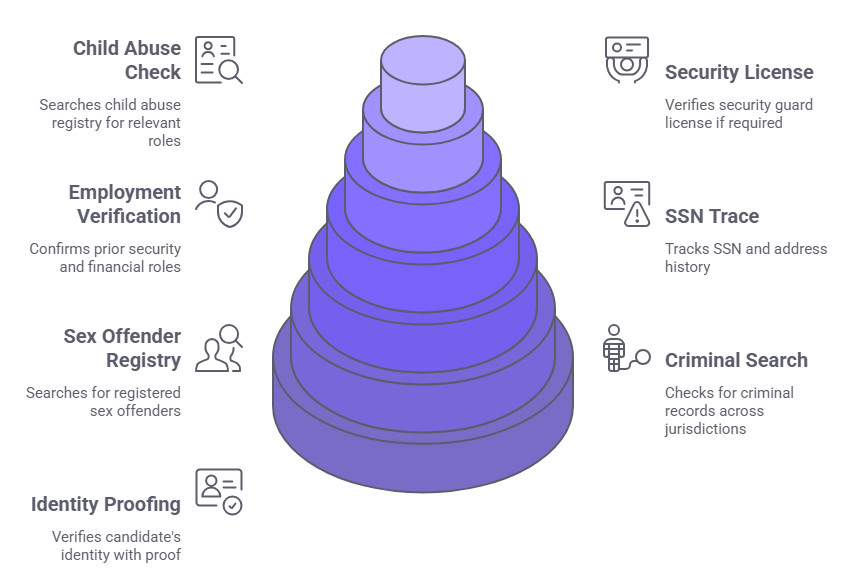
- Full identity proofing.
- Federal and multi-jurisdiction county criminal search.
- Sex offender registry search.
- Full SSN trace and address history.
- Employment or engagement verification with specific reference to prior security, financial, or child-contact roles.
- Security guard license verification where state law requires licensure for the role.
- Child abuse registry check for workers with regular children’s programming access, where the state maintains a searchable registry.
| Verification Component | Tier 1 | Tier 2 | Tier 3 |
| Identity verification and SSN trace | Yes | Yes, with document authentication | Yes, full identity proofing |
| National criminal database check | Yes | Yes | Yes |
| Multi-jurisdiction county criminal search | No | Yes | Yes, including federal |
| Sex offender registry | Yes | Yes | Yes |
| Address history | No | Yes | Yes, full history |
| Employment or engagement verification | No | Prior event roles | Security, financial, or child-contact roles specifically |
| Security guard license verification | No | No | Yes, where state licensing applies |
| Child abuse registry check | No | No | Yes, for children’s programming access |
Every worker with backstage, security, financial, or children’s programming access should sit in Tier 3 regardless of whether they are paid, volunteer, agency-placed, or contractor.
I think one of the biggest misconceptions in event hiring is believing that speed and thorough screening cannot exist together. As far as fast staffing is concerned regarding seasonal events, it is vital to remain focused on ensuring that there is an appropriate approach to allowing access to people, space, and any sensitive areas. In my experience, what I learned is that efficient screening does not mean slowing everything down, but rather developing a system that will be able to operate effectively when dealing with volume. �
FCRA Compliance for Event Workers: The Volunteer Misconception That Creates Liability
FCRA applies whenever a consumer reporting agency conducts a background check for employment or volunteer placement purposes. Volunteer status does not create a FCRA exemption. When an event organization uses a CRA to screen an unpaid volunteer, FCRA’s standalone disclosure requirement, written authorization requirement, and two-step adverse action process apply in full.
The Three Requirements Most Commonly Missed
Three FCRA requirements most commonly fail in event screening programs under time pressure:
- The standalone disclosure must be a separate document, not embedded in a volunteer application, onboarding packet, or waiver form.
- Written authorization must be obtained from every individual before any CRA-ordered check is initiated, including volunteers and contractors.
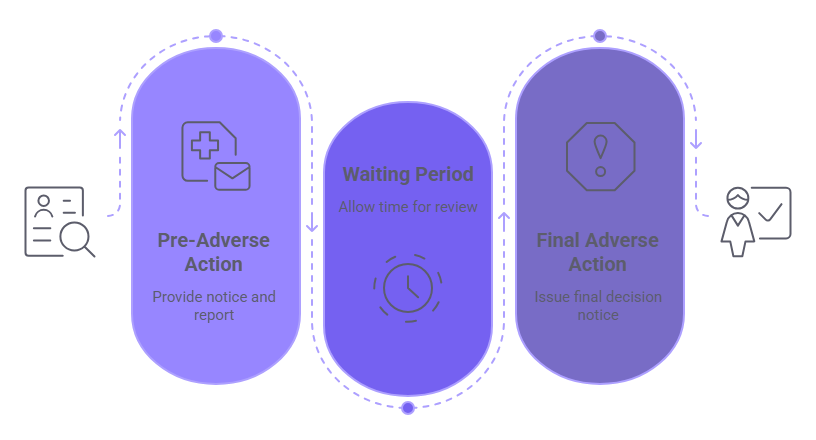
- When a check result affects a hiring or placement decision, the full two-step adverse action process applies: a pre-adverse action notice with a copy of the consumer report and the Summary of Rights Under the FCRA, followed by a waiting period of generally at least five business days per CFPB and FTC guidance, then a final adverse action notice.
The final adverse action notice must identify the CRA by name, address, and telephone number, state that the CRA did not make the decision, and inform the individual of their right to a free copy of the report within 60 days and their right to dispute its accuracy or completeness.
Ban-the-Box and Individualized Assessment Requirements
Ban-the-box requirements apply in major event markets including California, New York, Illinois, and Washington. In those jurisdictions, background check initiation must follow a conditional offer of engagement, not precede it. Furthermore, many ban-the-box jurisdictions impose individualized assessment requirements before adverse action can be finalized based on criminal history findings. Event organizers operating in covered markets should therefore confirm both the conditional offer sequencing requirements and any individualized assessment obligations with qualified legal counsel. This list is illustrative rather than exhaustive, and requirements vary by jurisdiction.
FCRA requirements and applicable state and local laws vary by jurisdiction. This section is informational only and does not constitute legal advice. Consult qualified legal counsel before implementing or modifying your event screening program.
Event Security Staff: The Most Under-Screened Worker Category in Large Events
Event security and crowd management personnel carry the highest access and authority profile in the event environment. They exercise control over attendees, manage restricted areas, and respond to incidents. They are also the worker category most likely to arrive through a staffing agency substitution that bypasses the screening standard the organizer believed was in place. Three failure modes are specific to event security staffing.
The Dual-Accountability Assumption
Event organizers who contract security staffing agencies typically assume the agency has screened all placed personnel to an adequate standard. Agencies, in turn, frequently assume the organizer has defined that standard and will handle any adverse action if a finding surfaces. Neither assumption is typically in the staffing agreement. When an incident involves a security employee, both parties face the question of who was responsible for screening and what standard applied. Moreover, when a security staffing agency conducts background checks on workers before placing them with an event organizer, questions may arise about whether those activities create FCRA obligations for the organizer, the agency, or both. Event organizers who rely on agency-conducted screenings to make placement decisions should therefore confirm with qualified legal counsel whether their specific arrangement triggers independent FCRA adverse action obligations.
The Substitution and License Verification Gaps
Event security staffing operates under real-time volume pressure. When a scheduled security placement calls out the day before an event, the agency fills the gap with an available substitute. That substitute may not have gone through the same screening standard as the original placement or may not have gone through the organizer’s program at all. Additionally, most states require security guards to hold a state-issued license. Event organizers contracting security staffing agencies frequently confirm headcount and uniform compliance without confirming that each placed worker holds a current, valid license in the state where the event is occurring.
The Contractual Solution
Event organizers should specify in their security staffing agreements exactly what screening components are required, which party is responsible for FCRA disclosure and authorization, how license verification will be confirmed, how substitutions will be handled, and what documentation the agency must provide before any worker is placed. This agreement must be in place before the first event, not drafted after the first incident.
Children’s Programming: The Elevated Standard Every Event Organizer Must Know
Any event with a dedicated children’s programming area, children’s activity zone, or supervised youth space carries an elevated negligent hiring standard for workers with access to that space. The elevated standard applies regardless of whether the event is structured as an outdoor festival, a corporate family day, a community fair, or a sports tournament. The organizing principle is access level, not event type.
Workers in children’s programming areas should receive the full Tier 3 verification stack, including a child abuse registry check where the state maintains a searchable registry and a sex offender registry search against all 50 states and territories. In some states, child abuse registry checks may be legally required for workers in child-contact roles regardless of the event’s formal designation. Consequently, event organizers with children’s programming areas should confirm the applicable mandatory screening requirements in their state with qualified legal counsel before treating the child abuse registry check as discretionary. For events with recurring children’s programming across multiple seasons, the American Camp Association annual re-screening standard serves as a recognized best-practice benchmark even for organizations not formally subject to ACA accreditation. Each season is a new screening event for workers in these roles.
Workflow Design: How to Screen 100 Event Workers in Two Weeks Without Creating a Queue
Event organizers who meet summer screening deadlines without FCRA failures design their screening workflow for volume before hiring begins. Four design principles separate programs that hold up under event timeline pressure from programs that create violations.
Initiate Disclosure at Application, Not at Offer
Building the FCRA standalone disclosure into the application workflow for paid staff and the volunteer registration workflow for unpaid workers means authorization can be collected before screening begins, eliminating the delay between offer and check initiation. In ban-the-box jurisdictions, however, disclosure may be collected at application but check initiation must still follow the conditional offer. Confirm sequencing requirements for each specific jurisdiction before standardizing the workflow.
Separate the Screening Pipeline by Access Tier
Tier 1 perimeter checks typically clear in 24 to 72 hours when the CRA has direct county court access. Tier 3 checks with federal records and full address history typically take two to five business days. Processing all worker types in a single queue means Tier 3 checks delay Tier 1 clearances. Separating the queue by tier and setting tier-appropriate start date expectations with operations prevents this without reducing the depth of any check.
Confirm Direct County Court Access Before Hiring Begins
A CRA with direct court access returns county records in 24 to 48 hours. By contrast, a CRA relying on a third-party researcher in the same jurisdiction may take five to seven business days. For an event with a fixed opening date, that difference determines whether screening is a bottleneck or a background process. Confirm direct access before hiring begins, not after the first delay surfaces.
Build Adverse Action Into the Platform
Manual adverse action tracking fails at volume. A platform that generates individual pre-adverse notices, tracks individual waiting periods by worker, and triggers final adverse action notices removes the human failure point from a process that must apply individually to every worker regardless of how many are in the pipeline simultaneously.
Conclusion
The event staffing background check programs that hold up after an incident are the ones that matched screening depth to access level rather than worker classification, applied FCRA compliance to volunteers and contractors as well as paid staff, held security staffing agencies contractually accountable for screening and license verification, treated each season as a new screening event for returning workers, and designed their screening workflow for the volume they expected rather than the volume they usually managed. The gap between a program that works for five hires and one that works for 150 is a workflow design problem, and it is solvable before the first event date.
Frequently Asked Questions
With quick hiring comes numerous inquiries related to issues of screenings, compliance, and time. The following Frequently Asked Questions have been put together to enable organizations gain an insight into what is important when formulating a screening policy.
What background checks do event organizers need to run on summer staff?
Event organizers should use an access-tiered framework. Perimeter and support roles need identity verification, a national criminal check, and a sex offender registry search. Guest-facing roles add multi-jurisdiction county records and engagement verification. Restricted access, security, financial, and children’s programming roles require the full Tier 3 stack including federal records, full address history, license verification for security roles, and child abuse registry checks where applicable.
Does FCRA apply to background checks on event volunteers?
Yes, when a consumer reporting agency conducts the check. Volunteer or unpaid status does not create a FCRA exemption. Standalone written disclosure and authorization are required before any CRA-ordered check. The two-step adverse action process applies to any placement decision a check result affects, regardless of whether the worker is paid.
How long do event staff background checks take?
Tier 1 perimeter checks typically clear in 24 to 72 hours when the CRA has direct county court access. Tier 3 checks with federal records typically take two to five business days. Separating the screening queue by access tier prevents slower Tier 3 checks from delaying faster Tier 1 and Tier 2 clearances.
Can an event organizer use last season’s background check for returning staff?
No. Each season is a new screening event. Prior season authorization does not carry forward and prior clearances do not substitute for a current check. A returning worker whose clearance is eleven or twelve months old may have disqualifying developments that an updated check would surface.
What background check is required for event security staff?
Event security staff should receive the full Tier 3 stack: full identity proofing, federal and multi-jurisdiction county criminal search, sex offender registry search, full address history, and employment verification with reference to prior security roles. State security guard license verification is required where state law mandates licensure. All requirements should appear in the security staffing agency agreement before any placement is made.

ABOUT THE CREATOR
Charm Paz, CHRP
Recruiter & Editor
Charm Paz is an HR professional at GCheck, specializing in background screening, fair hiring, and regulatory compliance. She holds from the Professional Background Screening Association (PBSA) and helps organizations navigate employment regulations with clarity and confidence.
With a background in Industrial and Organizational Psychology, she translates policy into practice to build ethical, compliant, human-centered hiring systems that strengthen decision-making over time.