

Continuous background monitoring is the ongoing, automated review of an employee’s criminal and driving records throughout their employment, not only at the point of hire. In hospitality, it applies most directly to roles with master key access, cash handling, or unsupervised guest contact. Run well, it is an expression of Protective Compliance: it protects guests and staff without treating a workforce as suspects.
Key Takeaways
- Continuous monitoring checks employee records on a recurring basis after hire, closing the gap that a one-time background check leaves open
- Hospitality’s turnover rate is among the highest of any industry the Bureau of Labor Statistics tracks, which means a hire-time check has a short shelf life
- Master key access, cash handling, and unsupervised guest contact are the access categories that justify a monitoring program, not job title alone
- Monitoring requires its own consent language covering checks “throughout the course of employment,” separate from the original hire-time authorization
- An alert from a monitoring program is information, not a decision. The same pre-adverse and adverse action sequence used at hire still applies
- California’s Fair Chance Act and New York’s Article 23-A both extend individualized assessment requirements to current employees, not just applicants
What Continuous Background Monitoring Means in Hospitality

Continuous background monitoring is an automated system that scans criminal record databases, and in some programs motor vehicle records, on a recurring basis to detect new activity tied to a current employee. It is distinct from two things it often gets confused with: a one-time pre-hire check, and periodic rescreening on a fixed schedule. The table below breaks down how the three compare.
| Screening type | When it runs | What it identifies |
| Pre-hire background check | Once, before the candidate starts | A snapshot of history as of the check date |
| Periodic rescreening | On a fixed schedule, commonly every one or two years | New activity, but only as of the next scheduled run |
| Continuous monitoring | Ongoing, triggered by new database activity | New arrests, charges, or convictions close to when they are filed |
For hospitality employers, the practical difference matters more than the technical one. A housekeeper who passed a clean background check in March and picks up a theft charge in October will not surface in an annual rescreen until the following March, if the program even runs on schedule. A continuous monitoring program would have surfaced that charge within days or weeks. The gap between when something happens and when an employer learns about it is exactly what continuous monitoring is built to close.
Adoption is still uneven across industries. According to the Society for Human Resource Management, only a small share of employers run continuous or rolling background checks on their workforce, and accommodation and food services was specifically named among the industries with more frequent adoption, behind transportation, utilities, and government agencies. Hospitality is ahead of many other sectors on this practice, even though most individual properties have not yet implemented it.
Most programs monitor the same underlying data sources a pre-hire check already draws on:
- County and state criminal record repositories
- National criminal database aggregators
- Sex offender registries
- Motor vehicle records, for roles that involve driving
What changes is not the data source but the frequency and trigger. Instead of a human ordering a new report on a schedule, the system watches for new filings and generates an alert when one appears tied to a monitored employee.
What Continuous Monitoring Does and Doesn’t Cover
Continuous monitoring closes a real gap, but it is not a complete safety net on its own, and a hospitality operator building a program should understand its limits before relying on it as the sole post-hire control.
What It Typically Covers
- New arrests, charges, and convictions entered into monitored criminal databases
- License suspensions or restrictions, for programs that include motor vehicle records
- Activity in the jurisdictions the monitoring vendor actively covers
What It Doesn’t Replace
- The pre-hire check that establishes a baseline before someone is granted a master key or handed a cash drawer
- Clear workplace policies and manager training on recognizing behavioral warning signs
- A defined escalation path for concerns raised through other channels, such as a guest complaint or a coworker report
Database coverage is not universal. Court reporting practices vary by county, some jurisdictions report new filings within days while others take weeks, and no single monitoring system reaches every database in every state. An alert-based program will still miss activity that has not yet been entered into a monitored database, which is why it works best as a layer added to an existing screening program rather than a replacement for it.
Why a Point-in-Time Check Doesn’t Hold Up in Hospitality’s Highest-Turnover Roles
Hospitality has a structural problem that most other industries do not share to the same degree: the roles with the highest guest and property access are frequently the same roles with the shortest average tenure. Housekeeping, front desk, and food and beverage positions turn over quickly, and the employees filling them are handed master keys, cash drawers, and unsupervised access to guest rooms within days of being hired.
The Bureau of Labor Statistics tracks employee separations by industry through its Job Openings and Labor Turnover Survey. Government labor data has repeatedly shown that accommodation and food services experiences some of the highest employee turnover of any industry tracked, consistently and by a wide margin ahead of the all-industry average. The exact rate moves from year to year, but the pattern has held for as long as the data has been collected: hospitality employees leave, and get replaced, faster than almost any other workforce in the country.
That turnover rate is exactly what makes a hire-time-only background check a weak long-term control. A background check answers one question: who was this person on the day the check ran. It says nothing about who they are eight months later, after they have settled into a role that still carries the same key access it did on day one.
High turnover also cuts in an unexpected direction for the employees who stay:
- The workers who build real tenure, a housekeeping supervisor on staff for three years, or a front desk lead who trains every new hire, are often the ones with the deepest access and the least recent scrutiny
- Their last formal check may be years old, simply because they have outlasted the standard rescreen cycle
- A monitoring program does not single these employees out; it applies the same standard evenly across everyone in an access category, rather than concentrating scrutiny only on people in their first ninety days
Which Hospitality Roles Actually Justify Ongoing Monitoring
Not every hospitality position needs the same level of post-hire oversight. The determining factor is access and exposure, not job title or department. The table below maps the access categories that typically justify continuous monitoring against the roles that carry them.
| Access category | Typical roles | Why it matters |
| Master key or guest room access | Housekeeping, maintenance, engineering | Unsupervised entry to guest rooms and private property |
| Cash handling or financial systems | Front desk, night audit, food and beverage management | Direct access to payments, refunds, and room charges |
| Unsupervised guest contact | Security, concierge, valet, in-room service | Direct physical proximity to guests with limited oversight |
| Vehicle operation | Valet, shuttle drivers | Driving record relevant in addition to criminal history |
A property does not need to monitor every employee at the same intensity to run a defensible program. What it needs is a documented policy that ties monitoring scope to actual access, so that the housekeeper with a master key and the seasonal server without one are treated according to genuinely different risk profiles, not according to an arbitrary blanket rule.
Job titles are not a reliable proxy for access. One hotel’s “guest services associate” may carry master key access while another’s does not, so scoping a role should come down to a few concrete questions rather than a title on an org chart:
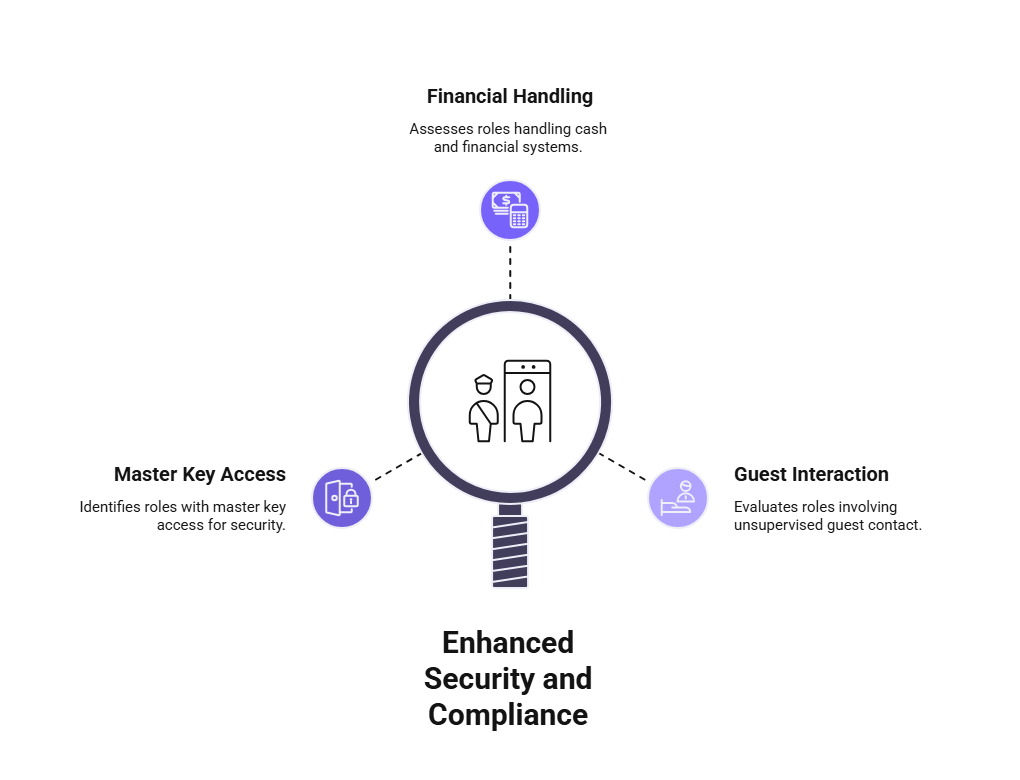
- Does this role carry master key or unsupervised guest room access?
- Does this role handle cash, refunds, or financial systems?
- Does this role involve driving, or unsupervised guest contact?
A policy built around those questions travels across brand and property inconsistencies in a way a title-based policy cannot, and it gives HR and security teams a clear, defensible answer when asked why one employee is monitored and another in a similarly titled role is not.
Building a Compliant Program: Consent, Alerts, and Individualized Assessment
Consent Has to Cover Ongoing Checks, Not Just the Initial Hire
The Fair Credit Reporting Act requires a clear, standalone disclosure and a signed authorization before an employer procures a consumer report. That requirement does not disappear once someone is hired, and it does not automatically extend to cover monitoring.
| Authorization | Covers the pre-hire check | Covers ongoing monitoring |
| Original hire-time authorization, written for a single check | Yes | Generally no |
| Authorization refreshed at program launch, naming ongoing monitoring | Yes | Yes |
Properties rolling out a monitoring program need consent language that explicitly names ongoing monitoring, and most employers refresh that consent at the point the program launches rather than assuming the original hire-time paperwork already covers it.
An Alert Is Information, Not a Decision
A monitoring alert is a starting point for review, not an automatic trigger for discipline or termination. When a new charge or conviction surfaces, the same two-step adverse action sequence used at hire still applies. Adverse action is the formal notice process an employer must follow whenever a background check finding is going to be used against a candidate or employee in an employment decision:
- A pre-adverse action notice is sent to the employee, including a copy of the report and a copy of the “Summary of Your Rights Under the Fair Credit Reporting Act”
- The employee gets a reasonable window to respond or dispute the finding
- Only after that window closes does the employer issue a final adverse action notice, if it proceeds
In 2024, the Consumer Financial Protection Bureau specifically confirmed that these disclosure, consent, and adverse action obligations apply not only to hiring decisions but to ongoing employment actions like reassignments and terminations, and flagged growing scrutiny of employee monitoring tools more broadly. For hospitality operators building a program now, that guidance is the clearest signal that continuous monitoring sits squarely inside FCRA’s existing framework rather than outside it.
How Fair Chance Protections Extend to Current Employees, Not Just Applicants
Continuous monitoring does not create a shortcut around fair chance and individualized assessment requirements. An individualized assessment is a case-by-case evaluation of whether a specific offense is actually job-related, rather than a blanket rule applied to every candidate or employee with any criminal history. Continuous monitoring just moves that same obligation to a later point in the timeline. Two of hospitality’s largest markets illustrate the point clearly.
| State | Law | Applies to current employees | Key requirement before acting on an alert |
| California | Fair Chance Act | Yes | Individualized assessment of job-relatedness, plus the same notice and response process used at application; seven-year lookback restriction on older convictions |
| New York | Correction Law Article 23-A | Yes | Eight-factor individualized assessment, with the employee entitled to see the written analysis before a final decision |
A hospitality employer in California or New York that learns of a new conviction through a monitoring alert cannot skip straight to discipline. Both states require the same job-relatedness weighing that applies at the application stage, carried forward into any post-hire decision. These two states illustrate the pattern rather than define its limits: other states and cities have their own current-employee protections, so a multi-property operator’s policy needs checking against every jurisdiction it hires in, not just the two covered here.
What a Well-Run Continuous Monitoring Program Looks Like
A defensible hospitality continuous monitoring program is built around a few consistent elements, regardless of property size or brand standard:

- Monitoring scope is tied to documented access categories (master key, cash handling, unsupervised guest contact, vehicle operation), not applied as a blanket policy across every role
- Consent language explicitly names ongoing monitoring and is refreshed when a program launches, rather than reused from hire-time paperwork
- Every alert routes to human review before any employment action is considered, consistent with an individualized assessment rather than an automatic disqualification
- The full pre-adverse and adverse action sequence is documented for any alert that leads toward discipline or termination
- Policies account for state-specific rules, including California’s lookback restrictions and New York’s Article 23-A factors, for any property operating in those states
- Records of alerts, reviews, and outcomes are retained in a format that demonstrates consistent application across similar cases, stored separately from general personnel files with access limited to those who need it
The type of alert should shape the response, not just the fact that an alert occurred:
| Alert type | Recommended employer response |
| Arrest or new charge, no conviction yet | Document and continue monitoring; most fair chance laws restrict acting on arrests alone |
| New conviction relevant to job duties | Individualized assessment, followed by the pre-adverse and adverse action sequence if disqualification is being considered |
| License suspension, for driving roles | Individualized assessment plus a driver qualification file update, since the role’s legal basis for driving may be affected |
None of this requires treating a workforce as under surveillance. It is what Protective Compliance looks like in practice: safeguarding guests and reducing organizational risk through human-reviewed, job-relevant monitoring, not automated surveillance. The goal is the same one that applies at the point of hire: give guests and staff a property where access is matched to demonstrated trust, and give employees a program that stays true to Transparent Compliance as well, one that is clear about what is checked, why, and how a finding gets reviewed before it affects their job.
Documentation matters as much as the monitoring itself. A written policy tying monitoring scope to access categories, with records of every alert, review, and outcome, puts a property in a materially stronger position if a guest incident or employment dispute is ever examined after the fact. The absence of a program is itself a data point in a negligent retention claim.
Fitting Continuous Monitoring Into an Existing Hospitality Screening Program
Continuous monitoring is most effective as the second half of a screening program that already includes a compliant pre-hire process, not as a standalone addition bolted onto an otherwise informal hiring workflow. A property that already runs the following before hire has done most of the groundwork a monitoring program needs:
- Criminal background checks
- Employment verification
- Identity confirmation
Extending consent language to cover ongoing checks, and routing alerts through the same adjudication process used for pre-hire findings, is a smaller lift for a property that already has those pieces in place than for one building a screening program from nothing.
| Starting point | What’s already in place | What monitoring adds |
| Informal hiring process, no standing screening program | Little to build on; disclosure, authorization, and adjudication practices need to be established first | A monitoring program on its own, without a compliant pre-hire process underneath it |
| Compliant pre-hire screening program already running | Disclosure and authorization practices, an adjudication process, documentation habits | A consent refresh and an alert-routing workflow layered onto existing practices |
For multi-property operators, monitoring scope can be set once, at the policy level, rather than negotiated property by property. A documented access-based policy travels consistently across every location a brand operates, which matters for hospitality groups managing hiring standards across dozens of properties and multiple state jurisdictions at once.
Frequently Asked Questions
What is continuous background monitoring for hotel employees?
Continuous background monitoring is an automated system that checks an employee’s criminal records, and sometimes driving records, on a recurring basis after they are hired. It differs from a one-time pre-hire background check and from periodic rescreening because it is not tied to a fixed schedule. It flags new activity close to when it is filed rather than waiting for the next scheduled check.
Which hotel or restaurant roles need continuous monitoring?
Roles that carry master key access, cash handling responsibilities, or unsupervised guest contact are the strongest candidates, including housekeeping, front desk, night audit, security, and valet or shuttle driver positions. The determining factor is the access the role carries, not the job title or department.
Does continuous monitoring replace the initial background check?
No. Continuous monitoring is a complement to a pre-hire background check, not a substitute for one. It extends visibility across the length of employment, while the pre-hire check establishes a baseline before someone is granted access to guest rooms, cash, or vehicles.
Do employees have to consent to continuous monitoring separately?
Yes. The Fair Credit Reporting Act requires a clear disclosure and signed authorization before an employer procures a consumer report, and that authorization needs to explicitly cover ongoing checks throughout employment. A disclosure written only for a single pre-employment check generally does not cover a monitoring program added later.
Can a hotel fire an employee immediately after a monitoring alert?
No. A monitoring alert is the start of a review, not an automatic basis for termination. The same pre-adverse and adverse action notice sequence used at hire applies, and in states like California and New York, an individualized assessment weighing the offense’s relevance to the job is required before any adverse action.
Is continuous monitoring as thorough as running a brand-new background check?
Not entirely. Court reporting speed varies by county and no monitoring system reaches every database in every jurisdiction. Continuous monitoring closes the gap between scheduled checks, but it works best alongside a compliant pre-hire process and clear escalation paths for concerns raised through other channels, such as guest complaints.

ABOUT THE CREATOR
Charm Paz, CHRP
Recruiter & Editor
Charm Paz is an HR professional at GCheck, specializing in background screening, fair hiring, and regulatory compliance. She holds from the Professional Background Screening Association (PBSA) and helps organizations navigate employment regulations with clarity and confidence.
With a background in Industrial and Organizational Psychology, she translates policy into practice to build ethical, compliant, human-centered hiring systems that strengthen decision-making over time.