

Continuous monitoring for staffing agencies works the same way it does for any employer, checking for new criminal activity after hire, rather than only at the point of placement. What’s different is the workforce itself: a temp worker can rotate across several client worksites over one tenure with the agency, which changes who needs to know about a finding, whether the original consent still covers it, and what actually happens next.
Key Takeaways
- Staffing agencies face a harder version of the continuous monitoring problem than a direct employer, because a single worker’s tenure with the agency can span multiple, unrelated client worksites.
- FCRA’s own guidance covers employment decisions including “hiring, retention, promotion or reassignment,” language that already anticipates the exact situation a staffing agency faces when moving a worker between clients.
- A single signed authorization can cover ongoing monitoring for a worker’s full tenure with the agency, but only if the disclosure explicitly and conspicuously says so, not just at the point of initial placement.
- Continuous monitoring addresses negligent retention exposure, a distinct legal concept from the negligent hiring and negligent referral risks most staffing background-check guidance already covers.
- Negligent retention law recognizes reassignment as a legitimate remedial action alongside discipline or discharge, which maps directly onto a staffing agency pulling someone from a specific client’s site without necessarily terminating them from the agency’s roster.
- No existing state or federal framework directly resolves whether a rescreening clock resets when a worker moves between clients while remaining employed by the same agency, which is exactly why a documented agency policy matters.
Why Staffing Carries a Harder Version of the Continuous Monitoring Problem
A direct employer’s continuous monitoring question is relatively simple: does this person, in this one job, still meet the standard they met at hire. A staffing agency’s version of that question multiplies by however many client worksites a worker rotates through over their tenure. The same person might spend six months at a warehouse, three months at a call center, and two months on a manufacturing line, all while remaining employed by the same agency the entire time. A single continuous monitoring program has to account for all of it, not just the placement that happens to be active when a finding surfaces.
Consider the practical version of this: a worker is enrolled in continuous monitoring at their first placement with a logistics client. Four months later, that assignment ends and the agency places the same worker at a retail client instead. Nothing about the worker’s employment relationship with the agency changed, they never left the agency’s roster, never signed a new offer letter, never went through a rehire process. But the environment the monitoring is meant to protect changed completely, along with the specific risk profile that matters at the new site. A program built only around “this person, this job” quietly stops making sense the moment the job changes underneath a continuous employment relationship.
This isn’t a gap in the law so much as a gap in how the law usually gets applied. The FTC’s own guidance on consumer reports, “Using Consumer Reports: What Employers Need to Know,” covers employment decisions including hiring, retention, promotion, or reassignment. Reassignment is already there, sitting in the same sentence as hiring and retention, because the FTC’s guidance was written broadly enough to cover exactly this situation. Most background-screening guidance simply doesn’t dwell on it, because most employers don’t reassign workers across entirely different worksites and job functions the way a staffing agency routinely does.
Getting the Consent Scope Right for a Rotating Workforce
The starting mechanic is the same one that applies to any employer running continuous monitoring: a single signed authorization can cover ongoing monitoring for the full length of someone’s employment, but only if the disclosure explicitly and conspicuously says so. The FTC’s guidance is direct about this: “If you want the authorization to allow you to get consumer reports throughout the person’s employment, make sure you say so clearly and conspicuously.” An authorization that only mentions the initial placement doesn’t automatically extend to monitoring six months later at a different client site, even though the worker never technically left the agency’s employment.
For a staffing agency, that means the disclosure and authorization signed at initial placement needs to describe the agency’s actual practice, not a generic one-time-check template. At minimum, it should state clearly and conspicuously that:
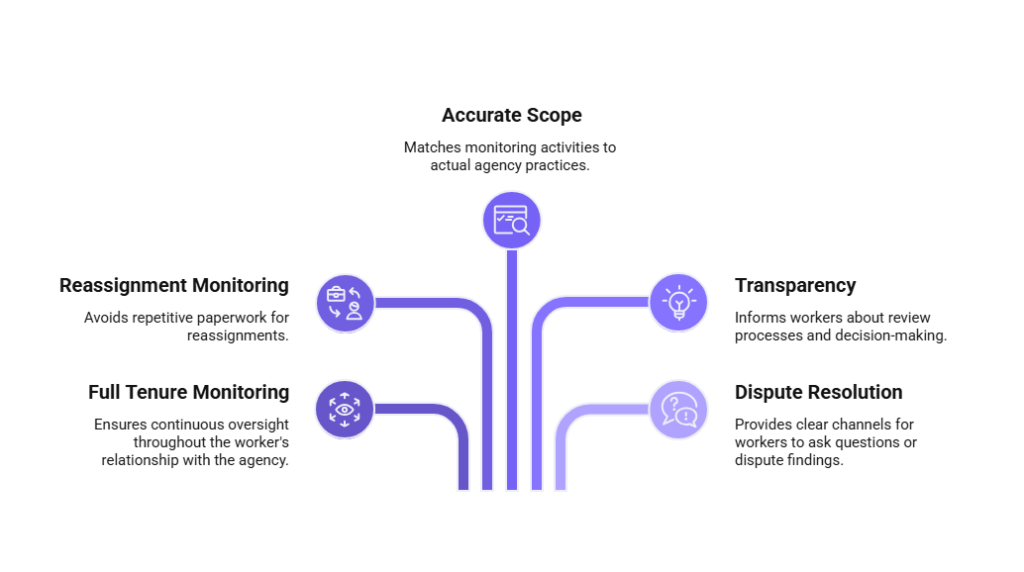
- Monitoring covers the worker’s full tenure with the agency, not any single placement
- Monitoring continues across future reassignments to different clients without requiring a new signature each time
- The scope of what’s monitored (criminal records, for instance) matches what the agency actually runs, not a broader or vaguer description
- The worker understands who at the agency reviews a finding and how a decision affecting a current assignment gets made
- The worker knows how to ask questions or dispute a finding, regardless of which client site they’re currently assigned to
A worker who signed on expecting a one-time check tied to their first placement hasn’t meaningfully consented to monitoring that continues into their third, unrelated assignment eight months later, even if the paperwork technically remains on file. Getting this right at the outset avoids having to re-paper every worker every time they move to a new client.
What Happens When a Mid-Assignment Finding Surfaces
A continuous monitoring alert is a lead, not a verdict. Before it influences any decision about a worker’s current assignment, an agency needs to work through the same sequence that applies to continuous monitoring in any industry:
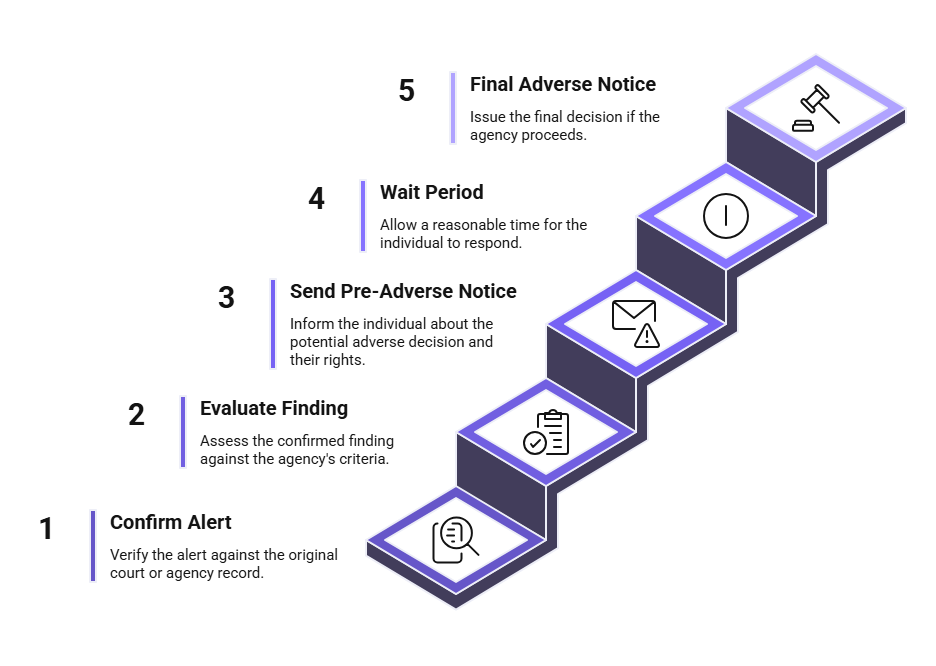
- Confirm the alert against the underlying court or agency record directly, rather than acting on the alert itself
- Evaluate the confirmed finding against the agency’s own documented criteria for the specific role or site involved
- If the finding supports an adverse decision, send a pre-adverse notice with a copy of the report and a summary of rights
- Allow a reasonable waiting period before finalizing anything
- Send a final adverse action notice if the agency proceeds
That sequence is identical to the one that applies at initial hire; continuous monitoring doesn’t relax any FCRA step just because the finding surfaced mid-assignment rather than at placement.
The staffing-specific complication sits in who else needs to know. A direct employer’s continuous monitoring finding stays internal by default. A staffing agency’s finding usually can’t, because the worker is physically present at a client’s site, and the client has its own legitimate interest in knowing whether someone currently on its premises has a new disqualifying record. That creates a real tension: the agency owes the worker confidentiality and a fair process, but it also owes the client enough information to make an informed decision about continued access to its site. The safest structure separates the two: confirm and evaluate the finding internally first, using the agency’s own documented criteria, and only share with the client the operational outcome, whether the worker will continue the assignment, not the underlying record itself, unless the client contract specifically requires more.
Negligent Retention: The Liability This Actually Addresses
Most staffing-specific background-check guidance focuses on negligent hiring and negligent referral: failing to screen adequately before placing someone, or passing along inaccurate information about a candidate to a client. Continuous criminal monitoring addresses a different, later-stage exposure: negligent retention.
Negligent retention is a distinct legal concept from negligent hiring. Negligent hiring concerns the placement decision itself, whether the agency screened adequately before sending someone to a client site. Negligent retention concerns what happens after that decision, whether the agency continued the placement once it knew, or should have known, that the worker posed a risk. An employer that ran a thorough background check at hire can still face negligent retention exposure if it learns of a disqualifying event months later and does nothing about it.
For a staffing agency, that exposure carries an added dimension a direct employer doesn’t face in quite the same way: the risk plays out on a third party’s premises, not the agency’s own. If a worker with a newly surfaced, job-relevant finding continues working at a client’s site because nobody at the agency was watching for it, both the agency and the client can end up exposed, the agency for continuing the placement, the client for the incident itself. That shared exposure is precisely why the client’s interest in knowing about a finding is legitimate and not merely a courtesy, and why an agency without a continuous monitoring program is relying entirely on a single point-in-time check to cover a relationship that, structurally, keeps generating new risk exposure at every new assignment.
Reassignment Is a Recognized Remedy, Not Just a Staffing Improvisation
One detail from negligent retention law is worth naming directly, because it gives staffing agencies a legally grounded answer to a question that otherwise feels improvised. Legal treatments of negligent retention describe the remedial actions available to an employer once it has notice of a problem as including investigating, disciplining, discharging, or reassigning the employee. Reassignment sits on that list as a legitimate response, not a workaround.
That matters operationally. Pulling a worker from a specific client’s site in response to a confirmed finding is not the same action as terminating them from the agency’s roster entirely, and it doesn’t need to be treated as one. An agency can conclude that a finding disqualifies someone from a specific role or site, healthcare, childcare, or a role involving financial access, for instance, without concluding that the same finding disqualifies them from every future placement the agency might make. That distinction has to be documented and applied consistently, the same individualized assessment standard that governs any adverse decision based on criminal history, but it gives staffing agencies room to respond proportionately rather than defaulting to an all-or-nothing outcome every time.
One point worth stating plainly: reassignment doesn’t sidestep FCRA’s adverse action process just because it’s a lighter-touch outcome than termination. FCRA’s own permissible-purpose framework already treats reassignment as a covered employment decision, alongside hiring, retention, and promotion. If a worker loses a specific assignment because of a finding in a consumer report, that’s an adverse action, and it still requires the same pre-adverse notice, waiting period, and final adverse action notice as a termination would. Reassignment is a more proportionate outcome than removing someone from the agency entirely, not a shortcut around the notice requirements that apply either way.
Does a Rescreening Reset When a Worker Moves Between Clients?
No existing framework answers this cleanly for the staffing-specific scenario, a worker changing worksites while remaining employed by the same agency, and that gap is worth naming rather than glossing over. The closest available parallel comes from federal childcare rules, and it’s illustrative precisely because of where it falls short:
- Under 45 CFR 98.43, background clearances for childcare staff must be renewed at least every five years
- Many states don’t allow portability, meaning a worker changing employers within the same regulated sector needs a fresh check rather than carrying an old one forward
- That rule was written for someone moving between two different employers, not for someone who stays employed by the same staffing agency while only the worksite changes
That mismatch is the point. State and federal rescreening rules were largely written with a single, stable employer relationship in mind, one person, one employer, one clock. A staffing agency’s model doesn’t fit that assumption: the employer relationship never changes, but the operating environment does, repeatedly, sometimes every few months. Relying on existing rescreening cadence rules to answer the “does this reset” question will usually leave a real gap unaddressed, since those rules simply weren’t built with a rotating-worksite employment structure in mind. The safer approach is for the agency to set its own documented policy, tenure-based monitoring that runs continuously regardless of which client site a worker happens to be assigned to at a given moment, rather than assuming a state’s rescreening interval was ever designed to answer this question in the first place.
Building a Continuous Monitoring Program for a Rotating Workforce
A program built for a staffing agency’s specific structure needs a few things a direct employer’s program typically doesn’t.
| Program element | What it involves | Why staffing needs it specifically |
| Tenure-based consent scope | Disclosure and authorization that explicitly covers the full length of employment with the agency, not a single assignment | Reassignment between clients doesn’t automatically extend a narrower, placement-specific consent |
| Assignment-independent monitoring | Monitoring runs continuously regardless of which client site is currently active | A gap between assignments shouldn’t create a gap in coverage |
| Finding confirmation before action | Every alert verified against the underlying record before it affects a live assignment | Prevents an unconfirmed alert from disrupting a placement based on a false match |
| Documented information-sharing boundary | A defined line between what the agency shares with a client (the outcome) and what stays internal (the underlying record) | Balances the client’s legitimate interest against the worker’s confidentiality |
| Individualized assessment per role, not per worker globally | A finding evaluated against the specific site or role it affects, not treated as an automatic bar to every future placement | Supports reassignment as a proportionate response rather than defaulting to termination |
| Client-facing outcome protocol | A pre-agreed, contract-level understanding of what the agency communicates to a client and when | Prevents ad hoc disclosure decisions made under time pressure when a finding surfaces mid-assignment |
| Reassignment tracking | A record of every worksite change tied to a given worker’s ongoing monitoring enrollment | Keeps the monitoring program synchronized with where the worker actually is, not just where they started |
None of this treats a mid-tenure finding as automatic grounds for removing someone from the agency’s roster. The point of documenting criteria and applying them consistently is the same point it is anywhere else in background screening: a worker gets evaluated on the specifics of what was found and where it matters, not on a blanket rule that ends their relationship with the agency the moment any record surfaces.
Frequently Asked Questions
Does continuous monitoring consent need to be renewed every time a staffing agency reassigns a worker to a new client?
No, provided the original disclosure and authorization explicitly and conspicuously stated that monitoring would continue throughout the worker’s employment with the agency, not just for a single placement. If the original consent was narrower than that, a new authorization is the safer approach before continuing monitoring into a new assignment.
What’s the difference between negligent hiring and negligent retention for a staffing agency?
Negligent hiring concerns the screening decision made before a placement, whether the agency adequately vetted the candidate before sending them to a client site. Negligent retention concerns what happens afterward, whether the agency continued the placement after learning, or having reason to know, that the worker posed a risk. Continuous monitoring is specifically designed to address the second exposure.
Does an agency have to tell a client everything a continuous monitoring alert surfaces?
Not necessarily. A defensible approach confirms and evaluates the finding internally first, then shares the operational outcome, such as whether the placement will continue, with the client, without necessarily disclosing the underlying record itself, unless the specific client contract requires more detail.
Can a staffing agency reassign a worker to a different role instead of terminating them after a finding?
Yes. Reassignment is recognized in negligent retention law as a legitimate remedial action alongside discipline or discharge. An agency can determine that a finding disqualifies someone from a specific site or role without concluding it disqualifies them from every future placement, provided the decision is documented and applied consistently. Reassignment based on a report finding is still an adverse action under FCRA, so the standard pre-adverse notice, waiting period, and final adverse action notice apply the same way they would to a termination.
Does a background check reset when a temp worker moves from one client site to another?
There’s no clean existing rule that answers this for staffing specifically. State and federal rescreening frameworks, including childcare’s five-year renewal requirement under 45 CFR 98.43, were generally written for workers changing employers, not for workers who stay with the same staffing agency while the worksite changes. Agencies should set their own documented, tenure-based monitoring policy rather than relying on rules built for a different employment structure.
Sources cited
- Federal Trade Commission, “Using Consumer Reports: What Employers Need to Know”
- Fair Credit Reporting Act, 15 U.S.C. §1681b (permissible purposes; disclosure and authorization)
- Fair Credit Reporting Act, 15 U.S.C. §1681m (adverse action requirements)
- U.S. Equal Employment Opportunity Commission, Enforcement Guidance on the Consideration of Arrest and Conviction Records in Employment Decisions Under Title VII, April 25, 2012
- 45 C.F.R. §98.43 (Child Care and Development Fund background check requirements, illustrative parallel only, not a staffing-specific rule)

ABOUT THE CREATOR
Charm Paz, CHRP
Recruiter & Editor
Charm Paz is an HR professional at GCheck, specializing in background screening, fair hiring, and regulatory compliance. She holds from the Professional Background Screening Association (PBSA) and helps organizations navigate employment regulations with clarity and confidence.
With a background in Industrial and Organizational Psychology, she translates policy into practice to build ethical, compliant, human-centered hiring systems that strengthen decision-making over time.