

An attorney background check and a bar admission check serve different purposes and are conducted by different parties. The bar admission check, typically a character and fitness investigation conducted at the point of licensure, serves the regulator and the public. A law firm’s employer background check serves the firm and its clients. Both have value; neither substitutes for the other.
Key Takeaways
- A bar character and fitness investigation is conducted at the time of bar admission. It covers the applicant’s history up to that point, not what has happened since.
- NCBE provides character and fitness services for many jurisdictions but makes no determinations regarding who is eligible or ineligible to practice law. Jurisdictions make that determination, and requirements, deadlines, and processing times vary among jurisdictions.
- A law firm’s attorney background check is a separate process the firm conducts for its own due diligence. It is not a repeat of the bar check and covers a different time period.
- While state bar associations strive to remain current on each lawyer’s standing, there is risk between periodic checks. The standard for entry at a law firm can reasonably be as high as it is for admission to the bar.
- Verifying current bar admission status, including active license, good standing, and no active suspensions, is a straightforward step firms can take through each state bar’s public directory.
- FCRA applies when a law firm uses a consumer reporting agency to conduct the attorney background check. The bar’s own character and fitness investigation is not conducted through a CRA and is not subject to FCRA.
Law firms hiring attorneys often carry an implicit belief: this person has already been through a thorough background check. The bar examined their character and fitness, they were admitted, they hold a license. That assumption is understandable. It is also incomplete.
The bar’s character and fitness investigation serves the regulator’s purpose: determining whether the applicant was fit to hold a law license at the time of admission. The firm’s background check serves the firm’s purpose: verifying who the firm is hiring today, including everything that has happened since that attorney was admitted. These are two different questions, answered at two different times, by two different parties.
What a Bar Character and Fitness Investigation Typically Covers
A bar character and fitness investigation is a background review conducted by the state bar or NCBE on behalf of a jurisdiction as part of the bar admission process. It typically examines an applicant’s criminal history, civil matters, financial history, employment record, and prior disciplinary actions, all as of the time of application. The investigation is comprehensive, extending well beyond basic background and educational history.
Based on publicly available process documents, these investigations commonly cover:
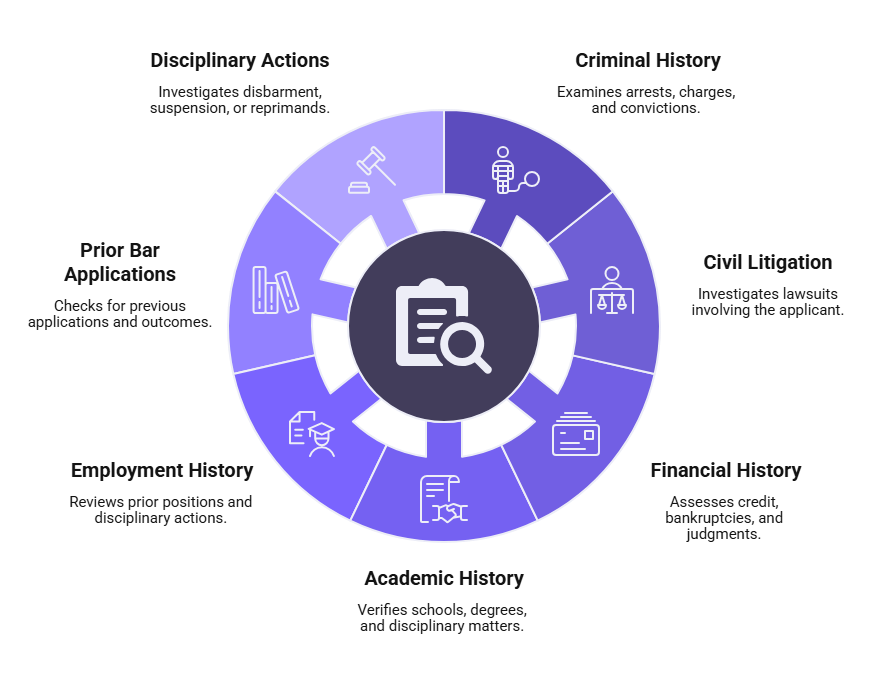
- Criminal history: arrests, charges, and convictions, including matters dismissed or expunged in some jurisdictions
- Civil litigation history: lawsuits involving the applicant as a party
- Financial history: credit, bankruptcies, and outstanding judgments
- Employment history: prior positions, dates, and any disciplinary matters at prior employers
- Academic history: all schools attended, degrees, and any academic disciplinary matters
- Prior bar applications: any prior application in any jurisdiction, including withdrawn or denied ones
- Prior disciplinary actions as an attorney: including any matter where the applicant has been disbarred, suspended, censured, or otherwise reprimanded or disqualified
NCBE provides character and fitness services for many jurisdictions but makes no determinations regarding who is eligible or ineligible to practice law. Jurisdictions make that determination, and the process, scope, and depth vary by jurisdiction. The bar check is a point-in-time review of history up to the application date.
What a Law Firm Attorney Background Check Typically Covers
The employer background check a law firm runs when hiring an attorney serves the firm’s own due diligence. It covers a different period, uses different sources, and addresses questions the bar check cannot answer. Standard components include:
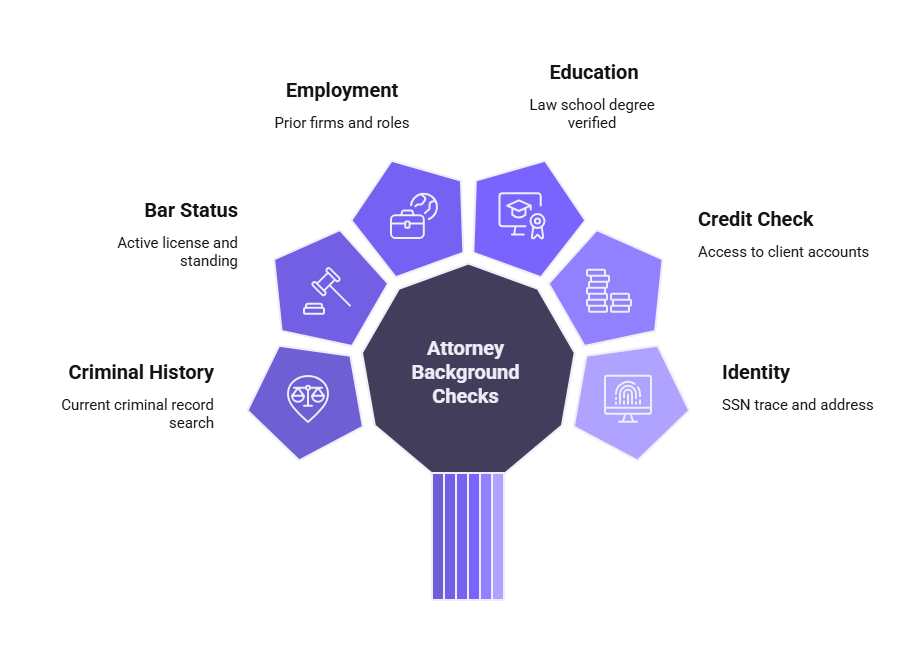
- Criminal history check: A current search of county, state, and federal criminal records, reflecting the attorney’s record as of today, not as of bar admission
- Current bar status verification: Active license, current standing, and any public disciplinary actions on record in each state of admission, verified through state bar public directories
- Employment verification: Prior firms, dates, roles, and circumstances of departure since admission
- Education verification: Law school degree, graduation date, and any post-JD credentials
- Credit check where applicable: For attorneys with access to client trust accounts or firm financial systems
- Identity verification: SSN trace and address history, which forms the foundation for determining which jurisdictions’ criminal records to search
These components are ordered through a CRA and are subject to FCRA compliance requirements, covered in the section below.
Side-by-Side Comparison
Understanding where these two processes overlap and where they diverge helps firms design a screening program that uses both appropriately, rather than assuming one covers the other.
| Dimension | Bar Admission Check | Law Firm Attorney Background Check |
| Who conducts it | State bar / NCBE on behalf of jurisdiction | Law firm, typically through a CRA |
| Who it serves | The regulator and the public | The firm and its clients |
| When conducted | At the time of bar admission | At the time of hire |
| Time period covered | History up to admission date | Current status plus history since admission |
| Criminal history | Yes, at time of application | Yes, current CRA search |
| Current bar status | Not applicable at time of admission | Yes, primary verification step |
| Post-admission activity | Not covered | Yes, the core gap it closes |
| Employment since admission | Not covered | Yes, employment verification |
| FCRA applicability | No | Yes, when ordered through a CRA |
| Ongoing or periodic | Varies by jurisdiction | Can be supplemented with monitoring |
Neither check substitutes for the other. Used together, they address different time periods and serve different stakeholders.
The Post-Admission Gap: What the Bar Check Cannot Cover
The bar admission check is comprehensive at the moment it is conducted. It is also fixed in time. Once an attorney is admitted, the bar’s ongoing oversight typically operates through a different mechanism: professional conduct oversight, complaints filed by clients or opposing counsel, and in some jurisdictions periodic reporting processes. This is a materially different system from the point-in-time investigation conducted at admission.
While state bar associations strive to remain current on each lawyer’s standing, there is risk between periodic checks. For a law firm hiring a lateral attorney admitted ten years ago, the bar admission check covers only the period before that attorney was admitted. It does not cover:
- Criminal matters that arose after admission
- Civil litigation involving the attorney since admission
- Employment history at firms since admission, including circumstances of any departures
- Financial matters since admission, including any trust account issues at prior firms
- Disciplinary complaints filed since admission that have not yet resulted in public discipline
Some of these surface through a current criminal background check and employment verification. Others, such as the circumstances of a quiet departure from a prior firm, may require careful reference checking beyond what a CRA report provides. The bar admission check cannot, by design, answer questions about who an attorney is today. The firm’s background check addresses that question.
What Law Firms Typically Add to Close the Gap
Based on standard practice among firms with structured screening programs, the employer attorney background check typically adds the following components that the bar check either does not cover or covers only as of the admission date:
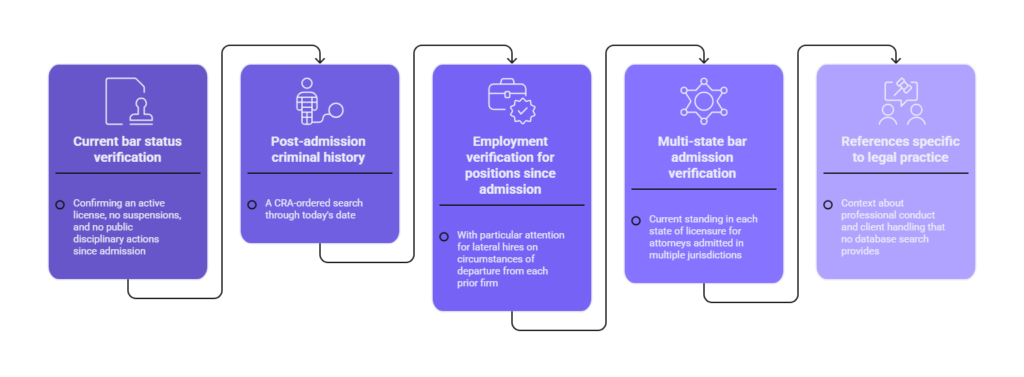
- Current bar status verification: The most immediate step, confirming an active license, no suspensions, and no public disciplinary actions since admission
- Post-admission criminal history: A CRA-ordered search through today’s date
- Employment verification for positions since admission: With particular attention for lateral hires on circumstances of departure from each prior firm
- Multi-state bar admission verification: Current standing in each state of licensure for attorneys admitted in multiple jurisdictions
- References specific to legal practice: Context about professional conduct and client handling that no database search provides
For firms that appoint attorneys in ongoing client-facing roles, professional license monitoring provides continuous coverage between credentialing cycles, generating alerts when a license status changes, a disciplinary action is recorded, or a suspension is entered.
A Practical Note on FCRA
When a law firm uses a consumer reporting agency to run any component of the attorney background check, including criminal history, employment verification, credit check, or professional license verification, the Fair Credit Reporting Act applies. This is true regardless of the seniority of the attorney being screened or the collegial nature of the hiring process at many firms. Two compliance steps are commonly missed in law firm attorney hiring.
Standalone disclosure and authorization. FCRA requires a written disclosure in a standalone document, separate from the offer letter and any other hiring document, and written authorization before the CRA check is ordered. Many law firms treat partner and associate hiring as a collegial process and skip this step without realizing it applies. Omitting the standalone disclosure and authorization when a CRA is used creates FCRA compliance exposure.
Adverse action process. If a background check result influences a decision not to hire or to rescind an offer, FCRA’s two-step adverse action process applies. The process requires a pre-adverse action notice with a copy of the report and the CFPB Summary of Rights, a reasonable opportunity for the attorney to respond or dispute, typically interpreted as at least five business days, before the final decision is made, and a final adverse action notice if the firm proceeds. The bar admission check is not subject to FCRA. FCRA applies only when a consumer reporting agency is used, and the bar’s character and fitness process is not conducted through a CRA.
This section is informational only and does not constitute legal advice. Consult qualified employment counsel for FCRA compliance guidance specific to your firm.
Frequently Asked Questions
What is the difference between an attorney background check and a bar admission check?
An attorney background check is conducted by the law firm at the time of hire through a CRA, covering the attorney’s current record and history since admission. A bar admission check is conducted by the bar or NCBE at the time of licensure, covering history up to the application date. They cover different time periods and serve different parties.
Does passing a bar admission check mean a law firm doesn’t need to run a background check?
No. The bar check covers history up to admission only. It does not cover criminal matters, employment history, or changes in bar standing that occurred after admission. A firm’s own background check verifies current status and closes the post-admission gap.
How do law firms verify an attorney’s current bar status?
The most direct method is checking each state bar’s public online directory. For attorneys admitted in multiple states, NCBE’s attorney status tool supports multi-state verification. Firms can also order a CRA-based professional license verification check for a documented, audit-ready record.
Does FCRA apply to background checks on attorney candidates?
Yes. When a law firm uses a consumer reporting agency to run any component of an attorney background check, FCRA’s disclosure, authorization, and adverse action requirements apply regardless of the attorney’s seniority. This includes criminal history, employment verification, and credit checks.
What does a law firm attorney background check cover that a bar admission check doesn’t?
The firm’s check covers the period since bar admission: post-admission criminal history, employment at firms since admission, current bar standing in all states of licensure, and in some cases financial history for roles with trust account access. The bar check covers only the period before admission.
Additional Resources
- NCBE Character and Fitness Investigation Process
https://www.ncbex.org/character-and-fitness/ - ABA Model Rules of Professional Conduct
https://www.americanbar.org/groups/professional_responsibility/publications/model_rules_of_professional_conduct/ - Background Checks: What Employers Need to Know (FTC / EEOC Joint Guidance)
https://www.ftc.gov/tips-advice/business-center/guidance/background-checks-what-employers-need-know - EEOC Enforcement Guidance: Consideration of Arrest and Conviction Records in Employment Decisions
https://www.eeoc.gov/laws/guidance/enforcement-guidance-consideration-arrest-and-conviction-records-employment-decisions - NCBE Attorney Status Tool
https://www.ncbex.org/attorney-status/

ABOUT THE CREATOR
Charm Paz, CHRP
Recruiter & Editor
Charm Paz is an HR professional at GCheck, specializing in background screening, fair hiring, and regulatory compliance. She holds from the Professional Background Screening Association (PBSA) and helps organizations navigate employment regulations with clarity and confidence.
With a background in Industrial and Organizational Psychology, she translates policy into practice to build ethical, compliant, human-centered hiring systems that strengthen decision-making over time.