


Travel nurse screening combines criminal background checks, multistate license verification, credential authentication, OIG exclusion screening, and facility-specific requirements into a single time-constrained package that standard healthcare hiring processes are not built to handle. This guide gives credentialing coordinators and compliance teams the operational framework to complete a compliant travel nurse screening package without losing the placement.
Key Takeaways
- Travel nurse screening is categorically more complex than standard healthcare employee screening because it combines multiple verification types across jurisdictions under placement deadlines measured in days.
- The complete screening package includes seven components: criminal background check, Nursys license verification, OIG exclusion check, credential verification, employment verification, drug screening, and sex offender registry check.
- Nursys is the required primary source verification platform for RN and LPN licenses. A state board website lookup does not satisfy Joint Commission primary source verification standards.
- Compact license status under the Nurse Licensure Compact grants multistate practice privileges, but placement in a non-compact state requires a separate state license or authorized temporary practice permit and independent verification.
- Credential gaps, not criminal findings, are the most common reason a travel nurse placement fails at the facility's credentialing desk.
- OIG exclusion status must be verified at each new assignment. A prior placement's clearance does not carry forward.
- Agencies that initiate screening components in parallel rather than one at a time can compress total time-to-placement without reducing scope.
- Agency and facility credentialing responsibilities are distinct. Gaps in contractual clarity about who owns which components are a common source of audit failure.
Why Travel Nurse Screening Is Different from Standard Healthcare Hiring
The Structural Complexity
A standard healthcare employee background check is a single-jurisdiction, single-employer process with a fixed timeline. Travel nurse screening is none of those things. A credentialing coordinator managing a travel nurse placement must simultaneously verify a license active in two or more states, confirm credentials from institutions in different regions, check exclusion status at both federal and state levels, satisfy a facility's onboarding checklist, and deliver the full package before a start date the facility set.
Each component draws from a different data source, runs on a different timeline, and carries a different consequence for failure. A missed license issue puts a nurse on a unit with a compromised credential. A failed OIG check exposes both the facility and the agency to Civil Monetary Penalty liability. An unverified specialty certification creates a Joint Commission finding. The risk is not abstract, and the timeline is not forgiving.
Dual Accountability and the MSP Layer
Travel nurse placements involve accountability on two sides. The staffing agency is responsible for delivering a credentialed, screened nurse. The facility is responsible for confirming that the agency's work meets its internal standards before clinical work begins. In environments where a Managed Service Provider oversees the agency relationship on behalf of the facility, credentialing requirements become more formal and audit exposure for gaps becomes more direct.
Growing MSP adoption in 2026 is raising the credentialing bar that agencies must meet to keep preferred vendor status. Agencies that treat travel nurse screening as a standard background check will fail facility audits. Consequently, they will lose placements to competitors with more thorough processes.
Credentialing for travel nursing provides a clear example of why hiring is not as straightforward as it once was. With multiple states’ licenses to obtain, credential verifications to perform, exclusion screening requirements, and a tight deadline from the facility, it only takes one missing piece to hold up an entire placement. The staffing agencies that do a good job in this area tend to be those that have systems set up for coordination, speed, and accuracy.
The Complete Travel Nurse Screening Checklist
Criminal Background Check and License Verification
The first two components of a complete travel nurse screening package address criminal history and license standing.
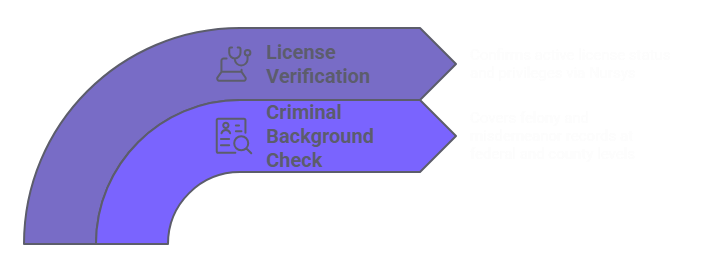
- Criminal background check (federal and county level, lookback period varies by jurisdiction and position salary threshold): Covers felony and misdemeanor records at the federal level and in counties of residence and employment. The applicable lookback period depends on the FCRA salary threshold exemption and any state-specific restrictions in the assignment jurisdiction. Travel nurses with multistate work history typically require multi-jurisdiction searches, and the scope of any search must align with the nurse's written authorization and FCRA disclosure requirements in each jurisdiction. Agencies should confirm the applicable lookback and permissible search scope with qualified legal counsel for each placement state.
- License verification via Nursys: Confirms active license status, absence of issues, and multistate practice privileges under the Nurse Licensure Compact. Nursys is the NCSBN-maintained primary source verification platform. A state board website lookup does not meet Joint Commission primary source verification standards.
Exclusion, Credentials, and Employment Verification
The next three components address federal exclusion status, credential authenticity, and work history.
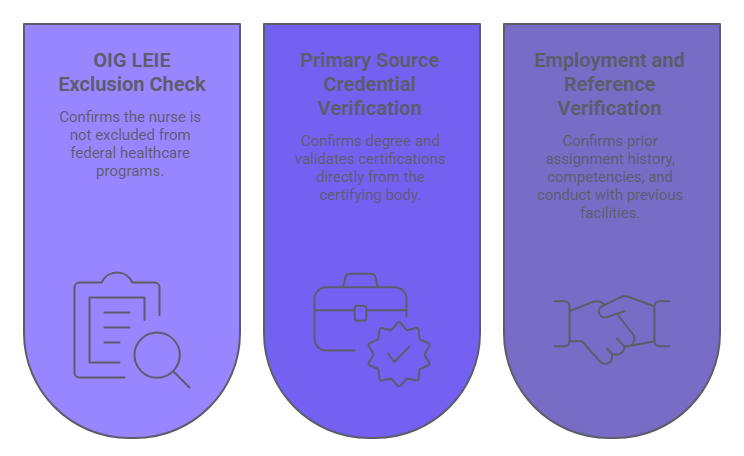
- OIG LEIE exclusion check (federal and applicable state Medicaid lists): Confirms the nurse is not excluded from participation in federal healthcare programs. Agencies must run this check at each new assignment, not carry it forward from prior placements. Applicable state Medicaid exclusion lists must be checked in addition to the federal LEIE.
- Primary source credential verification (nursing degree, specialty certifications): Confirms degree from the issuing institution and validates BLS, ACLS, PALS, NIH Stroke Scale, and other specialty certifications directly from the certifying body. Nurse-supplied documentation may start the verification process, but the certifying organization must independently confirm the certification's validity, issue date, and expiration date before the credential is verified. Expired or unverifiable certifications are the most common cause of placement failure at the facility credentialing stage.
- Employment and reference verification (prior clinical placements): Confirms prior assignment history, clinical competencies, and professional conduct with previous facilities or agencies. Travel nurse employment history is often agency-mediated rather than direct. As a result, this verification requires confirmation of both the agency relationship and the underlying facility experience.
Drug Screening and Registry Check
The final two components address substance testing and sex offender registry status.
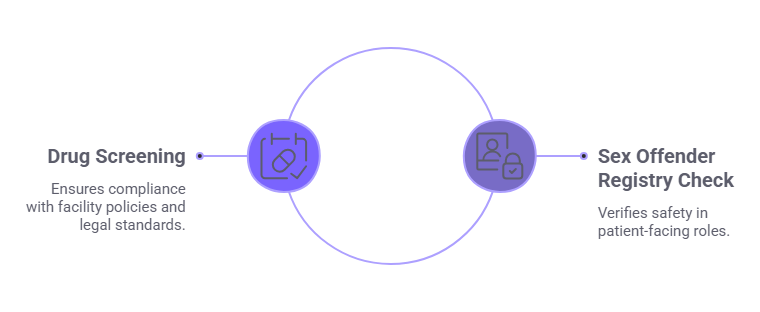
- Drug screening (per facility or agency policy and applicable state or federal legal requirements): Required by most facility contracts and accreditation standards. Panel composition and cutoff levels may vary by facility, and some facilities require observed collection. State law in the assignment jurisdiction may restrict testing scope, including limitations on marijuana testing. Agencies should confirm applicable drug testing requirements and restrictions with qualified legal counsel for each placement state.
- Sex offender registry check: Required by most healthcare facility contracts and standard in any clinical setting involving patient contact. Multi-state registry checks are appropriate for travel nurses with multistate work history.
License Verification and Nursys: The Primary Source Requirement
What Nursys Is and Why It Is Required
Nursys is the national license verification database maintained by the National Council of State Boards of Nursing. It provides real-time primary source verification of RN and LPN licenses issued by participating state boards. Results include active status, license number, expiration date, and the presence of any issues, disciplinary actions, or practice restrictions. Joint Commission standards require primary source verification of clinical licenses, meaning verification must come directly from the issuing authority or a recognized primary source platform. Nursys satisfy this requirement for participating states. A state board public license lookup does not, because it does not produce a verifiable, auditable record in the format Joint Commission standards require.
For travel nurses, Nursys also shows Nurse Licensure Compact privilege status. Specifically, it displays which compact states a nurse may practice in under their home state license. Individual state board websites do not offer this view, which is one of the key operational advantages of using Nursys as the verification source.
Interpreting Nursys Results
A Nursys result for a travel nurse should confirm four things: the license is active, it carries no issues, the expiration date covers the full assignment period, and the compact privilege status matches the assignment state. A license that is active but has restrictions requires immediate escalation to the agency's clinical or compliance team before placement moves forward. A license expiring during the assignment requires the agency to set up a renewal process before the nurse starts work. Discrepancies between Nursys records and the nurse's self-reported license information are common. Moreover, they require direct resolution with the relevant state board before the placement proceeds.
Nursing Compact States and Multistate License Implications
How the Nurse Licensure Compact Works
The Nurse Licensure Compact is an agreement among member states. It allows a registered nurse or LPN licensed in their home state to practice in other compact member states without a separate license for each. As of 2026, most U.S. states participate in the NLC. A nurse whose home state is a compact member holds a multistate license granting practice privileges in all other compact states. That privilege ties directly to the home state license. Therefore, if the home state license carries an issue or expires, the multistate privileges are also affected.
For travel nursing agencies, compact status simplifies multistate placements within the compact. However, it does not remove the verification duty. Agencies must still confirm through Nursys that multistate privileges are active and clear for the specific assignment state before placement proceeds.
Non-Compact State Placements
When a travel nurse takes an assignment in a state outside the NLC, that nurse must hold an active, unencumbered license issued by that state, or hold an authorized temporary practice permit where available. A multistate compact license does not grant practice privileges in non-compact states. Placing a compact-licensed nurse in a non-compact state without a valid state license or authorized permit means placing a nurse without full practice authorization, regardless of their overall qualifications.
Fortunately, some states issue temporary practice permits that allow a nurse to work legally while a full licensure application is in progress. Agencies should therefore confirm available authorization pathways with the relevant state board before canceling a placement on licensure grounds alone. The time required to obtain full licensure in a non-compact state can be significant, so early verification is essential.
Credential Verification: Beyond the License
Specialty Certifications and Primary Source Verification
Most travel nurse assignments require specialty certifications beyond the base RN or LPN license. BLS certification from the American Heart Association or American Red Cross is a baseline requirement across virtually all clinical settings. ACLS is required for most emergency, critical care, and cardiac settings. PALS applies to pediatric assignments. NIH Stroke Scale certification is required in many neurology and stroke unit placements.
Each certification must be verified directly from the certifying body. A nurse-supplied certification card does not count as primary source verification and cannot serve as the final record for Joint Commission purposes. Nurse-supplied documents may start the process, but the certifying organization must independently confirm the certification's validity, issue date, and expiration date before the credential is verified. Expired certifications are the most common gap found during facility onboarding. An ACLS certification that expired three months before the assignment start date will fail the facility's review regardless of when it was submitted. Agencies should therefore build expiration tracking into their workflow and flag renewals before a nurse enters an active placement cycle.
Degree Verification and Facility-Specific Requirements
Nursing degree verification must trace back to the issuing institution. It should confirm the degree type, field of study, and conferral date. For nurses educated outside the U.S., the process includes credential evaluation through a recognized evaluation service. Some facilities also require additional competency documentation specific to their unit, such as skills checklists or competency assessments. These requirements vary widely across hospital systems. Accordingly, agencies should confirm them with each facility's credentialing or medical staff office at the start of each placement.
OIG Exclusion Screening for Travel Nurses
The Agency Obligation at Placement
The OIG LEIE exclusion check applies fully to travel nurse placements. Before a nurse begins providing services at a facility, the placing agency must verify that the nurse does not appear on the federal LEIE or applicable state Medicaid exclusion lists. This duty applies at each new placement, not only at initial hire. A nurse who cleared an exclusion check six months ago for a prior assignment may have been added to the LEIE since then. Therefore, the prior result does not satisfy the current placement obligation.
Civil Monetary Penalties under 42 U.S.C. Section 1320a-7a may attach to any entity that arranges for services by an excluded individual reimbursed under a federal healthcare program. Whether and to what extent liability attaches to a staffing agency versus the placing facility is a fact-specific determination that depends on the nature of the arrangement. Agencies should confirm their specific exposure with qualified legal counsel and address exclusion screening obligations explicitly in facility contracts.
The Facility Obligation and Shared Exposure
The placing facility carries its own OIG exclusion verification duty, independent of the agency's check. A facility that relies solely on the agency's clearance without running its own check is not fully covered. In practice, many facility contracts require agencies to provide documented OIG clearance as part of the credentialing package. The facility then confirms that documentation meets its internal standards. Agencies should retain dated, documented exclusion check results for each placement. They should also confirm which state Medicaid exclusion lists apply, based on the facility's location and the states where the nurse has held prior assignments.
Turnaround Timelines: What Agencies Should Realistically Plan For
Component-by-Component Ranges
Travel nurse screening timelines vary by component. The ranges below reflect realistic expectations under normal processing conditions. They assume parallel initiation of all components at the start of the credentialing process.
| Component | Typical Turnaround | Primary Delay Cause |
| Criminal background check | 24 to 72 hours | County court closures, manual court access requirements |
| Nursys license verification | Real-time to 24 hours | Discrepancy resolution with state board |
| OIG LEIE exclusion check | Same day | Name variation false positives requiring manual review |
| Specialty certification verification | 24 to 48 hours | Certifying body response time |
| Degree verification | 1 to 3 business days | Institution processing volume, international credential evaluation |
| Employment and reference verification | 2 to 5 business days | Prior employer or agency responsiveness |
| Drug screening | 24 to 48 hours | Specimen collection scheduling, MRO review for non-negatives |
Initiating all components at once rather than one after another allows the slowest components to process while faster ones complete. This parallel approach compresses total time-to-placement without reducing scope.
Compressing Time-to-Placement
Parallel initiation is the single most effective strategy for reducing total credentialing time. Sequential initiation, where agencies wait for one result before starting the next, adds unnecessary days to the timeline. A workflow that starts all seven components simultaneously and tracks each one independently can realistically complete the full package in three to five business days under normal conditions. However, this estimate does not cover scenarios involving international credential evaluation, Nursys discrepancy resolution requiring state board involvement, non-negative drug screen results requiring MRO review, or facility-specific steps that extend the process. Agencies should therefore share realistic timeline ranges with facilities and maintain escalation protocols for each component.
Reassignment Screening: What Must Be Re-Run Between Placements
The Carry-Forward Question
The question agencies most often get wrong is whether a prior placement's screening results satisfy the requirements for a new assignment. The honest answer depends on three factors: how much time has passed since the prior check, the facility's specific reassignment screening policy, and any state or accreditation requirements that set maximum lookback windows. No single rule governs this decision. Agencies should therefore confirm the specific requirements in each facility agreement rather than applying one standard policy across all placements.
In practice, most facilities and accreditation frameworks treat criminal background checks as valid for a set period, often 12 months, after which a new check is required. OIG exclusion checks must be re-run at each new assignment without exception. Nursys license verification should be re-confirmed at each assignment start. Drug screening requirements vary by facility and typically appear in the agency-facility contract.
Portable vs. Refresh-Required Components
Agencies managing active travel nurse rosters benefit from a clear internal policy on which components carry forward and which require a refresh. The table below reflects common practice across facility contracts and accreditation standards. Agencies should confirm the specific requirements in each facility agreement before applying this framework.
| Component | Typically Portable | Typically Requires Refresh |
| Criminal background check | Within 12 months, same agency | After 12 months or facility-mandated interval |
| Nursys license verification | Not portable, re-run each assignment | Always |
| OIG exclusion check | Not portable, re-run each assignment | Always |
| Specialty certifications | If not expired | If expired or facility requires re-verification |
| Degree verification | Yes, if previously primary-sourced | Not typically required to refresh |
| Drug screening | Per facility contract | Per facility contract |
Agency vs. Facility Responsibility: Who Owns What
The Division of Credentialing Accountability
The split between agency and facility credentialing responsibility is a frequent source of compliance gaps. In most travel nursing arrangements, the agency completes the pre-placement credentialing package, including criminal background check, license verification, credential authentication, and OIG exclusion check, and delivers it to the facility before the nurse's start date. The facility then reviews that package against its internal standards, confirms all components meet its requirements, and conducts any additional competency assessments specific to its unit.
This division breaks down when agencies assume that delivery equals acceptance. An agency that delivers a package that does not meet the facility's specific requirements has not finished its job. Accordingly, agencies should get and maintain a current copy of each facility's credentialing checklist and confirm their package satisfies each item before submitting it.
Contractual Clarity and Audit Exposure
Agency-facility contracts should spell out credentialing responsibilities clearly. They should specify which components the agency delivers, the required format for each, the timeframe for facility review, and how both sides handle discrepancies. Contracts that use vague terms like "agency shall provide a complete background check" without defining what that means create audit exposure for both parties. Furthermore, agencies should confirm with qualified legal counsel whether transmitting consumer report information to the facility triggers FCRA redisclosure obligations. Background check results may only be shared with parties holding a permissible purpose under the FCRA. Compliance-focused agencies treat the credentialing section of every facility contract as a liability document and review it with the same care they give to indemnification clauses.
Conclusion
Travel nurse background checks are not a single check. They are a multi-component credentialing process that combines criminal screening, primary source license and credential verification, OIG exclusion screening, and facility-specific requirements under placement timelines that leave little margin for error. Agencies that build systematic, parallel-initiation workflows, maintain clear contractual definitions of their credentialing obligations, and treat reassignment screening as a recurring decision rather than a one-time task are the ones that sustain preferred vendor status and scale without audit exposure. Requirements vary by facility, accreditor, and state, and agencies should confirm their specific obligations with qualified legal and credentialing counsel.
Frequently Asked Questions
Below is a list of some of the most frequently asked questions regarding some of the most common concerns faced by agencies in screening and credentialing travel nurses. Due to the nature of travel nursing, where there is licensing in multiple states and facility-specific requirements along with short timelines, even a minor glitch in the process may result in delay or potential audits.
What background checks do travel nurses need?
A complete travel nurse screening package includes seven components: a criminal background check at federal and county level, Nursys license verification, an OIG LEIE exclusion check against federal and applicable state lists, primary source credential verification, employment and reference verification, drug screening, and a sex offender registry check. Omitting any component creates facility audit exposure for the placing agency.
How quickly do travel nurse background checks come back?
Criminal checks typically return in 24 to 72 hours, Nursys verification is near real-time, and OIG exclusion checks complete the same day under normal conditions. Specialty certification verification takes 24 to 48 hours, while degree and employment verification typically take one to five business days. Agencies that initiate all components in parallel can realistically complete the full package in three to five business days under normal conditions.
Do travel nurses need a new background check for each assignment?
It depends on elapsed time, facility policy, and applicable accreditation requirements. Criminal background checks are typically portable within 12 months at the same agency. OIG exclusion checks and Nursys license verification must be re-run at each assignment without exception. Drug screening and other components follow facility-specific contract terms.
What is the Nursys database and why is it required for travel nurses?
Nursys is the national license verification database maintained by the National Council of State Boards of Nursing. It provides real-time primary source verification of RN and LPN licenses, including active status, encumbrances, and Nurse Licensure Compact multistate privilege status. A state board website lookup does not produce an auditable primary source record and does not satisfy Joint Commission standards.
How does compact licensure affect travel nurse placements?
A nurse licensed in a Nurse Licensure Compact member state holds multistate practice privileges in all other compact member states under a single home state license. Placement in a non-compact state requires a separate state-issued license or an authorized temporary practice permit where available. Agencies should confirm available authorization pathways with the relevant state board before canceling a placement on licensure grounds alone.
Who is responsible for OIG exclusion checks in a travel nurse placement?
Both the placing agency and the facility carry independent OIG exclusion verification obligations. The agency must confirm exclusion status before the nurse begins any federally reimbursed clinical work. Whether CMP liability attaches to the agency versus the facility is a fact-specific determination. Agencies should confirm their specific exposure with qualified legal counsel.
What causes delays in travel nurse credentialing, and how can agencies reduce them?
Common delay causes include county court closures slowing criminal checks, slow prior employer responses during verification, Nursys discrepancy resolution requiring state board involvement, and non-negative drug screen results requiring MRO review. Agencies reduce total credentialing time by initiating all components at once, maintaining escalation protocols for each component, and tracking certification expirations so nurses enter placements with current credentials confirmed.
What should an agency-facility contract specify about travel nurse credentialing?
The contract should define which components the agency delivers, the required documentation format, the timeframe for facility review, and how both sides resolve discrepancies. Agencies should also confirm whether transmitting consumer report information to the facility triggers FCRA redisclosure obligations. Vague contract language creates audit exposure for both parties when a credentialing gap surfaces during a Joint Commission review or facility audit.
Additional Resources
- Nursys License Verification Platform (NCSBN)
https://www.nursys.com - Nurse Licensure Compact: State Participation Map (NCSBN)
https://www.ncsbn.org/nurse-licensure-compact.htm - OIG List of Excluded Individuals and Entities (LEIE) Search Tool
https://exclusions.oig.hhs.gov - OIG Special Advisory Bulletin: Contractual Joint Ventures and Exclusion Obligations
https://oig.hhs.gov/compliance/alerts-and-bulletins/ - The Joint Commission: Primary Source Verification Requirements
https://www.jointcommission.org/standards/standard-faqs/critical-access-hospital/human-resources-hr/000001545/ - NCSBN Nurse Licensure Compact Administration
https://www.ncsbn.org/public-files/NLC_Administration.pdf

ABOUT THE CREATOR
Charm Paz, CHRP
Recruiter & Editor
Charm Paz is an HR professional at GCheck, specializing in background screening, fair hiring, and regulatory compliance. She holds from the Professional Background Screening Association (PBSA) and helps organizations navigate employment regulations with clarity and confidence.
With a background in Industrial and Organizational Psychology, she translates policy into practice to build ethical, compliant, human-centered hiring systems that strengthen decision-making over time.