
LEGAL & COMPLIANCE

How SmartRecruiters handles background checks: turnaround, check types, thoroughness, and provider options for enterprise HR teams.
Created by

SmartRecruiters handles background check initiation and tracking through its recruiting workflow, connecting to third-party screening providers that run the actual searches and return results into the candidate’s profile. This guide covers turnaround time, check types, thoroughness, and provider choice for teams running high-volume or global hiring through SmartRecruiters.
SmartRecruiters‘ recruiting workflow handles background check initiation and tracking, connecting to whichever third-party screening provider an employer has set up to run the actual searches and generate reports. Hiring teams initiate a screening request as a candidate advances through the pipeline, track status alongside other candidate data, and carry results into the same profile used for offer and onboarding steps.
This distinction matters for compliance purposes. Under the Fair Credit Reporting Act, the entity that assembles and furnishes a consumer report is the party subject to FCRA obligations as a consumer reporting agency. SmartRecruiters’ role as a talent acquisition platform positions it as the system of record and workflow orchestrator, while the connected screening provider carries the consumer reporting agency obligations for the checks it runs, including confirming a permissible purpose exists and obtaining the candidate’s authorization before a report is pulled.
SmartRecruiters serves more than 4,000 customers, with its own site describing it as built for organizations with at least 50 employees and a significant volume of open job requisitions, spanning mid-market and enterprise companies including several named enterprise customers (SmartRecruiters, smartrecruiters.com, 2026). SAP completed its acquisition of SmartRecruiters in September 2025, and SmartRecruiters continues to operate as a standalone product fully compatible with SAP SuccessFactors and other HCM systems rather than being folded into a single combined product (SAP, acquisition completion announcement, September 2025). On G2, SmartRecruiters carries a 4.3 out of 5 average across roughly 500 reviews, with just over half of reviewers coming from mid-market organizations (G2.com, SmartRecruiters product comparison pages, 2026).
Turnaround time for a SmartRecruiters-initiated background check is set by the connected screening provider, not by SmartRecruiters itself, and typically ranges from same-day results for basic identity and database checks to several business days for multi-jurisdiction criminal searches or verifications that depend on third-party responses. SmartRecruiters’ workflow can trigger a screening request as soon as a candidate advances to that stage, but the clock from request to completed report runs on the provider’s infrastructure and the specific searches included in the package.
Several factors affect how long that clock runs:
As a point of reference, GCheck’s own published integration materials cite an average turnaround window of 12 to 24 hours for standard screening packages on its SmartRecruiters integration, framed as an average rather than a guarantee since individual cases vary based on jurisdiction response times (GCheck, SmartRecruiters Background Check Integration, 2026). HR teams evaluating turnaround expectations should ask any prospective screening partner for their actual average completion time by package type rather than relying on marketing language alone.
| Search type | Typical speed driver | Why it varies |
| National criminal database scan | Fastest, often automated | Database coverage varies by state; often paired with a direct county search |
| County or state criminal search | Moderate | Depends on courthouse or state repository response time |
| Federal criminal search | Moderate | Runs against federal district court records, generally automated |
| Employment or education verification | Slower | Depends on a prior employer, registrar, or clearinghouse responding |
| International or multi-country checks | Slowest, most variable | Depends entirely on the record-holding country’s systems and response times |
Under the FCRA, a U.S. employer must give the candidate a clear and conspicuous standalone disclosure and get written authorization before ordering a report. For global hires, the equivalent consent and disclosure requirements are set by each country’s own laws rather than the FCRA, so an employer hiring across multiple countries through SmartRecruiters needs a provider that tracks those differences by jurisdiction rather than applying one standard form everywhere.
SmartRecruiters’ workflow supports ordering several categories of background checks through its integration marketplace and API, with the connected screening provider running the actual searches. HR teams can typically order these categories of checks from a connected provider:
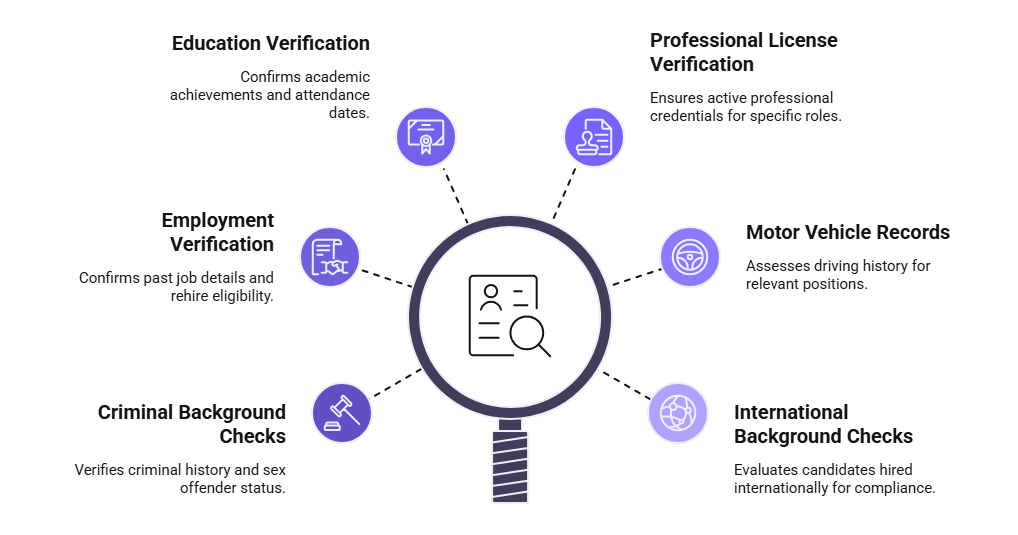
Which of these actually run on a given candidate depends entirely on the screening package the employer configures with its provider. An employer hiring high volumes of frontline or hourly roles typically configures a narrower package than one filling specialized or regulated positions that need license verification or deeper multi-jurisdiction searches.
Background check is worth defining plainly here since the term covers a range of products. A background check is a point-in-time review of a candidate’s criminal history, employment record, education, and other public or consented records, run once before or shortly after a hiring decision. This differs from continuous monitoring, which re-screens a worker at intervals throughout employment; whether continuous monitoring is available depends on whether the connected provider offers it as a separate service.
Social media screening, reference checks, credit checks, and global watchlist or sanctions screening are typically offered as add-ons rather than bundled by default, since they carry their own disclosure requirements. Credit checks in particular face state-level restrictions beyond the federal FCRA baseline: several states now limit or prohibit employment credit checks outright, and New York’s statewide restriction took effect April 18, 2026. A package compliant in one U.S. state, let alone one country, is not automatically compliant for a candidate working in another.
Thoroughness is determined by the screening package an employer configures and by how the connected provider structures its searches, adjudication logic, and compliance workflow. Two employers using the same SmartRecruiters workflow can end up with very different levels of screening depth depending on which provider and which package they select.
A few variables drive real thoroughness beyond the surface-level list of check types:
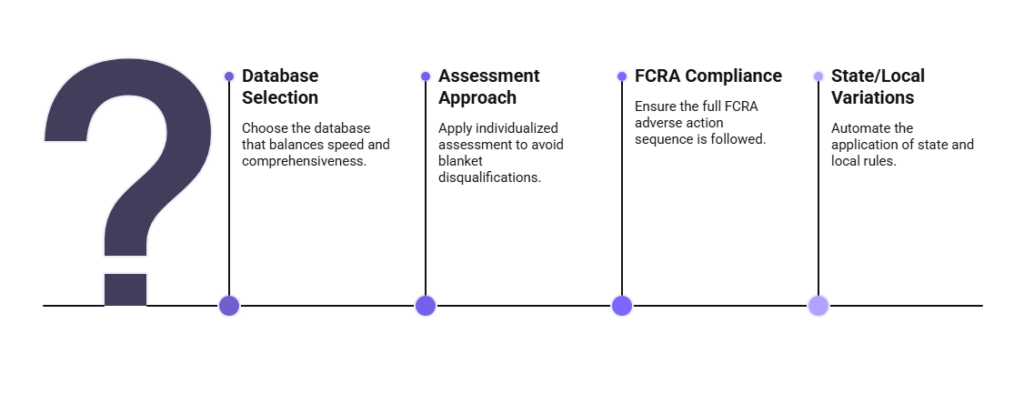
SmartRecruiters’ workflow surfaces status and stores documentation throughout this process. The adjudication logic and jurisdiction handling that determine real compliance depth live with the connected provider’s platform and the package configuration, which is why HR teams should evaluate a prospective screening partner’s adjudication logic and jurisdiction handling directly.
SmartRecruiters is built around high-volume and enterprise-scale hiring, and both scenarios create the same underlying thoroughness risk: a screening package tuned for one location or role type can miss what a different state, country, or job classification requires once volume and variety increase. A provider that routes these differences automatically, based on the candidate’s location and role, closes a gap a manual or one-size-fits-all process leaves open. HR teams can test this directly: ask how a candidate in a second state or country gets screened under that jurisdiction’s own rules, and what the audit trail looks like if it is requested later. This should extend to data handling too, since retention period, access controls, and security certifications matter as much as search depth, particularly when screening volume is high enough that a documentation gap could affect many candidates rather than one.

SmartRecruiters supports multiple background check providers rather than locking employers into one. Employers can connect providers through its integration marketplace or direct API access, and which provider an organization uses is a configuration choice made at the account level.
GCheck maintains a confirmed API-based integration with SmartRecruiters. Based on GCheck’s own integration documentation, the connection supports automatic screening triggers, real-time status tracking mapped to SmartRecruiters candidate profiles, and FCRA-aligned adverse action workflows with documentation that carries through the hiring lifecycle. This is offered as one example of what a SmartRecruiters-connected integration looks like, not a claim that GCheck is SmartRecruiters’ designated or exclusive partner.
Choosing among available providers comes down to a few practical questions, particularly for organizations running high-volume or multi-location hiring:
Specialized screening integrations generally offer two things a manual process cannot: automated compliance documentation that reduces the chance a required notice gets missed, and a consistent candidate experience across every business unit and location. Both matter more as hiring volume grows, since consistency becomes harder to maintain manually once more requisitions and locations are involved.
No. SmartRecruiters is a talent acquisition platform, not a consumer reporting agency. Its workflow lets HR teams trigger and track background screening requests, but the actual searches and report generation happen through whichever third-party screening provider the employer has connected.
It depends on the connected provider and the checks ordered, not on SmartRecruiters itself. Simple checks can return same-day, while multi-jurisdiction or international searches can take several business days. Ask any prospective provider for their average turnaround by package type.
Through its integration marketplace and API, employers can typically order criminal background checks, employment verification, education verification, professional license verification, motor vehicle records, and international background checks, depending on which provider and package the employer has configured.
Yes, when the connected provider supports it. Providers with API-based integrations can return results directly to the candidate profile inside SmartRecruiters, letting offer and onboarding steps proceed from the same record.
SmartRecruiters itself does not administer adverse action notices. That responsibility sits with the connected screening provider’s compliance workflow, which should include a pre-adverse action notice with a copy of the report and the Summary of Rights, a waiting period, and a final adverse action notice if the decision stands.
Evaluate whether the integration triggers automatically from the hiring workflow, whether it routes multi-state and multi-country compliance requirements without manual tracking, whether its adverse action process covers all FCRA-required steps, and what its confirmed average turnaround time is by package type.
Recruiter & Editor
Charm Paz is an HR professional at GCheck, specializing in background screening, fair hiring, and regulatory compliance. She holds from the Professional Background Screening Association (PBSA) and helps organizations navigate employment regulations with clarity and confidence.
With a background in Industrial and Organizational Psychology, she translates policy into practice to build ethical, compliant, human-centered hiring systems that strengthen decision-making over time.

Contact us today for efficient, FCRA-compliant screening solutions
designed to keep your hiring process moving safely and smoothly.



LEGAL DISCLAIMER: The information provided in this article is for general informational and educational purposes only and should not be construed as legal advice or a substitute for consultation with qualified legal counsel. While we strive to ensure accuracy, employment screening laws and regulations—including but not limited to the Fair Credit Reporting Act (FCRA), Equal Employment Opportunity Commission (EEOC) guidelines, state and local ban-the-box laws, industry-specific requirements, and other applicable federal, state, and local statutes—are subject to frequent changes, varying interpretations, and jurisdiction-specific applications that may affect their implementation in your organization. Employers and screening decision-makers are solely responsible for ensuring their background check policies, procedures, and practices comply with all applicable laws and regulations relevant to their specific industry, location, and circumstances. We strongly recommend consulting with qualified employment law attorneys and compliance professionals before making hiring, tenant screening, or other decisions based on background check information.