

Evaluation criteria are the weighted scoring standards a procurement team applies to every background screening proposal before a single bid is opened, and they are what actually decides the award, not the narrative sections of a vendor’s response. A defensible scoring matrix assigns a percentage weight to each dimension of the decision (accuracy, compliance readiness, turnaround, cost, and track record) and scores every bidder against the same rubric, so the outcome can withstand a protest and a public records request alike.
Key Takeaways
- Evaluation criteria should be written and weighted before proposals are opened, not reverse-engineered afterward to justify a preferred vendor.
- A defensible matrix typically weights five dimensions: data accuracy and methodology, compliance readiness, turnaround and service levels, cost structure, and references or track record.
- Weightings should reflect what actually matters for the buying organization’s risk profile, not a generic template applied unchanged across every solicitation.
- Certain vendor responses (undisclosed litigation, refusal to detail data sources, vague turnaround language) function as disqualifying red flags regardless of how well the vendor scores elsewhere.
- Publishing the scoring matrix inside the RFP itself, rather than keeping it internal, is what makes the process transparent and defensible under public records review.
Why a weighted scoring matrix beats an unweighted checklist
A checklist tells an evaluator whether a vendor offers a capability. A weighted scoring matrix tells the evaluator how much that capability should matter relative to everything else being evaluated, and it forces that judgment to be made in advance, before any proposal has been read. This ordering matters more than it sounds like it should. An evaluation committee that decides weightings after seeing the proposals is, in practice, choosing the weightings that produce the outcome it already prefers, whether or not anyone on the committee intends that. Applying one published standard to every bidder before any proposal is opened is what GCheck calls Fair Compliance: a consistent rubric applied without exception, not a case-by-case judgment call that happens to land differently depending on who is being evaluated.
Public procurement offices that run competitive background screening solicitations consistently use a weighted-percentage structure rather than a pass/fail checklist. A multi-institution higher education purchasing consortium’s 2024 RFP for background screening services, for example, scored proposals across five factors: price inclusive of total cost of ownership at 30 percent, service level and support at 30 percent, adherence to contract terms at 15 percent, vendor experience at 15 percent, and supplier risk at 10 percent. Every bidder was scored against that identical breakdown, which is what let the evaluation committee defend its award decision on the record.
A Connecticut state agency’s standard RFP for background check services takes a similar approach with a different five-category breakdown: organizational plan and capability at 15 percent, service delivery and performance expectations (including timeliness, accuracy, and confidentiality) at 20 percent, data and technology capability at 25 percent, financial plan at 20 percent, and budget plan at 20 percent. The specific categories differ from the higher education example, which is itself the point: the right weighting depends on what a given buyer actually values, but both examples publish a percentage breakdown rather than a vague overall impression. The pattern across public sector solicitations is consistent: the more specifically a criterion is defined and weighted, the less room there is for an evaluation to be challenged later.
The five dimensions a defensible matrix should score
Most background screening evaluation matrices, once built out in real detail, converge on five scoring dimensions. The relative weight given to each should shift based on the buying organization’s actual risk profile, a hospital system weighting compliance readiness more heavily than a low-risk retail employer would, for instance, but the five dimensions themselves recur consistently enough to serve as a starting structure.
Data accuracy and search methodology
This dimension scores how the vendor actually obtains its records, not just what record types it claims to search. A vendor that runs direct courthouse searches for county-level criminal records is providing a meaningfully different service than one relying entirely on third-party aggregated databases, even if both list “county criminal search” as a covered service on their capability sheet. Scoring under this dimension should specifically credit primary-source verification, documented identity-matching procedures for common names, and a stated dispute or correction rate, since a vendor unwilling to disclose a dispute rate is itself informative.
Compliance readiness
This dimension scores whether the vendor’s processes actually support the buyer’s own compliance obligations under the Fair Credit Reporting Act, rather than merely asserting general FCRA awareness. Concretely, this means scoring whether the vendor has built-in disclosure and authorization workflows, whether adverse action notice generation is a supported feature rather than something the buyer must build separately, and whether the vendor can produce documentation of a compliance training program for its own staff. A vendor’s membership status with the Professional Background Screening Association, and current information security certifications such as SOC 2 Type II, belong here as supporting evidence, not as the entire score.
Turnaround and service level commitments
Turnaround should be scored per search type, not as a single blended average, because a county criminal search and an international education verification do not take comparable amounts of time and a blended average obscures which specific searches will actually create hiring delays. The matrix should also credit whether the vendor’s proposed turnaround commitment carries a stated remedy if missed, and whether the vendor has proactively disclosed which search types commonly exceed the buyer’s target window due to third-party response times outside the vendor’s control. A vendor who volunteers that information during the RFP process is demonstrating exactly the kind of transparency the buyer will need throughout the contract term.
Cost structure
Cost should never be scored as a single blended per-check number, because a blended number hides whether the underlying pricing is itemized in a way the buyer can actually compare across bidders. The scoring should specifically reward a rate structure that separates the vendor’s own service fee from pass-through costs like court access and database fees, since a vendor who bundles these together may look cheaper on the surface while a vendor who itemizes honestly looks more expensive for disclosing the same underlying cost. Volume-based pricing tiers, and any proposed annual cost escalation mechanism for multi-year contracts, should also factor into this dimension.
References and track record
This dimension scores documented history rather than self-reported claims. Litigation history within a defined lookback period, Better Business Bureau standing, and direct reference contact with comparable organizations (similar size, similar industry, similar volume) all belong here. A vendor with no litigation history and strong references from organizations of a comparable scale should score meaningfully higher than one relying on general marketing claims about client satisfaction.
Adjusting weights for your organization’s risk profile
The five dimensions above hold across most background screening procurements, but the weight assigned to each should shift with the buying organization’s actual exposure, not stay fixed at a generic default. A healthcare system screening clinical staff and volunteers with patient contact has good reason to weight compliance readiness above 25 percent, since the downstream cost of a missed exclusion-list match or a licensure lapse is measured in patient safety, not just administrative rework. A transportation or logistics employer running high-volume driver hiring may reasonably weight turnaround more heavily than a typical enterprise employer would, since a slow motor vehicle record check directly delays a vehicle sitting idle. A financial services employer subject to FINRA and state licensing requirements has a similar case for weighting compliance readiness and references above the illustrative defaults, since a screening failure in that sector carries regulatory exposure beyond ordinary FCRA liability. None of this argues for abandoning a standard structure. It argues for stating, in writing, why a particular procurement’s weights depart from the default, so the reasoning is part of the record rather than an unstated assumption the evaluation committee carries into scoring.
A worked example matrix
The table below shows one way these five dimensions can be assembled into a scored rubric. The specific weights are illustrative; a procurement team should adjust them to reflect its own risk profile before publishing the final version inside the RFP.
| Evaluation Criterion | Weight | What Scores Highest |
| Data accuracy and methodology | 25% | Direct courthouse and primary-source searches; documented identity-matching procedures; disclosed dispute rate |
| Compliance readiness | 25% | Built-in disclosure/authorization workflows; adverse action support; current SOC 2 Type II; documented compliance training |
| Turnaround and service levels | 20% | Per-search-type turnaround commitments with a stated remedy for missed SLAs; proactive disclosure of exception cases |
| Cost structure | 20% | Itemized base fee vs. pass-through costs; transparent volume tiers; stated multi-year escalation terms |
| References and track record | 10% | No material litigation in the lookback period; verifiable references at comparable scale |
A committee using this structure scores each bidder from 0 to 100 on each row, multiplies by the weight, and sums the result. The advantage over a narrative “which proposal felt strongest” evaluation is that the math is auditable after the fact, by the losing bidders, by internal audit, and by anyone who requests the evaluation record under public disclosure law.
Scoring three hypothetical bidders against the matrix

The mechanics of a weighted matrix are easier to see worked through than described in the abstract. The three vendor profiles below are anonymized and hypothetical, built to represent common patterns rather than any real proposal, but they show how the same five-dimension rubric produces genuinely different outcomes depending on how a bidder actually performs, not just how it presents itself.
Vendor A is a full-service national provider with direct courthouse relationships across most major jurisdictions and a documented, low dispute rate. Its pricing is itemized but comes in highest overall, and it has not yet completed a SOC 2 Type II audit, though its FCRA workflows are otherwise mature.
Vendor B is a mid-size regional provider with a mix of primary-source and aggregated-database searches, solid FCRA workflows, and current PBSA membership. Its turnaround commitments are specific and reasonable, but its pricing is presented as a single blended rate rather than itemized between base service fees and pass-through costs.
Vendor C markets aggressively on speed and price, relies heavily on aggregated third-party databases rather than direct source verification, and declines to state a specific dispute rate when asked, describing its accuracy as “industry-leading” without further detail. During reference checks, the evaluation committee discovers a lawsuit the vendor did not disclose in its proposal, despite the RFP explicitly requiring litigation disclosure.
| Evaluation Criterion | Weight | Vendor A | Vendor B | Vendor C |
| Data accuracy and methodology | 25% | 90 | 70 | 50 |
| Compliance readiness | 25% | 70 | 80 | 65 |
| Turnaround and service levels | 20% | 75 | 80 | 90 |
| Cost structure | 20% | 55 | 70 | 95 |
| References and track record | 10% | 90 | 75 | 40 |
Multiplying each raw score by its weight and summing the row produces a weighted total of 75.0 for Vendor A and 75.0 for Vendor B, an effective tie. Vendor C’s raw weighted total, calculated the same way, comes to 69.75, which on the numbers alone would place it third but still within striking distance. The number never gets used, though, because Vendor C’s undisclosed litigation is exactly the kind of red flag described in the next section: a disqualifying threshold issue, not a scoring input to be weighed against everything else. Once the undisclosed lawsuit is confirmed, Vendor C is removed from consideration entirely, regardless of how competitively it scored on turnaround and cost.
That leaves Vendor A and Vendor B in a genuine tie on the published matrix, which is a common and entirely normal outcome once a scoring instrument is built with real weights rather than a vague overall impression. A well-constructed RFP anticipates this by stating a tie-break method in advance, commonly a secondary criterion the committee has already agreed matters most (references, or a live technical demonstration), rather than leaving the committee to improvise a resolution once the numbers are in front of them. Deciding the tie-break rule after two proposals have already tied is the same problem as deciding weightings after proposals have been read: it invites the appearance, whether or not the substance, of a result reverse-engineered to fit a preference.
Red flags that should override an otherwise strong score
Some vendor responses function less as a scoring input and more as a threshold the vendor must clear before scoring even applies. A vendor should generally be disqualified, or scored a mandatory zero on the relevant dimension regardless of its answers elsewhere, for any of the following:
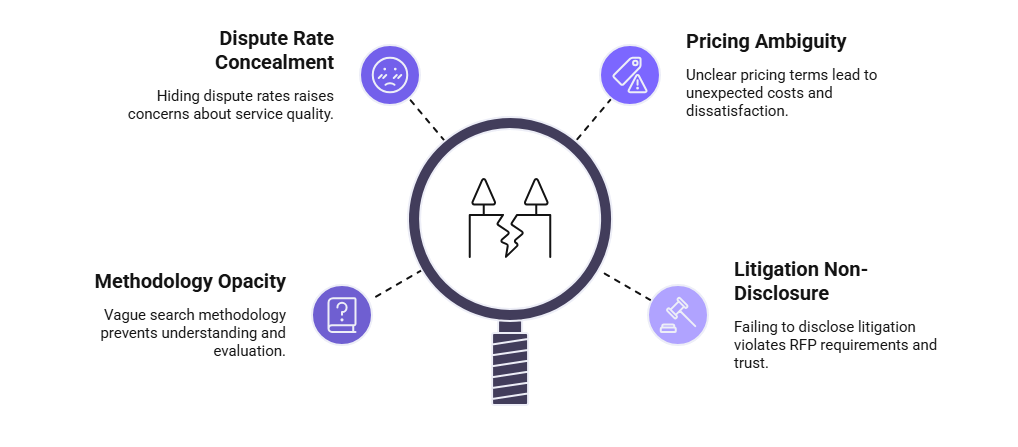
- Refusing to disclose methodology for a specific search type, or describing it only as “comprehensive” or “industry-standard” without specifics
- Declining to state a dispute or error rate when directly asked
- Presenting pricing with undefined terms such as “standard search” that could later be redefined to add charges for aliases, additional counties, or international records
- Undisclosed material litigation discovered independently during reference checks, when the RFP specifically required disclosure
Building these thresholds into the scoring instrument in advance, rather than discovering them mid-evaluation and deciding ad hoc how much they should matter, is what keeps an evaluation defensible when a losing bidder challenges the outcome.
Understanding the cost of getting evaluation wrong
Weighting cost structure appropriately, rather than defaulting to lowest price as the deciding factor, matters because the downstream cost of inadequate screening compliance routinely exceeds the savings from choosing a cheaper, less compliant vendor. Under the Fair Credit Reporting Act‘s private right of action for negligent noncompliance, statutory damages run $100 to $1,000 per violation, and a single defective disclosure form can affect every applicant processed through it, which is how individual violations compound into class-scale exposure (15 U.S.C. § 1681n and § 1681o). Willful violations add punitive damages with no statutory cap, plus the applicant’s attorney’s fees under the Act’s fee-shifting provision. Separately, Title VII of the Civil Rights Act caps combined compensatory and punitive damages per complaining party at $50,000 to $300,000 depending on employer size for discriminatory screening practices, though actual settlements in discrimination cases involving criminal-history screening policies have run well past those caps when they affect a class of applicants rather than one individual (42 U.S.C. § 1981a). A scoring matrix that weights compliance readiness and data accuracy appropriately is, in effect, pricing in this downstream risk before a contract is ever signed.
Publishing the matrix inside the RFP itself
A weighted scoring matrix only delivers its full value if it is published inside the solicitation document, not held internally as an evaluation team’s private reference. Publishing the matrix accomplishes two things. First, it tells every bidder exactly what the buyer values most, which produces proposals that actually address the buyer’s real priorities instead of generic capability claims. Second, and more importantly for public sector buyers specifically, it is what makes the eventual award decision defensible if a losing bidder requests the evaluation record or files a bid protest. An evaluation conducted against criteria the bidders never saw is difficult to defend as fair, regardless of how sound the underlying reasoning was.
This is, in practical terms, what Fair Compliance and Transparent Compliance look like applied to procurement itself: every bidder held to a published, consistent standard, and the buyer’s own reasoning available for scrutiny rather than treated as a private judgment call. GCheck refers to this operating standard as Compliance for Good®, built on the idea that clear disclosure and consistent process, applied to how a service is evaluated as much as how a result is explained, is what actually earns trust rather than simply claiming it.
Frequently asked questions
What should be included in background check RFP evaluation criteria?
Evaluation criteria for a background screening RFP should score data accuracy and search methodology, compliance readiness under the Fair Credit Reporting Act, turnaround time and service level commitments per search type, cost structure with pass-through fees itemized separately from base service fees, and references or documented track record. Each dimension should carry a stated percentage weight rather than being evaluated narratively.
How much weight should it cost to carry in a background check RFP scoring matrix?
There is no fixed rule, but cost is commonly weighted between 20 and 30 percent in public sector screening RFPs, similar to or slightly below compliance readiness and data accuracy. Weighting costs too heavily relative to compliance and accuracy risks selecting a vendor whose lower price reflects lower investment in the areas that create the most downstream liability.
Should turnaround time be scored as a single average or broken out by search type?
Turnaround should be scored per search type. A single blended average obscures which specific searches, such as international verifications or less common state criminal searches, will actually create hiring delays, which is the information an evaluation committee needs to compare vendors meaningfully.
What red flags should disqualify a background check vendor during RFP evaluation, regardless of score?
A vendor that refuses to disclose search methodology in specific terms, declines to state a dispute or error rate, uses undefined pricing language like “standard search,” or has undisclosed material litigation discovered during reference checks should generally be disqualified or scored a mandatory zero on the relevant dimension, regardless of how it scores elsewhere.
Why should a scoring matrix be published inside the RFP rather than kept internal?
Publishing the matrix tells bidders what the buyer actually values, which produces more relevant proposals, and it makes the eventual award decision defensible if a losing bidder requests the evaluation record or files a protest. An evaluation against criteria bidders never saw is difficult to defend as fair.
Sources cited
- Big Ten Academic Alliance, Request for Proposal No. 205: Background Screening Services (Michigan State University, issued 2024). Referenced for the five-factor weighted evaluation criteria example (Section 3.8). Verified by direct document fetch.
- State of Connecticut Department of Developmental Services, RFP: CCH Criminal Background Checks (issued October 2024). Referenced for a second, differently-weighted five-category evaluation criteria example (Section III.B.4). Verified by direct document fetch.
- Fair Credit Reporting Act, 15 U.S.C. § 1681n (willful noncompliance) and § 1681o (negligent noncompliance). Statutory damages of $100 to $1,000 per violation apply only under § 1681n; negligent violations under § 1681o carry actual damages and attorney’s fees but no fixed statutory damages range.
- Civil Rights Act of 1964, Title VII, damages cap at 42 U.S.C. § 1981a. Combined compensatory and punitive damages per complaining party are capped between $50,000 and $300,000 depending on employer size.
- GCheck, “FCRA Compliance Guidelines 2026: Essential Requirements for Employers” (gcheck.com/blog). Independently confirms the corrected $100–$1,000 statutory damages figure; used as the corrected internal link destination.

ABOUT THE CREATOR
Charm Paz, CHRP
Recruiter & Editor
Charm Paz is an HR professional at GCheck, specializing in background screening, fair hiring, and regulatory compliance. She holds from the Professional Background Screening Association (PBSA) and helps organizations navigate employment regulations with clarity and confidence.
With a background in Industrial and Organizational Psychology, she translates policy into practice to build ethical, compliant, human-centered hiring systems that strengthen decision-making over time.