


Independent contractor screening compliance requires that organizations engaging contractors, 1099 workers, gig economy workers, or third-party vendors with facility, system, or client access run access-tiered background checks through a FCRA-compliant process, document the screening rationale as a security and access requirement rather than an employment condition, treat each re-engagement as a new screening event, and hold vendors and platforms contractually accountable for screening standards they delegate to apply.
Key Takeaways
- The FCRA applicability question for contractor screening points toward caution regardless of classification. The key variable is degree of control and the purpose of the check, not whether the worker receives a W-2 or a 1099.
- Negligent hiring doctrine does not require an employment relationship and extends to independent contractors in many jurisdictions. The standard of care scales with the contractor’s access and risk profile.
- The access profile and liability exposure that justify screening do not turn on worker classification. A contractor with facility badge access, system credentials, or client-facing authority carries the same risk profile as an employee with identical access.
- A contractor screening framework can work without creating misclassification risk if it is structured around access level and framed as a security requirement rather than an employment condition.
- The three most common contractor screening gaps are the access assumption, the vendor delegation assumption, and the one-time check assumption. Each is a structural program design failure, not an oversight.
- Documentation of the screening decision is the negligent hiring defense regardless of whether the contractor is an employee.
Why the Contractor Screening Gap Exists and What Sustains It
Most organizations have a background screening policy. Most of those policies apply to employees. The contractors who install IT infrastructure, service facility systems, handle customer data, staff the reception desk through a vendor, and manage the warehouse fulfillment line often have equal or greater access to organizational assets and sensitive information than the employees around them. Their screening status is unknown, or it rests on an assumption that someone else handled it. Four organizational dynamics create and sustain this gap.
The Classification Boundary Assumption
HR screening programs are built around the employment relationship. When teams treat the boundary between employee and contractor as the natural boundary for screening programs, contractors fall outside the program by default rather than by deliberate decision. The gap is not a policy choice. It is the result of a policy that was never designed to include contractors.
The Vendor Delegation Assumption
Organizations that engage contractors through a staffing agency, vendor management program, or platform frequently assume the intermediary has already screened the contractor. The intermediary, in turn, assumes the client organization has specified what screening is required. Neither assumption is typically documented. That gap is where FCRA violations and negligent hiring exposure accumulate. This dynamic operates just as strongly in enterprise contractor programs as in the logistics, construction, and event staffing contexts covered elsewhere in this series.
The Misclassification Concern as a Paralytic
Some HR and legal teams avoid contractor screening programs because they worry that running background checks on contractors makes those workers look more like employees for classification purposes. This concern is not baseless. However, it is frequently overstated and produces no screening at all rather than a structured program designed to avoid classification signals. The absence of any screening program is not a classification-neutral outcome. It is an unmanaged liability.
The Access Assumption
Contractors with facility or system access are frequently assumed to have cleared screening somewhere in the engagement process, by the vendor, the platform, the staffing agency, or a prior client. That assumption is rarely documented and frequently wrong. IT, facilities, or operations teams manage access grants and typically do not coordinate with HR screening programs. As a result, a contractor may receive full facility access without anyone verifying their background.
I think one of the biggest shifts in hiring today is how much we now rely on contractors, freelancers, and project-based talent to keep businesses moving. This being said, one of the most important lessons I have learned is how to treat the contractor selection process with the same attention as we treat the employee selection process, especially when the individual has access and responsibilities. This isn’t because it makes things complicated, but to ensure that there is consistency throughout the workplace. �
Does FCRA Apply to Background Checks on Independent Contractors?
FCRA may apply to background checks on independent contractors when a consumer reporting agency conducts the check and the engaging organization uses the result to make an engagement decision. The key variable is not the worker’s tax classification but the degree of control the engaging organization exercises and the purpose of the check. Two legal frameworks make contractor screening a compliance obligation rather than an optional risk management practice.
FCRA Applicability
The FCRA defines employment purposes in terms of employee relationships. However, the FTC has issued guidance and informal opinions indicating that background checks on independent contractors may trigger FCRA obligations when the engaging organization exercises sufficient control and uses the check for an employment-adjacent purpose. Courts have applied the FCRA in contractor contexts based on the degree-of-control analysis applicable to the specific relationship. Accordingly, organizations ordering CRA-based checks on contractors should treat FCRA compliance as the operationally safer default and confirm applicability with qualified legal counsel.
Three FCRA requirements are most commonly missing from contractor screening programs:
- Standalone written FCRA disclosure delivered as a separate document before any check is ordered, not embedded in a vendor agreement or contractor onboarding packet.
- Written authorization from the contractor before any CRA-ordered check begins.
- Individual pre-adverse notice with a copy of the consumer report and the Summary of Rights Under the FCRA, followed by a waiting period, before a final adverse action notice goes out.
The practical risk calculation is clear. Running contractor checks through a CRA without FCRA process creates litigation exposure. That exposure exists whether or not a court would ultimately find FCRA applicable in the specific situation. FCRA compliance for contractor checks costs little. A class action FCRA claim for running non-compliant checks on thousands of contractors costs far more.
Negligent Hiring Doctrine
In many jurisdictions, an organization that engages a contractor and knew, or reasonably should have known, that the contractor posed a foreseeable risk may face negligent hiring liability for harm the contractor causes. The extension of this doctrine to independent contractor relationships varies by jurisdiction and circumstance. Furthermore, the standard of care scales with the contractor’s access and risk profile. A contractor with unescorted facility access or system credentials carries a higher foreseeability standard than one with supervised, limited-duration, low-access work. Organizations should confirm the applicable negligent hiring standard for contractor engagements in their jurisdiction with qualified legal counsel.
FCRA applicability to independent contractor screening involves legal interpretation that varies by degree of control and circumstance. This section is informational only and does not constitute legal advice. Consult qualified legal counsel before establishing or modifying your contractor screening program.
The Three Contractor Screening Gaps That Create the Most Liability
Three failure modes appear most consistently in organizational contractor screening programs. Each is a structural design failure, not an oversight that a revised checklist can fix.
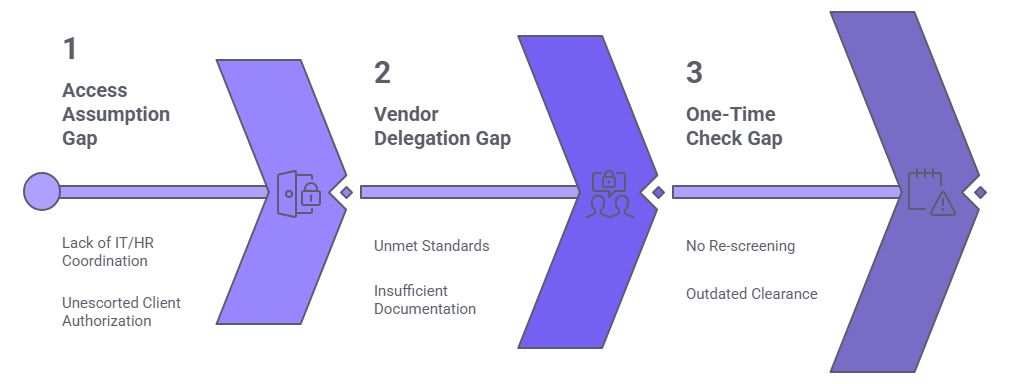
The Access Assumption Gap
Organizations assume that a contractor with facility badge access, system credentials, or client-facing authority cleared screening before those access grants went out. In practice, IT, facilities, or operations teams manage access grants and do not coordinate with HR screening programs. A contractor may receive full facility access, administrative system credentials, or unescorted client site authorization without anyone verifying their background. In a negligent hiring claim, the organization must show it exercised reasonable care. An access grant with no associated screening record is the opposite of that showing.
The Vendor Delegation Gap
An organization that engages contractors through a vendor or platform and relies on the vendor’s own screening program to satisfy its duty of care is making three simultaneous assumptions: that the vendor’s program meets its standard, that the vendor ran the check on the specific individual being placed, and that the check is current enough to be reliable. None of those assumptions hold without contractual specification and documentation. The vendor delegation gap is not a risk transfer. It is an unmanaged assumption presented as a compliance practice.
The One-Time Check Gap
Organizations that screen contractors at initial engagement and never re-screen accumulate the same between-check gap that continuous monitoring programs address for volunteers. Consider a contractor re-engaged annually for three years without re-screening. Their clearance is three years old. Any arrest, conviction, registry listing, or license suspension during that period stays invisible to the organization. Each re-engagement is a new screening event. Treating it otherwise creates exactly the undisclosed history gap that a current check is designed to close.
Building a Contractor Screening Framework That Does Not Create Misclassification Risk
A contractor screening framework can avoid the behavioral and economic indicators that courts examine in misclassification analysis while still satisfying the safety and compliance obligations that justify screening. Three framework design principles maintain the screening obligation without creating classification signals.
Screen for Access, Not for Control
The justification for screening a contractor is the access they have to facilities, data, clients, and organizational assets. It is not the organization’s desire to control how the contractor works. A screening program framed around access level rather than worker behavior or work method avoids the control indicators that courts examine in misclassification analysis. The program answers one question: does this contractor’s background support the access level we are granting?
Use Access-Tier Language in Contractor Agreements, Not Employment Language
Contractor screening requirements should appear in vendor agreements and onboarding documents as facility access requirements and data security obligations, not as employment conditions. A clause stating that access to client facilities requires criminal history and identity verification reads as a security requirement. A clause stating the contractor must pass the company’s employment background check reads as an employment condition. This distinction reflects how courts analyze control indicators. It reduces, but does not eliminate, misclassification risk. Organizations should confirm their specific contract language with qualified legal counsel before implementation.
Document the Business Purpose for the Access Requirement
The organization’s file should contain a documented rationale for each contractor screening requirement. That rationale should reference facility security policy, data protection obligations, or client contractual requirements rather than employment standards. This documentation serves two purposes. First, it supports the access-based framing that makes the screening requirement classification-neutral. Second, it provides the negligent hiring defense by showing that the organization identified the access risk and took a documented step to address it.
The Contractor Screening Stack: What to Check and When
A defensible contractor screening program applies across three phases of the contractor engagement lifecycle. Verification components and timing vary by access level and re-engagement status.
Pre-Engagement
For any contractor with facility, system, or client access, the pre-engagement stack includes:
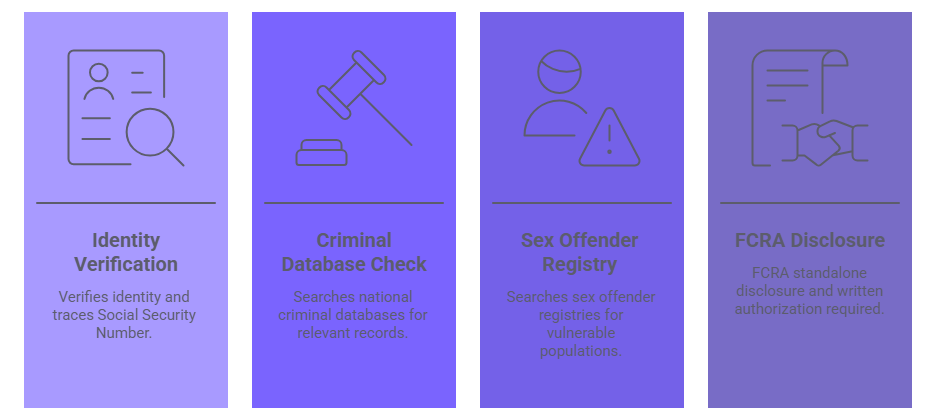
- Identity verification and SSN trace.
- National criminal database check.
- Sex offender registry search where access involves vulnerable populations or sensitive environments.
- FCRA standalone disclosure and written authorization before any CRA-ordered check begins.
For contractors with elevated access, including IT system credentials, financial system access, sensitive data handling, or direct client relationship management, the pre-engagement stack adds:
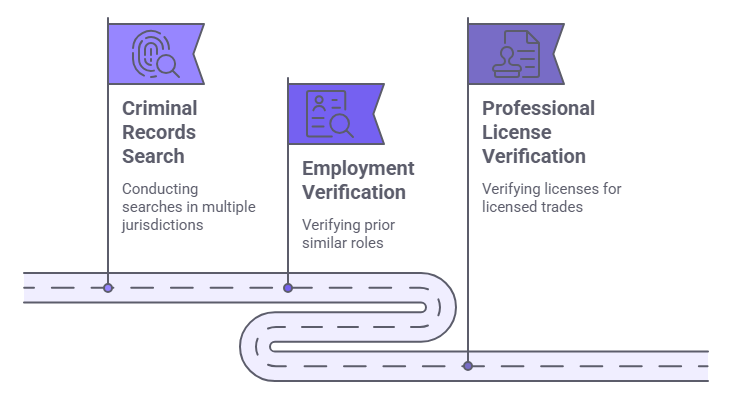
- Multi-jurisdiction county and state criminal records search.
- Employment and engagement verification for prior similar roles.
- Professional license verification where the engagement involves a licensed trade or profession.
At Re-Engagement
Each new contract period or engagement renewal is a new screening event. A contractor re-engaged for a second year needs a new standalone FCRA disclosure, new written authorization, and a new check if a CRA conducts it. The new disclosure must accurately describe the scope of the check being ordered. A prior-season disclosure covering only the initial pre-engagement check may not satisfy this requirement for a re-engagement refresh that covers additional components. The elapsed time since the last check and the nature of the access being granted determine how comprehensive the re-engagement check needs to be. For contractors with elevated or continuous access, the standard should default to a full refresh of the pre-engagement stack.
Vendor and Platform Contractor Screening Specification
For contractors placed through a vendor, platform, or staffing agency, the engagement contract must specify exactly what screening components are required, which party handles FCRA disclosure and authorization, how the engaging organization will verify that screening occurred, and what documentation the vendor must deliver before placement. This specification is not a formality. It is the only mechanism that turns the vendor delegation assumption into a documented, enforceable compliance standard.
When a screening finding leads the organization to decline or terminate a contractor engagement and a CRA conducted the check, the contractor is entitled to a pre-adverse notice with a copy of the consumer report and the Summary of Rights Under the FCRA. The contractor must also have a waiting period of generally at least five business days per CFPB and FTC guidance. After that period, the organization must issue a final adverse action notice that identifies the CRA by name, address, and telephone number, states that the CRA did not make the adverse action decision, and informs the contractor of their right to a free copy of the report within 60 days and their right to dispute its accuracy or completeness.
Where the Contractor Screening Gap Is Most Acute
Four organizational contexts create the highest contractor screening liability exposure. In each, the gap between assumed screening status and actual screening status is widest.
| Context | Primary Risk | Key Screening Components |
| IT and technology contractors | Data breach, fraud, synthetic identity in remote onboarding | Criminal history search with attention to fraud and computer crime categories, subject to individualized assessment before any adverse decision; identity verification; credential verification |
| Facility and maintenance contractors | Negligent hiring for physical access incidents | Access-tiered criminal search, identity verification, license verification where applicable |
| Client-facing and relationship contractors | Reputational and contractual liability, client contract certification requirements | Full access-tier stack, engagement verification, professional license verification |
| Gig economy and platform contractors | Access assumption gap at its most acute | FCRA disclosure and authorization, identity verification, criminal history, platform screening gap documentation |
In each of these contexts, the engaging organization cannot rely on platform or vendor screening built for platform liability to satisfy its own duty of care. The access assumption gap is most acute where the informality of the engagement model creates the strongest impression that someone else has already addressed a compliance obligation that has not been addressed at all.
Conclusion
The contractor screening gap is not a policy gap. It is a structural program design failure that most organizations have never examined because their screening program was built around the employment relationship and contractors fall outside it by default. The access profile, liability exposure, and legal duty of care that justify screening do not turn on classification. A contractor screening framework built around access level rather than worker status, documented as a security and compliance requirement rather than an employment condition, and applied consistently across engagement and re-engagement cycles is both legally defensible and classification-neutral.
Frequently Asked Questions
With an increase in the number of contractors and freelancers, issues related to screening, compliance, and accountability have been arising for HR professionals and even managers. The following Frequently Asked Questions aim to answer key concerns and provide advice on developing screening procedures that comply with the law.
Does FCRA apply to background checks on independent contractors?
FCRA may apply when a CRA conducts the check and the engaging organization uses the result to make an engagement decision. The key variable is degree of control and the purpose of the check, not the contractor’s tax classification. Organizations running contractor checks through a CRA should treat FCRA compliance as the operationally safer default and confirm applicability with qualified legal counsel.
Can a company require a background check on an independent contractor without creating an employment relationship?
Yes, when the requirement is framed correctly. A screening requirement based on facility access level and data security obligations is more likely to be characterized as a security requirement in misclassification analysis. This framing reduces, but does not eliminate, misclassification risk. Organizations should confirm their specific contract language with qualified legal counsel.
What background checks should an organization run on independent contractors?
The screening stack should match the contractor’s access profile. Contractors with any facility, system, or client access need identity verification, a national criminal check, and FCRA-compliant disclosure and authorization. Elevated access roles add multi-jurisdiction county records, engagement verification, and professional license verification where applicable.
How often should independent contractors be re-screened?
Each re-engagement or contract renewal is a new screening event. A contractor re-engaged for a second year requires a new FCRA disclosure, new authorization, and a new check if a CRA conducts it. Elapsed time since the last check and the nature of the access being granted determine how comprehensive the re-engagement check needs to be.
What happens if an organization does not screen an independent contractor who causes harm?
In many jurisdictions, an organization that engages a contractor and knew, or reasonably should have known, that the contractor posed a foreseeable risk may face negligent hiring liability for harm the contractor causes. The absence of a screening record is evidence of failure to exercise reasonable care. Organizations should confirm the applicable negligent hiring standard in their jurisdiction with qualified legal counsel.

ABOUT THE CREATOR
Charm Paz, CHRP
Recruiter & Editor
Charm Paz is an HR professional at GCheck, specializing in background screening, fair hiring, and regulatory compliance. She holds from the Professional Background Screening Association (PBSA) and helps organizations navigate employment regulations with clarity and confidence.
With a background in Industrial and Organizational Psychology, she translates policy into practice to build ethical, compliant, human-centered hiring systems that strengthen decision-making over time.