

An automated reference check is a background screening process that sends former employers and supervisors a structured digital questionnaire instead of relying on a recruiter to reach them by phone, with responses compiled into a standardized report. Under the Fair Credit Reporting Act, a reference check run by a third-party consumer reporting agency is typically an investigative consumer report, which carries its own disclosure and authorization requirements before an employer can request one.
Key takeaways
- Automated reference checks replace recruiter phone calls with structured digital questionnaires sent by email, text, or portal, and the responses are compiled into a standardized report.
- When a third-party provider conducts the reference check, federal law generally treats it as an investigative consumer report, which triggers specific disclosure obligations under the FCRA.
- Candidates authorize the process before any reference is contacted, and references answer the same question set so responses can be compared fairly across candidates.
- Manual reference calling has traditionally taken a recruiter thirty minutes to over an hour per reference, spread across several days of scheduling.
- Automation does not remove the legal responsibilities tied to reference checking. It changes how the outreach happens, not what an employer is required to disclose.
What an automated reference check is and how it differs from a manual reference check
A manual reference check runs on a recruiter’s calendar. The recruiter calls a former supervisor, tries to reach them between meetings, and works through a short list of questions verbally, taking notes as the conversation moves. In a widely cited 2008 account of the traditional process, SHRM reported that a recruiter typically spends thirty minutes to over an hour calling roughly three references over a period of three or four days, largely because reaching someone by phone during business hours is itself the bottleneck. The mechanics of a phone-based reference check have not changed much since then, which is why the description still holds.
| Manual reference check | Automated reference check | |
| Point of contact | Recruiter phone call | Digital questionnaire (email, text, or portal) |
| Typical timeline | Three to four days, per SHRM’s 2008 account | Same day to a few days, once the reference responds |
| Channels used | Phone only | Email, text, phone, and portal, depending on the reference’s preference |
| Recruiter’s role | Places and repeats calls | Reviews completed responses and follows up with non-responders |
What stays the same
The underlying goal has not changed. Both approaches exist to confirm employment history and gather a former supervisor’s perspective on a candidate’s performance and conduct. What changes is the mechanism: a synchronous phone conversation becomes an asynchronous written response, and a recruiter’s limited calling hours become a system that can reach a reference at any time of day. The reference is still being asked to vouch for someone they worked with, and the employer is still trying to confirm what a resume and an interview cannot show on their own.
Reaching references through more than one channel
Reaching a reference through the channel they actually use, rather than defaulting to a single phone number, is a meaningful part of why automated outreach tends to produce a higher completion rate than a single recruiter working down a call list. Most automated systems support:
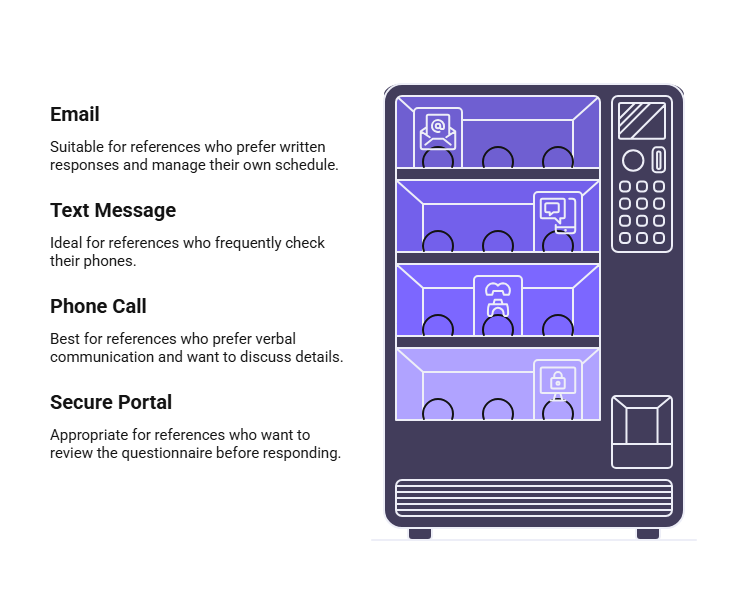
- Email, for references who prefer to respond in writing on their own schedule.
- Text message, for references who check phones more often than inboxes.
- A short phone option, for references who prefer to talk something through.
- A secure portal, for references who want to review the questionnaire before responding.
What a compliant automated reference check workflow looks like end to end
A structured automated reference check generally moves through four stages, and each stage exists to solve a specific failure point in the manual process.
| Stage | What happens |
| Intake and authorization | The candidate’s information and the reference’s name, contact details, and relationship to the candidate are submitted into the system. The candidate must have already received the required disclosure and given consent before any reference is contacted, not after the fact. |
| Outreach | Once authorization is confirmed, the system sends the reference a request through whichever channels the workflow supports, along with clear instructions for how to respond and an assurance of how their answers will be used. |
| Collection and tracking | As responses come in, the system logs completion status against each reference, giving the recruiter one place to see who has responded, who has not, and who may need a follow-up reminder. |
| Standardized reporting | The results are compiled into a report that presents every reference’s answers in the same format, so a hiring manager can compare feedback across candidates without reconciling differently structured notes. |
What information automated reference checks actually collect
A structured reference questionnaire typically confirms basic employment facts, then asks the reference to describe the candidate’s performance and conduct in more depth:
- Dates of employment and job title
- Whether the reference held a supervisory relationship to the candidate
- Job performance and reliability, often rated on a scale
- Professional conduct and teamwork, usually captured through short written responses
- Eligibility for rehire, where the reference is in a position to answer
Because every reference for every candidate answers the same question set, the resulting responses are directly comparable in a way that unstructured phone notes rarely are. One recruiter’s handwritten summary of a phone call inevitably reflects what that recruiter thought to ask and what the reference happened to volunteer, while a standardized questionnaire asks every reference the same things in the same order regardless of who conducts the outreach.
Telling candidates plainly what a reference will be asked and why is the foundation of Transparent Compliance: candidates should never have to guess what a former supervisor might be asked about them, and a standardized questionnaire makes that scope visible and consistent up front.
A fixed question set also limits the risk of a reference conversation drifting into territory that has nothing to do with the job. A recruiter working from memory on a phone call can inadvertently ask about topics unrelated to job performance, while a reviewed, structured questionnaire keeps every reference interaction anchored to the same job-related categories.
Are reference checks consumer reports under the FCRA
This is the part of automated reference checking that vendor marketing pages rarely address, and it is the piece employers most need to understand. The Fair Credit Reporting Act defines a category called an “investigative consumer report,” covering information about a consumer’s character, general reputation, personal characteristics, or mode of living gathered through personal interviews with people who know them, such as former supervisors, coworkers, or associates (15 U.S.C. §1681a(e)). A reference check that asks a former supervisor to describe a candidate’s conduct and performance generally falls within that definition when a third-party consumer reporting agency is the one collecting it, whether the exchange happens by phone or through a written questionnaire.
That classification is not a technicality. It is the reason reference checks conducted through a screening provider carry specific legal obligations that a recruiter’s own informal phone call to a friend-of-a-friend reference would not. An employer running reference checks entirely in-house, without a third-party provider, generally sits outside these specific FCRA obligations, though state law may still apply.
| FCRA provision | Requirement | What it means for automated reference checks |
| 15 U.S.C. §1681a(e) | Defines an “investigative consumer report” as one built on personal interviews about character, reputation, or conduct | A structured reference questionnaire generally fits this definition when run through a third-party provider |
| 15 U.S.C. §1681d(a)(1) | The consumer must be clearly and accurately told, in writing, that such a report may be made, within three days of the report being first requested | The disclosure has to go out before or immediately alongside the first reference request, not after |
| 15 U.S.C. §1681d(a)(2) | The requesting party must certify to the consumer reporting agency that the required disclosures were made | An employer cannot simply instruct a provider to run reference checks without having already given proper notice |
| 15 U.S.C. §1681l | Adverse information from a personal interview cannot carry into a later report unless re-verified or received within the prior three months | A provider running repeat reference checks on returning candidates has to track this timing rather than reuse an earlier answer |
State law can add further requirements
Federal law sets a floor, not a ceiling. Several states, including California, have their own investigative consumer reporting statutes that impose disclosure, consent, or reporting obligations beyond what the federal FCRA requires, and the specifics vary by state. A reference-check program built only around federal requirements can still fall short of a particular state’s rules, so the applicable state law needs its own review for any state where a reference is being contacted.
What consent and disclosure automated reference checks require
Authorization sits upstream of every reference request. Before any reference is contacted, the candidate needs to have received the FCRA-required disclosure and given written consent for the investigative consumer report to be made. This is separate from the general consumer report disclosure many candidates already see for a standard background check, and combining the two disclosures into a single document is a frequent source of FCRA disclosure litigation, so combined-disclosure language should be reviewed by counsel rather than assumed to be compliant by default.
Proper consent accomplishes three things at once:
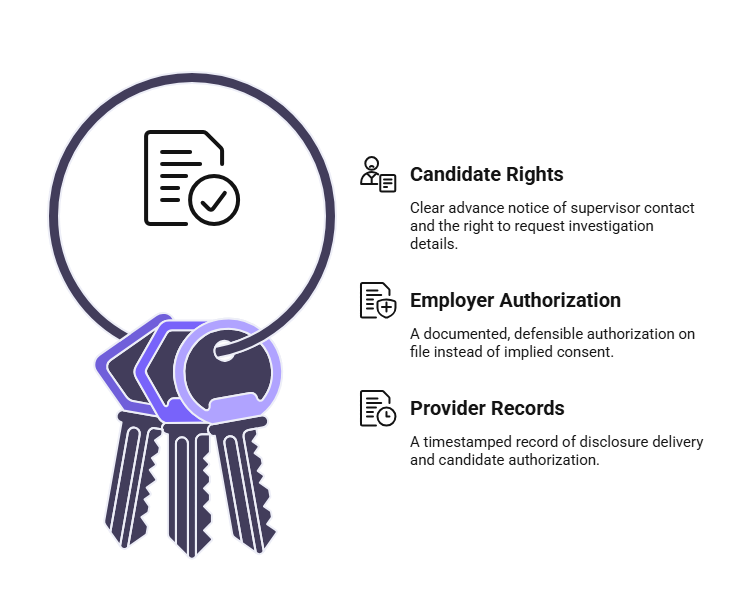
- For the candidate: clear, advance notice that a former supervisor may be asked to describe their conduct and performance, plus the right to request more detail about how the investigation was conducted.
- For the employer: a documented, defensible authorization on file, rather than an assumption that consent was implied because the candidate applied for the job.
- For the screening provider: a timestamped record of when the disclosure was delivered and when the candidate authorized the process.
A properly built automated reference check workflow captures this authorization as a discrete step before any outreach happens. That record is what an employer would need to produce if a candidate later disputed that a reference was contacted without their knowledge.
The timing of this authorization matters as much as its content. A disclosure delivered after a reference has already been contacted does not satisfy the FCRA’s requirement, so the workflow has to gate outreach behind confirmed consent rather than treating consent as paperwork to collect afterward.
How automation changes reference check speed and consistency
Speed and consistency are the two outcomes most reference-check automation is built to improve, and they come from different parts of the process:
- Speed comes from removing the scheduling dependency. A phone-based reference check can only move as fast as a recruiter’s calendar and a reference’s availability overlap, which is why SHRM’s 2008 account of the manual process points to days of back-and-forth for what amounts to a handful of short conversations. An automated system sends the request the moment authorization is complete, and the reference can respond outside business hours, on a mobile device, whenever they have a few minutes. The bottleneck shifts from availability to willingness to respond, which is generally a shorter delay.
- Consistency comes from the structure of the questionnaire itself, not from the fact that a computer sent it. A recruiter reading from the same list of questions on every call could, in principle, achieve similar consistency, but phone conversations drift, follow-up questions vary, and note-taking is imperfect in practice. A structured questionnaire holds the same shape every time, regardless of who is reviewing the response.
That consistency is what makes the resulting reports genuinely comparable across candidates and gives a hiring team a defensible record to point to if a decision is later questioned.
Neither improvement depends on the other. A team could adopt structured questions without automating outreach and gain consistency without gaining speed, or automate outreach around an unstructured set of open questions and gain speed without gaining consistency. Automated reference checks generally aim to capture both at once.
How reference data is tracked and secured through the process
An automated reference check generates a paper trail. Centralized tracking means that record lives in one place rather than scattered across a recruiter’s email, phone log, and personal notes, which matters both for day-to-day visibility and for reconstructing what happened if a decision is challenged later. The trail typically includes:
- The authorization the candidate gave, and when
- The timestamp and channel of each reference request
- Whether and when each reference responded
- The completed questionnaire itself
Because reference responses can include a former supervisor’s candid assessment of someone’s performance and conduct, access to that data should be limited to the people who have a legitimate reason to see it, and it should be retained only as long as it serves that purpose. That documentation is what Protective Compliance looks like in practice: consent handled properly, data limited to those who need it, and a record that holds up if it is ever questioned, for the candidate as well as the employer.
Retention policy deserves the same attention as collection. A reference report that stays in a system indefinitely after a hiring decision is made expands the pool of people who could later access sensitive commentary about a candidate, long after that commentary served its original purpose.
Who typically uses automated reference checks
Recruiting teams and HR departments running any regular volume of hiring are the most common users, largely because the time savings compound. A single reference check might take a recruiter an hour of phone tag to complete manually; multiply that across dozens of open roles and the hours add up quickly.
| Organization type | Why automation tends to help |
| High-volume hiring (retail, hospitality, staffing) | Manual reference coordination is one of the first parts of the hiring process to break down when application volume spikes |
| Enterprise HR with steady hiring | Time saved on manual reference calling compounds across many open roles at once |
| Smaller employers with occasional hiring | The same consent and questionnaire workflow applies regardless of volume, so the process still holds up even without frequent use |
What changes across organization size is less the workflow itself and more how much time it saves relative to the alternative. A company hiring once a quarter feels the benefit differently than one hiring continuously, but both are subject to the same disclosure and authorization requirements described above.
Frequently asked questions
What is an automated reference check?
An automated reference check is a background screening process that sends former employers and supervisors a structured digital questionnaire, rather than having a recruiter call them directly. References respond by email, text, or through a secure portal, and their answers are compiled into a standardized, comparable report for the hiring team.
Do automated reference checks require candidate consent?
Yes. Before any reference is contacted, the candidate needs to have received the disclosure the FCRA requires for an investigative consumer report and given written authorization. This disclosure and consent step applies whether the reference check is conducted manually or through an automated system, since the legal requirement attaches to the type of report being prepared, not the method used to collect it.
Are reference checks considered consumer reports under the FCRA?
Often, yes. When a third-party consumer reporting agency collects information about a candidate’s character, conduct, or performance through interviews with former supervisors or coworkers, that report generally falls under the FCRA’s definition of an investigative consumer report, which carries its own disclosure and certification requirements separate from a standard background check.
How much faster is an automated reference check compared to a phone call?
Manual reference checking has traditionally taken a recruiter thirty minutes to over an hour per reference, spread across three to four days of scheduling and phone tag, according to a 2008 SHRM account of the process that still describes how phone-based reference checking works today. Automated reference checks remove the scheduling dependency by sending the request immediately and letting the reference respond on their own time, which typically shortens the completion window from days to a shorter turnaround.
Can automated reference check responses be compared across candidates?
Yes, and this is one of the clearest advantages of a standardized approach. Because every reference answers the same structured question set, responses can be compared side by side across candidates for the same role, which is difficult to do reliably with phone notes that vary based on what each recruiter happened to ask and what each reference happened to volunteer.
Who uses automated reference checks?
Recruiting and HR teams handling any regular volume of hiring are the most common users, since the time saved on manual reference calling compounds across open roles. High-volume hiring environments such as staffing and retail tend to benefit most directly, though the same consent and questionnaire structure works equally well for employers with occasional hiring needs.
Sources cited
- 15 U.S.C. §1681a(e), Fair Credit Reporting Act, definition of investigative consumer report.
- 15 U.S.C. §1681d, Fair Credit Reporting Act, disclosure of investigative consumer reports.
- 15 U.S.C. §1681l, Fair Credit Reporting Act, restrictions on investigative consumer reports (repeat-report verification window).
- Fox, A. (2008, October 22). Automation Can Help Ease the Pain of Reference Checking. SHRM.
- Consumer Financial Protection Bureau, FCRA Examination Procedures manual, section on investigative consumer reports.

ABOUT THE CREATOR
Charm Paz, CHRP
Recruiter & Editor
Charm Paz is an HR professional at GCheck, specializing in background screening, fair hiring, and regulatory compliance. She holds from the Professional Background Screening Association (PBSA) and helps organizations navigate employment regulations with clarity and confidence.
With a background in Industrial and Organizational Psychology, she translates policy into practice to build ethical, compliant, human-centered hiring systems that strengthen decision-making over time.