

Key Takeaways
- Among the 1,272 workers in our survey who had a coworker whose behavior consistently made work worse, 38% said nothing happened to that person and 23% said they were rewarded, promoted, or protected.
- Workers quit before their difficult coworker did four times as often when the company rewarded or protected that coworker (40%) as when it removed them (10%).
- Seniority changes the response. Managers and senior leaders were rewarded or protected in 36% of cases and removed in 21%, while junior coworkers faced almost the reverse odds.
- Workers want enforcement, not leniency. Their top two requests are managers stepping in early and consequences that apply even to strong performers.
- HR can document all of this, but acting on it often requires authority that belongs to leadership.
Turnover shows up in the budget. The reason for it rarely does.
Most companies can tell you what they spent replacing people last year, down to the dollar. Far fewer could tell you whether any of those exits trace back to one person that half the team had already complained about and quietly learned to work around.
We wanted to know how often that happens. GCheck’s Consequence Gap report surveyed 1,500 US workers in August 2026, and the questions were deliberately narrow. We asked about one coworker: the person whose behavior consistently made everyone else’s work life worse. Eighty-five percent of workers said they have had one.
Then we asked the part that usually goes unexamined. What happened to that person?
Among the 1,272 workers who had such a coworker, 38% said nothing happened at all. Another 23% said the person was rewarded, promoted, or protected. Only 36% watched them leave or get removed. Put those three numbers side by side and the shape of the problem becomes clear: most of the time the person causing the damage stays exactly where they are, and a meaningful share of them come out ahead.
We call that distance the consequence gap. It measures how hard a workplace has become on everyone against how hard it actually gets on the one person making it worse.
Background checks are what GCheck does for a living, so I want to be precise about what that work actually covers. Screening confirms who someone says they are: their identity, where they’ve worked, what licenses they hold, and whether their record is clean. Some of our clients also run ongoing monitoring to keep that information current. But it can’t tell you whether that person is decent to sit next to every day. That’s a separate problem, and it’s exactly where this report picks up.
I doubt the problem is a missing policy. Almost every company has one. What our survey measured is what happens after the behavior becomes obvious to everyone in the room.
Who Actually Pays for a Difficult Coworker

We asked a simple question with an uncomfortable answer. Who left the job first, you or that coworker?
The responses split along a clean line, and the company drew it.
Where the difficult coworker had been rewarded or protected, 40% of the workers around them quit first. Where the company removed that coworker, the figure fell to 10%. That is four times the exits, and the variable that moved was the company’s response.
I want to be careful about what that shows. A survey captures what people say they saw and what they say they did next, so it can establish a relationship without settling the direction of it. We cut the data several ways looking for the pattern to break. It held.
SHRM put a national price on this some years ago, estimating that bad workplace culture cost US employers as much as $223 billion in turnover across five years (SHRM, 2019). That research stands on its own and I would not stretch it to cover ours. A number that large tells you the problem is expensive. It cannot tell a manager where to look on Monday morning, and that is the part our survey gets closer to.
Think about how each of these outcomes registers inside a company. A promotion is visible. So is a firing. When the answer is that nothing happened, there is no event to point at and no decision to review. No wonder it was the most common answer we received, and the easiest one for leadership to miss. One worker, asked what finally pushed them out, put it this way:
“The last straw was disrespect and nothing was done and it was brushed under the rug.” – a GCheck Consequence Gap survey respondent, describing a coworker whose behavior went unaddressed
Seniority changed the picture considerably.
| Who caused the problem | Rewarded or protected | Removed or left |
| A manager or senior leader (119 cases, directional) | 36% | 21% |
| A peer (603 cases) | 20% | 37% |
| A more junior coworker (342 cases) | 24% | 41% |
Workers watched senior people get protected more often and removed less often than junior people causing the same kind of damage. Most difficult behavior still comes from a peer at the next desk rather than from a boss. But the further up it goes, the gentler the response gets.
I would stop short of calling that a policy failure. It does raise a question that deserves to be asked out loud in a leadership meeting. Does our conduct standard hold at every level, or only below a certain one? One worker described the answer she lived with:
“I ended up moving to a different department. There was a union grievance filed against her. She was taken out of a supervisory role and given a higher-paying position. Now our team has moved to the building she is in, and we have to see her, though we were told that would not happen.” – a GCheck Consequence Gap survey respondent, whose manager was rewarded or protected
The damage follows the same line. Three in four workers with a difficult manager said they came to dread the workday, against roughly half of the workers whose problem coworker was a peer. So the cases companies are least willing to touch are the ones doing the most harm, and they are the same cases where good people start looking for the door.
HR Can Document the Problem. It Can’t Always Fix It.
HR can write the conduct policy. HR can take the complaint and run the investigation. HR can document what it finds and recommend what should happen next. That work is real, and the people who do it take it seriously.
Then the limits arrive. A promotion decided two levels up stays decided. A business unit protecting someone with strong numbers keeps protecting them. That person’s output appears on a dashboard every month, while the cost of keeping them appears nowhere at all.
That imbalance is why I think this belongs on the leadership agenda rather than the HR one. A problem filed as a culture project tends to stay filed.
There is a measurement habit underneath it, too. Companies watch performance closely and ask a clear question about it every quarter: did this person hit their numbers? Conduct gets no equivalent question and no equivalent owner. A missed deadline turns up in a report within the week. A manager who hits every target while making the team miserable can go years without a single note in a file.
Difficult people do leave, and often. When we asked who tends to go first, 44% of workers said the strongest performers do. Among the 630 workers whose experience is now behind them, the record came out more mixed: 57% said the difficult coworker left before they did.
So the fear runs worse than the average case. The exception is where the money goes. When a company protects that person instead of acting, the exits move to everyone else, and those are the people it was trying to keep.
What Workers Say Would Actually Help
We gave workers a list and asked what would keep this kind of behavior from spreading. They ranked it this way:
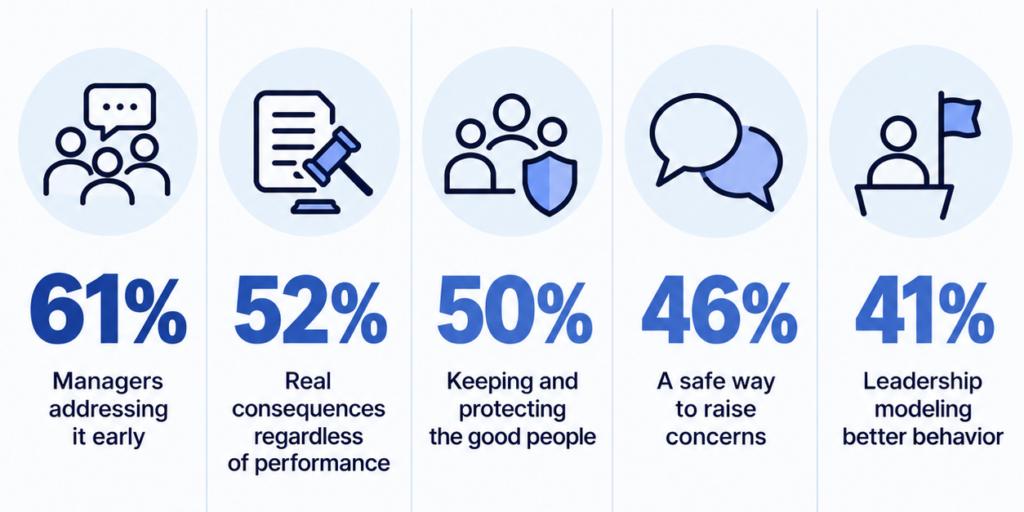
- Managers addressing it early: 61%
- Real consequences regardless of performance: 52%
- Keeping and protecting the good people: 50%
- A safe way to raise concerns: 46%
- Leadership modeling better behavior: 41%
Look at what they chose. Every item asks for firmer enforcement. The second one asks for something most companies do not currently practice: a consequence that lands even when the person is hitting their targets. Workers named the rank pattern themselves, and that is their answer to it.
What they want is consistency. Nearly every company believes it already delivers that. A written policy is easy to produce. Real consistency is not, and most workplaces never get there.
Closing this starts with one question, asked out loud, by someone senior enough that the answer carries weight. Do we hold the difficult person everyone protects to the same standard as the one nobody defends? Most companies can produce a policy on request. Far fewer can answer that question honestly.
Left alone, this spreads. The team is watching to see what happens next, and whatever they see becomes the standard they work to. Hold the person who broke that standard accountable, and everyone else stops paying for it.
Frequently Asked Questions
What is the “consequence gap” at work?
The consequence gap is the distance between how hard a workplace has become on employees generally and how hard it actually gets on the one coworker whose behavior is the problem. In GCheck’s Consequence Gap report, a survey of 1,500 US workers, 85% said they had worked closely with such a coworker. Most of those coworkers faced no consequence or came out ahead.
How does unaddressed behavior relate to employee turnover?
Workers report a strong link. Where a difficult coworker was rewarded or protected, 40% of the 283 workers around them quit before that coworker did. Where the company removed the coworker, only 10% of 476 workers did. The finding is self-reported, so it establishes a link rather than proof of what caused what.
Are senior employees treated differently than junior employees for the same behavior?
Workers describe a clear difference by rank. Managers and senior leaders were rewarded or protected in 36% of reported cases and removed in 21%. Junior coworkers faced almost the reverse odds, at 24% protected and 41% removed. The more senior the person, the more often workers watched them get protected.
What do employees say would actually help?
Two answers outrank the rest: managers stepping in early (61%) and consequences that hold regardless of the person’s performance (52%). Both ask for firmer enforcement. Workers are asking companies to apply the standard they already claim to have.
Why can’t HR solve this alone?
HR can write policy, investigate a complaint, and recommend an outcome. It usually cannot reverse a promotion decided above it or impose one standard on a team protecting a strong performer. Because those decisions belong to leadership, closing the gap generally takes leadership working alongside HR.

ABOUT THE CREATOR
Houman Akhavan
Founder and CEO, GCheck
Houman Akhavan is the Founder and CEO of GCheck, a hire-to-retire screening platform built on the principle of Compliance for Good®. He is and serves on the boards of two NASDAQ-traded companies (POWW and CDON.ST), where he contributes to audit, compensation, and corporate governance.
With more than 25 years of experience building and scaling technology businesses, Houman brings a rare combination of operational discipline and compliance expertise to the background screening industry. Previously, as Chief Marketing Officer at CarParts.com (NASDAQ: PRTS), he directed $50M+ annual budgets and helped lead the company through a significant period of digital transformation and growth. He also served on Google's Retail Advisory Council.
Houman founded GCheck on a straightforward belief: background screening should be fast, fair, and transparent for both employers and candidates. He lives and works in the Los Angeles area.