
LEGAL & COMPLIANCE

Ensure compliance with I-9 verification. Discover the crucial steps for document acceptance and record retention for US employers.
Created by

I-9 verification is required for every new hire in the United States regardless of citizenship, company size, or industry, yet it remains one of the most frequently mishandled compliance obligations in American employment law. This guide covers the complete I-9 verification process, from document acceptance rules and timing requirements through remote verification, record retention, anti-discrimination obligations, and audit readiness.
I-9 verification is the federally required process by which employers confirm that every person they hire is legally authorized to work in the United States. The requirement originates from the Immigration Reform and Control Act (IRCA) of 1986 and is administered by U.S. Citizenship and Immigration Services (USCIS). Every employer in the United States, regardless of size or industry, must complete Form I-9 for every new hire, including US citizens and lawful permanent residents.
There are no exemptions based on company size, and no employee category is excluded except workers hired before November 7, 1986. Failure to comply exposes employers to civil and criminal liability under federal law.
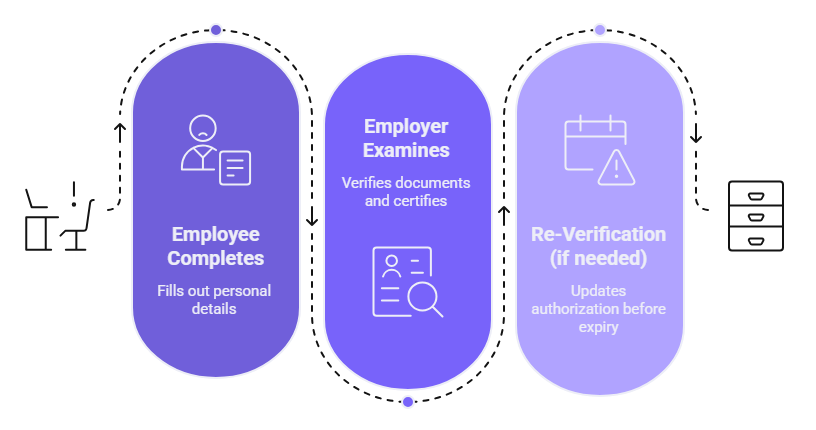
The form has three sections. Section 1 is completed by the employee. Section 2 is completed by the employer after physically examining identity and work authorization documents. Section 3 is used for re-verification when a worker’s employment authorization expires. The legal nuances of document acceptance, timing, anti-discrimination rules, and record retention create substantial compliance complexity for employers of every size.
Exceptions to the I-9 requirement include independent contractors and certain casual domestic employees. IRCA contains separate reporting rules applicable to certain recruiters or referrers for a fee, which are distinct from the I-9 completion requirement.
I-9 compliance is not optional, and enforcement is real. The legal framework rests on IRCA, which prohibits employers from knowingly hiring, recruiting, or continuing to employ individuals who are not authorized to work in the United States. USCIS publishes the rules, but it is U.S. Immigration and Customs Enforcement (ICE) that conducts worksite audits and civil enforcement, while the Department of Justice (DOJ) enforces anti-discrimination provisions through its Immigrant and Employee Rights Section.
| Violation Type | First Offense Range | Notes |
| Paperwork violations (per I-9 form) | $288 to $2,861 | Includes technical errors reclassified as substantive violations |
| Knowingly hiring or employing unauthorized workers (per worker) | $716 to $28,619 | Higher tiers apply for repeat offenses |
| Document fraud (per violation) | $590 to $4,730 (first offense); subsequent offenses up to $11,823 | Per 8 U.S.C. §1324c; adjusted annually for inflation (2025 Federal Register) |
| Pattern or practice of violations | Criminal fines and imprisonment possible | Applies to responsible individuals |
Civil penalty figures reflect the 2025 DHS inflation adjustment and are subject to annual adjustment. Paperwork fines apply per I-9 form; knowing employment fines apply per unauthorized worker. These are distinct penalty categories.
One compliance trap that surprises many employers is that both over-documenting and under-documenting create legal risk. Requesting more documents than required, or demanding specific documents from certain employees, can trigger anti-discrimination investigations. Requesting too few documents, or failing to properly examine what is presented, can result in paperwork violation fines. The legal obligation is precise: accept any valid document from the correct list, examine it in person, and record it accurately.
March 2026 Enforcement Update: On March 16, 2026, ICE reclassified more than 10 error categories previously treated as correctable technical violations into substantive violations subject to immediate fines of $288 to $2,861 per form. These errors are no longer eligible for the statutory 10-day cure period. Employers should review their I-9 programs with qualified immigration counsel to assess exposure under the current enforcement posture.
Legal Notice: Criminal penalties under IRCA can apply to employers who engage in a pattern or practice of knowingly hiring unauthorized workers, including fines and imprisonment for responsible individuals. Civil penalties alone can easily exceed $100,000 for a mid-size employer after a single audit with multiple violations.
The I-9 verification process has three steps: the employee completes Section 1 by the first day of employment, the employer examines original documents and completes Section 2 within 3 business days of the employee’s start date, and Section 3 is used later for re-verification of expiring work authorization.
Acceptable I-9 documents fall into three lists. List A documents establish both identity and work authorization, so one List A document satisfies both requirements. List B documents establish identity only. List C documents establish work authorization only. Employees may present one List A document, or one List B document combined with one List C document.
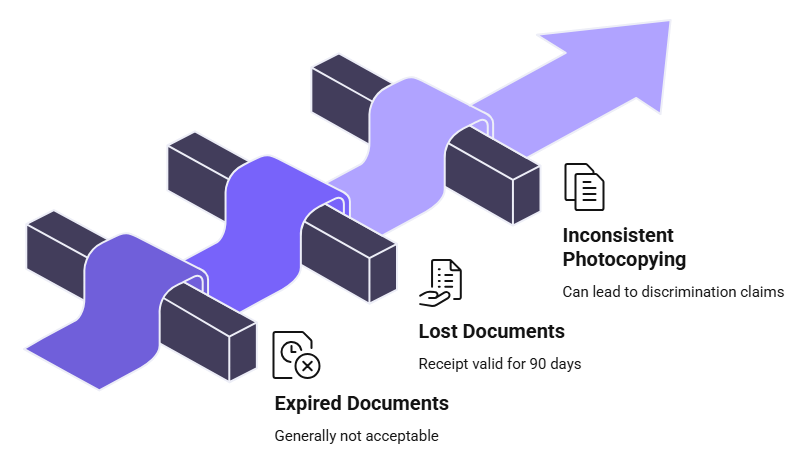
Employers must accept any valid document from the correct list. You cannot tell an employee which specific document to bring, and you cannot reject a valid document because you prefer a different one. Doing so may constitute an unfair documentary practice under IRCA’s anti-discrimination provisions.
| List | What It Establishes | Common Examples |
| List A | Identity AND Work Authorization (one document satisfies both requirements) | US Passport, US Passport Card, Permanent Resident Card (Form I-551), Employment Authorization Document (Form I-766), Foreign Passport with I-94 and valid nonimmigrant status |
| List B | Identity Only (must be combined with a List C document) | State-issued driver’s license, state ID card, school ID with photo, voter registration card, US military card |
| List C | Work Authorization Only (must be combined with a List B document) | Social Security card (unrestricted), Certification of Birth Abroad (Form FS-545), US Birth Certificate |
Document Request Warning: Never tell an employee which specific documents to bring from the acceptable lists. Even a casual instruction such as “just bring your passport” can constitute an unfair documentary practice and expose your organization to a DOJ IER investigation.
For most standard hires, the I-9 timeline works as follows. The employee must complete Section 1 no later than the close of business on their first day of employment for pay. The employee may complete Section 1 before the first day only after a job offer has been accepted. The employer must complete Section 2 no later than 3 business days after the employee begins work for pay.
| Scenario | Section 1 Deadline | Section 2 Deadline | E-Verify Case Creation |
| Standard hire (more than 3 days) | By end of first day of work | Within 3 business days of start | Within 3 business days of start |
| Short-term hire (3 days or fewer) | By end of first day of work | By end of first day of work | By end of first day of work |
| Pre-hire completion (after offer accepted) | Before first day (permissible) | Still within 3 business days of start | Within 3 business days of start |
| Remote hire (E-Verify alternative procedure) | By end of first day of work | Within 3 business days via live video | Within 3 business days of start |
Section 2 of Form I-9 must be completed by the employer or an authorized representative, which USCIS defines broadly as any person the employer designates. The employee cannot verify their own documents. The employer remains legally responsible for Section 2 accuracy regardless of who completes it on their behalf.
An authorized representative can be any person the employer designates, including an HR team member at a different office, a company agent, a staffing agency representative, or a notary public acting as a company agent. USCIS does not require a formal written designation agreement, though maintaining one is a best practice for documenting your compliance program.
Notaries public deserve a specific note: a notary can serve as an authorized representative for I-9 purposes, but they are acting as a company agent, not performing a notarial act. The form should not be notarized. The notary should sign in the employer representative section using their name and address, not a notary seal.
Effective August 1, 2023, DHS implemented an authorized alternative procedure for remote document examination, available exclusively to employers enrolled in E-Verify in good standing. This procedure allows qualifying employers to examine I-9 documents remotely via live video interaction, eliminating the in-person examination requirement for remote employees.
The remote examination process: the employee transmits copies of their documents to the employer or authorized representative before or during the live video session. The employer examines the documents during a live video interaction, verifying that documents reasonably appear genuine and belong to the person presenting them. The employer must retain copies of all documents presented and annotate Section 2 with the phrase “Alternative Procedure” in the Additional Information field.
| DHS Alternative Procedure (E-Verify Employers) | Authorized Representative Model (All Employers) |
| Live video document examination | In-person document examination by designated agent |
| No in-person meeting required | E-Verify enrollment not required |
| Employer must be actively enrolled in E-Verify | Representative can be anyone employer designates |
| Document copy retention required for 3 years from hire or 1 year after termination, whichever is later | Standard retention rules apply |
| Must annotate Section 2 with “Alternative Procedure” | No special annotation required |
| Employer retains full legal liability | Employer retains full legal liability |
Remote Verification Best Practice: If you use the alternative remote procedure, build a checklist into your video examination workflow: confirm employee identity on camera, review both sides of applicable documents such as the I-551, retain screenshots or scans of all documents presented, and document the date and time of the live video examination in your records.
Employers not enrolled in E-Verify cannot use the DHS alternative procedure. For those employers, remote hires still require in-person document examination by an authorized representative in the employee’s local area. Regardless of method, the employer remains fully liable for any errors or omissions in Section 2.
I-9 records must be retained for whichever period is longer: 3 years from the date of hire, or 1 year from the date the employment relationship ends. For a long-tenured employee terminated after 10 years of service, the 1-year post-termination rule applies. For an employee terminated after only 1 year of service, the 3-year-from-hire rule governs.
Retention Formula: Retain I-9 records for whichever period is longer: 3 years from the date of hire, OR 1 year from the date employment ends. Apply this formula to every separated employee to determine the purge date.
Employers may store I-9 forms on paper, microfilm or microfiche, or electronically. Electronic storage systems must meet DHS regulatory standards, which include the ability to reproduce legible copies upon request, a system of controls to ensure integrity and authenticity, an inspection and quality assurance program, and the ability to print the form on demand for government inspectors.
When ICE initiates a worksite audit, it begins with a Notice of Inspection (NOI). Upon receipt of an NOI, employers have only 3 business days to produce all requested I-9 records. This tight window means audit readiness cannot begin after an NOI arrives. It must be built into your compliance program continuously.
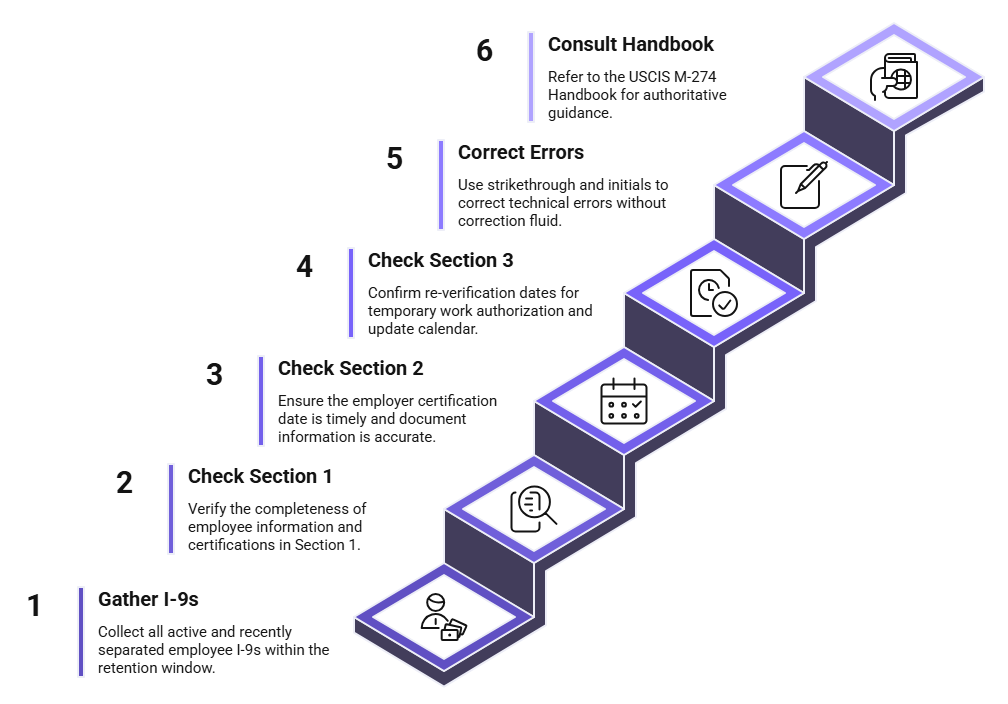
A self-audit is the most effective pre-enforcement tool available to employers. Review all active employee I-9 forms for completeness, accuracy, and timely completion. Correctable technical violations should be corrected using a single line through the error, the correct information entered, and the correction initialed and dated. Never use correction fluid or obliterate the original entry.
IRCA prohibits four discriminatory practices during I-9 verification: citizenship status discrimination, national origin discrimination, unfair documentary practices, and retaliation. The DOJ’s Immigrant and Employee Rights Section (IER) enforces these prohibitions independently of ICE, meaning an IER investigation can begin from a single employee complaint with no connection to an ICE audit.
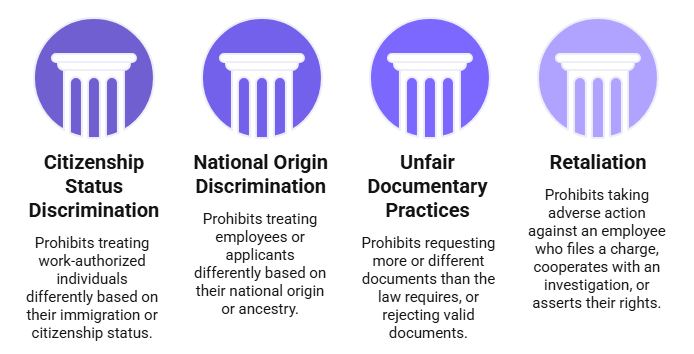
Concrete examples of prohibited behavior include: asking only employees who appear foreign-born to provide a passport in addition to a driver’s license and Social Security card; refusing to accept a valid Employment Authorization Document because the employer is unfamiliar with it; requiring a specific List A document when the employee has already presented a valid List B and List C combination; and terminating an employee for filing a discrimination complaint with IER.
IER Investigation Risk: IER investigations are triggered by employee complaints and do not require an ICE audit to initiate. A single complaint from a work-authorized employee about improper document demands can result in an IER investigation, civil penalties, and mandatory back pay awards.
E-Verify is a federal electronic system that checks I-9 information against Social Security Administration and DHS databases. It is separate from but complementary to Form I-9. E-Verify does not replace Form I-9. Employers enrolled in E-Verify must complete both. The I-9 is the foundational document; E-Verify is a secondary electronic verification layer.
An E-Verify case must be created within 3 business days of the employee’s first day of work for pay, mirroring the Section 2 deadline. E-Verify is voluntary for most private employers but mandatory for federal contractors subject to the Federal Acquisition Regulation E-Verify clause and for all employers in states with all-employer mandates.
| Employer Type | E-Verify Requirement |
| Federal contractors (FAR clause) | Required |
| All employers in states with all-employer mandates | Mandatory |
| State and local government employers (additional states) | Required in many jurisdictions |
| Private employers outside mandate states | Voluntary |
When E-Verify returns a Tentative Nonconfirmation (TNC), it means the information submitted did not match federal records. A TNC does not mean the employee is unauthorized to work. It may result from data entry errors, name changes, or database update delays. Upon receiving a TNC, the employer must notify the employee immediately, give them the opportunity to contest it, and must not take any adverse action, including termination, reduced hours, or delayed start, while the TNC is pending.
The employee has 10 federal government working days to contact SSA or DHS to resolve the mismatch. A Final Nonconfirmation (FNC) means E-Verify could not confirm work authorization after the resolution process. At that point, the employer may terminate the employee and, if the employer continues employment, must notify DHS.
E-Verify State Mandates: States with all-employer E-Verify mandates as of the time of publication include Arizona, Alabama, Georgia, Mississippi, North Carolina, South Carolina, Tennessee, Utah, and Virginia. Mandate coverage changes as state legislation evolves. Confirm current requirements with legal counsel or USCIS E-Verify employer resources.
I-9 verification does not exist in isolation. It is one component of a multi-step onboarding and compliance workflow that also includes background screening, drug testing, and employment eligibility verification. Correct sequencing reduces legal risk and creates a defensible compliance record.
The general sequencing best practice: extend a conditional offer of employment first, making the offer contingent on successful completion of background screening, drug testing, and verification of eligibility to work. Once the offer is accepted, the employee may complete Section 1 of the I-9 before their first day, and the employer should initiate background screening and drug testing at the same time.
Sequencing Tip: Complete the conditional offer first, then initiate I-9, background check, and drug test simultaneously after the offer is accepted. Do not delay I-9 completion waiting for background check results, as that creates a Section 2 timing violation. Handle them as parallel processes, not sequential ones.
If a background check disqualifies a candidate after I-9 has been completed, the I-9 record should be retained according to standard retention rules even if the individual never actually began work for pay. Follow FCRA adverse action procedures independently of the I-9 process.
I-9 verification is not a one-time checkbox. It is an ongoing compliance program that requires timely document examination, accurate recordkeeping, periodic self-audits, re-verification tracking, and a firm commitment to non-discriminatory practices. The core obligations are clear: every new hire requires a completed I-9, Section 2 must be finalized within 3 business days of the start date, records must be retained using the correct formula, and employers must never demand more documentation than the law requires or treat employees differently based on citizenship status or national origin.
Enforcement is real and penalty exposure is significant. The 3-business-day window after a Notice of Inspection arrives is not enough time to build a compliance program from scratch. Build it before you need it.
Yes, with an important condition. Section 1 may be completed by the employee after a job offer has been accepted and before the first day of work. Section 2 may also be completed before the first day, but no earlier than after the offer has been accepted. Completing I-9 before an offer is extended can be construed as pre-employment immigration screening and may violate IRCA anti-discrimination rules.
If an employee cannot produce documents within 3 business days of their start date, the employer faces a compliance risk for each day Section 2 remains incomplete. If an employee has applied for a replacement document, they may present a receipt, which is acceptable for 90 days. After 90 days, the actual document must be presented. Employers should not allow employees to work indefinitely without completing I-9, as doing so constitutes an ongoing paperwork violation.
The official Form I-9 must be completed in English. USCIS provides a Spanish-language version that may be used in Puerto Rico. On the US mainland, a Spanish-language version may be provided to employees for reference, but the completed form retained by the employer must be the English version. Translators or preparers who assist employees with Section 1 must complete the Preparer/Translator Certification block in English.
A completely missing I-9 for an active employee is treated as a substantive violation under ICE audit guidelines, which typically results in a higher fine than a technical paperwork error. Civil penalty amounts for paperwork violations are adjusted annually by DHS and range from $288 to $2,861 per violation for a first offense under the 2025 adjustment schedule. Repeated or widespread missing forms can significantly increase total exposure across a workforce audit.
Independent contractors are not employees and do not require an I-9 from the company engaging them. However, you cannot use the independent contractor classification to avoid I-9 requirements for workers who are actually employees under applicable employment law tests. For staffing agency workers, the staffing agency is the employer of record and is responsible for completing I-9. If an employer knowingly uses a contract labor arrangement to employ unauthorized workers, IRCA liability can extend to the client company.
Re-verification must occur on or before the date the employee’s current work authorization expires. Build a tracking system that generates reminders at least 90 days before expiration. The employee presents a new document establishing continued authorization, and the employer completes Section 3. US citizens and lawful permanent residents with permanent green cards do not require re-verification, even if their Permanent Resident Card carries an expiration date.
Yes. All new employees hired after November 7, 1986, must complete Form I-9, including US citizens and US nationals. The requirement applies to every employee regardless of citizenship or national origin. US citizens typically attest to their status in Section 1 and present a US Passport, US Passport Card, or a combination of a List B and List C document such as a driver’s license and unrestricted Social Security card.
States with all-employer E-Verify mandates as of the time of publication include Arizona, Alabama, Georgia, Mississippi, North Carolina, South Carolina, Tennessee, Utah, and Virginia. Federal contractors subject to the Federal Acquisition Regulation E-Verify clause are required to use E-Verify regardless of state law. State mandate coverage changes as legislation evolves; confirm current requirements with legal counsel or the USCIS E-Verify employer resources.
Recruiter & Editor
Charm Paz is an HR professional at GCheck, specializing in background screening, fair hiring, and regulatory compliance. She holds from the Professional Background Screening Association (PBSA) and helps organizations navigate employment regulations with clarity and confidence.
With a background in Industrial and Organizational Psychology, she translates policy into practice to build ethical, compliant, human-centered hiring systems that strengthen decision-making over time.

Contact us today for efficient, FCRA-compliant screening solutions
designed to keep your hiring process moving safely and smoothly.



LEGAL DISCLAIMER: The information provided in this article is for general informational and educational purposes only and should not be construed as legal advice or a substitute for consultation with qualified legal counsel. While we strive to ensure accuracy, employment screening laws and regulations—including but not limited to the Fair Credit Reporting Act (FCRA), Equal Employment Opportunity Commission (EEOC) guidelines, state and local ban-the-box laws, industry-specific requirements, and other applicable federal, state, and local statutes—are subject to frequent changes, varying interpretations, and jurisdiction-specific applications that may affect their implementation in your organization. Employers and screening decision-makers are solely responsible for ensuring their background check policies, procedures, and practices comply with all applicable laws and regulations relevant to their specific industry, location, and circumstances. We strongly recommend consulting with qualified employment law attorneys and compliance professionals before making hiring, tenant screening, or other decisions based on background check information.