


Manufacturing employers face a version of FCRA compliance shaped by three operational realities that generic employer guides never address: high-volume hiring cycles that compress procedural steps, safety-sensitive role classifications that must inform but cannot replace individualized assessment, and heavy reliance on temp agencies whose FCRA obligations do not substitute for the facility’s own. This article provides the manufacturing-specific framework that plant HR teams and operations directors need to build a defensible screening program.
Key Takeaways
- FCRA applies to every manufacturing employer that uses a consumer reporting agency to screen workers for employment purposes, regardless of facility size, worker classification, or role type.
- Safety-sensitive role status strengthens the nexus analysis in individualized assessment but does not create a right to blanket disqualification. Documented individual review is still required.
- High-volume hiring surges, including shift expansions and new facility openings, are the most common source of systemic FCRA violations in manufacturing. Process design must account for volume.
- When a staffing agency places workers at a manufacturing facility, both the agency and the facility carry independent FCRA obligations. Neither party’s process satisfies the other’s.
- Industry-specific regulations including FSMA, DEA requirements, ITAR, and OSHA PSM create additional screening layers that operate alongside FCRA, not instead of it.
- OEM and Tier 1 supplier contract screening mandates and FCRA compliance are independent obligations. Satisfying one does not satisfy the other.
- A screening policy built for one state may be non-compliant at a facility in another state. Multi-site manufacturers must address state law variability systematically.
- The adverse action two-step process is the most frequently violated FCRA requirement in manufacturing. Skipping the pre-adverse notice under hiring pressure generates statutory damages without requiring the applicant to prove actual harm.
What Does FCRA Require of Manufacturing Employers Before Screening Workers?
The Fair Credit Reporting Act applies to any manufacturing employer that uses a consumer reporting agency to obtain background checks for employment purposes. The statute does not distinguish between industries, facility types, or worker classifications. A plant HR manager who orders a background check through a CRA is using a consumer report for employment purposes and must satisfy all corresponding FCRA obligations. Those obligations follow a defined sequence:
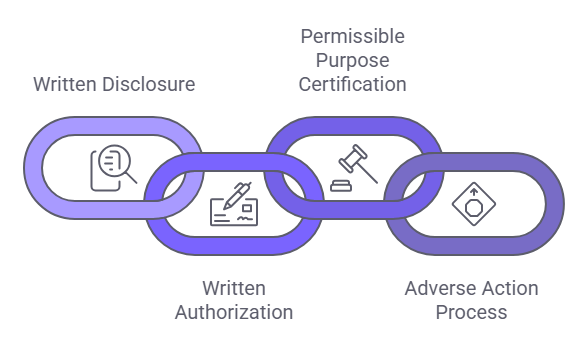
- Provide the applicant with a standalone written disclosure before obtaining the report. The disclosure must consist solely of the disclosure and nothing else.
- Obtain the applicant’s written authorization before contacting the CRA. Authorization must precede screening initiation, not follow it.
- Certify to the CRA that the employer has a permissible purpose and will comply with FCRA requirements.
- If the report is a factor in a decision not to hire, follow a two-step adverse action process: pre-adverse notice first, then a waiting period, then a final adverse action notice.
Where manufacturing programs break down is not in the employer’s understanding of these steps but in the operational environment in which the steps must be executed. Fast-cycle hiring, document-dense onboarding packets, reliance on staffing agencies, and multi-facility policy inconsistency all create conditions where the FCRA framework is technically known but systematically not followed. Readers who need foundational FCRA depth should review the full framework in GCheck’s FCRA compliance hub. This article addresses the manufacturing-specific application layer.
In manufacturing environments, compliance gaps often happen not because teams do not know the rules, but because hiring moves faster than the process was designed to handle. Large-scale hiring, collaboration with staffing agencies, and safety-sensitive positions make the process more complex and are issues that are not always considered by generic hiring systems. The best companies are those that can create processes that can remain consistent even when put under pressure. �
Safety-Sensitive Role Classification: How It Shapes Screening and Individualized Assessment
Which Roles Qualify and What the Classification Means
Manufacturing facilities include a range of roles that carry elevated safety risk: machine operators, forklift operators, chemical handlers, process safety management-designated positions, and line supervisors with oversight of hazardous equipment. These roles are legitimately safety-sensitive in the OSHA sense, and that classification is relevant to individualized assessment under EEOC guidance. The nexus between certain offense types and certain safety-sensitive roles is often stronger and more legally defensible in manufacturing than in general employment contexts.
However, safety-sensitive classification does not create a blanket disqualification right. A manufacturing employer who rejects all applicants with criminal records for any plant floor role, without documented individualized assessment, is applying a blanket policy that creates Title VII disparate impact exposure and fails to meet the FCRA adverse action standard, which requires record-specific review before an adverse decision is made. EEOC guidance has historically required assessment of the nature and gravity of the offense, the time elapsed, and the direct relationship between the offense and the job duties. The specific guidance documents on these factors have been subject to revision and administrative change. Employers should therefore confirm the current operative framework with qualified legal counsel.
Applying the Nexus Analysis to Manufacturing Roles
The nexus analysis in manufacturing must be role-specific, not facility-wide. The table below illustrates how the same offense type may carry different nexus weight depending on the role being filled.
| Role | Relevant Offense Type | Nexus Strength |
| Chemical handler or OSHA PSM position | Drug-related conviction | Strong, given controlled substance proximity |
| High-hazard machine operator | Assault conviction | Defensible, given co-worker safety environment |
| Warehouse receiving, minimal co-worker interaction | Assault conviction | Requires separate individualized analysis |
| Packaging line position | Drug-related conviction (non-dispensing context) | Requires separate individualized analysis |
| DEA Schedule II access role | Drug distribution conviction | Strong, given regulatory and access context |
Each determination must be documented and role-specific. A manufacturing employer who documents a clear and direct nexus between an offense type and a specific safety-sensitive role is in a substantially stronger position than one who relies on general plant safety rationale applied uniformly across all positions.
High-Volume Hiring and FCRA: Maintaining Compliance at Scale
Where the Process Breaks Down Under Volume
Manufacturing hiring surges, including seasonal ramp-ups, new facility openings, and shift expansions in response to contract awards, create conditions most likely to produce systemic FCRA violations. When a plant HR team is onboarding 50 workers in two weeks, the procedural steps that are manageable at five hires per month become operational bottlenecks. The three most common breakdown points under volume are:
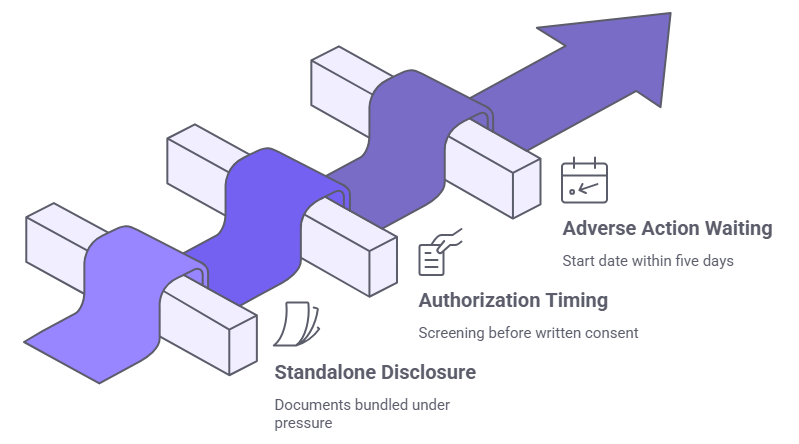
- The standalone disclosure step, where documents get bundled with onboarding paperwork under time pressure.
- The authorization timing, where screening begins before written consent is collected.
- The adverse action waiting period, where a worker’s start date falls within the five-business-day window.
Each breakdown point produces FCRA liability independent of whether the underlying hiring decision was correct. A bundled disclosure violates the statute regardless of whether the applicant signed the packet. A compressed adverse action notice violates the statute regardless of whether the finding was legitimately disqualifying.
Designing a Workflow That Scales
The manufacturing employer’s FCRA compliance program must produce consistent outcomes at peak volume, not just under normal conditions. This requires pre-built, standalone disclosure documents ready to deploy before a hiring event begins, a screening initiation workflow that contacts the CRA only after authorization is collected, an adverse action tracking system that monitors waiting periods by applicant rather than by hire date, and a designated compliance owner with authority to delay a start date when the adverse action process requires it. A compliance program that works for five hires per week but breaks down at fifty is not a compliant program at the volume the business actually operates.
Temp Agencies and Staffing Firms: Who Owns FCRA Compliance
The Dual-Accountability Gap
The most common FCRA compliance gap in manufacturing is the assumption that the staffing agency has handled it. When a temp agency places workers at a manufacturing facility, the agency typically conducts background screening as part of its placement process. The facility assumes the agency’s screening satisfies FCRA. The agency assumes its process covers the facility’s obligations. Neither assumption is correct, and the gap between them is where liability lives.
A staffing agency that obtains a consumer report on a candidate for employment placement is a user of that report under FCRA and must satisfy all corresponding obligations, including standalone disclosure, written authorization, CRA certification, and the full adverse action process. Agencies using very short-term or day-labor arrangements should confirm with qualified legal counsel whether those specific arrangements fall within FCRA’s employment definition under 15 U.S.C. Section 1681a(h). When the facility independently uses those results in its own access or credentialing decision, the facility may independently qualify as a user of that consumer report. FTC guidance has indicated that employers who receive and rely on third-party-obtained background check results in hiring decisions may be treated as users of those reports.
What the Facility Must Do Independently
Manufacturing facilities that rely on staffing agency screening cannot assume their FCRA obligations are satisfied by the agency’s process. The facility should confirm, through contractual clarity with the agency, which party is obtaining which report, who is providing the corresponding disclosure and authorization, and how adverse action accountability is allocated when a finding leads to a placement decision. Where the facility makes its own access or entry decision based on a background check result, it should treat that decision as triggering its own FCRA adverse action obligations. Contractual FCRA responsibility allocation, reviewed by qualified legal counsel, is the appropriate risk management tool for manufacturing employers who rely heavily on temp labor.
Industry-Specific Screening Layers: Food, Pharmaceutical, Defense, and Chemical Manufacturing
Regulatory Requirements That Run Alongside FCRA
Manufacturing sub-sectors carry industry-specific regulatory requirements that create additional screening obligations operating alongside FCRA. These requirements do not replace FCRA. They add a parallel compliance layer that must be satisfied independently.
| Manufacturing Subtype | Relevant Regulation | Screening Implication |
| Food manufacturing | FDA FSMA | FSMA requires that individuals in covered food handling roles be qualified individuals under facility food safety plans. Some facilities have incorporated background screening into their personnel qualification process as a result. Requirements vary by facility type and role. Confirm specific FSMA obligations with qualified legal and regulatory counsel. |
| Pharmaceutical manufacturing | DEA Schedule II | Employees with access to controlled substances may be subject to additional screening under DEA registration conditions. |
| Defense and aerospace manufacturing | ITAR, DCSA | Workers in roles requiring access to controlled technical data may need government security clearances administered outside the CRA framework. ITAR compliance may independently require employer-administered screening controls for foreign national access restrictions. Both obligations require specialist legal review. |
| Chemical manufacturing | OSHA PSM | Process Safety Management-designated facilities have specific personnel qualification requirements for covered process roles. |
| Automotive OEM and Tier 1 supplier | OEM supplier agreements | Supplier quality and safety contracts may require background check certification as a condition of facility access or preferred supplier status. |
Each regulatory layer requires its own compliance analysis and, in most cases, qualified legal and regulatory counsel specific to the applicable framework. None of them is a subset of FCRA, and FCRA compliance does not satisfy any of them.
When CRA Use and Industry Requirements Overlap
In many cases, the employer uses a CRA to satisfy an industry-specific screening requirement. When a CRA is used for that purpose, FCRA’s full disclosure, authorization, and adverse action framework applies to the screening transaction, even if the trigger for the check was a regulatory requirement rather than an independent employer policy. The employer must therefore satisfy both the industry-specific requirement and the FCRA procedural requirements for the same check.
OEM and Supplier Contract Background Check Provisions
OEM customers and Tier 1 suppliers increasingly include background check certification requirements in supplier agreements. A Tier 1 automotive supplier may require that all workers with facility access have passed a background check meeting defined criteria. A defense OEM may require documented screening of personnel with access to controlled areas. These contractual requirements are real and carry commercial consequences for non-compliance, including loss of preferred supplier status or contract termination. However, satisfying a contractual background check requirement does not satisfy FCRA, and satisfying FCRA does not satisfy the contractual requirement. A supplier who runs background checks meeting the OEM’s criteria but without providing the standalone FCRA disclosure is contractually compliant and FCRA non-compliant. Manufacturing employers must manage both obligations simultaneously through their screening program design.
State Law Variability for Multi-Site Manufacturers
Why a Single Policy Does Not Cover All Facilities
A manufacturing employer with facilities in multiple states cannot apply a single background check policy uniformly without significant compliance risk. State ban-the-box laws, lookback period limitations, and adverse action notice requirements vary materially across key manufacturing states. The table below reflects general awareness of key variability and is not legal advice. State and local law in this area is actively evolving.
| State | Key Variability |
| California | 7-year lookback limit for most positions regardless of salary threshold, which differs from the federal FCRA rule. Specific adverse action notice content and delivery requirements. Fair Chance Act applies to many employers. Confirm full compliance requirements with qualified legal counsel. |
| Michigan | No statewide ban-the-box for private employers, but some municipal ordinances apply. |
| Ohio | No statewide ban-the-box for private employers. No state-specific lookback restrictions beyond federal FCRA. |
| Illinois | The Illinois Job Opportunities for Qualified Applicants Act (ban-the-box) applies to private employers with 15 or more employees and restricts criminal history inquiry until after a conditional offer. The Illinois Human Rights Act further restricts criminal history use. Cook County and Chicago have additional fair chance hiring ordinances. Confirm full compliance obligations with qualified legal counsel. |
| Texas | No statewide ban-the-box for private employers. No state-specific lookback beyond federal FCRA. |
| North Carolina | No statewide ban-the-box for private employers. Some municipal ordinances in effect. |
Multi-site manufacturers should obtain state-specific legal review for each facility location before implementing or updating their background check policy.
Building State-Specific Policy into the Program
Multi-site manufacturing employers should treat state law variability as a structural program requirement, not a one-time legal review item. This means identifying the applicable ban-the-box, lookback, and adverse action notice rules for each facility state at program design, building state-specific disclosure and adverse action notice templates into the screening workflow, and scheduling annual legal review of each state’s requirements as part of the program’s ongoing compliance calendar. A single-policy approach that worked when the company operated one facility will not scale to a multi-state footprint without creating state-specific compliance gaps.
Building a Defensible FCRA-Compliant Screening Program for Manufacturing
What a Defensible Program Requires
A defensible FCRA-compliant screening program for a manufacturing employer is not simply a checklist of procedural steps. It is a documented system that produces consistent outcomes across all worker classifications, volume levels, staffing arrangements, and facility locations. The core components are:
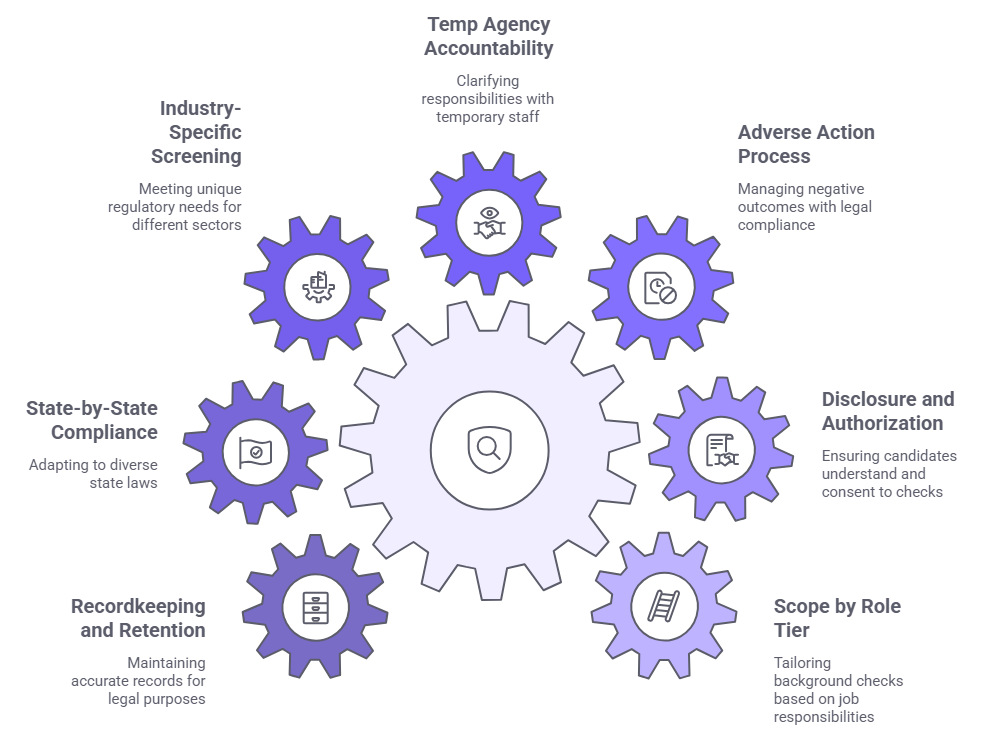
- A written background check policy covering scope by role tier.
- A disclosure and authorization workflow with standalone document controls.
- An adverse action process with system-enforced waiting period tracking.
- A temp agency FCRA accountability structure with contractual clarity.
- Industry-specific screening layer documentation for applicable regulatory requirements.
- A state-by-state compliance review cadence.
- A recordkeeping and documentation retention protocol covering adverse action notices, proof of delivery, waiting period records, and authorization documents for the applicable retention period, confirmed with qualified legal counsel by state.
The Commercial and Compliance Case for Program Investment
Manufacturing employers who discover FCRA compliance gaps typically do so through one of three triggers: a candidate dispute that reveals the adverse action process was never formally established, a staffing agency audit that surfaces dual-authorization failures, or an OEM supplier audit that flags a policy gap in screening certification. Each trigger is more expensive to remediate than the program investment required to prevent it. A screening program built around the manufacturing-specific framework in this article, reviewed by qualified legal counsel, and scaled to the employer’s actual hiring volume is the appropriate baseline for any facility with ongoing hiring activity.
Conclusion
FCRA compliance in manufacturing is not a generic compliance checkbox. It is an operational discipline that must be designed around the realities of plant floor hiring: high volume, safety-sensitive role classifications, temp agency reliance, industry-specific regulatory layers, and multi-state policy complexity. Manufacturing employers who build their screening programs around these realities, confirm state-specific obligations with qualified legal counsel, and establish clear contractual FCRA accountability with their staffing partners are in a substantially stronger compliance position than those who apply a standard employer checklist to a structurally distinct workforce.
Frequently Asked Questions
Below are some commonly asked questions that seek to clarify compliance issues in relation to implementing background checks within the manufacturing industry. Due to the high volume of hiring processes, the sensitivity of the positions being filled, and the multiple states in which the work takes place, there is potential for large risks to develop from seemingly small procedural mistakes.
Do manufacturing employers have to follow FCRA when screening workers?
Yes. FCRA applies to any manufacturing employer that uses a consumer reporting agency to obtain background checks for employment purposes. Employers must provide a standalone disclosure, obtain written authorization, certify their permissible purpose to the CRA, and follow a two-step adverse action process when a report finding is a factor in a hiring decision.
Does FCRA apply to factory and plant workers?
Yes. FCRA’s employment provisions apply to consumer reports obtained for employment-related decisions and do not exclude factory or plant roles. A background check ordered through a CRA for any manufacturing worker is subject to FCRA’s full disclosure, authorization, and adverse action requirements regardless of role type or seasonal status.
Who is responsible for FCRA compliance when using a staffing agency for manufacturing workers?
Both the staffing agency and the manufacturing facility carry independent FCRA obligations. The agency must satisfy FCRA as the party obtaining the consumer report. The facility may independently qualify as a user of that report if it relies on the results in its own hiring or access decision. Contractual clarity about FCRA responsibility allocation between both parties is the appropriate risk management tool.
Can a manufacturing company reject a worker for a criminal record?
Yes, but not through a blanket policy and not without following the FCRA adverse action process. EEOC guidance and many state fair chance laws require individualized assessment of the specific offense against the specific role before adverse action is taken. Safety-sensitive role status strengthens the nexus analysis but does not eliminate the individualized assessment obligation. Blanket disqualification policies create Title VII disparate impact exposure and fail to meet the FCRA adverse action standard.
What background checks are required for food manufacturing workers?
No single federal law mandates a specific background check for all food manufacturing workers. FDA’s Food Safety Modernization Act requires that individuals in covered food handling roles be qualified individuals under facility food safety plans, and some facilities have incorporated background screening into that personnel qualification process. When a food manufacturing employer uses a CRA to conduct those checks, FCRA governs the transaction. Employers should confirm specific FSMA obligations with qualified legal and regulatory counsel.
What is the adverse action process for manufacturing employers?
When a background check finding is a factor in a decision not to hire, FCRA requires a two-step process. First, provide the applicant with a pre-adverse action notice including the consumer report and Summary of Rights, then allow a waiting period of generally at least five business days per CFPB and FTC guidance. Second, if proceeding, provide a final adverse action notice identifying the CRA and informing the applicant of their dispute rights.
How does ban-the-box apply to manufacturing employers?
Application varies by state and municipality. Illinois, for example, has a statewide ban-the-box law applying to private employers with 15 or more employees, while other major manufacturing states such as Michigan, Ohio, and Texas have no statewide private employer requirement, though local ordinances may apply. Multi-site manufacturers should confirm the applicable requirements in each facility location with qualified legal counsel.
What happens if a manufacturing employer skips the pre-adverse action notice?
Skipping the pre-adverse action notice violates FCRA regardless of whether the underlying hiring decision was correct. Willful violations may result in statutory damages of $100 to $1,000 per violation, plus actual damages, punitive damages, and attorney’s fees, without requiring the applicant to prove actual harm. In a high-volume manufacturing hiring program, systematic process gaps can generate exposure across a large applicant pool. Manufacturing employers should treat adverse action process deficiencies as a high-priority remediation item.
Additional Resources
- FTC: Using Consumer Reports for Employment Purposes
https://www.ftc.gov/business-guidance/resources/using-consumer-reports-employment-purposes - CFPB: A Summary of Your Rights Under the Fair Credit Reporting Act
https://www.consumerfinance.gov/consumer-tools/credit-reports-and-scores/consumer-reporting-companies/fcra-summary-of-rights/ - EEOC: Employment Practices Guidance and Resources
https://www.eeoc.gov/laws/guidance - FDA: Food Safety Modernization Act Overview
https://www.fda.gov/food/food-safety-modernization-act-fsma/full-text-food-safety-modernization-act-fsma - OSHA: Process Safety Management Standard (29 CFR 1910.119)
https://www.osha.gov/process-safety-management - 15 U.S.C. Section 1681: Fair Credit Reporting Act Full Text
https://www.govinfo.gov/content/pkg/USCODE-2022-title15/pdf/USCODE-2022-title15-chap41-subchapIII.pdf

ABOUT THE CREATOR
Charm Paz, CHRP
Recruiter & Editor
Charm Paz is an HR professional at GCheck, specializing in background screening, fair hiring, and regulatory compliance. She holds from the Professional Background Screening Association (PBSA) and helps organizations navigate employment regulations with clarity and confidence.
With a background in Industrial and Organizational Psychology, she translates policy into practice to build ethical, compliant, human-centered hiring systems that strengthen decision-making over time.