

New survey data reveals that Gen Z job seekers engage in outright fabrication at rates that dwarf every other generation, not because they lack integrity, but because they entered the workforce inside a system that normalized and rewarded it. The harder finding is what comes next: Gen Z also experiences the sharpest post-hire fallout of any cohort, making their hiring behaviors a structural liability that employers inherit.
Key Takeaways
- Embellishment during the job search is a cross-generational norm, with 91% to 97% of all age groups reporting at least one form of misrepresentation.
- Gen Z diverges from other generations not in participation rates but in the severity of specific fabrication behaviors, including fake references and false credentials.
- Gen Z candidates listed fake references at 40%, compared to 7% among Baby Boomers, a gap that signals a qualitative shift from inflation to fabrication.
- AI tools lowered the cost of fabrication and were adopted earliest by younger workers, amplifying every existing deception behavior across the hiring funnel.
- Only 26% of embellishers reported that a discrepancy was actually detected, making fabrication a rational calculation inside a weak verification environment.
- Gen Z experienced negative workplace consequences from resume misrepresentation at 38%, the highest rate of any generation and well above the 25% overall figure.
- The same candidates who fabricate most aggressively also support transparent, human-reviewed screening at rates consistent with the broader workforce.
- Proactive disclosure of what will be verified, paired with independent source confirmation, addresses both the fabrication incentive and the post-hire mismatch risk.
The Participation Baseline: Everyone Embellishes
A market behavior, not a generational character flaw
Before examining where Gen Z diverges, the data requires a foundational correction to the framing most HR leaders bring to this topic. The survey in the 2026 Trust in Hiring Report (n=1,500 full-time U.S. workers, Pollfish, February 2026) found that 96% of Gen Z respondents reported engaging in at least one form of embellishment or misrepresentation during a recent job search. What makes that figure structurally important is its context.
| Generation | Overall Embellishment Rate |
| Baby Boomers | 97% |
| Gen Z | 96% |
| Millennials | 93% |
| Gen X | 91% |
Embellishment is not a generational pathology. It is a market behavior spanning every age group, experience level, and credential tier. When nine in ten workers across all generations report some form of resume misrepresentation, the cause is a hiring system that has made honesty a competitive disadvantage, not a character deficit concentrated in any one cohort.
The common behaviors that cut across all generations
The most prevalent embellishment behaviors are consistent across age groups: exaggerating expertise in a specific skill (61% overall), inflating the scope of previous roles (59%), and fabricating interview stories (47%). These behaviors represent the baseline of what the survey calls “careerfishing,” defined as the systematic embellishment, distortion, or fabrication of professional qualifications as a deliberate competitive strategy driven by market pressure and weak verification expectations.
Understanding this baseline matters for two reasons. First, it prevents the analysis of Gen Z job search struggles from becoming a generational blame exercise. Second, it establishes the floor against which the Gen Z divergence data, which is far more significant, should be measured.
Why this framing is the correct starting point
HR leaders working with this data should resist the instinct to treat high Gen Z fabrication rates as evidence of generational values differences. The participation data shows clearly that older workers embellish at equivalent or higher overall rates. The relevant question is not whether Gen Z embellishes more. It is whether they embellish differently, and whether those differences carry a higher organizational cost. On both questions, the answer is yes.
The job hunting scenario has been so dramatically altered within the last couple of years as a result of the advent of AI technology, virtual hiring, and growing competition. The one thing that was quite surprising about this discussion was the impact of hiring problems on both the job seeker and the employer at once. The pressure to look more competent can eventually lead to stress and mismatch on both ends, thus creating serious problems in performance and overall work. �
Where Gen Z Diverges: Fabrication, Not Embellishment
The distinction that changes the risk profile
There is a meaningful difference between embellishment and fabrication. Embellishment inflates something real. Fabrication invents something that does not exist. Both create verification problems, but fabrication creates a categorically different liability because it cannot be partially confirmed. A candidate who overstates a skill may still hold some version of that skill. A candidate who lists a reference that does not exist, or claims a credential they never earned, creates a verification dead end.
The fabrication triad: three data points that tell a single story
The 2026 Trust in Hiring Report data shows that Gen Z’s divergence from other generations is concentrated almost entirely in fabrication behaviors. The gap on these specific measures is not marginal. It is structural.
| Fabrication Behavior | Gen Z | Baby Boomers |
| Listed fake references | 40% | 7% |
| Claimed unearned educational credentials | 37% | 17% |
| Described termination as voluntary | 41% | 17% |
Taken together, these three behaviors paint a picture that is qualitatively different from the embellishment baseline. Gen Z is not simply more willing to stretch the truth. Within specific, high-consequence fabrication categories, they are operating at rates that older generations have not approached.
What the gap reflects, not what it indicts
These numbers describe a pattern. They do not resolve into a simple moral verdict on their own. To understand why Gen Z’s fabrication rates look the way they do requires understanding the conditions under which this cohort entered the workforce, which is the subject of the sections that follow.
AI as the Accelerant
Tools that lowered the cost of fabrication
The survey documents a range of AI-assisted behaviors in the job search, and the numbers are significant across the full sample. Consider the scale of adoption:
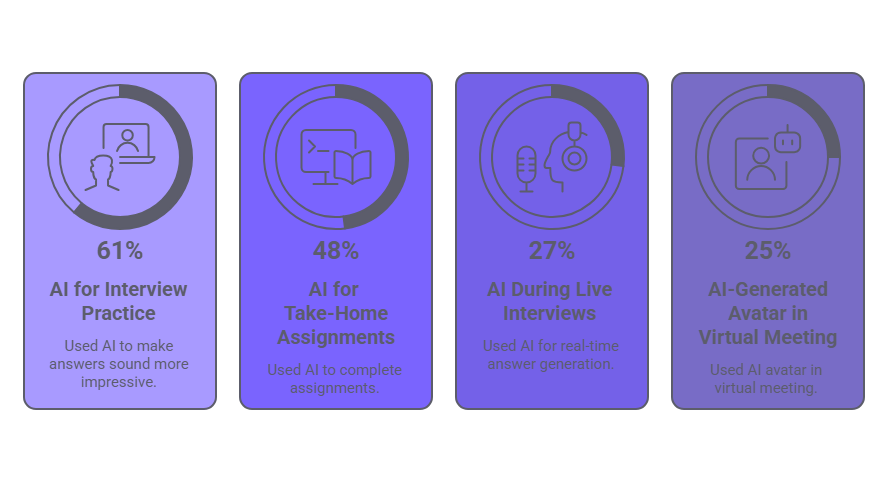
These behaviors are not distributed evenly across the workforce. Younger workers adopted AI tools for job searching earliest and at the highest rates. AI did not create fabrication as a strategy, but it dramatically reduced the effort required to execute it. Writing a credible reference list, constructing interview stories that hold up under follow-through, and generating resume bullets for skills a candidate does not hold are all tasks that AI tools make faster, cheaper, and more convincing.
The virtual interview vulnerability
The rise of remote hiring created conditions that amplified these tools further. Beyond AI avatars, the survey found that 44% of respondents used notes or external prompts off-camera during virtual interviews, 31% received real-time assistance from another person, and 28% had someone else assist with technical assessments. These behaviors describe a verification environment where the person being evaluated and the person performing during the interview are not necessarily the same in knowledge, identity, or preparation.
For employers relying on virtual interview fraud detection, the data makes clear that the problem extends well beyond deepfake technology. The combination of off-camera assistance, real-time AI prompting, and, in a quarter of cases, AI avatars means that virtual hiring processes face a multi-layered set of identity and performance integrity challenges that were not present in in-person hiring at scale.
The detection failure that makes fabrication rational
Only 26% of respondents who embellished reported that someone actually verified their claims and found a discrepancy. Only 28% reported losing an opportunity because an exaggeration was detected. When the probability of detection is that low, fabrication becomes a rational calculation regardless of generation. For a cohort that has grown up with AI tools designed to make that calculation easier, the behavior is not surprising. It is predictable given the incentive structure. The background check effectiveness gap is not a technology problem alone. It is a scope and process problem.
The Market Pressure They Inherited
Why the conditions of entry matter
Gen Z entered the workforce during a period of simultaneous credential inflation and AI proliferation. These are not background conditions. They are the active environment in which hiring norms were formed for this cohort. The survey data captures the motivational structure of embellishment across all respondents, and it reveals something important: the pressure that drove fabrication was real and broadly felt.
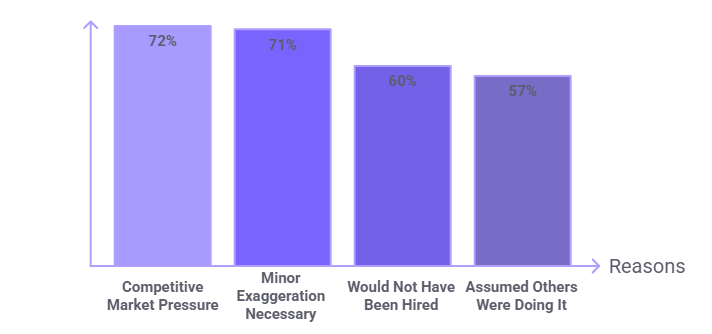
- 72% of embellishers cited competitive market pressure as the driver.
- 71% said minor exaggeration was necessary to stay competitive.
- 60% said they would not have been hired if they had presented their experience fully accurately.
- 57% assumed other candidates were doing the same.
These are not rationalizations. They are descriptions of a perceived incentive structure, and the data on hiring outcomes suggests that perception is not entirely wrong. Candidates who received and accepted job offers averaged more resume misrepresentation types than those who did not.
The honesty tax in practice
The survey describes this dynamic as the Honesty Tax: the penalty imposed on candidates who present themselves accurately in a market where embellished profiles are more likely to advance. When 60% of a workforce believes full honesty would cost them the job, and the verification environment confirms that belief by detecting discrepancies only 26% of the time, the individual calculation is clear even if the systemic outcome is corrosive. Gen Z did not design this system. They inherited it at the moment of labor market entry, during a period when the tools available to game that system were more capable and more accessible than at any prior point.
The Post-Hire Fallout: Where Gen Z Pays the Steepest Price
The reversal that changes the employer calculus
Here is the finding that most HR leaders do not see coming, and the one that most directly affects organizational planning. Gen Z fabricates at the highest rates of any generation in the survey. Gen Z also experiences the worst outcomes after the hire.
| Post-Hire Consequence | Gen Z | Overall Average |
| Negative workplace consequences from skills mismatch | 38% | 25% |
| Post-hire stress or anxiety | 39%* | 39%* |
| Overstatement became apparent on the job | 29%* | 29%* |
*Figures represent all embellishers across generations; Gen Z workplace consequence rate is the cohort-specific divergence point.
That 13-point gap on workplace consequences is not noise. It is the cost of the mismatch between what was presented during hiring and what was discovered during employment. The generation that optimized most aggressively for getting hired is paying the steepest price for having done so.
What employers are inheriting
The post-hire fallout data extends beyond performance metrics. Among all respondents who embellished, 39% experienced post-hire stress or anxiety, and 29% found that their overstatement became apparent after starting the role. Hispanic respondents reported the highest post-hire stress at 55%, and Gen Z experienced the sharpest workplace fallout of any cohort. For HR Directors and talent acquisition leaders, this reframes the business case for more rigorous screening. The question is no longer only about risk at the point of hire. It is about the downstream cost of a workforce populated with employees whose stated credentials did not survive contact with the role.
The Awareness Paradox: They Know It Is Wrong
Self-awareness without a viable alternative
The most structurally significant finding in the survey is not any single behavior rate. It is the convergence of behavior and belief. Eighty-eight percent of all respondents, including those who fabricated, agreed that candidate misrepresentation puts businesses at significant or moderate risk. Among those who engaged in the highest levels of misrepresentation, the awareness rate remained above 89%. This is not a population operating in moral ignorance. It is a population that understands the systemic consequences of its own behavior and continues that behavior anyway, because the alternative is perceived as a competitive disadvantage.
Why this matters for how employers respond
Understanding this awareness paradox changes the appropriate employer response. Candidates who fabricate and simultaneously acknowledge the risk are not well served by additional ethics messaging or hiring policy language about honesty expectations. They already know. What the survey data suggests they want, and what would address the root behavior, is a verification environment that makes honesty viable by reducing the advantage that fabrication currently holds. Transparency is not only an ethical posture. It is a deterrence mechanism, particularly given that 56% of respondents cited not knowing what would be checked as a primary concern.
What Gen Z Actually Wants From Screening
Trust conditions that are not uniquely generational
One of the article’s most actionable findings is also one of its most counterintuitive: Gen Z’s trust conditions for background screening are not meaningfully different from the rest of the workforce. The data is consistent and clear.
- 82% want a clear explanation of what is being checked before they apply.
- 81% want human review of findings rather than fully automated decision-making.
- 77% want the ability to review or dispute findings.
- 75% want consistent screening standards applied to all candidates.
These are not generational demands. They are workforce-wide expectations that describe what a trust-based hiring process looks like from the candidate’s perspective. The fact that the generation with the highest fabrication rates endorses these conditions at rates consistent with the broader workforce is significant. It means the solution framework is not Gen Z-specific. It is systemic.
Screening transparency as a retention mechanism
The 82% transparency figure is particularly relevant for employers competing for Gen Z talent. When candidates want to know what will be verified and that information is not available, a segment of the candidate pool self-selects out of the process. The survey found that 52% of respondents in the most self-aware cohort avoided job opportunities due to screening anxiety. That avoidance represents a real pipeline cost. Communicating verification standards clearly, early, and specifically addresses both the fabrication deterrent and the pipeline shrinkage problem simultaneously.
Human review as a specific requirement
The 81% figure on human review reflects a candidate-level understanding that automated processes can produce inaccurate or decontextualized findings. For employers, this preference maps directly to a compliance posture: automated screening systems that flag candidates without human review of those findings create candidate experience costs and may increase exposure under applicable employment screening laws, which require specific procedural steps before any employment decision is made based on background check findings. The data supports a process design that treats human review as a standard component, not an exception escalation.
What Employers Should Do Differently
Proactive disclosure before the application
The most cost-effective intervention the survey data supports is proactive disclosure of verification scope. When candidates know what will be checked before they apply, the fabrication calculation changes. A reference list cannot function as a deception tool if the candidate knows that references will be verified through independent channels. An employment record cannot be altered if the candidate knows that employment dates and departure circumstances will be confirmed directly with prior employers. A straightforward statement in the job posting, describing the categories of information that will be verified, serves as a deterrent at the earliest point in the funnel. It also signals to integrity-oriented candidates that this employer operates a fair and consistent process.
Independent verification of employment and education history
The reference manipulation data is striking. Forty-five percent of respondents coached a reference on what to say, 41% had a friend or family member pose as a professional reference, and 33% asked a coworker to pose as a manager. This describes a verification environment in which candidate-supplied references cannot be treated as independent confirmation. Screening Gen Z candidates effectively on this dimension requires moving from candidate-supplied references to direct confirmation with prior employers and institutions. That means confirming employment dates, titles, and departure circumstances directly with the source organization, and verifying educational credentials with the issuing institution rather than accepting a document on its face. These are not novel methodologies. They are the application of existing practices to a candidate pool that has clearly adapted to weaker verification standards.
Human-centered review and consistent standards
The survey data does not support screening policies that treat Gen Z candidates as a uniformly high-risk group requiring separate processes. Applying heightened scrutiny specifically to younger candidates would produce inconsistent verification standards, the opposite of what 75% of candidates said they want, and would carry compliance implications beyond what this data recommends. The appropriate response is a consistently structured verification process applied to all candidates, designed in accordance with applicable federal, state, and local fair hiring laws, which may impose jurisdiction-specific requirements on timing, scope, and individualized assessment.
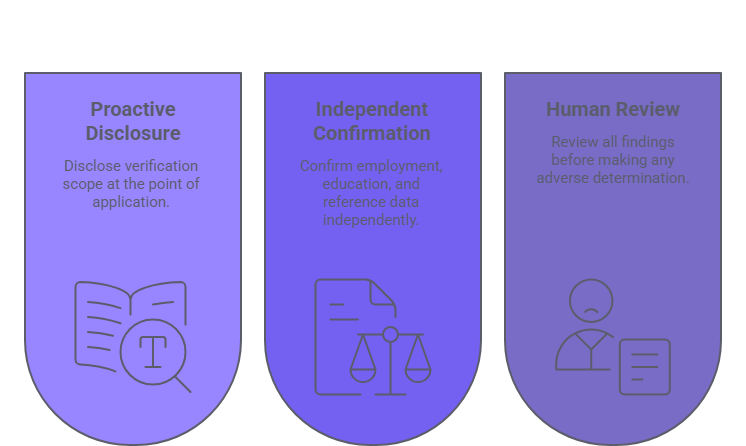
- Proactive disclosure of verification scope at the point of application.
- Independent source confirmation for employment, education, and reference data.
- Human review of all findings before any adverse determination is made.
Automated systems that flag discrepancies without contextual review produce false positives that eliminate qualified candidates. Human review allows for the kind of contextual judgment that the survey’s own findings demand, while maintaining the consistency and fairness that candidates across all generations say they want.
Conclusion
Gen Z job search struggles are not a story about a generation that chose dishonesty. They are a story about a generation that entered a broken market at the worst possible moment and adopted the tools and strategies that the market made available and rewarded. The post-hire fallout data is the corrective the hiring industry needs: fabrication deferred the consequences, it did not eliminate them. Employers who want a different outcome need a verification process that changes the incentive at the front of the funnel, not a policy statement about integrity.
About the 2026 Trust in Hiring Report
The 2026 Trust in Hiring Report is a proprietary research study published by GCheck, based on a national survey of 1,500 U.S. adults employed full-time who actively applied for at least one job in the past 18 months. Fielded February 14-22, 2026 via Pollfish, the study examines how Careerfishing, AI-assisted deception, identity concealment, and broken verification expectations are reshaping the employer-candidate trust gap. The report introduced the Careerfishing framework and documented that 93% of recent job seekers have engaged in at least one form of resume embellishment or misrepresentation. The full report, including methodology, demographic breakdowns, and the Compliance for Good framework for rebuilding trust in hiring, is available at gcheck.com/whitepapers/trust-in-hiring-report/.
Frequently Asked Questions
Why do Gen Z candidates have higher fabrication rates than older generations?
The survey data points to structural factors rather than generational values. Gen Z entered the workforce when competitive credential inflation and AI-assisted application tools were already normalized. They adopted those tools earlier and at higher rates. The gap between Gen Z and Boomer fabrication behaviors reflects the environment of entry, not a fundamental difference in character or ethics.
What is the difference between embellishment and fabrication in hiring?
Embellishment inflates something real, overstating a skill or expanding a job title slightly. Fabrication invents something that does not exist, such as a reference who cannot verify the candidate, a credential that was never earned, or an employment circumstance that did not occur as described. Fabrication creates a verification dead end and carries a higher organizational risk because it cannot be partially confirmed.
How common is resume embellishment across all generations?
According to the 2026 Trust in Hiring Report (n=1,500), embellishment rates are high across every generation: 97% of Baby Boomers, 96% of Gen Z, 93% of Millennials, and 91% of Gen X reported at least one form of misrepresentation during a recent job search. Embellishment is a market-wide behavior, not a generational one.
What are the most common fake reference behaviors in candidate hiring?
The survey found that 45% of respondents coached a reference on what to say, 41% had a friend or family member pose as a professional reference, and 33% asked a coworker to pose as a manager or supervisor. These behaviors directly undermine reference check effectiveness when employers rely solely on candidate-supplied contact information.
How does AI use in job searching connect to candidate misrepresentation statistics?
The survey documents a dose-response relationship between AI usage intensity and every other form of hiring deception. Candidates using four or more AI tactics showed significantly higher rates of resume misrepresentation, reference manipulation, and remote interview exploitation. AI did not create fabrication as a strategy but reduced the effort and skill required to execute it convincingly.
What post-hire consequences do Gen Z employees face from resume embellishment?
Gen Z experienced negative workplace consequences from skills mismatch at 38%, compared to 25% across the full survey sample. Among all embellishers regardless of generation, 39% reported post-hire stress or anxiety and 29% found that their overstatement became apparent after starting the role. The post-hire fallout is real, measurable, and falls disproportionately on younger workers.
What do candidates want from background check effectiveness and screening processes?
The survey found that 82% want a clear explanation of what will be checked before they apply, 81% want human review of findings rather than fully automated decisions, 77% want the ability to review or dispute findings, and 75% want consistent screening standards applied to all candidates. These preferences are consistent across all age groups, not specific to Gen Z.
What is virtual interview fraud detection and why does it matter for hiring?
Virtual interview fraud refers to a range of behaviors that misrepresent candidate identity or capability during remote hiring processes. The survey found that 25% of respondents used an AI avatar of themselves in a virtual meeting, 31% received real-time assistance from another person, and 44% used off-camera notes or prompts. Detection requires process design that goes beyond basic video authentication, including structured assessment components that cannot be completed with external assistance.
Additional Resources
- U.S. Equal Employment Opportunity Commission: Enforcement Guidance on the Consideration of Arrest and Conviction Records in Employment Decisions
https://www.eeoc.gov/laws/guidance/enforcement-guidance-consideration-arrest-and-conviction-records-employment-decisions - Federal Trade Commission: Fair Credit Reporting Act Full Text
https://www.ftc.gov/legal-library/browse/statutes/fair-credit-reporting-act - U.S. Department of Labor: Occupational Information Network (O*NET)
https://www.onetonline.org - Society for Human Resource Management: Talent Acquisition Resources
https://www.shrm.org/topics-tools/topics/talent-acquisition

ABOUT THE CREATOR
Charm Paz, CHRP
Recruiter & Editor
Charm Paz is an HR professional at GCheck, specializing in background screening, fair hiring, and regulatory compliance. She holds from the Professional Background Screening Association (PBSA) and helps organizations navigate employment regulations with clarity and confidence.
With a background in Industrial and Organizational Psychology, she translates policy into practice to build ethical, compliant, human-centered hiring systems that strengthen decision-making over time.