


Youth-serving organizations must navigate overlapping statutory mandates, organizational liability exposure, and evolving fair chance hiring principles when determining what disqualifies someone from working with youth. While certain convictions trigger automatic legal bars, most screening decisions require structured discretion, documented rationale, and procedural compliance to balance child safety against workforce needs and rehabilitation considerations.
Key Takeaways
- Disqualification operates at three levels: statutory mandates that organizations cannot override, organizational policies shaped by risk tolerance and insurance requirements, and case-by-case discretionary judgments.
- Crimes against children, violent felonies, and sexual offenses typically create automatic bars, though specific definitions and lookback periods vary significantly by state.
- A three-tier offense categorization system (Red/Yellow/Green) helps organizations operationalize consistent, defensible screening decisions beyond binary approve/reject frameworks.
- Time elapsed since conviction serves as a meaningful risk indicator, though FCRA seven-year reporting limits differ from organizational consideration periods and should not be conflated.
- Structured evaluation criteria for borderline cases—including offense-to-role relationship, rehabilitation evidence, and pattern analysis—reduce discrimination exposure while maintaining safety standards.
- State laws, organizational type, and insurance carrier requirements create substantial variation in disqualification thresholds that prevent universal standards.
- Procedural compliance with FCRA adverse action requirements and documented decision-making processes represent essential liability protections separate from substantive screening standards.
- Common misconceptions about expungement visibility, arrest records, and misdemeanor severity create both inappropriate denials and dangerous approval gaps that formal policies must address.
Disqualification Framework Overview
Many organizations approach volunteer and employee screening assuming that what disqualifies someone from working with youth represents a fixed, universal standard. The reality is quite different. In practice, disqualification operates at three distinct levels, each governed by different authority sources and organizational control.
Three Levels of Disqualification
Statutory disqualification encompasses legal prohibitions that organizations cannot waive regardless of internal policy preferences. These mandates typically appear in state child protection codes, education regulations, and youth sports governance statutes. When state law forbids employment or volunteer service based on specific convictions, organizational discretion ceases. Compliance failures expose the organization to direct regulatory enforcement, potential criminal liability for responsible parties, and civil negligence claims that insurance policies may not cover.
Organizational policy disqualification reflects risk tolerance decisions within the boundaries of legal requirements. Groups establish these standards based on:
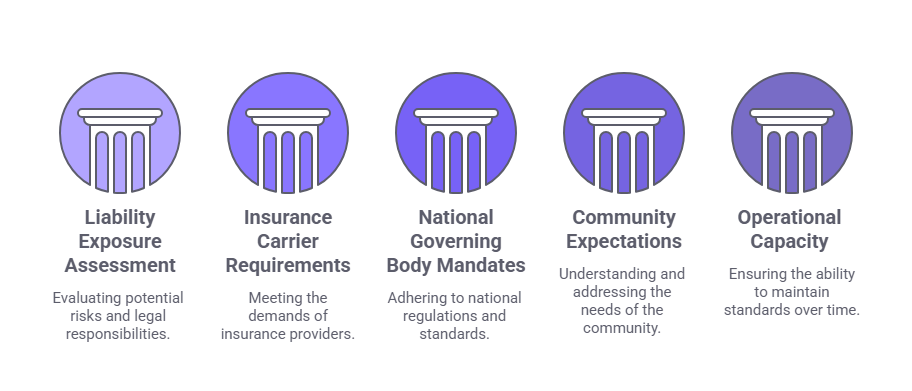
- Liability exposure assessment
- Insurance carrier requirements
- National governing body mandates
- Community expectations
- Operational capacity for ongoing monitoring
A recreational soccer league may adopt different thresholds than a residential youth treatment facility, even when operating in the same jurisdiction under identical statutory requirements.
Discretionary case-by-case disqualification addresses situations where neither statute nor blanket policy provides clear guidance. These decisions require structured evaluation methods to ensure consistency, show non-biased application, and create defensible records.
Common Mistakes Organizations Make
Understanding this three-level structure prevents two common errors. Some groups believe they possess discretion to approve applicants despite statutory bars, especially when the applicant presents compelling rehabilitation evidence or the organization faces volunteer shortages.
On the other hand, some groups treat policy preferences as inflexible legal requirements, denying reconsideration even when changed circumstances warrant re-evaluation. Both mistakes create unnecessary legal exposure and operational inefficiency.
A lot of people thought reference checks were something of a quick formality, but the more we think about it, the more we will realize what a critical component of the process it is. They are not just about getting information, but about understanding patterns, judgment, and presence in real-world situations. What catches my attention is the way potential pitfalls may be overlooked if the process is not well structured or consistent. As an HR practitioner, what comes to my mind is that the hiring process is not just about being efficient; it is also about being thoughtful.
Statutory Automatic Disqualifiers
State legislatures have enacted specific prohibitions that remove organizational discretion for certain conviction categories. While substantial variation exists across jurisdictions, several offense types consistently trigger statutory bars in most states.
| Offense Category | Typical Scope | Common Lookback Period |
| Crimes Against Children | Child abuse, neglect, endangerment, pornography | Lifetime |
| Sexual Offenses | Rape, assault, indecent exposure, registry placement | Lifetime |
| Violent Felonies | Murder, kidnapping, arson, robbery, aggravated assault | Lifetime to 15 years |
| Drug Manufacturing/Distribution | Sales near schools, distribution to minors | 10 to 15 years |
| Domestic Violence | Intimate partner violence convictions | 7 to 10 years |
Crimes Against Children
This category represents the most universally prohibited group of offenses. These violations include child abuse, child neglect, child endangerment, contributing to the delinquency of a minor, and child pornography possession or distribution.
State laws typically define crimes against children broadly to cover any criminal conduct where the victim was a minor, regardless of whether the offense title specifically references children.
Sexual Offenses and Violent Felonies
Sexual offenses create automatic disqualification in virtually all jurisdictions, with particularly strict application when the victim was a minor. Sex offender registry placement typically generates lifetime bars from youth-serving roles. Convictions such as rape, sexual assault, indecent exposure, and possession of child sexual abuse material fall within this category.
Violent felonies frequently appear in statutory prohibition lists, though definitions vary considerably. Murder, manslaughter, kidnapping, arson, robbery, and aggravated assault typically qualify. Some states extend bars to any felony involving weapons, use of force, or threat of serious bodily harm.
Domestic Violence and Federal Considerations
These convictions are included within statutory disqualification categories in some jurisdictions, often classified under violent misdemeanor provisions. Some states impose mandatory bars based on the reasoning that perpetrators of intimate partner violence may pose elevated risk in positions of authority over children, though many jurisdictions leave these choices to organizational discretion.
Federal firearms prohibitions for domestic violence misdemeanors (18 U.S.C. § 922(g)(9)) create practical barriers for roles involving shooting sports or hunting programs, as individuals subject to these restrictions cannot legally possess firearms regardless of state youth-serving eligibility.
Multi-Jurisdictional Complexity
Groups operating in multiple states face particular complexity, as an individual may be statutorily eligible in one state but prohibited in another for identical conduct. Youth-serving groups should obtain legal counsel confirmation regarding which convictions trigger mandatory disqualification in their operating jurisdiction.
Background check reports may not clearly flag statutory bars, leaving interpretation responsibility to the organization.
Offense Categorization System
Beyond state-mandated bars, organizations benefit from structured offense classification methods that make risk assessment practical while keeping consistency across decisions.
Red Category: Automatic Organizational Disqualification
These offenses typically warrant organizational disqualification regardless of timeframe, rehabilitation evidence, or role specifics, though organizations should verify that categorical lifetime exclusions for non-statutorily mandated offenses comply with applicable fair chance hiring laws in their jurisdiction.
This category typically includes:
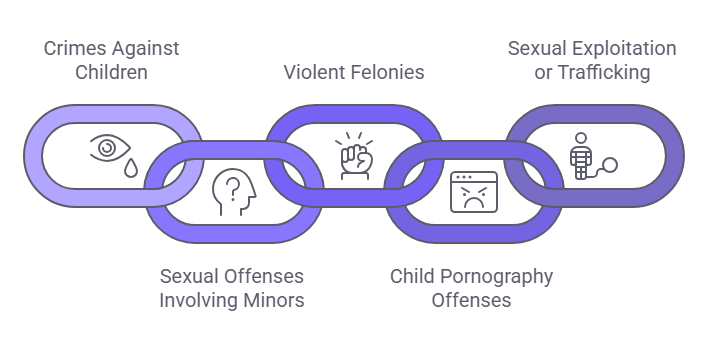
- Crimes against children beyond statutory requirements
- All sexual offenses involving minors
- Violent felonies against any victim
- Child pornography offenses
- Sexual exploitation or trafficking
Red categorization should be reserved for offenses where the conduct itself shows disqualifying judgment or impulse control deficits, not merely policy violations.
Yellow Category: Case-by-Case Evaluation Required
These offenses require structured discretionary review rather than automatic approval or denial. Yellow-category convictions present meaningful concerns that demand individualized assessment but do not inevitably show unsuitability for all youth-serving roles under all circumstances.
This category commonly includes:
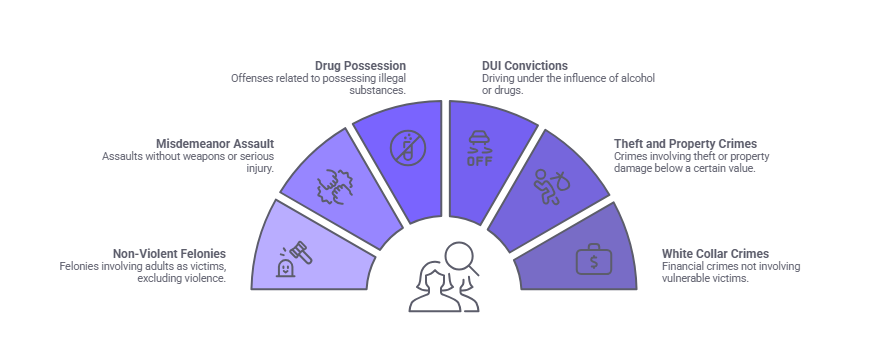
- Non-violent felonies where the victim was an adult
- Misdemeanor assault without weapons or serious injury
- Drug possession offenses
- DUI convictions
- Theft and property crimes below specified value thresholds
- White collar crimes not involving vulnerable victims
Groups should develop written criteria specifying what extra information Yellow cases require, such as character references, explanation letters, proof of treatment completion, or in-person interviews.
Green Category: Generally Acceptable with Context
These offenses represent convictions that do not typically warrant disqualification absent aggravating factors. Green-category violations may include:

- Minor traffic violations beyond DUI
- Disorderly conduct or trespassing misdemeanors without violence
- Marijuana possession in legalized jurisdictions
- Offenses occurring during the applicant's own youth
This classification prevents screening paralysis where staff agonize over decades-old minor violations while showing proportionality that strengthens discrimination defenses.
Time-Elapsed Considerations
How long ago a conviction occurred materially affects recidivism risk and rehabilitation likelihood, making time elapsed a critical factor in screening decisions. However, organizations frequently mix up distinct timeframe concepts.
Understanding Different Timeframe Types
| Timeframe Type | Purpose | Scope |
| FCRA Reporting Limits | Controls what appears in consumer reports | 7 years for most convictions (exceptions: positions with $75,000+ salary; convictions with sentences exceeding one year imprisonment) |
| Organizational Lookback | Policy decision on history examination depth | Varies by offense: lifetime to 7 years |
| Time Since Release | Risk assessment indicator | Measures conviction-free community living |
| Statutory Consideration Period | Legal mandate on allowable consideration | State-specific: 5 to lifetime |
FCRA Reporting Limits vs. Organizational Consideration
The Fair Credit Reporting Act generally limits consumer reporting agencies to seven-year reporting periods for most criminal convictions. This limitation affects what information appears in reports, not what information organizations may consider.
Youth-serving groups must not treat FCRA reporting limits as establishing that seven-year-old convictions carry no relevance.
Organizational Lookback Policies
These periods represent separate policy decisions about how far into an applicant's history screening will examine. Different offense categories may warrant different lookbacks.
An organization might adopt lifetime consideration for sex offenses against minors while using ten-year lookbacks for property crimes.
Recency as a Risk Indicator
This concept derives from criminological research showing that recidivism likelihood decreases as time from offense increases. However, recency relevance varies by offense type.
Groups should consider conviction patterns rather than isolated timeframes. Three theft convictions across 15 years show different trajectories than a single theft conviction 15 years ago with no subsequent criminal history.
Ban-the-Box Laws and Exceptions
Some jurisdictions have enacted specific lookback limits that constrain organizational discretion. Ban-the-box laws in multiple cities and states prohibit inquiry into convictions beyond designated timeframes, typically seven or ten years, for covered employers and positions.
However, many of these laws contain clear exceptions for positions involving work with children or vulnerable populations. Youth-serving groups should verify whether their roles fall within these exceptions in their jurisdiction.
Decision Framework for Borderline Cases
Yellow-category offenses require structured evaluation to prevent inconsistent, biased, or poorly recorded decisions. Groups should use standardized criteria that decision-makers apply to each case, creating written rationale that shows non-arbitrary process.
Core Evaluation Criteria
Nature and severity of the offense examines what the conviction reveals about judgment, impulse control, and risk to youth. Groups should consider the underlying conduct rather than relying only on conviction charges, which may reflect plea negotiations rather than actual behavior.
Relationship between offense and role responsibilities addresses whether the conviction shows unfitness for the specific position under consideration:
- Financial crimes matter more for treasurer roles than field coaching positions
- DUI convictions matter more when roles involve transporting youth
- Positions involving overnight travel require stricter scrutiny
- One-on-one contact roles present different risk than group supervision
Pattern versus isolated incident examines whether the conviction represents aberrational behavior or characteristic conduct. A single conviction following otherwise law-abiding life warrants different consideration than multiple convictions spanning years.
Applicant Candor and Current Stability
How applicants handle the screening process provides meaningful information about trustworthiness and judgment. Those who voluntarily disclose convictions before background checks return, provide accurate details, and offer context show different qualities than applicants who omit convictions or provide false information.
However, groups should account for confusion regarding expungement, sealed records, and reporting requirements before labeling omissions as intentional deception.
Evidence of Rehabilitation
Youth-serving groups evaluating what disqualifies someone from working with youth must balance legitimate safety concerns against principles of redemption and second chances.
| Evidence Type | What It Demonstrates | Verification Method |
| Treatment Program Completion | Commitment to addressing underlying issues | Official certificates, provider confirmation |
| Stable Employment History | Successful community reintegration | Employment verification, reference checks |
| Character References | Post-conviction conduct assessment | Direct contact with references |
| Educational Attainment | Investment in self-improvement | Transcript or degree verification |
| Offense Acknowledgment | Accountability and genuine reform | Interview, personal statement review |
Treatment Programs and Employment Stability
Completed treatment programs show commitment to addressing underlying issues. Substance abuse treatment, mental health counseling, domestic violence intervention, anger management, and cognitive behavioral programming all provide structured rehabilitation pathways.
Groups should verify completion through official records rather than unsupported claims.
Stable employment history following conviction indicates successful community reintegration. Sustained employment shows reliability, ability to meet obligations, and successful navigation of structure and authority, all relevant to volunteer or staff roles with youth.
Character References and Accountability
References from individuals with knowledge of the applicant's post-conviction conduct provide qualitative assessment of rehabilitation. References from probation officers, treatment providers, employers, clergy, or community leaders carry special weight.
Offense acknowledgment and accountability represents perhaps the most critical rehabilitation indicator. Applicants who take responsibility for their conduct, articulate understanding of harm caused, and explain what they learned show different trajectories than those who minimize, justify, or deny.
Creating a Rehabilitation Portfolio
Groups should request that applicants provide rehabilitation evidence in writing as part of Yellow-category reviews. A complete portfolio might include:
- Certificates of completion from treatment programs
- Reference letters from credible sources
- Personal statement explaining the offense and later growth
- Records of education or employment
Importantly, rehabilitation evidence may justify approval for Yellow-category offenses but rarely overrides Red-category or state-mandated bars.
State and Organizational Variation
No uniform national standard governs what disqualifies someone from working with youth. Substantial variation exists across states, cities, organizational types, and even individual programs. This means that it is necessary to be mindful of the specific context in which the organization is operating, as opposed to making assumptions about it. As the requirements are constantly changing, it becomes necessary to be adaptable in order to maintain compliance.
Jurisdictional Differences
State statutory variation creates different mandatory disqualification categories and timeframes across jurisdictions. One state may impose lifetime bars for any felony conviction, while neighboring states limit bars to specified offense categories or impose ten-year lookback periods.
City and county laws layer extra requirements or limits beyond state law. Some cities have enacted:
- Ban-the-box rules
- Fair chance hiring ordinances
- Limits on consideration of specific offense types
- Restrictions that apply even when state law permits broader inquiry
Insurance and Governing Body Requirements
Insurance carrier requirements functionally mandate certain screening standards regardless of legal minimums. Liability insurance policies for youth-serving groups typically require background check protocols as coverage conditions.
Insurers may specify offense categories that render applicants uninsurable, creating practical disqualification even absent statutory prohibition. Groups should review actual policy language and obtain written confirmation from carriers regarding specific screening requirements, rather than relying on verbal statements or past practice.
National governing body standards apply to organizations affiliated with sport-specific federations or membership associations. USA Swimming, Little League Baseball, and similar entities impose screening requirements on affiliated local programs that typically exceed minimum state legal standards.
FCRA Procedural Requirements
Youth-serving groups face legal exposure not only from substantive screening decisions but from procedurally deficient processes.
Pre-Adverse Action Process
These requirements apply when organizations use consumer reports obtained through consumer reporting agencies. Before taking adverse action based on consumer report information, organizations must provide:
- Pre-adverse action notice
- Copy of the consumer report
- Summary of consumer rights under FCRA
- Reasonable review period (typically five business days)
This process serves critical functions beyond legal compliance. Background check reports contain errors at non-trivial rates. Criminal records may reflect identity confusion, outdated dispositions, expunged convictions that should not appear, or incomplete information about case outcomes.
Final Adverse Action and Consequences
Final notices must follow after the review period concludes if the organization proceeds with denial. The notice must include:
- The consumer reporting agency's contact information
- A statement that the CRA did not make the decision
- Information about the applicant's dispute rights
Groups that fail to comply with FCRA adverse action procedures face statutory damages, attorney fees, and potential class action exposure. The procedural violations exist independently of whether the substantive decision was correct.
Documentation and Confidentiality
Documentation requirements protect organizations by showing that decisions resulted from legitimate, non-biased factors applied consistently across applicants. Each screening decision should create written records including:
- What information was reviewed
- What risk factors were identified
- How evaluation criteria were applied
- What rationale supported the final choice
Confidentiality protections govern how background check information may be used and shared. Criminal history information obtained for screening purposes should be disclosed only to individuals with legitimate need to know for decision-making purposes.
Common Misconceptions
Several persistent misunderstandings about background screening create both inappropriate denials and dangerous approval gaps.
Expungement and Classification Myths
The belief that expunged convictions don't show up reflects incomplete understanding of expungement effects. Many states exempt youth-serving organizations from expungement limits, permitting access to sealed records for child protection purposes.
Additionally, private background check databases do not always update when expungements occur, meaning expunged convictions may appear in consumer reports until applicants initiate dispute processes.
The assumption that "it was just a misdemeanor" minimizes offenses based on legal classification rather than actual conduct. Many violent crimes, domestic violence offenses, drug crimes, and theft offenses appear as misdemeanors under state classification systems. Groups should evaluate conviction details rather than accepting classification labels at face value.
Arrest Records and Screening Coverage
Believing that arrest records indicate risk conflates arrest with guilt. Arrests occur when probable cause exists to believe someone committed an offense, a substantially lower standard than proof beyond reasonable doubt required for conviction.
Using arrest records without conviction as disqualifying factors creates significant bias exposure under federal EEOC guidance and is clearly prohibited by law in some states. Groups should verify whether their jurisdiction restricts consideration of non-conviction arrest records.
The notion that one background check covers everything ignores the reality that no single search comprehensively captures all criminal history across all jurisdictions:
- State repository searches miss federal convictions
- County courthouse searches miss other counties
- Federal searches miss state convictions
- National databases depend on variable reporting practices
Complete screening requires multi-jurisdiction approaches.
Registry Limitations and Redemption
Assuming that registry checks are sufficient reflects misplaced confidence that sex offender registries capture all individuals who pose risk to youth. Registries include only individuals convicted of specified offenses in jurisdictions with registration requirements. Registry checks represent one element of comprehensive screening, not a complete process.
The belief that people with criminal records can't change reflects discredited assumptions about recidivism and redemption. Research shows that recidivism risk declines substantially over time for most offense types.
Groups should use evidence-based screening protocols that account for timeframe, rehabilitation, and offense-to-role relationship rather than imposing categorical lifetime bars beyond what statute requires.
Conclusion
Determining what disqualifies someone from working with youth requires organizations to navigate overlapping legal mandates, evidence-based risk assessment, and procedural compliance requirements while balancing safety imperatives against workforce needs and rehabilitation principles. State-mandated bars remove discretion for specific conviction categories, but most screening decisions occur within organizational policy space that demands structured evaluation methods, written rationale, and consistent application.
Frequently Asked Questions
Can someone with a felony conviction ever work with youth?
Whether a felony conviction disqualifies someone depends on the offense type, jurisdiction, organizational policy, and role specifics. Violent felonies and crimes against children typically create permanent bars, while non-violent felonies may be acceptable after substantial time has elapsed with demonstrated rehabilitation. Roles with limited supervisory authority and strong organizational oversight structures provide additional context for evaluation.
Do expunged convictions still appear in background checks for youth programs?
Expungement effects vary by state, and many jurisdictions exempt youth-serving organizations from expungement limits. This allows access to sealed records for child protection purposes. Private background check databases may retain expunged convictions until applicants initiate disputes, meaning expunged records sometimes appear in screening results even when legally sealed.
How far back do youth organization background checks typically search?
Lookback periods vary by organization, state law, and offense type. Many organizations use seven to ten-year lookbacks for most offenses while keeping lifetime consideration for sex offenses and crimes against children. FCRA generally limits consumer reporting agencies to seven-year reporting for most convictions, though exceptions exist for higher-salary positions and serious offenses.
Can you volunteer with youth sports if you have a DUI conviction?
DUI convictions typically do not create automatic disqualification for youth sports volunteering unless organizational policy or state law specifically prohibits it. Relevant considerations include how recently the conviction occurred, whether the role involves transporting youth, whether patterns of multiple DUIs exist, and whether the applicant completed treatment programs. Groups evaluate these factors during case-by-case review processes.
What's the difference between arrest records and conviction records for youth program screening?
Arrests indicate probable cause to believe someone committed an offense but do not prove guilt. Convictions show that charges were proven beyond reasonable doubt or admitted through guilty plea. Using arrest records without conviction as disqualifying factors creates bias exposure and fairness concerns, as arrests may result from insufficient evidence or mistaken identity.
Do all states require background checks for youth sports volunteers?
State requirements vary substantially. Some states mandate background checks for all youth-serving volunteers, others require checks only for paid positions or specific organizational types, and some impose no legal requirement. Groups should verify their state's specific legal requirements, though conducting background checks for youth-serving roles represents best practice regardless of legal mandates.
Can organizations deny applicants based on pending criminal charges?
Consideration of pending charges raises due process concerns since charges have not been proven. Some organizations suspend applicants with pending serious charges that would be disqualifying if convicted, allowing conditional participation while cases resolve. Groups should adopt clear policies addressing how pending matters will be treated to ensure consistent application.
How do multi-state organizations handle different state background check laws?
Multi-state organizations typically adopt standards meeting the strictest state requirements across all locations to ensure consistent national application. This approach may inadvertently disqualify individuals who could legally serve under their own state's law. Alternatively, organizations may use jurisdiction-specific protocols, though this requires more complex administration.
Additional Resources
- Fair Credit Reporting Act: Consumer Rights and Employer Obligations
https://www.ftc.gov/legal-library/browse/statutes/fair-credit-reporting-act - National Sex Offender Public Website (NSOPW)
https://www.nsopw.gov/ - U.S. Equal Employment Opportunity Commission: Background Checks and Employment
https://www.eeoc.gov/laws/guidance/enforcement-guidance-consideration-arrest-and-conviction-records-employment-decisions - Federal Trade Commission: Using Consumer Reports for Employment Purposes
https://www.ftc.gov/business-guidance/resources/using-consumer-reports-what-employers-need-know - National Conference of State Legislatures: Criminal Records and Employment
https://www.ncsl.org/labor-and-employment/criminal-records-and-employment - U.S. Department of Justice: National Criminal History Improvement Program
https://bja.ojp.gov/program/national-criminal-history-improvement-program-nchip

ABOUT THE CREATOR
Charm Paz, CHRP
Recruiter & Editor
Charm Paz is an HR and compliance professional at GCheck, working at the intersection of background screening, fair hiring, and regulatory compliance. She holds both FCRA Core and FCRA Advanced certifications through the Professional Background Screening Association (PBSA) and supports organizations in navigating complex employment regulations with clarity and confidence.
With a background in Industrial and Organizational Psychology and hands-on experience translating policy into practice, Charm focuses on building ethical, compliant, and human-centered hiring systems that strengthen decision-making and support long-term organizational health.