

Teacher background check requirements by state vary significantly in scope, timing, disqualification criteria, and documentation processes. These variations create complex compliance obligations for K-12 hiring teams. This guide reflects teacher background check requirements in effect as of 2026. State laws remain subject to ongoing legislative updates. The guide provides operational guidance for HR professionals who navigate differences in fingerprinting mandates, lookback periods, ongoing rescreening obligations, and interstate credential portability across all 51 U.S. jurisdictions.
Key Takeaways
- States establish teacher screening requirements, with districts adding position-specific requirements on top of baseline mandates.
- FBI fingerprint checks and state criminal history databases form the foundation of most state requirements, but processing timelines and repeat fingerprinting policies differ substantially.
- States apply different lookback periods for criminal records based on offense type, with some reviewing entire criminal histories while others impose seven or ten-year limits.
- Disqualifying offenses typically include violent crimes, sex offenses, and crimes against children, but states differ on whether certain misdemeanors, drug offenses, or financial crimes create permanent bars to certification.
- Interstate teacher mobility faces complications from non-reciprocal screening requirements, with many states requiring new fingerprinting even when candidates hold current certification from another state.
- States differ on conditional employment policies, with some permitting teachers to begin work while background checks are pending under specific supervised conditions and others prohibiting any student contact until clearance is complete.
- Some states require periodic rescreening, mandating updated criminal history checks every three to five years even for continuously employed teachers.
- States apply varying screening requirements to substitute teachers, student teachers, and contractor personnel that may mirror or differ from those applied to full-time certificated staff.
Understanding the State-Level Framework for Teacher Background Checks
States govern teacher background check requirements primarily through state education codes, certification statutes, and child protection laws rather than through a unified federal standard. The Every Student Succeeds Act (ESSA) and other federal education laws establish broad safeguarding expectations. However, state boards of education, certification agencies, and individual school districts hold implementation responsibility.
This decentralized structure creates meaningful operational differences. A teacher certified and cleared in one state may face entirely new screening requirements when crossing state lines. HR professionals who manage hiring workflows must verify current requirements in their specific state. They must also monitor legislative changes that can alter screening mandates, disqualification criteria, or timelines mid-cycle.
State requirements typically address several dimensions. These include the types of checks required, who must undergo screening, when screening occurs, how agencies evaluate results, and whether ongoing rescreening is mandatory. HR teams who understand these dimensions can design compliant workflows that minimize delays without compromising safeguarding standards.
Federal Baseline and State Augmentation
Federal law does not prescribe specific criminal history check procedures for teachers. However, it establishes a framework for how agencies can access and use background check data. The National Child Protection Act and subsequent amendments authorize states to access FBI criminal history databases for employment screening of individuals who work with children.
The Fair Credit Reporting Act (FCRA) governs background checks that employers conduct through third-party consumer reporting agencies. Districts that use external vendors for screening must provide written disclosures and obtain authorization before ordering reports. Employers must follow specific procedures if background check results may lead to adverse employment decisions. Before adverse action can occur, employers must first issue a pre-adverse action notice that includes the required disclosures. During this period, candidates must be given reasonable time to review and respond. Only if the decision remains unchanged should a final adverse action notice be sent.
State laws build on this federal framework by specifying which checks are mandatory. They also define acceptable turnaround times, fees, and appeals processes. Some states centralize screening through a state education agency clearance system. Others delegate responsibility to individual districts or regional educational service agencies.
Variations in State Statutory Architecture
States organize teacher screening requirements through different legal mechanisms. Some states embed requirements directly in teacher certification statutes. This approach makes background clearance a prerequisite for credential issuance. Other states place requirements in education employment law, separating certification from hiring clearance. A third group addresses screening in child welfare or criminal history access statutes that apply across multiple child-serving sectors.
| State Approach | Clearance Timing | Administrative Responsibility | Workflow Impact |
| Certification-Integrated | Before credential issuance | State education agency | District hires only certified candidates with completed clearance |
| Employment-Based | After conditional offer | Individual school districts | District manages screening and compliance documentation |
| Hybrid Model | Varies by credential type | Shared state/district responsibility | Different processes for initial vs. renewal certification |
This structural variation affects workflow design. In states where clearance integrates into certification, the state education agency often manages fingerprinting and criminal history review. In states where screening serves as an employment prerequisite separate from certification, individual districts manage the process and bear responsibility for compliance.
State-by-State Fingerprinting and Criminal History Check Requirements
Fingerprint-based criminal history checks that combine FBI and state databases serve as standard requirements for teachers across all U.S. jurisdictions. However, specific implementation, timing, and exemptions vary by state and credential type. The timing, frequency, portability, and administrative process for these checks vary significantly.
Initial Certification and Employment Fingerprinting
Most states require fingerprinting as part of the initial teacher certification process. Candidates submit fingerprints to a state-designated vendor or law enforcement agency. The agency transmits prints to both the state identification bureau and the FBI. The state certification agency receives results and determines whether any disqualifying offenses appear.
Processing times for fingerprint checks vary significantly by state infrastructure, FBI workload, and time of year:
- Electronic fingerprinting with direct transmission commonly returns results within one to two weeks, though delays may occur during high-volume periods
- Paper-based fingerprint cards can take four to six weeks or longer, with extended timelines possible if manual review becomes necessary
Some states issue conditional or temporary certifications valid for a defined period (commonly 90 to 120 days) while fingerprint results are pending. This approach allows candidates to begin employment under supervision. Other states prohibit any classroom assignment until agencies document full clearance.
Repeat Fingerprinting for Interstate Moves
States vary significantly on whether they accept fingerprint-based criminal history checks that another state completed. This creates one of the most operationally significant variations. Reciprocity policies differ widely.
Some states accept out-of-state fingerprint checks if they are recent (commonly within 12 months). They must have been processed through FBI and originating-state databases. Other states require new teachers to complete a full fingerprint-based check using the new state's process, regardless of prior screening in another state. A third group participates in reciprocity agreements or clearinghouse systems, such as the NASDTEC Interstate Agreement. These may help credential portability but often still require state-specific criminal history checks.
HR teams who recruit out-of-state candidates face extended timelines and duplicative costs due to this lack of universal reciprocity. Communicating these requirements clearly during recruitment helps prevent surprises that could delay start dates or cause candidates to withdraw.
Ongoing Rescreening and Recertification Checks
Approximately one-third of states require periodic rescreening of employed teachers, even when they have remained continuously employed in the same district. Rescreening intervals typically range from three to five years. Certification renewal cycles may trigger these requirements.
States with rescreening requirements generally mandate updated state and FBI fingerprint checks. In some cases, they require only state-level criminal history checks if the teacher has not left the state. HR systems must track rescreening due dates for compliance. This becomes particularly important in states where expired clearances can result in immediate employment ineligibility or certification suspension.
What Disqualifies a Teacher: Offense Categories and Adjudication Standards
HR professionals who manage conditional offers and appeals must understand what shows up on a teacher background check and how agencies evaluate findings. State disqualification criteria fall broadly into three categories: automatic disqualifiers, reviewable offenses, and non-disqualifying records.
Automatic Disqualification Offenses
States universally prohibit individuals convicted of certain serious offenses from holding teaching credentials or working in K-12 settings. However, the specific definitions and offense categories vary by jurisdiction. Common automatic disqualifiers include:
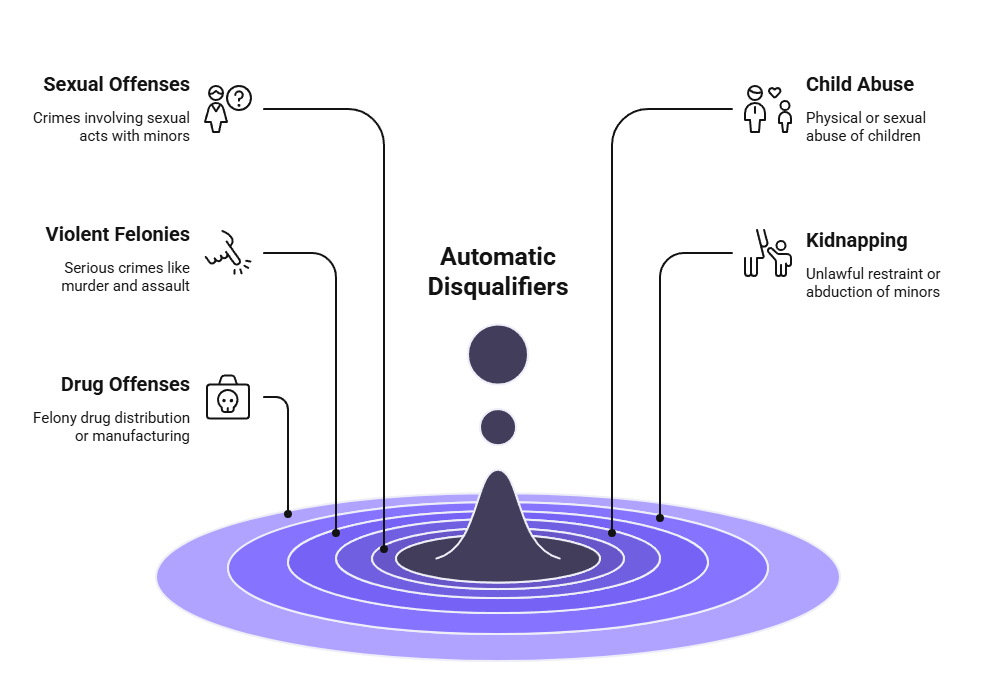
- Sexual offenses involving minors
- Physical or sexual abuse of children
- Violent felonies including murder, manslaughter, and aggravated assault
- Kidnapping or unlawful restraint of minors
- Felony drug offenses involving distribution or manufacturing
Automatic disqualifiers typically apply regardless of how much time has passed since the conviction. Many states extend these bars to include attempted offenses, conspiracy charges, and equivalent offenses from other jurisdictions. Some states also disqualify individuals who appear on sex offender registries, even if the underlying offense might not independently trigger disqualification in that state.
Reviewable and Discretionary Offenses
Beyond automatic disqualifiers, states identify offense categories that permit individualized review. These commonly include misdemeanor assault or domestic violence offenses, theft or financial crimes, DUI or drug possession charges, offenses committed as a juvenile, and older felony convictions outside core disqualification categories.
When a reviewable offense appears, the state certification agency or school district evaluates several factors. These include the nature and severity of the offense, time elapsed since conviction, evidence of rehabilitation, and relevance to teaching responsibilities. Some states use structured review frameworks that assign points or risk levels to offenses and consider mitigating factors. Others grant broad discretion to certification boards or district superintendents.
Arrest Records, Charges Without Conviction, and Expunged Records
State and local laws vary significantly in how they treat non-conviction records. Many jurisdictions impose Ban-the-Box or fair chance hiring restrictions on criminal history inquiries. Some states permit consideration of pending charges or arrests not resulting in conviction when they involve offenses that would disqualify if convicted. Other states prohibit employment decisions based on arrest records unless a conviction results. Employers should verify applicable state and local restrictions before using arrest or non-conviction information in hiring decisions.
State law intends to exclude expunged, sealed, or pardoned records from background checks. However, the scope and effect of expungement vary significantly. Federal law restricts the FBI from reporting expunged convictions in most circumstances. Yet state databases and commercial background check vendors may continue to report expunged records due to database limitations or update delays. Employers should not use expunged records in employment decisions. They should verify record status when discrepancies appear.
HR professionals should consult legal counsel when background checks reveal non-conviction records or when candidates disclose expunged offenses. Basing adverse employment decisions on legally excluded records can create liability under state employment law and civil rights statutes.
Lookback Periods and Reporting Limitations
How far back teacher background checks go depends on state law, the type of offense, and the databases agencies query. Unlike some employment sectors where seven-year reporting limits are common, teacher background checks typically have no time limit for serious offenses.
| Offense Category | Typical Lookback Period | State Variations |
| Violent felonies and sex offenses | Lifetime | Standard across jurisdictions, though some states provide review mechanisms for very old convictions |
| Crimes against children | Lifetime | Standard across jurisdictions |
| Felony drug offenses | Lifetime to 10 years | Varies by state and offense severity |
| Misdemeanor offenses | 7 to 10 years | Some states apply limited lookback |
| Non-disqualifying misdemeanors | State discretion | May be excluded from consideration after 7 years |
Most states require reporting of felony convictions and specified misdemeanors regardless of age. For offenses involving violence, sexual misconduct, or crimes against children, states broadly apply lifetime lookback standards. This approach reflects the child safety rationale that underlies teacher screening.
Some states impose seven or ten-year lookback limits for non-disqualifying misdemeanors or offenses outside core child safety categories. These limits apply primarily to offenses that trigger discretionary review rather than automatic disqualification.
Screening Requirements for Substitutes, Student Teachers, and Non-Certificated Personnel
Teacher background check requirements by state often extend beyond full-time certificated staff. They frequently include substitute teachers, student teachers who complete field placements, and non-instructional personnel with student access.
Substitute Teachers
States generally subject substitute teachers to the same fingerprint and criminal history check requirements as full-time teachers. Some states issue substitute certifications or permits that require initial background clearance and periodic renewal checks. Short-term or emergency substitute provisions in some states allow individuals to serve temporarily without completed fingerprints if they work under supervision and have initiated fingerprinting.
Districts that maintain substitute pools must track clearance expiration dates. They must ensure that rescreening occurs in compliance with state timelines. Using substitutes whose clearances have lapsed can create significant liability and regulatory violations.
Student Teachers and Practicum Students
States generally require student teachers to complete background checks before beginning field placements. However, the entity responsible for initiating and funding the check varies. Some states require the educator preparation program to manage screening. Others place responsibility on the school district that hosts the placement.
Timelines for student teacher checks can complicate academic program schedules. This becomes particularly challenging for students placed in multiple districts or states during their preparation program. States typically subject student teachers to the same disqualification criteria as employed teachers. However, some states allow review processes for older or less serious offenses when the individual is still in training.
Paraprofessionals, Contractors, and Volunteers
Screening requirements for non-certificated staff, contractors, and volunteers vary widely. Some states mandate fingerprint checks for any individual with unsupervised student contact, regardless of employment status. Others limit mandatory checks to employees and allow districts discretion for contractors and volunteers.
Common roles subject to background check requirements include:
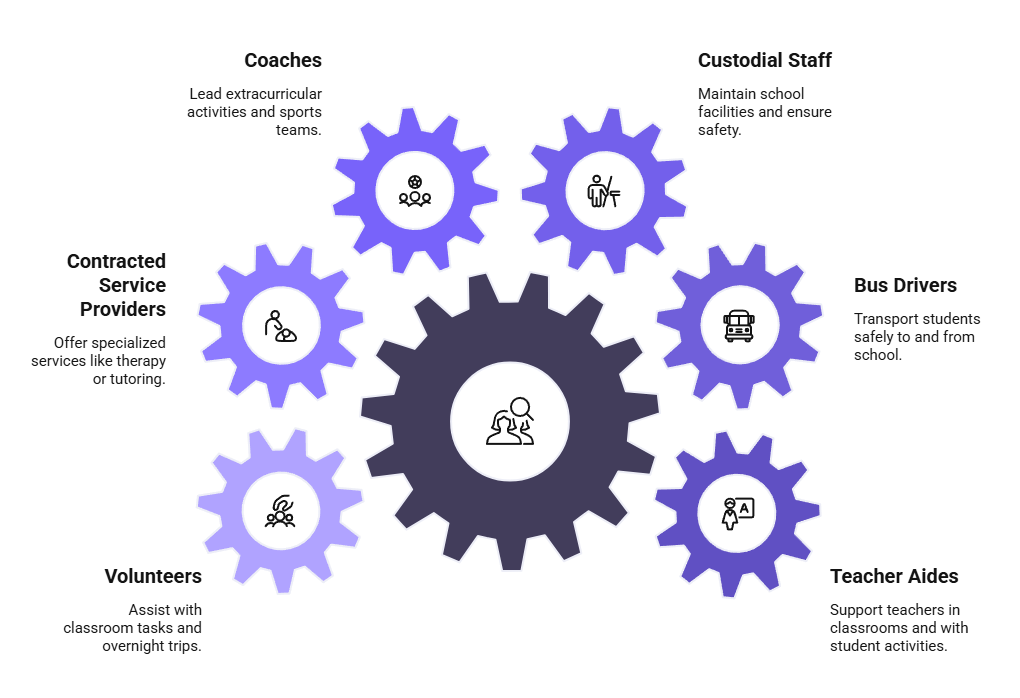
- Teacher aides and paraprofessionals
- Bus drivers and transportation staff
- Custodial and maintenance workers with building access during school hours
- Coaches and extracurricular activity supervisors
- Contracted service providers such as therapists or tutors
- Regular volunteers with classroom or overnight trip responsibilities
Conditional Employment and Pending Background Checks
HR teams who manage hiring timelines frequently ask whether a teacher can work while a background check is pending. This question becomes particularly important when districts fill positions close to the school year start date.
State laws take three general approaches to conditional employment during pending background checks:
Prohibition of any student contact: Some states require complete background clearance before any work assignment, including supervised or observational roles. Teachers in these states may receive conditional employment but cannot enter school buildings or have student interaction until agencies receive and review fingerprint results.
Supervised conditional assignment: Other states permit individuals to work in supervised capacities while fingerprints are pending. Districts must meet specific conditions: fingerprinting has been initiated, the candidate disclosed no disqualifying offenses on the application, and a certificated employee directly supervises all student interactions. These provisions typically limit conditional work to 30, 60, or 90 days.
Preliminary clearance systems: A third group of states offers expedited preliminary clearance based on state-only criminal history checks, sex offender registry searches, or child abuse registry checks while FBI fingerprint results are pending. Teachers who pass preliminary screening may begin supervised work while awaiting full clearance.
Even in states that permit conditional employment, districts may adopt more restrictive policies as a risk management measure. When districts use conditional assignments, they should document the supervision plan. They should ensure that supervisors understand their responsibilities. They should establish check-in procedures to confirm that full clearance is obtained within required timelines.
Maintaining Compliance: Documentation, Audits, and Policy Updates
Managing teacher background check requirements by state effectively requires robust documentation systems, periodic compliance audits, and processes for monitoring legal changes.
State laws often specify how long districts must retain background check records and who may access them. Common requirements include retaining fingerprint results and clearance documentation for the duration of employment plus a specified period after separation. They also include maintaining records in confidential personnel files with restricted access and documenting supervisory plans and clearance timelines for conditional employees.
HR information systems should include fields for tracking background check initiation dates, clearance dates, rescreening due dates, and any review or appeals documentation. Automated alerts for upcoming rescreening deadlines help ensure timely compliance.
Periodic Compliance Audits
Annual or biennial audits of background check compliance help identify gaps before they create regulatory risk. Audit procedures might include:
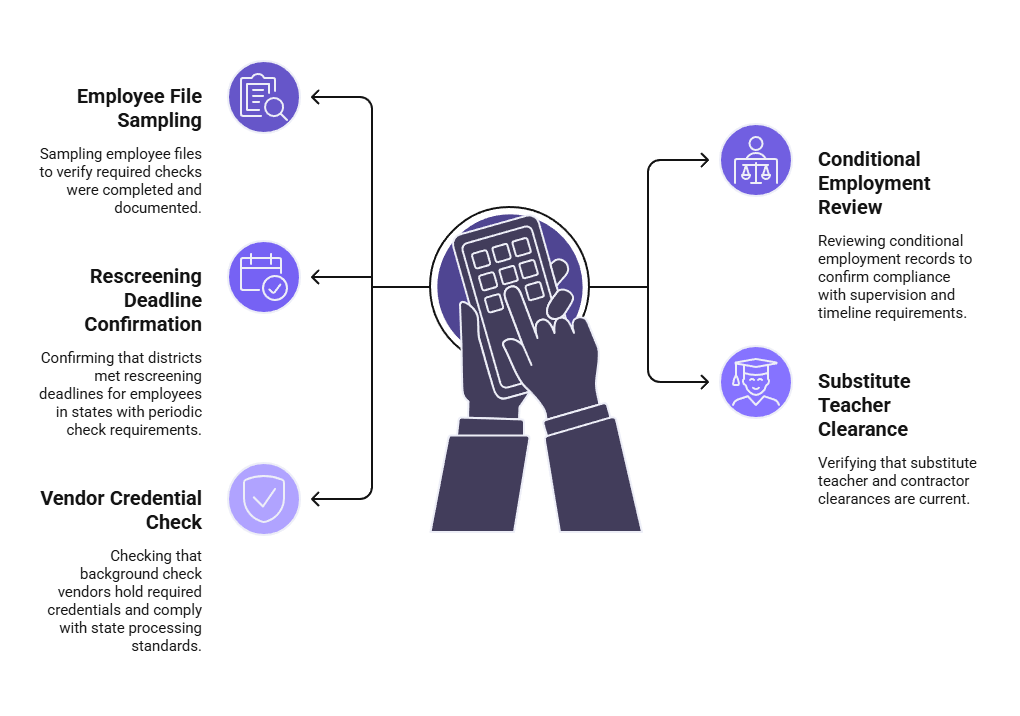
- Sampling employee files to verify that districts completed and documented required checks
- Reviewing conditional employment records to confirm compliance with supervision and timeline requirements
- Confirming that districts met rescreening deadlines for employees in states with periodic check requirements
- Verifying that substitute teacher and contractor clearances are current
- Checking that background check vendors hold required credentials and comply with state processing standards
Districts should document audit findings. Corrective action plans should address any deficiencies.
Monitoring Legal and Regulatory Changes
Teacher background check requirements by state face ongoing legislative amendments, regulatory updates, and case law developments. HR teams should establish monitoring processes to identify relevant changes. They can subscribe to state education agency updates, review proposed legislation during state legislative sessions, participate in state and regional HR associations where members share legal updates, and consult with legal counsel when changes are reported.
When requirements change, districts should update written policies. They should revise training materials, communicate changes to hiring managers, and adjust HR system workflows to reflect new mandates.
Conclusion
Teacher background check requirements by state create a complex compliance environment. HR professionals must understand jurisdiction-specific mandates, manage documentation and timelines carefully, and monitor evolving legal standards. Districts can meet their legal obligations while supporting efficient hiring processes by treating these requirements as part of a comprehensive safeguarding and risk management system.
Frequently Asked Questions
What is the difference between state and FBI fingerprint checks for teachers?
State fingerprint checks query criminal history databases that the state identification bureau maintains. These capture offenses processed within that state. FBI fingerprint checks query the national Interstate Identification Index. This system aggregates records from participating states and federal agencies. Most states require both checks to ensure complete coverage.
Can a teacher be hired in a new state if they were already fingerprinted in another state?
Whether prior fingerprinting satisfies requirements in a new state depends on that state's reciprocity policies. Some states accept recent out-of-state fingerprint checks. Others require only a supplemental state-level check. Many require entirely new fingerprinting regardless of prior screening. Teachers who relocate across state lines should verify requirements with the new state's certification agency.
How long does a teacher background check typically take?
Processing times vary by state infrastructure and the method used. Electronic fingerprinting with direct submission typically returns results within one to two weeks. Paper fingerprint cards may require four to six weeks or longer. Additional delays can occur if records require manual review or if state agencies experience backlogs.
What happens if a teacher's background check reveals an old misdemeanor?
The impact of an old misdemeanor depends on state law and the offense nature. Offenses involving violence, dishonesty, or substance abuse may trigger review processes even if they occurred years ago. Many states allow agencies to consider time elapsed, rehabilitation evidence, and offense relevance to teaching duties. Teachers should prepare to provide court documentation and character references.
Are substitute teachers required to complete the same background checks as full-time teachers?
In most states, substitute teachers face the same fingerprinting and criminal history check requirements as full-time certificated staff. Some states issue specific substitute permits or certifications that include background clearance as a prerequisite. Emergency or short-term substitute provisions may allow individuals to work briefly under supervision while fingerprinting is pending. These exceptions typically limit work to five to ten days.
Do teachers need to be re-fingerprinted when renewing their teaching license?
Re-fingerprinting requirements at license renewal vary by state. Approximately one-third of states require updated fingerprint-based criminal history checks at certification renewal, typically every three to five years. Other states conduct initial fingerprinting only. They do not mandate periodic rescreening unless the teacher has a break in employment or certification lapses.
What disqualifies someone from becoming a teacher?
Automatic disqualifiers in nearly every jurisdiction include convictions for violent felonies, sexual offenses, crimes against children, and abuse or neglect findings. Many states also disqualify individuals with felony drug distribution convictions or those who appear on sex offender registries. Beyond automatic bars, reviewable offenses such as theft, assault, DUI, or fraud may result in disqualification depending on severity.
Can teachers work while their background check is being processed?
Whether teachers can work during pending background checks depends on state law. Some states prohibit any student contact until agencies document full clearance. Others allow supervised conditional assignments for limited periods, typically 30 to 90 days, provided fingerprinting has been initiated. A few states offer preliminary clearance processes that permit supervised work while FBI results are pending.
Additional Resources
- Every Student Succeeds Act (ESSA) Overview
https://www.ed.gov/essa - FBI Criminal Justice Information Services: Background Checks
https://www.fbi.gov/services/cjis - U.S. Equal Employment Opportunity Commission: Background Checks and Employment
https://www.eeoc.gov/laws/guidance/background-checks-and-credit-history - Federal Trade Commission: Using Consumer Reports for Employment Decisions
https://www.ftc.gov/business-guidance/resources/using-consumer-reports-what-employers-need-know - NASDTEC Interstate Agreement
https://www.nasdtec.net/page/Interstate

ABOUT THE CREATOR
GCheck Editorial Team
Meet the GCheck Editorial Team, your trusted source for insightful and up-to-date information in the world of employment background checks. Committed to delivering the latest trends, best practices, and industry insights, our team is dedicated to keeping you informed.
With a passion for ensuring accuracy, compliance, and efficiency in background screening, we are your go-to experts in the field. Stay tuned for our comprehensive articles, guides, and analysis, designed to empower businesses and individuals with the knowledge they need to make informed decisions.
At GCheck, we're here to guide you through the complexities of background checks, every step of the way.