



Pharmaceutical industry hiring compliance requires coordinated employment screening that satisfies federal regulatory expectations, protects product integrity, and supports operational efficiency. This guide provides HR managers, compliance officers, and talent acquisition teams with a structured framework for building risk-intelligent hiring workflows that align legal, quality assurance, and human resources objectives.
Key Takeaways
- Pharmaceutical employment screening addresses both regulatory compliance and patient safety by verifying credentials, criminal history, and professional qualifications before granting facility access.
- Federal agencies expect pharmaceutical employers to implement appropriate screening measures as part of broader quality management and safety systems, though specific hiring requirements vary by role and operational context.
- Credential verification pharmaceutical staff processes must authenticate licenses, certifications, and educational qualifications using primary-source verification methods to ensure accuracy and regulatory defensibility.
- Healthcare compliance employment screening extends beyond criminal background checks to include sanctions list monitoring, reference verification, and role-specific assessments tailored to manufacturing or clinical responsibilities.
- Cross-departmental collaboration among HR, quality assurance, and legal teams ensures that pharmaceutical industry hiring compliance protocols align with Good Manufacturing Practice expectations and organizational risk tolerance.
- Pharma industry pre employment screening timelines must balance thoroughness with operational needs, requiring clear communication and contingency planning to avoid production delays or onboarding gaps.
- Technology-assisted screening platforms can improve efficiency and record-keeping accuracy when implemented with appropriate human oversight and data privacy safeguards.
- Ongoing monitoring and periodic rescreening policies help pharmaceutical employers manage evolving risks throughout the employment lifecycle, particularly for roles with direct product contact or data access.
Understanding Pharmaceutical Industry Hiring Compliance in 2026
Pharmaceutical industry hiring compliance has evolved into a multi-layered operational discipline. It integrates regulatory expectations, patient safety imperatives, and workforce risk management. Employers in pharmaceutical manufacturing and drug development face heightened scrutiny regarding personnel qualifications, criminal history screening, and ongoing suitability monitoring.
The regulatory landscape affecting pharmaceutical employment screening includes federal drug safety laws, workplace safety requirements, and consumer protection statutes. These frameworks establish expectations that pharmaceutical employers will exercise reasonable care when selecting personnel. This applies especially to workers who handle controlled substances, access sensitive data, or participate in manufacturing processes that affect product quality. Employers must design hiring compliance programs that satisfy these expectations while respecting candidate privacy rights and employment discrimination protections.
Modern pharmaceutical industry hiring compliance operates at the intersection of human resources, quality assurance, and legal risk management. HR teams carry primary responsibility for candidate evaluation and employment decisions. However, effective screening programs require input from quality assurance professionals who understand manufacturing risk points and legal advisors who can assess regulatory exposure.
Pharmaceutical industry hiring is an exemplary case to show how background screening fits into risk management, rather than being seen as an HR activity in isolation. The best pharmaceutical industry hiring processes are those that integrate the interests and goals of the HR, quality, and legal functions in the organization. By designing the screening program to the specific risk profile of the role, it is possible to protect the integrity of the business without impacting the efficiency of the hiring process. Good design creates a compliance process that is an enabler for the business and the people in it.
Regulatory Foundations and Industry Expectations
Federal regulatory agencies do not mandate uniform background check requirements across all pharmaceutical positions. However, they establish quality system expectations that require appropriate personnel screening. Pharmaceutical manufacturers must demonstrate that individuals performing critical manufacturing tasks possess suitable qualifications. They must also show these workers do not present unacceptable risks to product quality or patient safety.
Healthcare compliance employment screening in pharmaceutical contexts also intersects with controlled substance regulations. Organizations that manufacture, distribute, or conduct research with controlled substances face additional personnel screening obligations. These requirements help prevent diversion and unauthorized access and may include:
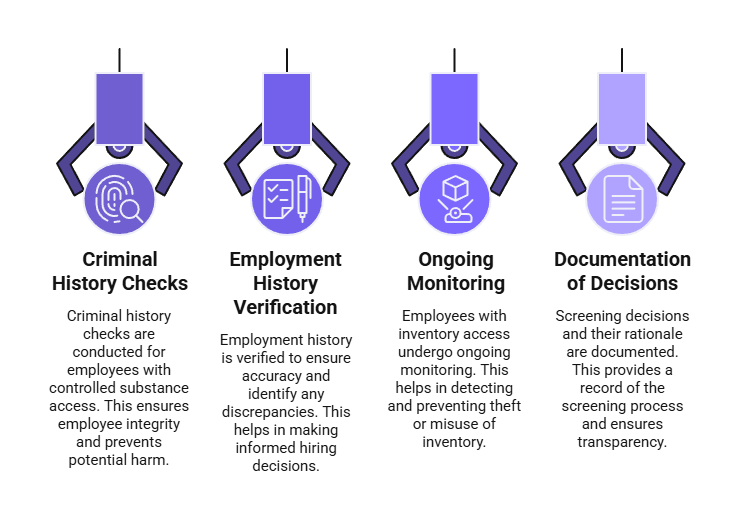
- Criminal history checks for employees with controlled substance access
- Employment history verification covering defined timeframes
- Ongoing monitoring for employees with inventory access
- Documentation of screening decisions and rationale
State and local jurisdictions frequently impose binding employment screening requirements or restrictions. Many states and cities limit the types of criminal history information that employers may lawfully consider. They prohibit inquiries before specific hiring stages, restrict use of arrest records, impose lookback period limits, or mandate detailed applicant notifications. Pharmaceutical employers must ensure compliance with all applicable federal, state, and local laws in each jurisdiction where they operate.
The Role of Cross-Departmental Stakeholders
Effective pharmaceutical industry hiring compliance depends on collaboration among human resources, quality assurance, and legal departments. HR professionals bring expertise in candidate evaluation, employment law compliance, and onboarding logistics. Quality assurance teams contribute knowledge of manufacturing risk points, regulatory inspection priorities, and quality system documentation requirements. Legal advisors provide guidance on privacy law compliance, discrimination risk mitigation, and regulatory interpretation.
This collaborative model ensures that employment screening decisions reflect a comprehensive risk assessment rather than a checklist approach. Regular communication among these stakeholders also supports continuous improvement of pharmaceutical employment screening protocols. This becomes essential as regulatory expectations evolve, inspection findings emerge, or operational needs change.
Core Components of Pharmaceutical Employment Screening
Pharmaceutical employment screening encompasses multiple verification and assessment activities. Organizations design these activities to evaluate candidate suitability for roles within regulated manufacturing or development environments. Organizations typically customize the scope and depth of these screening elements based on role-specific requirements and organizational risk tolerance.
| Screening Component | Purpose | Typical Verification Method |
| Criminal History | Identify conviction records that may present risks to product integrity or workplace safety | Search criminal court records at county, state, and federal levels |
| Credential Verification | Authenticate educational degrees, professional licenses, and specialized certifications | Contact issuing institutions, licensing boards, or certification bodies directly |
| Employment History | Confirm accuracy of previous employment dates, job titles, and responsibilities | Contact former employers to validate information provided on applications |
| Sanctions List Screening | Ensure candidates have not been barred from participating in government healthcare programs | Check federal and state exclusion lists before extending offers |
Criminal History Screening
Criminal history screening helps pharmaceutical employers identify candidates with conviction records that may present risks. These risks include threats to product integrity, workplace safety, or regulatory compliance. When employers obtain criminal history reports through consumer reporting agencies, they must comply with federal requirements. These requirements include written disclosure, candidate authorization, and adverse action notice procedures. Criminal history searches typically involve reviewing court records at county, state, and federal levels. Employers search for felony and misdemeanor convictions within relevant timeframes.
Employers must evaluate criminal history information through individualized assessment. They cannot apply automatic disqualification rules. Federal guidance emphasizes that blanket exclusion policies may raise compliance concerns. Factors including the nature of the offense, time elapsed since conviction, evidence of rehabilitation, and relationship to specific job duties must inform employment decisions. Legal counsel can help develop assessment frameworks that satisfy these requirements.
Credential and License Verification
Credential verification pharmaceutical staff processes authenticate educational degrees, professional licenses, and specialized certifications that candidates claim. This verification typically involves contacting issuing institutions, licensing boards, or certification bodies directly. Employers confirm that credentials are current, valid, and held by the individual in question. Primary-source verification provides the highest level of assurance. It reduces the risk of relying on falsified or misrepresented qualifications.
For roles requiring professional licenses such as pharmacists, clinical research coordinators, or quality control chemists, verification must confirm active and unrestricted status. Licensing boards often maintain public databases that allow employers to check license status, expiration dates, and any disciplinary actions.
Employment and Reference Verification
Employment history verification confirms the accuracy of previous employment dates, job titles, and responsibilities that candidates report. This process typically involves contacting former employers to validate information provided on applications or resumes. Verification helps identify gaps in employment, clarifies the scope of previous responsibilities, and detects misrepresentations that could indicate integrity concerns.
Reference checks complement employment verification by gathering assessments of candidate performance, work habits, and professional conduct. Effective reference checks involve structured questions. These questions elicit specific examples of behavior and performance rather than general impressions.
Sanctions and Exclusion List Screening
Healthcare compliance employment screening in pharmaceutical contexts includes checking federal and state exclusion lists. Employers verify that candidates have not been barred from participating in government healthcare programs. Employers should disclose this screening activity to candidates as part of comprehensive background check notifications. They must obtain appropriate written authorization before conducting searches. Individuals who appear on these lists may not work in roles where their compensation derives from federal healthcare program funds.
Sanctions list screening should occur before employers extend employment offers. It should continue periodically throughout employment. Many organizations conduct monthly or quarterly rescreening to detect newly added exclusions. Organizations that fail to identify and address excluded individuals can face significant financial penalties, loss of contracting privileges, and reputational damage.
Implementing Risk-Intelligent Screening Workflows
Building effective pharmaceutical industry hiring compliance programs requires more than selecting appropriate screening components. Organizations must design workflows that sequence these activities logically. These workflows must accommodate operational timelines and provide clear decision-making frameworks.
Tailoring Screening Protocols to Role Risk Profiles
Not all pharmaceutical positions present identical risks to product quality, patient safety, or regulatory compliance. Manufacturing technicians who compound sterile injectable products face different risk considerations than marketing analysts who develop promotional materials. Effective screening workflows recognize these distinctions and adjust verification depth accordingly.
Organizations typically establish role classification systems that group positions by risk level. These systems specify corresponding screening requirements:
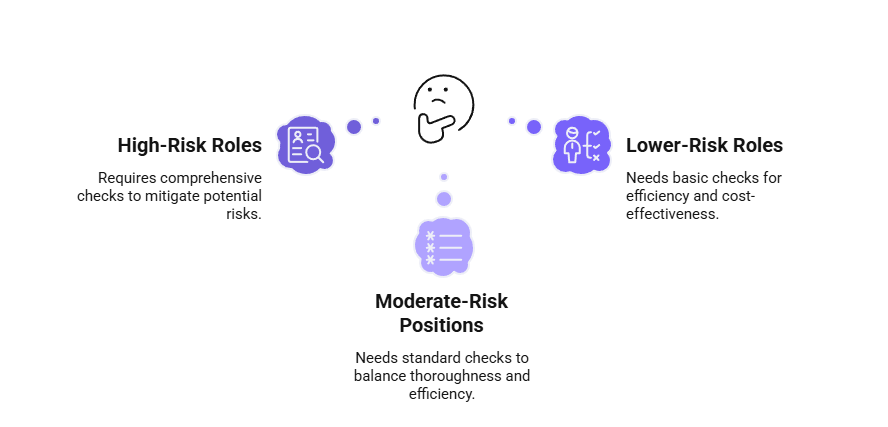
- High-risk roles: Comprehensive criminal history searches, detailed employment verification covering ten years, primary-source credential verification, and enhanced reference checks
- Moderate-risk positions: Narrower criminal history searches, abbreviated employment verification, and standard reference checks
- Lower-risk roles: Basic identity verification and limited criminal history screening
This risk-based approach improves resource allocation. It directs the most intensive verification efforts toward positions where screening failures carry the greatest consequences.
Sequencing and Timing Considerations
The order in which screening activities occur affects both efficiency and candidate experience. Many organizations conduct preliminary screens early in the hiring process. This helps identify disqualifying factors before investing resources in final-stage assessments. However, certain screening activities such as detailed criminal history checks or comprehensive employment verification typically occur after employers extend a conditional offer of employment. This timing protects candidate privacy. It also ensures compliance with ban-the-box and fair chance hiring laws that many states and municipalities have enacted. These laws often prohibit criminal history inquiries until specific hiring stages. Employers should verify timing requirements in each jurisdiction where they recruit or hire.
Pharmaceutical employers must also account for verification timelines when planning onboarding schedules. Primary-source credential verification can require several weeks. This is particularly true for international credentials or institutions with slow response times. Criminal history searches in some jurisdictions may take longer than expected due to court processing delays. Building buffer time into hiring timelines reduces the risk that screening delays will disrupt production schedules or leave critical positions vacant.
Decision-Making Frameworks and Adjudication Standards
Clear decision-making frameworks help ensure that organizations evaluate screening findings consistently and legally. These frameworks specify how to assess particular types of information such as criminal convictions, employment gaps, or credential discrepancies. They also identify who has authority to make final employment decisions and what documentation organizations must maintain.
Adjudication standards should require individualized assessment rather than automatic disqualification based on screening findings. Documentation practices are essential for demonstrating that employment decisions rest on legitimate, non-discriminatory factors. Organizations should maintain records showing what screening information they obtained, how they evaluated it, and what reasoning supported final decisions.
Technology-Assisted Screening Platforms
Technology platforms can streamline pharmaceutical employment screening by automating verification requests, tracking screening status, and maintaining centralized records. These systems may integrate with applicant tracking platforms, generate compliance reports, and flag verification results requiring human review.
However, technology-assisted screening requires appropriate human oversight. Employers remain legally responsible for screening decisions even when using third-party vendors or automated systems. Automated systems may return false positive matches, misclassify offense severity, fail to account for jurisdictional legal restrictions on criminal history use, or perpetuate bias. Qualified personnel must review technology-generated results before making employment decisions.
Data privacy and security considerations are critical when implementing screening technology. Systems must protect sensitive candidate information through encryption and access controls. They must limit data access to authorized personnel only. Systems must comply with applicable federal and state privacy laws, including state data breach notification requirements. They must implement data minimization practices and establish appropriate retention and deletion schedules. Employers should consult privacy counsel when implementing new screening technologies. This is particularly important for technologies processing Social Security numbers, dates of birth, or other sensitive identifiers.
Addressing Common Implementation Challenges
Even well-designed pharmaceutical industry hiring compliance programs encounter practical challenges during implementation. These obstacles may involve incomplete screening results, conflicting information from multiple sources, or difficulty verifying international credentials.
| Challenge | Common Causes | Potential Solutions |
| Incomplete Verification Results | Unresponsive former employers, slow credential verification processes, court processing backlogs | Provisional start policies with restricted duties, alternative verification methods, enhanced documentation |
| Conflicting Information | Resume discrepancies, employer record errors, institutional name changes | Candidate explanation opportunities, investigation before adverse action, documentation of resolution |
| International Credential Verification | Language barriers, different educational systems, limited verification infrastructure | Specialized credential evaluation services, licensing board reciprocity checks, additional documentation requirements |
Incomplete or Delayed Verification Results
Verification delays can disrupt hiring timelines. They create difficult decisions about whether to proceed with onboarding before all screening results are complete. Some organizations establish provisional start policies that allow candidates to begin work in limited capacities while final verifications are pending. These arrangements might restrict access to sensitive areas, require enhanced supervision, or limit the scope of responsibilities until employers receive all screening results.
When verification sources do not respond to initial requests, alternative verification methods may provide adequate assurance. Employers can often verify professional licenses through online databases maintained by licensing boards. They might confirm employment dates through tax records or pay stubs provided by candidates.
Conflicting Information from Multiple Sources
Screening occasionally produces conflicting information about employment dates, job titles, or credential details. Organizations should give candidates opportunities to explain discrepancies before making adverse decisions. Many conflicts have simple explanations such as informal versus official job titles, institutional name changes, or administrative errors in employer records.
When conflicts remain unresolved after candidate explanation, organizations must assess the significance of the discrepancy. Minor inconsistencies in dates or titles may not warrant adverse action. This is particularly true if other aspects of the candidate's background are well-verified.
International Credential Verification
Verifying credentials earned outside the United States presents unique challenges. These challenges stem from differences in educational systems, credential formats, and verification processes. Organizations that frequently hire candidates with international credentials may benefit from engaging specialized credential evaluation services. These services assess international credentials for equivalency to United States standards. They may facilitate verification with foreign institutions. However, employers should recognize that not all international credentials can be definitively verified. Evaluation service methodologies vary. When verification is incomplete, employers must determine acceptable alternative documentation and risk tolerance on a case-by-case basis.
For professional licenses earned internationally, verification requirements vary by profession and jurisdiction. Some United States licensing boards maintain reciprocity agreements with foreign jurisdictions. These agreements streamline credential recognition.
Ongoing Monitoring and Periodic Rescreening
Pharmaceutical industry hiring compliance extends beyond initial employment screening. It includes ongoing monitoring and periodic rescreening throughout the employment relationship. This continuous oversight helps organizations identify changes in employee status that could affect their suitability for current roles or create new risks to product quality and patient safety.
License and Credential Monitoring
Professional licenses and certifications may expire, become subject to disciplinary action, or be revoked after initial verification. Organizations should implement monitoring systems that track expiration dates for role-critical credentials. These systems verify that employees maintain current, unrestricted licenses. Automated monitoring tools can alert HR or compliance teams when licenses are approaching expiration or when disciplinary actions are reported.
The frequency of license monitoring depends on the credential type and role responsibilities:
- Positions requiring active professional licenses: Monthly or quarterly monitoring to detect lapses promptly
- Certifications without regulatory weight: Less frequent monitoring based on renewal cycles
- High-risk manufacturing roles: Continuous tracking of all role-critical credentials
When monitoring reveals that an employee's license has lapsed or been restricted, organizations must respond quickly. They must assess whether the employee can continue in their current role.
Exclusion List Rescreening
Regular rescreening against federal and state exclusion lists helps organizations detect employees who become excluded after initial hiring. Authorities add individuals to exclusion lists due to criminal convictions, civil fraud settlements, or professional license revocations. Most organizations conduct exclusion list rescreening monthly, though some perform checks more frequently.
Automated screening tools can streamline this process. They check employee rosters against updated exclusion lists and flag potential matches for investigation. If rescreening identifies an employee on an exclusion list, organizations must take immediate action. They must ensure the individual's compensation does not derive from federal healthcare program funds.
Criminal History Updates and Continuous Monitoring
Some organizations implement continuous criminal history monitoring systems. These systems alert employers to new arrests or convictions for current employees. However, continuous criminal history monitoring raises significant legal and practical considerations. Many jurisdictions prohibit or restrict employer use of arrest records that have not resulted in convictions. When employers conduct monitoring through consumer reporting agencies, it may trigger additional notice and authorization requirements. Continuous monitoring may also create disparate impact concerns. Employers considering continuous monitoring should obtain legal counsel review before implementation.
Periodic rescreening at defined intervals such as every three or five years represents an alternative to continuous monitoring. This approach provides updated criminal history information at reasonable intervals. It avoids some concerns associated with real-time surveillance.
Balancing Compliance, Efficiency, and Candidate Experience
Pharmaceutical industry hiring compliance programs must satisfy regulatory expectations and organizational risk management needs. They must also respect candidate rights and maintain operational efficiency. Achieving this balance requires thoughtful program design, clear communication, and ongoing evaluation of screening effectiveness.
Organizations should ensure that screening processes include appropriate candidate disclosures. These disclosures explain what information will be obtained and how it will be used. Written authorization forms should clearly describe the scope of background checks. Employers should present them separately from other application materials where legally required. When screening through consumer reporting agencies reveals information that will contribute to an adverse employment decision, federal law typically requires specific steps. Employers must provide the candidate with a pre-adverse action notice, a copy of the report, and a summary of rights before finalizing the decision. After allowing reasonable time for the candidate to respond, employers must then provide a final adverse action notice if they confirm the decision. Organizations should consult legal counsel to ensure compliance with all applicable notice requirements.
Efficiency improvements may come from pre-identifying reliable verification sources. Organizations can establish relationships with responsive former employers or credential verification services. They can use technology to automate routine tasks. Clear communication with hiring managers about screening timelines and potential delays helps set realistic expectations. It supports workforce planning.
Organizations can improve candidate experience by providing clear explanations of screening requirements and timelines. They should respond promptly to candidate questions and treat sensitive information with appropriate confidentiality. Even when screening results ultimately lead to adverse decisions, treating candidates professionally throughout the process preserves the employer brand. It reduces the risk of complaints or legal challenges.
Conclusion
Pharmaceutical industry hiring compliance in 2026 requires integrated workflows that satisfy regulatory expectations, support quality objectives, and respect candidate rights. By implementing risk-intelligent screening protocols, fostering cross-departmental collaboration, and maintaining both thoroughness and efficiency, pharmaceutical employers can build hiring compliance programs that serve as operational assets rather than administrative burdens.
Frequently Asked Questions
What makes pharmaceutical employment screening different from other industries?
Pharmaceutical employment screening addresses heightened regulatory expectations related to product quality, patient safety, and controlled substance handling. While many industries conduct criminal history and employment verification, pharmaceutical organizations typically require more extensive credential verification, sanctions list screening, and ongoing monitoring.
How should organizations evaluate criminal history information for pharmaceutical positions?
Organizations should conduct individualized assessments that consider offense nature, recency, frequency, evidence of rehabilitation, and relationship to job duties. They cannot apply blanket disqualification rules. Many jurisdictions prohibit automatic exclusions based on conviction records. They require contextual evaluation.
What is primary-source credential verification and why does it matter?
Primary-source credential verification involves confirming licenses, certifications, and educational credentials directly with the issuing institution or licensing board. Organizations do not rely on candidate-provided documents. This method provides the highest assurance of credential authenticity and current status.
How often should pharmaceutical employers rescreen current employees?
Rescreening frequency depends on the screening component and role risk profile. Exclusion list checks typically occur monthly to detect newly excluded individuals promptly. Professional license monitoring might occur quarterly or when licenses approach expiration. Comprehensive background rescreening including criminal history often occurs every three to five years for high-risk roles.
Can pharmaceutical employers use technology platforms for employment screening?
Technology platforms can improve screening efficiency, record-keeping, and compliance tracking when implemented with appropriate human oversight. However, automated systems require review to ensure accuracy, identify false positive matches, and apply organization-specific adjudication standards.
What should employers do when credential verification is delayed?
Organizations may consider provisional start arrangements that allow candidates to begin work with restricted duties or enhanced supervision while verification is pending. Alternatively, employers might use alternative verification methods such as online license databases. They can request candidate-provided documentation when primary sources are unresponsive.
How do state and local laws affect pharmaceutical employment screening?
State and local jurisdictions may restrict when employers can request criminal history information. They may limit the types of convictions that employers can consider. They require specific applicant disclosures or mandate particular procedures before adverse employment decisions. Pharmaceutical employers operating in multiple locations must account for these jurisdictional variations when designing screening policies.
What role do quality assurance teams play in pharmaceutical employment screening?
Quality assurance professionals provide expertise on manufacturing risk points, regulatory inspection priorities, and quality system documentation requirements. Their input helps HR teams understand which roles require enhanced screening. They clarify what credential types are essential for specific positions. They explain how employers should maintain screening documentation for regulatory inspection readiness.
Additional Resources
- Fair Credit Reporting Act Summary of Rights
https://www.consumer.ftc.gov/articles/pdf-0096-fair-credit-reporting-act.pdf - FDA Quality Systems Guidance
https://www.fda.gov/drugs/pharmaceutical-quality-resources/facts-about-current-good-manufacturing-practices - U.S. Department of Health and Human Services List of Excluded Individuals and Entities
https://oig.hhs.gov/exclusions/ - Equal Employment Opportunity Commission Guidance on Arrest and Conviction Records
https://www.eeoc.gov/laws/guidance/arrest-and-conviction-records - National Association of Boards of Pharmacy License Verification
https://nabp.pharmacy/

ABOUT THE CREATOR
GCheck Editorial Team
Meet the GCheck Editorial Team, your trusted source for insightful and up-to-date information in the world of employment background checks. Committed to delivering the latest trends, best practices, and industry insights, our team is dedicated to keeping you informed.
With a passion for ensuring accuracy, compliance, and efficiency in background screening, we are your go-to experts in the field. Stay tuned for our comprehensive articles, guides, and analysis, designed to empower businesses and individuals with the knowledge they need to make informed decisions.
At GCheck, we're here to guide you through the complexities of background checks, every step of the way.