



Not every applicant tracking system can handle the compliance demands of healthcare hiring, where a weak background screening integration can expose your organization to federal penalties, patient safety risks, and audit failures. We scored 10 ATS platforms across six weighted factors built specifically for healthcare screening, including integration depth, FCRA automation, OIG/SAM monitoring, and support for role- and location-based screening packages. The results reveal a sharp divide between platforms purpose-built for healthcare compliance and those that will require significant added tooling to meet baseline requirements.
Key Takeaways
- Healthcare screening goes far beyond criminal checks. The strongest ATS platforms natively support the four-database core of NPDB, OIG LEIE, SAM, and state licensure board checks, plus ongoing post-hire monitoring for exclusion list and licensure changes.
- FCRA compliance must be automated with auditable timestamps, not tracked by hand. Platforms that lack built-in adverse action workflows, standalone disclosure support, and timed waiting periods put healthcare employers at serious legal risk.
- Integration architecture matters as much as the feature list. Native marketplace links with two-way data sync offer the strongest compliance safety, while manual export or portal-based processes fragment records and increase audit exposure.
- A clear scoring gap separates the top five platforms from the rest. Five platforms scored above 4.0 on our weighted scale, while the remaining five scored below 3.0, indicating that general-purpose recruiting tools often fall short of healthcare screening requirements.
- Hiring or retaining someone on the OIG exclusion list carries severe federal consequences. Violations can trigger payment bans and civil money penalties, and may also expose organizations to False Claims Act liability, making automated exclusion monitoring a necessity rather than a luxury.
Healthcare hiring in 2026 demands more from your applicant tracking system than posting jobs and collecting résumés. In fact, the right healthcare applicant tracking system should function as a compliance command center. Specifically, it should automate background screening, route candidates through healthcare-specific checks, and keep your organization aligned with federal and state rules.
This article reviews 10 ATS platforms on the depth of their background screening setups, scored specifically for healthcare employers. Whether you run a hospital system, skilled nursing facility, home health agency, healthcare staffing firm, or telehealth group, the quality of your ATS's screening ATS integrations directly affects patient safety, risk exposure, and time-to-fill.
As an HR professional, I see a healthcare hiring process as a compliance process first, a recruiting process second. An applicant tracking system should not only guide a candidate through a process, but also protect an organization by providing automated processes for screening, excluding, and documenting FCRA workflows. I always recommend that hiring managers not only consider what an applicant tracking system does, but also what an applicant tracking system will do for them if an audit, survey, or federal review is called for. In a healthcare organization, integration is not only a matter of convenience; it's a matter of protecting patients, professional licenses, and an organization's reputation.
Quick Answer: Which Healthcare ATS is Best For You?
The strongest ATS platforms for healthcare screening offer broad, pre-built links with multiple approved screening vendors, two-way API data sync, automated FCRA (Fair Credit Reporting Act) workflows, and native support for healthcare-specific databases: NPDB (National Practitioner Data Bank), OIG LEIE (Office of Inspector General List of Excluded Individuals/Entities), SAM (System for Award Management), and state licensure boards. Staffing software for healthcare must also support ongoing post-hire monitoring, not just point-in-time checks. This is because the industry has shifted toward ongoing tracking of exclusion lists and licensure status.
Why Background Screening Integration Quality Matters
Healthcare employers face severe compliance penalties. For instance, hiring or keeping people on the OIG LEIE triggers federal payment bans and civil money penalties under 42 U.S.C. § 1320a-7a. Moreover, knowingly sending claims for services by excluded people may expose groups to False Claims Act liability (31 U.S.C. §§ 3729–3733). In addition, clean slate laws mean criminal records can change post-hire, making periodic re-checks essential.
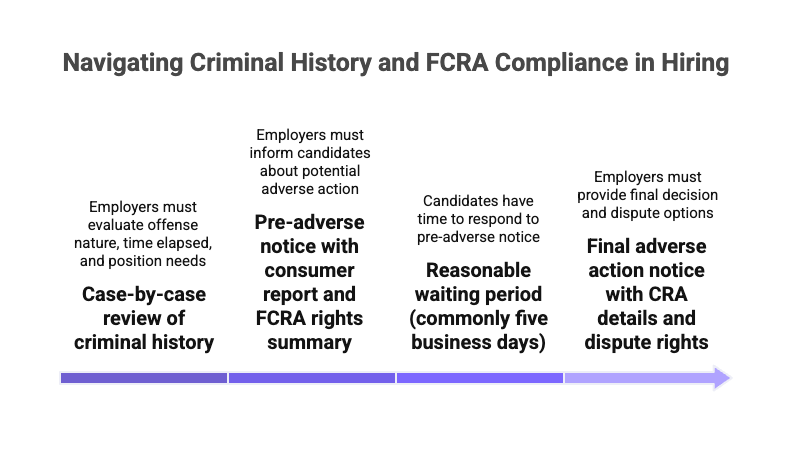
When criminal history appears, employers must conduct case-by-case reviews that consider offense nature, time elapsed, and position needs. Blanket rejection policies may violate Title VII, EEOC guidance, and state fair-chance laws. As a result, ATS platforms must also comply with Ban-the-Box laws, state-specific lookback periods (often seven years for convictions), and limits on using arrest records without convictions.
Furthermore, the FCRA requires disclosure in a standalone document (15 U.S.C. § 1681b(b)(2)(A)(i)). The adverse action process requires a pre-adverse notice with a copy of the consumer report and FCRA rights summary, a reasonable waiting period (commonly five business days), and then a final adverse action notice with CRA details and dispute rights. On top of that, several states require added disclosures, and many locations restrict credit history use and ban salary history inquiries.
In short, the best ATS platforms embed screening with auditable timestamps for all FCRA-required steps and support location-specific compliance setups.
ATS Platforms Compared for Healthcare Background Checks
1. iCIMS
iCIMS maintains one of the broadest screening partner networks of any enterprise ATS. Its cloud marketplace offers pre-built, two-way links with a wide range of approved screening providers. As a result, healthcare employers can order packages, receive results, and manage decisions without leaving the platform.
For healthcare groups, iCIMS supports role-based screening packages that can be set by job family, facility, and location. The workflow engine can trigger the full FCRA adverse action sequence with built-in records trails. In addition, iCIMS also supports high-volume hiring, multi-facility management, and compliance dashboards that surface screening delays in real time.
2. Zoho Recruit
Zoho Recruit is an affordable ATS with strong general recruiting features. Background screening links exist, but the system is narrower than large-scale platforms, with fewer vendor connectors and variable two-way sync depth.
Its strengths lie in its intuitive interface, AI-assisted candidate matching, and Zoho suite links. Smaller clinic groups with simple screening needs can make it work. However, groups needing NPDB queries, ongoing OIG/SAM monitoring, or full FCRA automation will likely need added tooling.
3. Workday
Workday's recruiting module sits within one of the most complete HCM systems for large health systems. It supports deep, two-way API links with screening providers, including those purpose-built for healthcare compliance. Role-based screening packages, location logic, and automated FCRA workflows are all set at the enterprise level.
Above all, large health systems value Workday's unified data model: screening data, credential records, I-9/E-Verify documents, and workforce analytics in one system. Post-hire monitoring triggers can also automate OIG/SAM re-checks on flexible schedules. On the other hand, setup is complex and typically requires dedicated project teams, which can slow time-to-value for mid-size groups.
4. Breezy HR
Breezy HR is popular among mid-market employers for its clean interface and drag-and-drop pipelines. Background screening links are available through a handful of connectors, but the system is modest. Screening workflows may require manual steps such as logging into a separate vendor portal.
Breezy performs well for standard criminal checks, identity checks, and drug testing. However, healthcare-specific features like NPDB lookups, OIG/SAM monitoring, nurse aide registry checks, and multi-board licensure checks are not natively supported. Therefore, employers using Breezy for healthcare hiring must ensure FCRA adverse action steps are documented and completed even if managed outside the platform.
5. Symplr
Symplr was designed from the ground up for hospitals, health systems, and healthcare staffing agencies. Screening is tightly woven into credential workflows, with native support for NPDB, OIG LEIE, SAM, and state licensure board checks — the four-database core widely regarded as best practice for healthcare screening.
Equally important, ongoing monitoring is a core feature, not a bolt-on. Symplr supports automated alerts for exclusion list changes and licensure status updates, together with review workflows that include step-up paths and records trails. Role-based controls allow facility-level compliance management with central policy oversight. For groups where credential checks and background screening intersect daily, Symplr offers a joined-up experience most general ATS platforms cannot match.
6. Ashby
Ashby has gained rapid adoption for its modern, analytics-first approach to recruiting with strong reporting and structured interview management. Background screening is supported through API-based links, but the partner network is still maturing.
The platform lacks native support for FCRA adverse action steps, OIG/SAM ongoing monitoring, or role-based screening packages split by clinical versus non-clinical roles. As a result, healthcare groups should verify that their screening provider has a live, two-way link before committing, and plan for added FCRA compliance tooling.
7. Dayforce
Dayforce offers a unified HCM platform where recruiting, screening, onboarding, and payroll operate on a single ongoing data record. Screening links support two-way sync with multiple approved providers and automate the full FCRA compliance sequence with auditable timestamps.
Healthcare employers benefit from flexible screening packages by role and location, post-hire monitoring for OIG/SAM exclusion checks and licensure checks, and I-9/E-Verify workflow support. What's more, the ongoing engine supports real-time compliance alerting — a meaningful edge for spread-out health systems managing hundreds of new hires monthly.
8. Manatal
Manatal is an AI-powered ATS gaining traction for rapid setup and candidate enrichment. Background screening is available through basic links, but healthcare-specific screening (NPDB, OIG/SAM, abuse registries, multi-state licensure checks) is not natively supported.
Manatal offers social media profile enrichment, but employers should exercise caution: accessing social media in hiring decisions can reveal protected-class traits and may violate social media privacy laws in over 25 states. For non-clinical roles with simple screening needs, Manatal's ease of use is appealing. Nevertheless, compliance-heavy clinical hiring will require major added tools.
9. UKG Pro
UKG Pro serves a large base of healthcare employers. Its screening partner network is mature, with pre-built links supporting two-way data exchange, automated screening starts, and FCRA compliance step tracking.
Healthcare-specific ATS features include multi-facility structures with role-based access, central compliance dashboards, and flexible screening policies by job type and state. In addition, UKG Pro supports post-hire monitoring and routes exclusion or licensure alerts to facility-level compliance officers. The broader HCM suite makes it appealing for groups seeking vendor merging. However, setup for large health systems can extend several months.
10. Teamtailor
Teamtailor is an employer-branding-focused ATS popular in Europe and growing in the U.S. It offers a polished career site builder and strong candidate engagement tools, but screening links are limited to a small number of general employment connectors.
Specifically, Teamtailor does not natively support NPDB queries, OIG/SAM monitoring, or FCRA adverse action steps. As a result, healthcare groups would need to manage most screening compliance through separate vendor portals or manual processes. Its strengths in employer branding and candidate experience are valuable but secondary to screening depth for compliance-driven healthcare hiring.
Scoring Table: Background Screening Ecosystem Strength for Healthcare
Each platform is scored 1–5 across six weighted factors. A score of 5 indicates best-in-class features; 1 indicates limited or absent features.
Method Note: Scores reflect the editorial team's review based on publicly available link records, vendor demos, and published feature sets as of [publication date]. Individual results may vary based on setup, rollout, and screening vendor choice. These scores are not audited on their own and should not be the sole basis for buying decisions.
| ATS | Screening Depth (30%) | HC Screening (25%) | FCRA Automation (15%) | Role/Location (10%) | HC ATS Features (10%) | Ease of Use (10%) | Weighted Total |
| iCIMS | 5 | 5 | 5 | 5 | 4 | 4 | 4.8 |
| Workday | 5 | 4 | 5 | 5 | 5 | 3 | 4.55 |
| Symplr | 4 | 5 | 4 | 5 | 5 | 4 | 4.45 |
| Dayforce | 5 | 4 | 4 | 4 | 4 | 4 | 4.3 |
| UKG Pro | 4 | 4 | 4 | 4 | 5 | 4 | 4.1 |
| Ashby | 3 | 2 | 3 | 2 | 2 | 5 | 2.75 |
| Zoho Recruit | 3 | 2 | 2 | 2 | 2 | 5 | 2.6 |
| Breezy HR | 3 | 2 | 2 | 2 | 2 | 5 | 2.6 |
| Manatal | 2 | 2 | 2 | 2 | 2 | 5 | 2.3 |
| Teamtailor | 2 | 1 | 2 | 2 | 2 | 5 | 2.05 |
Top picks: iCIMS, Workday, Symplr, Dayforce, and UKG Pro stood out for having the most complete, deeply linked screening systems suited to healthcare compliance. To summarize, iCIMS leads on link breadth. Symplr leads on healthcare-specific screening for groups where credential checks and exclusion monitoring are daily tasks. Workday and Dayforce offer powerful steps within unified HCM suites, and UKG Pro provides strong screening with deep healthcare workforce management features.
In contrast, the remaining platforms offer capable general recruiting tools but require added setup for healthcare screening and compliance.
How to Choose an ATS With the Best Background Screening Features
Integration Patterns: Know What You're Buying
Not all ATS screening links are equal. Three patterns exist, ranked strongest to weakest:
- Native marketplace links — Pre-built connectors with two-way data sync and embedded workflows. Screening orders, results, and decisions happen inside the ATS. Most reliable for compliance.
- Custom API/webhook links — Flexible but require dev resources and ongoing upkeep.
- Manual export/portal-based processes — Screener and ATS operate on their own. Compliance records are broken up and audit risk is highest.
For healthcare employers managing FCRA timelines, exclusion monitoring, and multi-state licensure checks, native marketplace links provide the strongest compliance safety.
Seven Questions to Ask During an ATS Demo
- Does screening status sync both ways into the candidate record on its own?
- Can I set up different screening packages by job family, facility, and location?
- Does the platform support post-hire ongoing monitoring alerts for OIG/SAM exclusions and licensure status?
- How does the system automate FCRA adverse action steps with auditable timestamps?
- How many approved screening providers are available in the link marketplace?
- Can the platform route screening exceptions and decisions to role-specific compliance officers at individual sites?
- Does the ATS support I-9/E-Verify with audit trails for remote document checks?
Red Flags That Signal a Weak Screening System
- Screening requires leaving the ATS to log into a separate vendor portal for ordering or reviewing results.
- No adverse action workflow steps — FCRA steps are tracked by hand or in spreadsheets.
- No audit trail for disclosure, consent, and adverse action timing.
- No support for OIG/SAM exclusion monitoring or state licensure checks post-hire.
- No support for location-specific screening rules — including Ban-the-Box compliance, lookback period limits, and state-specific disclosure needs.
Conclusion
Choosing the best ATS for healthcare background screening is, in the final analysis, a compliance decision. The real payoff is the risk you remove: excluded people caught before they touch a patient, licensure lapses flagged before surveyors find them, and FCRA violations avoided because every step is recorded and time-stamped. Because screening duties vary a great deal by location, employers should work with qualified legal counsel to ensure their ATS setup and decision policies comply with all laws that apply.
Disclaimer: This article provides general information and does not constitute legal advice. Background screening duties vary by federal, state, and local location. Employers should consult qualified legal counsel to ensure compliance with all laws that apply before setting up screening programs.
REFERENCES
[1] U.S. Department of Health and Human Services, Office of Inspector General. "Exclusions Program." https://oig.hhs.gov/exclusions/
[2] Health Resources and Services Administration. "National Practitioner Data Bank." https://www.npdb.hrsa.gov/
[3] Federal Trade Commission. "Fair Credit Reporting Act." https://www.ftc.gov/legal-library/browse/statutes/fair-credit-reporting-act
[4] General Services Administration. "System for Award Management (SAM)." https://sam.gov/
[5] New York City Department of Consumer and Worker Protection. "Automated Employment Decision Tools." https://www.nyc.gov/site/dca/about/automated-employment-decision-tools.page
[6] iCIMS. https://www.icims.com/
[7] Workday. "Enterprise Human Resource Management." https://www.workday.com/en-us/solutions/role/enterprise-hr.html
[8] U.S. Equal Employment Opportunity Commission. "Enforcement Guidance on the Consideration of Arrest and Conviction Records in Employment Decisions Under Title VII." https://www.eeoc.gov/laws/guidance/enforcement-guidance-consideration-arrest-and-conviction-records-employment-decisions[9] Consumer Financial Protection Bureau. "Summary of Rights Under the Fair Credit Reporting Act." https://www.consumerfinance.gov/consumer-tools/credit-reports-and-scores/

ABOUT THE CREATOR
GCheck Editorial Team
Meet the GCheck Editorial Team, your trusted source for insightful and up-to-date information in the world of employment background checks. Committed to delivering the latest trends, best practices, and industry insights, our team is dedicated to keeping you informed.
With a passion for ensuring accuracy, compliance, and efficiency in background screening, we are your go-to experts in the field. Stay tuned for our comprehensive articles, guides, and analysis, designed to empower businesses and individuals with the knowledge they need to make informed decisions.
At GCheck, we're here to guide you through the complexities of background checks, every step of the way.