



Motor Vehicle Record (MVR) screening serves as the foundational risk assessment tool for organizations employing or contracting delivery drivers, providing visibility into driving history that criminal background checks cannot reveal. This guide explains what MVR screening entails, how requirements differ across delivery verticals and employment classifications, and how to build defensible screening policies that balance operational needs with legal compliance and insurance carrier expectations.
Key Takeaways
- MVR reports reveal driving violations, license status, and accident history, but do not include criminal records or employment history unless driving-related.
- Liability exposure from negligent entrustment makes MVR screening a legal and insurance necessity, not merely a best practice.
- Disqualification criteria vary significantly by delivery vertical, with medical couriers and food delivery operations often facing stricter standards than package delivery.
- Employment classification (W-2, 1099, platform-contracted) determines whether FCRA compliance applies and how liability is distributed.
- Major delivery platforms apply proprietary MVR standards, but third-party logistics providers and direct employers must establish their own defensible criteria.
- Point-in-time MVR screening creates risk gaps in high-turnover delivery workforces, making continuous monitoring increasingly common.
- Written MVR policies with clear disqualification thresholds and documented exception processes reduce legal exposure and support consistent decision-making.
- State-level MVR reporting variations and lookback period limits require jurisdiction-specific verification during policy development.
What MVR Screening Means in the Delivery Driver Context
Motor Vehicle Record screening involves obtaining a driver's official history from state motor vehicle departments to evaluate their suitability for operating a vehicle in a work capacity. For delivery operations, MVR screening functions as the primary tool for assessing whether a driver presents acceptable risk based on past driving behavior, license status, and documented violations.
MVR vs. Criminal Background Checks
MVR reports and criminal background checks serve distinct purposes and pull from different data sources. An MVR contains only information maintained by state Departments of Motor Vehicles, including moving violations, license suspensions, at-fault accidents, and administrative actions such as DUI convictions that result in license restrictions.
Criminal background checks query court records, correctional databases, and sex offender registries, but typically do not include traffic violations unless they resulted in criminal prosecution. Organizations screening delivery drivers require both tools because each addresses different risk categories.
Scope of "Delivery Driver" in 2026
The term "delivery driver" now encompasses a broad range of roles, vehicle types, and operational models. This guide addresses MVR screening for drivers operating personal vehicles, cargo vans, and box trucks under 26,001 pounds in last-mile delivery, food delivery, medical courier, and package delivery operations. Drivers requiring a Commercial Driver's License fall under separate DOT regulations and are not the primary focus here.
Role of MVR in Multi-Layered Screening
MVR screening functions as one component within a broader risk assessment framework. Depending on jurisdiction, employment classification, and delivery vertical, organizations may also conduct criminal background checks, identity verification, employment history verification, drug screening, and reference checks. MVR data informs the driving-specific risk dimension but should not be evaluated in isolation.
Why MVR Screening Matters for Delivery Operations
Negligent Entrustment and Vicarious Liability
Negligent entrustment is a legal doctrine holding employers or vehicle owners liable when they permit an unqualified, incompetent, or reckless individual to operate a vehicle, and that individual causes harm. Conducting MVR screening and documenting the review process may support a defense by demonstrating reasonable care in driver selection, though courts evaluate multiple factors including ongoing monitoring, response to known issues, and adherence to written policies. Negligent entrustment standards vary by jurisdiction, and MVR screening alone does not eliminate liability exposure.
Vicarious liability imposes liability on employers for employee actions taken within the scope of employment. While MVR screening does not eliminate vicarious liability exposure, documented screening practices may be considered by courts and insurers when evaluating the employer's overall risk management approach. However, the impact on damages or settlement outcomes depends on jurisdiction-specific legal standards and the totality of the employer's hiring and retention practices.
“Hiring drivers is not simply about filling jobs. It is about managing risk on the road every single day.” As far as delivery operations are concerned, I believe MVR goes beyond being a necessary component of the hiring process. What I find most interesting is the extent of the importance of having clear criteria as opposed to making individualized decisions without any structure in place. Top organizations don’t simply verify; they create processes that consider safety, compliance, and operational reality. When done correctly, it instills not only trust in the hiring process but also trust in the entire delivery operation.
Insurance Carrier Requirements
Many commercial auto insurance carriers require MVR screening as a condition of coverage or premium pricing, though specific requirements vary by carrier, coverage type, fleet size, and the insured's risk profile. Insurers typically specify minimum screening standards, such as:
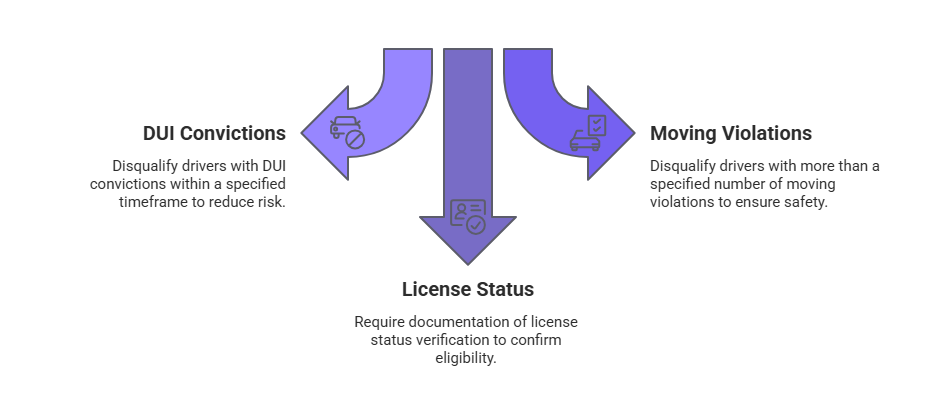
- Disqualifying drivers with DUI convictions within a certain timeframe
- Disqualifying drivers with more than a specified number of moving violations
- Requiring documentation of license status verification
Failure to comply with carrier-mandated screening can result in coverage denial, premium increases, or policy cancellation.
Litigation and Regulatory Risk
Inadequate MVR screening can trigger regulatory scrutiny, particularly in states with stringent transportation network company regulations or occupational safety enforcement. Documented screening failures can serve as evidence of systemic negligence in employment practices litigation. Regulatory agencies and plaintiff attorneys increasingly request MVR screening policies, application records, and decision documentation during discovery.
What an MVR Reveals and What Does Not Appear
Information Typically Included on MVR Reports
| Category | Details |
| License status | Valid, expired, suspended, revoked, or restricted |
| License class and endorsements | Authorized vehicle types and special operating permissions |
| Moving violations | Speeding, failure to yield, improper lane changes, following too closely |
| Serious traffic offenses | DUI, DWI, reckless driving, hit-and-run, driving on suspended license, vehicular manslaughter |
| At-fault accidents | Accidents determined to be the driver's fault (reporting varies by state) |
| License suspensions/revocations | Administrative actions, reasons, and duration |
| Points assessed | Current point total and contributing violations (in states using point systems) |
| Traffic-related court convictions | Convictions from traffic violations prosecuted in criminal or traffic court |
Information Not Included on MVR Reports
MVR reports do not contain criminal history unrelated to driving, employment history, credit information, parking tickets, non-moving violations (unless they resulted in license suspension), out-of-state violations in some cases, or expunged records depending on jurisdiction.
State Reporting Variations and Lookback Periods
States differ in what they report and how long violations remain on driving records. Some states report accidents only if they meet a damage threshold or involved injury. Others remove minor violations after three years, while serious offenses such as DUI may remain visible for ten years or longer.
Certain states impose statutory limits on how far back employers may consider violations in employment decisions, separate from how long the state maintains the record on the MVR. For example, some states restrict consideration of certain offenses beyond seven years. Organizations must verify both state MVR retention policies and any applicable employment use restrictions for each jurisdiction in which they operate.
Limitations of MVR as a Standalone Screening Tool
MVR screening captures only violations that resulted in official state action. It does not reflect unreported accidents, traffic stops that did not result in citations, or driving behavior that did not lead to documented violations. For these reasons, organizations should integrate MVR screening within a broader background check process.
Common MVR Disqualifiers for Delivery Drivers
Framework for Organizing Disqualification Criteria
Disqualification thresholds typically fall into three categories:
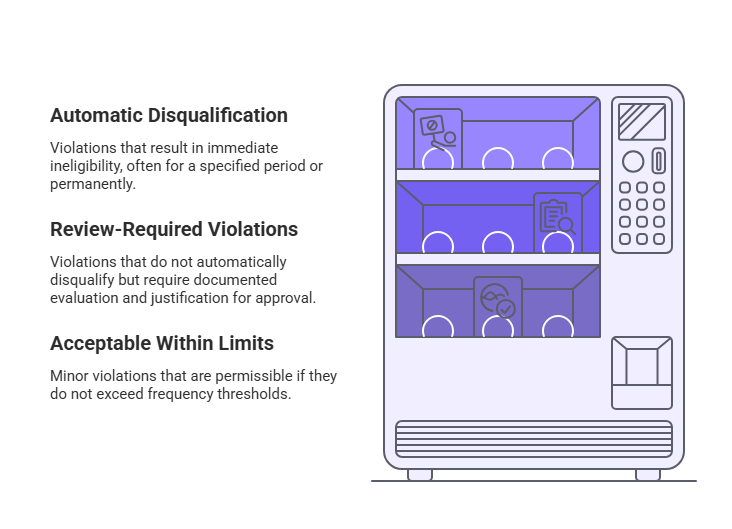
- Automatic disqualifications: Violations that result in immediate ineligibility, often for a specified period or permanently.
- Review-required violations: Violations that do not automatically disqualify but require documented evaluation and justification for approval.
- Acceptable within limits: Minor violations that are permissible if they do not exceed frequency thresholds.
Organizations should define each category in writing and apply criteria consistently across all candidates.
Serious Traffic Offenses: Automatic Disqualifiers
The following offenses commonly result in automatic disqualification, often for periods ranging from three to ten years or permanently:
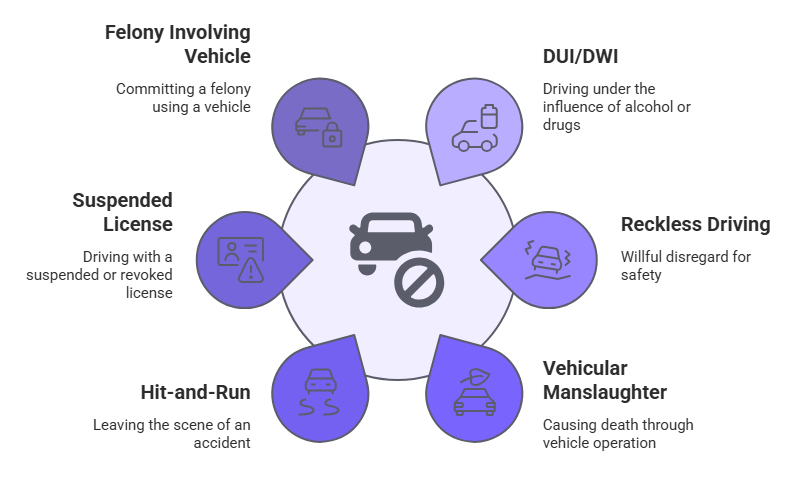
- DUI or DWI (driving under the influence of alcohol or drugs)
- Reckless driving (willful disregard for safety)
- Vehicular manslaughter or homicide
- Hit-and-run (leaving the scene of an accident)
- Driving on a suspended or revoked license
- Felony involving a vehicle
Insurers typically mandate disqualification for these offenses, and liability exposure is substantial if an organization knowingly hires a driver with such violations.
License Status Issues
Candidates must possess a valid, unrestricted license appropriate for the vehicle type and delivery role. Disqualifying license statuses include:
| Status | Disqualification Considerations |
| Suspended or revoked | Any current suspension or revocation disqualifies until reinstatement |
| Expired | Some organizations allow a grace period for renewal, others disqualify until current |
| Restricted or provisional | Restrictions (ignition interlock, daylight-only driving, prohibition on commercial activity) may disqualify depending on operational needs |
Organizations should verify that the license class matches the vehicle type the driver will operate and that no restrictions conflict with job duties.
Excessive Moving Violations
Frequency thresholds for moving violations vary by organizational risk tolerance and insurer requirements. Common standards include:
- Three or more moving violations within three years (often results in disqualification or mandatory review)
- Two or more at-fault accidents within three years (may disqualify or require review)
- One major violation plus minor violations (combination may trigger disqualification)
Organizations should specify whether certain minor violations, such as single speeding tickets below a certain threshold, are excluded from disqualification counts.
At-Fault Accidents
Accident history presents unique challenges because fault determination, reporting thresholds, and state practices vary widely. Organizations should establish clear criteria, such as:
- Two or more at-fault accidents within three years disqualifies
- One at-fault accident involving injury or significant property damage requires review
- Accidents with no fault determination do not count toward disqualification thresholds
When MVR data is unclear, organizations may request additional documentation such as police reports or insurance claim records.
Point System Considerations
In states that assign points for violations, organizations may establish disqualification thresholds based on total points within a lookback period:
| Point Range | Action |
| Six or more points within three years | Disqualified |
| Four to five points | Review required |
| Three or fewer points | Acceptable |
Because point values and accumulation rules vary by state, and not all states use point systems, organizations operating in multiple jurisdictions should establish screening criteria that account for state-specific reporting variations. Organizations should consult legal counsel or compliance specialists when developing multi-state MVR policies.
Segmentation by Delivery Vertical
Food Delivery: Elevated Brand and Safety Sensitivity
Food delivery operations face heightened reputational risk due to direct consumer interaction, access to private residences, and the perception of brand responsibility for driver conduct. Organizations in this vertical often apply stricter MVR standards than package delivery, particularly regarding DUI offenses and reckless driving. Some insurers require disqualification for any DUI within seven to ten years, compared to three to five years in other verticals.
Package and Parcel Delivery: Volume and Efficiency Focus
Package delivery operations prioritize efficiency and volume, often resulting in MVR standards that balance risk management with the need to maintain adequate driver capacity. While serious offenses remain disqualifying, some package delivery employers allow for minor violations that would disqualify candidates in food delivery roles.
Medical Courier: Regulatory and Chain-of-Custody Considerations
Medical courier operations transport pharmaceuticals, biological specimens, medical devices, and patient records, often under time-sensitive conditions and regulatory oversight. The need for reliable, trustworthy drivers who can maintain chain-of-custody and meet delivery windows creates a strong operational case for stringent screening. Some medical courier employers disqualify candidates with any major violation within ten years or any pattern of minor violations suggesting unreliability.
Last-Mile Logistics: Complexity and Scale
Last-mile logistics encompasses a wide range of operational models, from independent contractors delivering for e-commerce platforms to employee drivers operating company-owned fleets. MVR standards in this vertical vary significantly based on whether the organization directly employs drivers, contracts with independent operators, or relies on third-party logistics providers.
Employment Classification and Its Impact on Screening Obligations
W-2 Employees: Full FCRA Compliance Required
When delivery drivers are classified as W-2 employees, organizations must comply with the Fair Credit Reporting Act in all aspects of MVR screening:
- Providing clear disclosure: Candidates must receive a standalone document disclosing that a consumer report may be obtained for employment purposes.
- Obtaining written authorization: Candidates must authorize the MVR check in writing before it is conducted.
- Pre-adverse action process: If MVR findings may result in disqualification, the organization must provide the candidate with a copy of the report, a summary of rights under FCRA, and an opportunity to dispute inaccuracies.
- Final adverse action notice: The organization must provide written notice of the decision, the contact information of the reporting agency, and a statement of the candidate's right to dispute the report.
Failure to follow FCRA procedures can result in statutory damages, attorney fees, and class action liability.
Independent Contractors (1099): FCRA May Still Apply
The classification of a driver as an independent contractor does not automatically exempt the organization from FCRA compliance. FCRA applies when a consumer report is obtained for employment purposes, which the statute defines broadly to include evaluating individuals for employment, promotion, reassignment, or retention. Courts and regulators may determine that contractor screening falls within this definition based on the degree of control the organization exercises, the nature of the relationship, and how the MVR report is used. Organizations should consult legal counsel to determine FCRA applicability and should apply FCRA-compliant procedures when classification or relationship characteristics are uncertain.
Platform-Contracted Drivers: Distributed Responsibility
Delivery drivers contracted through third-party platforms are typically screened by the platform itself, not by the business requesting delivery services. However, businesses that rely on platform-contracted drivers should verify that the platform conducts MVR screening and should understand the platform's standards. In cases where the business exercises control over driver assignment, route selection, or performance management, courts or regulators may find that liability attaches despite contractual disclaimers, based on theories such as joint employment, vicarious liability, or negligent entrustment. Organizations should consult legal counsel to assess their specific risk exposure and contractual protections.
Misclassification Risk and Screening Liability
Misclassifying employees as independent contractors can result in significant penalties. From a screening perspective, if a driver classified as an independent contractor is later determined to be an employee, the organization's failure to conduct FCRA-compliant MVR screening may be cited as evidence of broader compliance failures.
Building a Defensible MVR Screening Policy
Establishing Written Criteria
A defensible MVR policy begins with written disqualification criteria that specify which violations result in automatic disqualification and for what period, which violations require documented review, frequency thresholds for minor violations, lookback periods for each violation category, and license status requirements. Written criteria ensure consistent application across candidates and reduce the risk of discriminatory decision-making.
Aligning with Insurance Carrier Requirements
Organizations should obtain written MVR standards from their insurance carriers and ensure that internal screening policies meet or exceed those requirements. Periodically reviewing carrier requirements during policy renewals or when changing insurers helps identify gaps and ensures continued alignment between screening practices and coverage terms.
Documenting Decision Processes
Every MVR review should be documented, including the date the MVR was obtained, identity of the reviewer, summary of findings, decision made, and justification for exceptions or discretionary decisions. Documentation serves as evidence of consistent, non-discriminatory application of screening criteria and supports the organization's defense in negligent entrustment or employment practices litigation.
Training Decision-Makers
Hiring managers, HR personnel, and fleet safety staff responsible for reviewing MVR reports should receive training on how to read and interpret MVR reports, applying disqualification criteria consistently, FCRA adverse action procedures, state-specific legal requirements, and recognizing and escalating ambiguous cases.
Establishing Exception Protocols
Organizations should establish a formal exception process that includes criteria for when exceptions may be considered, required documentation supporting the exception request, approval authority, additional risk mitigation measures, and written justification retained in the candidate's file. Exception protocols provide flexibility while maintaining consistency and reducing the risk of discriminatory application of screening criteria. Organizations should ensure that exceptions are granted based on documented, job-related justifications and are applied equitably across all candidates.
Ongoing Monitoring vs. Point-in-Time Screening
Limitations of Point-in-Time MVR Screening
Conducting MVR screening only at the time of hire creates a risk gap: drivers may accumulate violations, lose their license, or engage in disqualifying conduct after they begin working. In high-turnover delivery operations, this gap can be substantial.
Continuous MVR Monitoring Explained
Continuous MVR monitoring involves periodic or real-time updates to driver MVR data, allowing organizations to identify new violations, license suspensions, or other changes as they occur. Monitoring programs typically provide alerts when a driver's record changes, enabling the organization to take prompt action.
Operational Benefits and Implementation
Continuous monitoring provides early identification of high-risk drivers, improved compliance with insurance carrier requirements, reduced liability exposure, and workforce planning advantages. Organizations considering continuous MVR monitoring should evaluate cost, integration with existing systems, alert management workflows, FCRA compliance procedures, and driver notification requirements. Implementing monitoring without clear workflows for responding to alerts can create additional liability if violations are detected but not acted upon.
Conclusion
MVR screening serves as a foundational component of defensible delivery driver selection and retention practices. As delivery workforce models continue to evolve, organizations must establish written, consistently applied MVR policies that align with insurance carrier requirements, comply with FCRA and state-specific legal obligations, and account for the distinct risk profiles across delivery verticals. Continuous MVR monitoring is becoming increasingly common, providing early identification of risk and supporting proactive workforce management.
Frequently Asked Questions
The following frequently asked questions provide answers to common questions that often arise in the implementation and operation of MVR screening programs. While there may be some differences from one jurisdiction or business model to another, the information provided can be useful in assisting with understanding the application. The questions and answers provided can assist both operational and HR professionals with common scenarios.
What is the difference between an MVR and a background check?
An MVR is a report from a state Department of Motor Vehicles containing driving history, including violations, accidents, license status, and suspensions. A background check typically includes criminal records, employment verification, credit history, and other components. MVR screening focuses exclusively on driving-related information.
How far back do MVR reports typically go?
MVR lookback periods vary by state and violation type. Minor violations may remain on a record for three to five years, while serious offenses such as DUI may be reported for seven to ten years or longer. Some states impose statutory limits on how far back employers may consider certain violations. Organizations should verify state-specific retention periods and legal lookback limits.
Can delivery drivers with a DUI ever be hired?
Whether a driver with a DUI conviction can be hired depends on the organization's policy, the time elapsed since the conviction, the severity of the offense, and insurance carrier requirements. Many organizations disqualify candidates with DUI convictions within the past five to ten years.
Do independent contractor delivery drivers need MVR screening?
Independent contractors often require MVR screening. FCRA applies when a consumer report is obtained for employment purposes, which the statute defines broadly. Courts and regulators may determine that contractor screening falls within this definition based on relationship characteristics. Organizations should consult legal counsel to determine FCRA applicability.
What disqualifies a delivery driver on an MVR?
Common disqualifying factors include DUI or DWI convictions, reckless driving, driving on a suspended license, hit-and-run offenses, vehicular manslaughter, and excessive moving violations. Specific disqualification criteria vary by organization, delivery vertical, and insurer requirements.
How often should delivery driver MVRs be checked?
At minimum, organizations should conduct MVR screening at hire or contractor onboarding. Many organizations also conduct annual re-screening or implement continuous monitoring programs. The appropriate frequency depends on workforce size, turnover rates, operational risk, and insurer mandates.
Are there state laws that limit MVR screening for delivery drivers?
Yes. Some states impose lookback period limits, restricting how far back employers may consider certain violations. Ban-the-box laws generally apply to criminal history, but some jurisdictions have enacted fair hiring ordinances requiring individualized assessments rather than blanket disqualification policies. Organizations should verify local and state fair hiring laws in each jurisdiction.
What should an organization do if a driver's MVR changes after hire?
If continuous monitoring or periodic re-screening reveals new disqualifying violations, the organization should follow its written policy and FCRA adverse action procedures if applicable, including providing the driver with a copy of the updated MVR, an opportunity to dispute inaccuracies, and written notice of any adverse decision.
Additional Resources
- Fair Credit Reporting Act (FCRA) Summary of Rights
https://www.consumer.ftc.gov/articles/pdf-0096-fair-credit-reporting-act.pdf - EEOC Guidance on Arrest and Conviction Records
https://www.eeoc.gov/laws/guidance/arrest-and-conviction-records - National Highway Traffic Safety Administration (NHTSA) State Traffic Safety Information
https://www.nhtsa.gov/state-traffic-safety-information - Federal Motor Carrier Safety Administration (FMCSA) Regulations (for context on CDL requirements)
https://www.fmcsa.dot.gov/regulations - State-Specific MVR Reporting Requirements (National Association of Professional Background Screeners Resource Library)
https://www.napbs.com/

ABOUT THE CREATOR
GCheck Editorial Team
Meet the GCheck Editorial Team, your trusted source for insightful and up-to-date information in the world of employment background checks. Committed to delivering the latest trends, best practices, and industry insights, our team is dedicated to keeping you informed.
With a passion for ensuring accuracy, compliance, and efficiency in background screening, we are your go-to experts in the field. Stay tuned for our comprehensive articles, guides, and analysis, designed to empower businesses and individuals with the knowledge they need to make informed decisions.
At GCheck, we're here to guide you through the complexities of background checks, every step of the way.