



Continuous criminal record monitoring enables employers to receive alerts when existing employees have new criminal record activity, but operates within significant technical, jurisdictional, and accuracy constraints that vary by database architecture and coverage scope. Organizations in healthcare, education, financial services, transportation, senior care, childcare, and government contracting may require these programs to meet regulatory mandates, manage duty-of-care obligations, or satisfy contractual requirements, though implementation demands robust compliance frameworks and adjudication protocols.
Key Takeaways
- Continuous criminal record monitoring scans available databases at regular intervals to detect new criminal record events for existing employees, but does not cover all jurisdictions or databases comprehensively.
- Database coverage typically includes county, state, and federal criminal records, sex offender registries, and certain watchlists, though no single system accesses every criminal record source nationwide.
- Alert latency varies from hours to weeks depending on court processing speeds, database update cycles, and matching algorithms, meaning genuine real-time notification rarely occurs.
- FCRA compliance requires specific disclosure, written consent separate from pre-hire authorization, and individualized adverse action procedures when monitoring results trigger employment decisions.
- Healthcare, education, financial services, transportation, senior care, childcare, and government contractors face the highest regulatory, safety, or contractual justification for implementing continuous monitoring programs.
- False positives from name-matching errors, incomplete court data, or jurisdictional gaps necessitate structured adjudication workflows and verification protocols before any adverse action.
- Continuous monitoring complements rather than replaces pre-hire background checks and periodic re-screening, creating a layered approach to workforce risk management.
- Organizations must balance the compliance burden, operational overhead, and cost of continuous monitoring against specific risk profiles and regulatory requirements that apply to their industry and workforce.
What Continuous Criminal Record Monitoring Actually Is
Continuous criminal record monitoring refers to automated systems that scan designated criminal databases at predetermined intervals to identify new criminal record activity associated with existing employees. Unlike one-time pre-hire background checks or periodic re-screening conducted at fixed calendar intervals, continuous monitoring operates as an ongoing process that generates alerts when matching criminal record events appear in monitored databases.
Scope Delineation and Common Confusion
The term encompasses a specific subset of post-hire screening activity. Continuous criminal record monitoring focuses exclusively on criminal record data sources. It does not typically include the following unless specifically configured as part of a broader continuous monitoring program:
- Motor vehicle record monitoring
- Credit monitoring
- Professional license verification
- Employment eligibility reverification
This distinction matters because organizations sometimes use continuous monitoring as an umbrella term for multiple post-hire surveillance activities. For compliance and operational clarity, criminal record monitoring should be understood as monitoring criminal databases specifically, not as a proxy for comprehensive ongoing employee screening.
Distinguishing Monitoring from Periodic Re-Screening
Periodic re-screening involves conducting full background checks at regular intervals, such as annually or biennially. Each re-screening event follows the same process as an initial background check, including new consent, new database queries, and comprehensive reporting. Continuous monitoring operates through persistent database queries that run automatically without initiating a full background check each time.
Periodic re-screening provides comprehensive snapshots at specific moments but may miss criminal events that occur between screening cycles. Continuous monitoring provides more frequent alerts but only for databases actively monitored, which may represent a narrower scope than a full re-screening.
“‘Awareness after hiring matters just as much as decisions before it." Reading this statement reminded me that the role of monitoring is not about detecting everything, but being responsibly informed within the constraints of the world we live in. What strikes me is that good processes aren't just about good tools, but about how well organizations respond to what those tools tell them. At the end of the day, it’s about being fair, consistent, and thoughtful in protecting the workplace and the people in it.
Technical Architecture: How Database Scanning and Matching Work
Continuous criminal record monitoring systems operate through a technical architecture that combines database access, automated querying, record matching algorithms, and alert generation protocols.
Database Access and Coverage Categories
Monitoring systems typically access multiple categories of criminal record databases:
| Database Type | Coverage Scope | Characteristics |
| County-level criminal databases | Felony and misdemeanor records from county courts | Most granular level of criminal record data |
| State-level repositories | Aggregated records from multiple counties within a state | Varies by state reporting requirements and technological infrastructure |
| Federal criminal databases | Federal offenses prosecuted in federal courts | Covers federal jurisdiction offenses |
| Sex offender registries | State and national registered sex offender data | Specialized monitoring for registry population |
| Multi-jurisdictional aggregators | Compiled records from multiple sources | Broad coverage across multiple jurisdictions |
No single system accesses every criminal database in every jurisdiction. Coverage depends on which databases the monitoring system can access and how frequently those databases report new information.
Scan Frequency and Query Architecture
Most continuous monitoring systems execute database queries on a daily basis, though frequency may vary based on database provider, service configuration, or cost considerations. Query architecture determines how searches are structured. Name-based queries search databases using employee name and date of birth as matching criteria. More sophisticated systems may incorporate additional identifiers such as Social Security numbers (where authorized and permitted by applicable law), address history, or known aliases to improve matching accuracy.
Record Matching and Database Update Cycles
When a database query returns a potential match, the monitoring system must determine whether the criminal record belongs to the monitored employee or to a different individual with a similar name and date of birth. False positive rates increase when monitoring relies exclusively on common names or limited identifying information.
Criminal record information flows from courts to databases through multiple steps, each introducing potential delays. A criminal conviction finalized in court may not appear in a searchable database for days, weeks, or occasionally months depending on court backlog, data entry procedures, and database update schedules. Continuous monitoring systems can only detect records that have been processed into the databases being scanned.
What Continuous Monitoring Detects
Realistic expectations about detection capabilities help organizations determine whether continuous criminal record monitoring aligns with their risk management objectives.
Criminal Events Monitoring Detects
Continuous monitoring systems detect new criminal record entries that appear in monitored databases during the monitoring period:
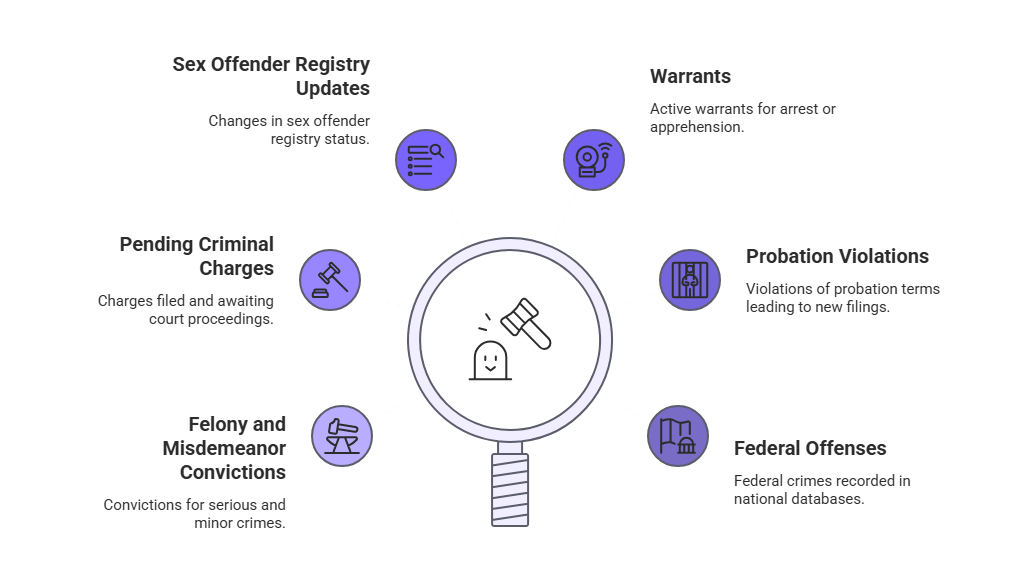
- Felony and misdemeanor convictions
- Pending criminal charges filed and entered into court systems
- Sex offender registry updates
- Warrants entered into accessible databases
- Probation violations that result in new court filings
- Federal offenses that appear in federal criminal databases
Detection occurs when records appear in databases that are actively monitored and when matching algorithms successfully link those records to employee profiles.
Coverage Scope Considerations
Monitoring systems detect criminal records when those records appear in monitored databases and matching algorithms successfully link them to employee profiles. Several factors affect monitoring scope:
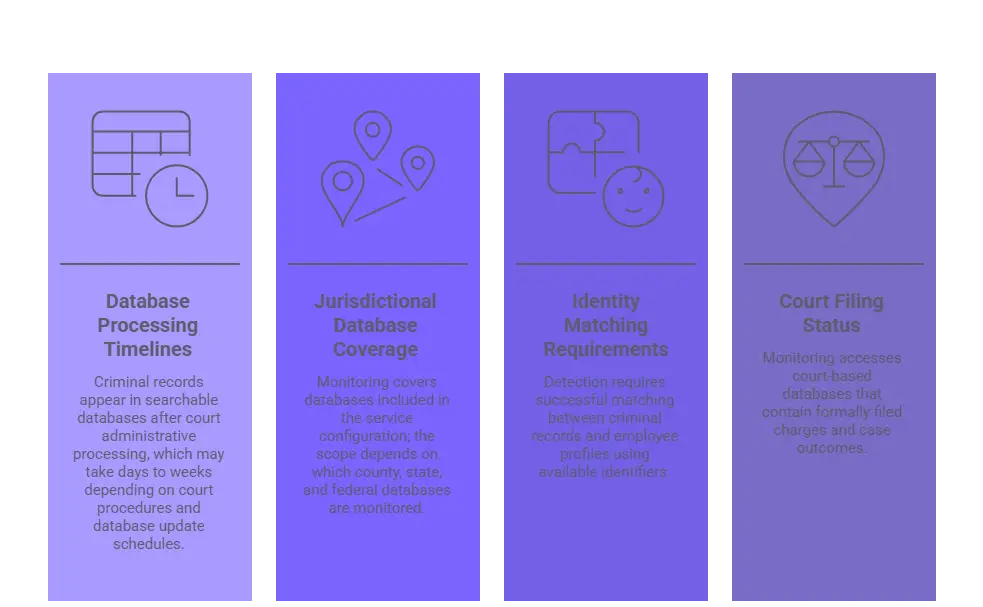
- Database processing timelines: Criminal records appear in searchable databases after court administrative processing, which may take days to weeks depending on court procedures and database update schedules
- Jurisdictional database coverage: Monitoring covers databases included in the service configuration; the scope depends on which county, state, and federal databases are monitored
- Identity matching requirements: Detection requires successful matching between criminal records and employee profiles using available identifiers
- Court filing status: Monitoring accesses court-based databases that contain formally filed charges and case outcomes
Organizations should understand these factors when evaluating whether continuous monitoring aligns with their risk management objectives and regulatory requirements.
Alert Latency, Reporting Speed, and Accuracy Considerations
The practical value of continuous criminal record monitoring depends substantially on how quickly alerts reach employers and how accurate those alerts are when they arrive.
Alert Timing and Notification
Marketing materials for monitoring services sometimes reference real-time alerts. Real-world timing depends on multiple factors: court processing time, database update cycles, monitoring system query frequency, alert generation protocols, and notification delivery.
In optimal scenarios, alerts may reach employers within a few days of a criminal event. In scenarios involving courts with significant backlogs or databases that update infrequently, timing can extend to weeks or months.
Accuracy Issues and False Positive Sources
False positives represent a significant operational challenge in continuous monitoring programs. They occur when monitoring systems generate alerts for criminal records that do not actually belong to the monitored employee.
| False Positive Source | Description | Impact |
| Common name matching | Employees with common names and birth dates match records belonging to different individuals | Highest volume of false positives |
| Data entry errors | Transposed digits in dates of birth, misspelled names, or incomplete identifying information | Can cause both false matches and missed true matches |
| Incomplete identifiers | Queries relying solely on name and date of birth without additional verification | Increased matching errors, particularly with common names |
These accuracy considerations necessitate verification procedures before taking any employment action based on monitoring alerts. Responsible monitoring programs include protocols for obtaining certified court records, confirming identity matches, verifying case status and outcomes, and providing employees with opportunities to explain or dispute information before adverse action occurs.
Federal and State Compliance Framework for Continuous Monitoring
Implementing continuous criminal record monitoring creates legal obligations under federal and state laws governing background checks, consumer reports, and employment decisions.
FCRA Requirements for Ongoing Monitoring
The Fair Credit Reporting Act regulates consumer reports used for employment purposes, including continuous monitoring reports. FCRA compliance requires clear disclosure that monitoring will occur, written authorization from employees separate from pre-hire consent, and certification to consumer reporting agencies that disclosures and authorizations have been obtained.
When monitoring generates information that may result in adverse employment action, employers must follow adverse action procedures. These procedures include providing pre-adverse action notice, supplying a copy of the monitoring report, providing a summary of FCRA rights, allowing reasonable time for the employee to respond, and issuing final adverse action notice if the decision to take adverse action proceeds.
Consent Requirements and State-Specific Limitations
Continuous monitoring requires explicit consent. Pre-hire background check authorizations do not cover post-hire monitoring. Organizations implementing monitoring programs must obtain separate written consent at the time monitoring begins that clearly explains the nature, scope, and duration of monitoring.
State laws increasingly regulate how employers can use criminal record information in employment decisions. Ban-the-box laws exist in numerous states and municipalities and may affect how employers respond to continuous monitoring alerts. Some jurisdictions restrict the use of arrest records that did not result in convictions, limit consideration of convictions beyond specific lookback periods, or require individualized assessment demonstrating a relationship between criminal history and job responsibilities before adverse action.
Individualized Assessment Requirements
When monitoring alerts reveal criminal record information, many jurisdictions require individualized assessment before adverse employment action. Individualized assessment involves evaluating the nature and gravity of the offense, the time elapsed since the offense or completion of sentence, and the nature of the job responsibilities to determine whether a direct relationship exists between the criminal conduct and the position. This requirement prevents blanket disqualification policies and demands that employers consider individual circumstances and opportunities for rehabilitation.
Operational Implementation: Building Monitoring Workflows and Adjudication Protocols
Effective continuous monitoring programs require structured workflows, clear roles and responsibilities, and consistent adjudication protocols.
Enrollment and Alert Management
Implementing monitoring begins with enrollment processes that obtain valid consent, verify employee identity, and establish monitoring profiles. Organizations must determine which positions to enroll based on defined risk criteria, regulatory requirements, or documented business necessity. Some organizations monitor specific job categories rather than all employees, while others limit monitoring to positions with the highest risk profiles or regulatory mandates.
When a monitoring alert arrives, designated personnel must conduct an initial review to assess alert validity and completeness. Organizations must designate who receives alerts, how quickly alerts must be reviewed, and what criteria determine whether an alert requires further action.
Verification and Individualized Assessment
Most monitoring alerts require verification before employment decisions can be made. Verification may include obtaining certified court records to confirm charge details and case outcomes, confirming that the criminal record belongs to the employee rather than a different individual with similar identifying information, and reviewing applicable laws to determine whether the criminal record information can legally be used in employment decisions.
When verification confirms that an employee has new criminal record activity, individualized assessment determines whether that activity warrants employment action. Assessment frameworks typically consider the nature and severity of the criminal offense, the relationship between the offense and job responsibilities, the time elapsed since the offense occurred, evidence of rehabilitation or mitigating circumstances, and applicable legal requirements.
Adverse Action and Documentation
When individualized assessment indicates that employment action is warranted, organizations must follow adverse action protocols required by FCRA and state laws. These protocols include providing pre-adverse action notice with a copy of the monitoring report, allowing time for the employee to dispute or explain the information, and issuing final adverse action notice if the decision proceeds.
Monitoring programs generate substantial documentation requirements including consent authorizations, alert notifications and review, verification efforts and findings, individualized assessments and decisions, and adverse action notices. Documentation demonstrates compliance with legal requirements, supports employment decisions if challenged, and provides audit trails for internal or external review.
Industry-Specific Risk Profiles and Regulatory Drivers
Continuous criminal record monitoring aligns with specific industry characteristics, regulatory requirements, and risk profiles that make ongoing monitoring operationally justified.
Healthcare: Patient Safety and Regulatory Mandates
Healthcare organizations face regulatory requirements and duty-of-care obligations related to patient safety. State licensing agencies, accreditation bodies, and federal programs including Medicare and Medicaid impose criminal background check requirements for healthcare workers. Some states require ongoing monitoring or periodic re-screening for licensed healthcare professionals or facility employees.
Education: Child Safety and State Certification Requirements
Educational institutions employ individuals in positions of trust with ongoing access to children. State laws typically impose criminal background check requirements for teachers, administrators, and other school employees, with many states requiring periodic re-checks or ongoing monitoring. Disqualifying offenses often include crimes against children, violent offenses, sexual offenses, and drug-related crimes.
Financial Services: Fiduciary Responsibility and FINRA Requirements
Financial services organizations manage client assets, process financial transactions, and handle sensitive financial information. The Financial Industry Regulatory Authority imposes background check requirements for registered representatives and other securities industry professionals, with ongoing obligation to update information when criminal events occur.
Transportation, Senior Care, Childcare, and Government Contractors
Transportation industry employers operate in safety-sensitive environments where employee criminal history may affect public safety. Department of Transportation regulations impose background check requirements for commercial drivers and other safety-sensitive positions. Disqualifying offenses may include DUI convictions, drug-related offenses, violent crimes, or offenses indicating risk to public safety.
Senior care facilities and childcare providers serve vulnerable populations under state licensing frameworks that impose criminal background check requirements, with many states requiring periodic re-screening or ongoing monitoring. Government contractors, particularly those requiring security clearances, face ongoing monitoring requirements as conditions of contract performance or clearance maintenance.
Continuous Monitoring vs. Periodic Re-Screening: A Decision Framework
Organizations evaluating post-hire screening options benefit from structured comparison of continuous monitoring and periodic re-screening approaches.
Cost, Coverage, and Compliance Considerations
Continuous monitoring typically involves per-employee monthly or annual fees for ongoing database scanning and alert delivery. Periodic re-screening involves costs associated with conducting full background checks at designated intervals. Organizations should compare total cost of ownership over time.
| Screening Approach | Coverage Characteristics | Compliance Burden |
| Continuous Monitoring | More frequent criminal record detection between scheduled events; typically focuses exclusively on criminal databases | Ongoing obligations for consent management, alert review, verification, individualized assessment, adverse action protocols |
| Periodic Re-Screening | Comprehensive coverage including criminal records, employment verification, education verification at specific moments | Concentrated compliance activities into scheduled re-screening events |
Periodic re-screening provides comprehensive coverage at the moment the re-screening occurs. Continuous monitoring provides more frequent detection of criminal record activity but typically focuses exclusively on criminal databases rather than other background check components.
Risk Profile and Hybrid Approaches
Organizations with high-risk profiles, regulatory mandates for ongoing monitoring, or positions involving vulnerable populations may find continuous monitoring better aligned with risk management objectives. Organizations without regulatory mandates or with lower-risk profiles may find periodic re-screening sufficient.
Some organizations implement hybrid approaches combining continuous monitoring for high-risk positions with periodic re-screening for broader employee populations.
Common Misconceptions and Operational Pitfalls
Continuous criminal record monitoring involves complexities that generate misconceptions and operational challenges requiring proactive management.
Misconception: Monitoring Catches Everything
A common misconception holds that continuous monitoring detects all criminal activity involving monitored employees. In practice, monitoring detects criminal events that appear in databases being monitored, at the frequency those databases are scanned, and when record matching successfully links criminal records to employee profiles. Monitoring does not detect arrests not yet processed into court systems, criminal events in jurisdictions not covered by the monitoring service, or activity that does not result in formal criminal charges. Database coverage and matching accuracy significantly affect what monitoring can and cannot detect.
Misconception: Real-Time Means Instant
Marketing references to real-time alerts create expectations that monitoring delivers instant notification when criminal events occur. Timing between criminal events and employer notification depends on factors including court processing speed and database update cycles.
Misconception: One-Time Consent Covers Monitoring
Some organizations mistakenly believe that pre-hire background check consent authorizations cover continuous monitoring. FCRA and many state laws require specific disclosure and consent for ongoing monitoring separate from pre-hire authorizations.
Operational Pitfall: Inadequate Verification and Inconsistent Application
Organizations sometimes take employment action based on monitoring alerts without adequate verification. Unverified alerts may contain incomplete information, reflect data entry errors, or match employees incorrectly with criminal records belonging to other individuals. Responsible monitoring programs include verification protocols that confirm alert accuracy before adverse action occurs.
Monitoring programs applied inconsistently across employee populations create legal risk and operational confusion. Organizations should establish clear criteria for determining which positions require monitoring and apply those criteria consistently.
Conclusion
Continuous criminal record monitoring functions as a specialized component of workforce risk management, detecting new criminal record activity for existing employees within the constraints of database coverage, matching accuracy, and inherent latency. Organizations in regulated industries or roles involving vulnerable populations may require monitoring to meet compliance obligations and duty-of-care standards, but effective implementation demands realistic expectations, robust verification procedures, and structured adjudication frameworks that respect legal requirements and individual circumstances.
Frequently Asked Questions
In order to assist in bringing clarity to some of the most commonly asked questions regarding continuous criminal record monitoring, the following FAQs are designed to break down some of the concepts in a more practical and easy-to-understand way, while also being relevant to real-world situations that HR teams and organizations are likely to encounter.
How does continuous criminal monitoring work at a technical level?
Continuous monitoring systems query criminal databases at regular intervals, typically daily, using employee identifying information including name, date of birth, and in some cases additional identifiers such as Social Security number or address history where specifically authorized. The effectiveness depends on which databases are monitored, how frequently they update, and how accurately matching algorithms link records to monitored employees.
What criminal records does continuous monitoring actually catch?
Continuous monitoring detects new criminal record entries that appear in monitored databases during the monitoring period, including felony and misdemeanor convictions, pending charges that have been filed in court, warrants entered into accessible databases, and sex offender registry updates. Detection depends on records being processed into monitored databases and matching algorithms successfully linking those records to employee profiles. Monitoring does not detect arrests not yet filed as court charges, criminal activity in jurisdictions not covered by the monitoring service, or events occurring under aliases not linked to the employee's profile.
What are the FCRA compliance requirements for ongoing criminal record monitoring?
FCRA requires employers to provide clear written disclosure that continuous monitoring will occur, obtain written authorization from employees specifically consenting to monitoring separate from pre-hire background check authorization, and certify to consumer reporting agencies that required disclosures and authorizations have been obtained. When monitoring generates information that may result in adverse employment action, employers must provide pre-adverse action notice including a copy of the monitoring report and allow reasonable time for the employee to respond.
Which industries require continuous criminal background checks?
Healthcare, education, financial services, transportation, senior care, childcare, and government contracting face the highest regulatory or operational justification for continuous monitoring. Healthcare organizations must protect patients and comply with state licensing requirements. Educational institutions operate under child safety mandates. Financial services firms manage fiduciary responsibilities and FINRA registration requirements. Transportation employers address safety-sensitive position regulations including DOT requirements.
What are the risks of not monitoring employee criminal records after hire?
Organizations may face duty-of-care liability if employees with disqualifying post-hire criminal activity cause harm when the organization could have detected the criminal activity through monitoring or periodic re-screening. Regulatory violations can occur when licensing agencies, accreditation bodies, or contract terms require ongoing monitoring but organizations fail to implement compliant programs.
How does continuous monitoring differ from periodic background checks?
Continuous monitoring involves automated ongoing database scanning that generates alerts when new criminal records appear, providing more frequent detection between scheduled screening events but typically focusing exclusively on criminal records. Periodic re-screening conducts comprehensive background checks at scheduled intervals, capturing criminal records and other background information at specific moments but potentially missing criminal events occurring between re-screening cycles.
What happens when a continuous monitoring alert is received?
When an alert arrives, designated personnel conduct an initial review to verify the alert pertains to the correct employee. Verification procedures obtain certified court records to confirm charge details and case status, ensuring the criminal record belongs to the monitored employee. Individualized assessment evaluates the nature and severity of the offense, the relationship between the offense and job responsibilities, and applicable legal requirements.
How accurate are continuous criminal monitoring alerts?
Alert accuracy depends on database quality, record matching algorithms, and completeness of identifying information. False positives occur when monitoring systems match employees incorrectly with criminal records belonging to different individuals with similar names or dates of birth. Data entry errors in court systems or databases can create false matches or cause systems to miss true matches.
Additional Resources
- Fair Credit Reporting Act – Full Text and Official Summary
https://www.ftc.gov/legal-library/browse/statutes/fair-credit-reporting-act - EEOC Guidance on the Consideration of Arrest and Conviction Records in Employment Decisions
https://www.eeoc.gov/laws/guidance/consideration-arrest-and-conviction-records-employment-decisions-under-title-vii - National Conference of State Legislatures – Criminal Records and Employment
https://www.ncsl.org/labor-and-employment/criminal-records-and-employment - U.S. Department of Justice – National Sex Offender Public Website
https://www.nsopw.gov/ - Federal Trade Commission – Using Consumer Reports for Employment Purposes
https://www.ftc.gov/business-guidance/resources/using-consumer-reports-employment-purposes

ABOUT THE CREATOR
GCheck Editorial Team
Meet the GCheck Editorial Team, your trusted source for insightful and up-to-date information in the world of employment background checks. Committed to delivering the latest trends, best practices, and industry insights, our team is dedicated to keeping you informed.
With a passion for ensuring accuracy, compliance, and efficiency in background screening, we are your go-to experts in the field. Stay tuned for our comprehensive articles, guides, and analysis, designed to empower businesses and individuals with the knowledge they need to make informed decisions.
At GCheck, we're here to guide you through the complexities of background checks, every step of the way.