

INDUSTRY GUIDES

For construction and skilled trades hiring firms, find out which ATS background check platforms excel in meeting legal standards.
Created by

Construction background screening sits at a uniquely complex intersection of FCRA requirements, EEOC criminal history guidance, state ban-the-box laws, DOT regulations, and immigration compliance, creating conditions where shortcuts are both common and costly. We compare 10 ATS platforms across five weighted criteria to reveal which platforms can actually hold up under that compliance pressure, and which ones could push the burden onto outside systems. Understanding where your ATS stands on screening integration depth, adverse action workflow support, and audit trail capability is not a technology question; it is a legal risk question.
Five ATS platforms stand out for background screening and compliance in construction and skilled trades: Workday, iCIMS, Greenhouse, BambooHR, and UKG Pro. In particular, these platforms support deep, API-driven links with background screening providers. They also include compliance workflow tools that help construction firms manage FCRA adverse action steps, ban-the-box timing, and audit records without leaving the ATS.
Background screening in construction is more complex than in most industries. In fact, project-based multi-employer worksites, safety-sensitive role needs, and fast startup timelines create conditions where compliance shortcuts are common and costly. As a result, construction HR teams must navigate FCRA adverse action handling, EEOC criminal record guidance, and state-level ban-the-box rules across dozens or hundreds of active hires.
“Compliance is rarely loud in construction hiring, but when it breaks, everyone hears it.” I have seen how fast paced projects and multi site crews can make background screening feel like just another box to check, yet it is often the quiet system holding legal and safety risk together. What really matters isn’t whether or not your ATS has a integration, it’s whether or not it can support the timing, documentation, and decision-making in a high-stress environment. In construction, the toughest hiring strategy is the one that stands up to tight timelines and high scrutiny.
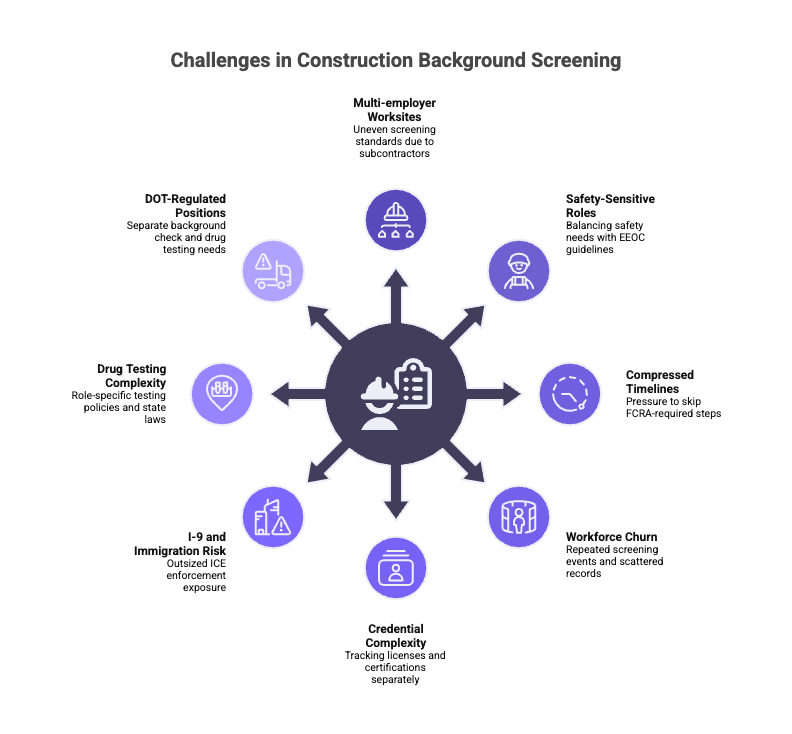
Construction employers face a uniquely dense set of compliance needs. Key factors that make construction background checks more complex than most industries:
Best for: Enterprise general contractors and multi-entity construction organizations
Workday's certified partner marketplace supports API-driven links with major screening providers. In addition, it includes multi-package screening logic for firms hiring across safety-sensitive, DOT-regulated, and office roles at the same time. Its compliance toolset covers flexible adverse action steps, ban-the-box stage controls, and full audit trails. That said, setup to reflect location-specific rules demands significant HR technology and legal skill, along with ongoing upkeep as laws change. Cost and complexity put it out of reach for smaller subcontractors.
Best for: Small to mid-size specialty subcontractors where compliance is managed through a dedicated screening provider
Zoho Recruit offers limited native screening links, and most users rely on manual export steps. This creates FCRA process risk when adverse action steps live in separate systems, and data privacy risk when moving candidate PII. There is no built-in FCRA adverse action workflow support. As a result, firms using Zoho Recruit must partner with a full-service screening provider and put strict data handling rules in place for manual PII transfers.
Best for: Mid-size to large general contractors and engineering firms with structured recruiting processes
Greenhouse connects screening providers via documented APIs, and its flexible stage timing supports location-specific ban-the-box rules. Audit trails support records for public and federally funded projects. It is strongest in structured professional hiring. However, high-volume hourly field hiring requires added setup. Stage settings require ongoing legal review for each location where the employer hires.
Best for: Small construction firms that put candidate experience first, where a dedicated screening provider manages all FCRA compliance externally
Teamtailor's screening links are limited, relying mainly on third-party automation tools or manual steps. The platform lacks built-in FCRA adverse action workflow tools entirely and is not designed for the legal demands of multi-site or multi-state construction hiring. In that case, a full-service screening provider is essential for any FCRA-compliant workflow.
Best for: Large general contractors, specialty contractors, and skilled trade staffing agencies with high-volume hiring needs
iCIMS offers one of the deepest screening link systems available, supporting automated order triggering, real-time status syncing, and result delivery within the ATS. Its native FCRA adverse action workflow covers the full required sequence, including ban-the-box stage gating and exportable audit trails suitable for federal project compliance. All settings must be reviewed by legal counsel for each location. Pricing and setup timelines can challenge mid-size subcontractors.
Best for: Small specialty subcontractors new to ATS adoption, where a dedicated screening provider manages all FCRA compliance externally
Breezy HR's screening links are lightweight and may not support the full automated workflows high-volume construction requires. It has no native FCRA adverse action workflow support, and the full adverse action sequence must be managed outside the platform. For that reason, a full-service screening provider is essential.
Best for: Mid-size specialty subcontractors, HVAC firms, electrical contractors, and construction companies managing both field and office staff
BambooHR supports API-based screening links through its partner marketplace and provides disclosure and consent tools, flexible ban-the-box stage timing, and audit trail features. State-specific disclosure rules and case-by-case review records must be verified by legal counsel for each location. The platform is less suited than enterprise options for very high-volume or complex multi-site hiring.
Best for: Small construction firms and boutique specialty contractors, where a dedicated screening provider manages all FCRA compliance externally
Recruitee offers limited native screening links and no built-in FCRA adverse action workflow tools. The full adverse action sequence must be managed entirely outside the platform. Its team-based hiring model does not address site-by-site construction hiring patterns, where uneven decisions across sites increase adverse action risk.
Best for: General contractors and large specialty subcontractors managing the full workforce lifecycle from recruiting through payroll
UKG Pro's marketplace links support automated screening order startup, result delivery, and candidate status updates within the platform. It covers the full FCRA adverse action workflow, ban-the-box stage controls, and full audit logging broad enough for multi-state construction work. Ban-the-box laws apply in roughly 37 states and more than 150 local areas as of mid-2025, with widely varying rules; settings must be reviewed by legal counsel by location. The platform's breadth can make setup complex for smaller firms.
Best for: Staffing agencies and small construction firms seeking low-cost, AI-assisted recruiting, where a dedicated screening provider manages all FCRA compliance externally
Manatal offers minimal native screening links and no FCRA adverse action workflow support or ban-the-box stage controls. All compliance steps must be managed through an outside system. Any construction employer using Manatal must partner with a full-service screening provider that manages all FCRA disclosure, consent, and adverse action steps on its own.
Platforms were scored on five criteria weighted by their impact on background screening compliance in construction hiring. Note: These scores reflect platform capabilities at the time of publication based on publicly available product information. Employers should verify current capabilities through legal counsel and direct vendor review before making platform selection decisions.
| ATS Platform | Screening Integration Depth (4) | FCRA Compliance Workflow (2) | Construction Fit (2) | High-Volume Hiring Ease (1) | Audit Trail (1) | Total (10) |
| iCIMS | 4.0 | 2.0 | 1.5 | 1.0 | 1.0 | 9.5 |
| Workday | 3.5 | 2.0 | 2.0 | 1.0 | 0.5 | 9.0 |
| UKG Pro | 3.5 | 2.0 | 2.0 | 1.0 | 0.5 | 9.0 |
| Greenhouse | 3.5 | 1.5 | 1.5 | 0.5 | 0.5 | 7.5 |
| BambooHR | 3.5 | 1.5 | 1.5 | 0.5 | 0.5 | 7.5 |
| Zoho Recruit | 1.5 | 0.5 | 1.5 | 1.0 | 0.5 | 5.0 |
| Recruitee | 1.5 | 1.0 | 1.5 | 0.5 | 0.5 | 5.0 |
| Manatal | 1.5 | 0.5 | 1.5 | 1.0 | 0.5 | 5.0 |
| Breezy HR | 1.5 | 0.5 | 1.5 | 0.5 | 0.5 | 4.5 |
| Teamtailor | 1.0 | 0.5 | 1.0 | 0.5 | 0.5 | 3.5 |
Workday, iCIMS, Greenhouse, BambooHR, and UKG Pro consistently outperform the field. This is because their link setups keep the full screening workflow inside the ATS, including standalone disclosure, consent, case-by-case review records, and the full adverse action sequence. That link depth is the single most important factor in preventing compliance failures during high-volume hiring cycles.
Zoho Recruit, Teamtailor, Breezy HR, Recruitee, and Manatal are functional recruiting tools for general hiring scenarios. However, construction firms should approach them with care for screening workflows. Their manual steps and limited compliance toolsets create real risk in settings where FCRA rules, ban-the-box timing, case-by-case review duties, and safety-sensitive role rules apply at the same time. Firms using these platforms must partner with a full-service screening provider that manages all FCRA-required steps on its own.
Choosing the right ATS starts with understanding the difference between an integration claim and one that holds up under compliance pressure. Ten criteria matter most:
Background screening in construction is a compliance-critical function, not a secondary concern. A single mistake, such as a missing summary of rights, a criminal history inquiry timed before a conditional offer in a location that prohibits it, or a missing case-by-case review, can carry serious results: FCRA private lawsuits, EEOC enforcement, and state regulatory action.
In summary, evaluate your ATS on the depth and compliance readiness of its background screening system, not just its recruiting features. No platform, regardless of how its compliance tools are marketed, removes the employer's legal duty to get it right.
Disclaimer: This article is provided for informational purposes only and does not constitute legal advice. Background check compliance duties, including FCRA rules, state and local ban-the-box laws, EEOC guidance, and privacy laws, are complex, location-specific, and subject to change. Construction employers should consult qualified legal counsel before setting up any background screening policy or ATS-based compliance workflow.
Recruiter & Editor
Charm Paz is an HR and compliance professional at GCheck, working at the intersection of background screening, fair hiring, and regulatory compliance. She holds both FCRA Core and FCRA Advanced certifications through the Professional Background Screening Association (PBSA) and supports organizations in navigating complex employment regulations with clarity and confidence.
With a background in Industrial and Organizational Psychology and hands-on experience translating policy into practice, Charm focuses on building ethical, compliant, and human-centered hiring systems that strengthen decision-making and support long-term organizational health.

Contact us today for efficient, FCRA-compliant screening solutions
designed to keep your hiring process moving safely and smoothly.



LEGAL DISCLAIMER: The information provided in this article is for general informational and educational purposes only and should not be construed as legal advice or a substitute for consultation with qualified legal counsel. While we strive to ensure accuracy, employment screening laws and regulations—including but not limited to the Fair Credit Reporting Act (FCRA), Equal Employment Opportunity Commission (EEOC) guidelines, state and local ban-the-box laws, industry-specific requirements, and other applicable federal, state, and local statutes—are subject to frequent changes, varying interpretations, and jurisdiction-specific applications that may affect their implementation in your organization. Employers and screening decision-makers are solely responsible for ensuring their background check policies, procedures, and practices comply with all applicable laws and regulations relevant to their specific industry, location, and circumstances. We strongly recommend consulting with qualified employment law attorneys and compliance professionals before making hiring, tenant screening, or other decisions based on background check information.