



Daycare providers must navigate a complex landscape of federal baseline requirements and state-specific background check rules that vary in frequency, scope, and enforcement. Understanding the difference between one-time checks, recurring renewals, and continuous monitoring is essential to maintaining licensing compliance and operational readiness for inspections.
Key Takeaways
- The CCDBG Act establishes a federal minimum of five background check types for childcare workers, but states layer additional requirements on top of this baseline.
- Continuous monitoring refers to ongoing notification of new criminal activity, while recurring checks are periodic re-screening obligations required by state licensing agencies.
- State requirements differ significantly in frequency, disqualification criteria, provisional employment rules, and whether home-based providers face distinct obligations.
- Child abuse and neglect registry checks are separate from criminal background checks and must be conducted independently in most states.
- Operators must maintain documentation that survives licensing inspections, including proof of completion, dates, and renewal schedules.
- Handling adverse results requires understanding state-specific disqualification lists, discretionary review processes, and immediate operational obligations.
- Home-based daycare providers often face requirements that extend to household members, creating a different compliance profile than center-based facilities.
- Proactive parent communication about screening practices can strengthen trust while respecting employee privacy and confidentiality obligations.
Definitions: Background Checks vs. Continuous Monitoring vs. Recurring Checks
The operational challenge begins with terminology. Childcare providers frequently use the terms "background checks," "continuous monitoring," and "recurring checks" interchangeably, but each refers to a distinct compliance mechanism with different costs, timelines, and legal obligations.
| Term | Definition | Frequency | Initiated By |
| One-Time Background Check | Point-in-time search of criminal, sex offender, and child abuse records | Conducted once at hire | Employer |
| Recurring Background Check | Periodic re-screening mandated by state licensing rules | Every 3–5 years (varies by state) | Employer |
| Continuous Monitoring | Ongoing notification of new criminal charges or registry entries | Real-time alerts after initial check | Monitoring service provider |
Understanding these distinctions prevents two common compliance failures. First, operators may assume that continuous monitoring satisfies recurring check requirements when it does not. Second, they may believe that a one-time FBI fingerprint check provides ongoing protection when it does not.
One-Time Background Checks
A background check is a point-in-time search of records to determine whether an individual has a disqualifying history. For childcare workers, this typically includes criminal history records, sex offender registries, and child abuse registries. Importantly, the check reflects only the information available at the time of the search.
Recurring Background Checks
State licensing agencies mandate recurring checks as periodic re-screening requirements. These are not automatic. Instead, the employer must initiate a new background check at specified intervals, such as every three or five years, depending on state law. Consequently, the individual undergoes re-fingerprinting or re-searching through the same channels as the initial check.
Continuous Monitoring
Continuous monitoring is a service that provides ongoing notification if a new criminal charge, conviction, or registry entry appears on an individual's record after the initial check. However, this is not the same as a recurring check. Monitoring systems do not re-search all databases. Rather, they track specific identifiers and notify the employer when a triggering event occurs. Federal law does not require continuous monitoring. Nevertheless, some states incorporate continuous monitoring into their licensing frameworks or may permit it as a partial or full substitute for recurring checks under specific conditions, such as use of state-approved systems or vendors. Therefore, operators should confirm with their state licensing agency whether continuous monitoring satisfies their renewal obligations and under what conditions.
“Compliance is not just about checking boxes. It is about protecting people.” I think reading this made me realize that we often assume that once we've checked the boxes for a background check, we've done our job, when in fact the process continues far beyond the hiring process. The number of requirements at the state and federal levels indicates that compliance is not a one-size-fits-all approach; it requires consistency, awareness, and intention. I think the thing that stood out to me the most, though, was the fact that trust isn't just built on the policies, but on the execution of those policies every day. At the heart of all of it, good processes aren't just about passing an audit; they're about providing a safer environment for all parties involved.
Federal Baseline: CCDBG Act Requirements for Childcare Workers
The Child Care and Development Block Grant (CCDBG) Act, reauthorized in 2014, established a federal floor for background check requirements in any childcare program receiving federal funding. Originally, states needed to implement comprehensive background check systems by September 30, 2017. However, many states received extensions, and implementation timelines varied, with some states finalizing systems through 2022 and beyond. Consequently, operators should verify current requirements directly with their state licensing agency.
Five Required Check Types
The CCDBG Act mandates the following five searches for all childcare staff members, including prospective employees, before they can work in a child care setting:
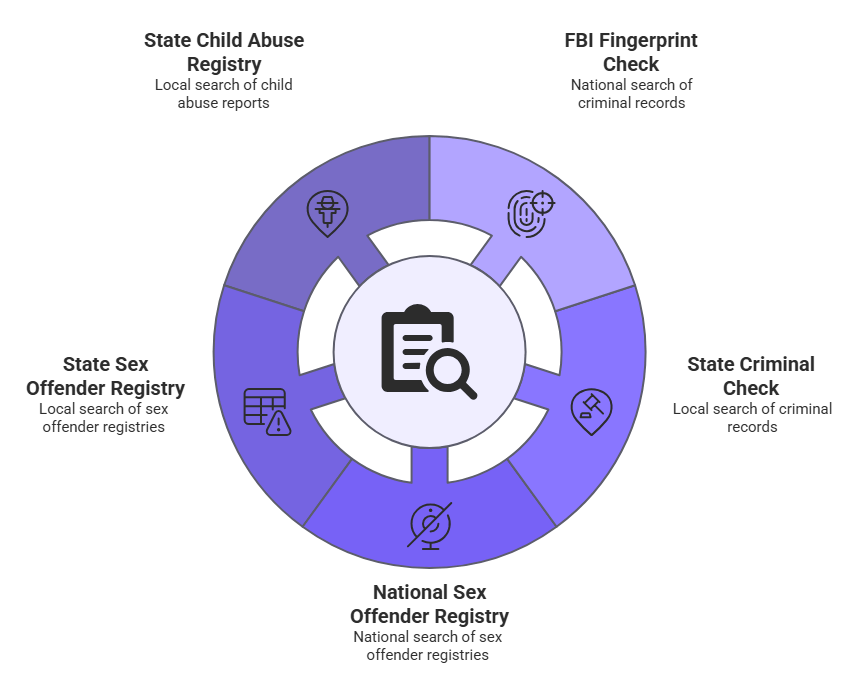
- FBI fingerprint-based criminal history check (national): This search queries the FBI's Interstate Identification Index, which aggregates criminal history records from participating states.
- State criminal history check (fingerprint or name-based): This check searches the state repository where the individual currently resides.
- National Sex Offender Registry (NSOR) check: This search queries the Dru Sjodin National Sex Offender Public Website, which aggregates state-level sex offender registries.
- State sex offender registry check: This check searches the registry maintained by the state where the individual resides.
- State child abuse and neglect registry check: This search queries the state's central registry of founded or indicated reports of child maltreatment.
Additionally, individuals who have resided in another state within the previous five years must undergo a criminal history check and child abuse registry check for each state of prior residence during that period.
Who Must Be Checked
The CCDBG Act applies to any individual whose activities involve the care or supervision of children, or who has unsupervised access to children. Specifically, this includes:
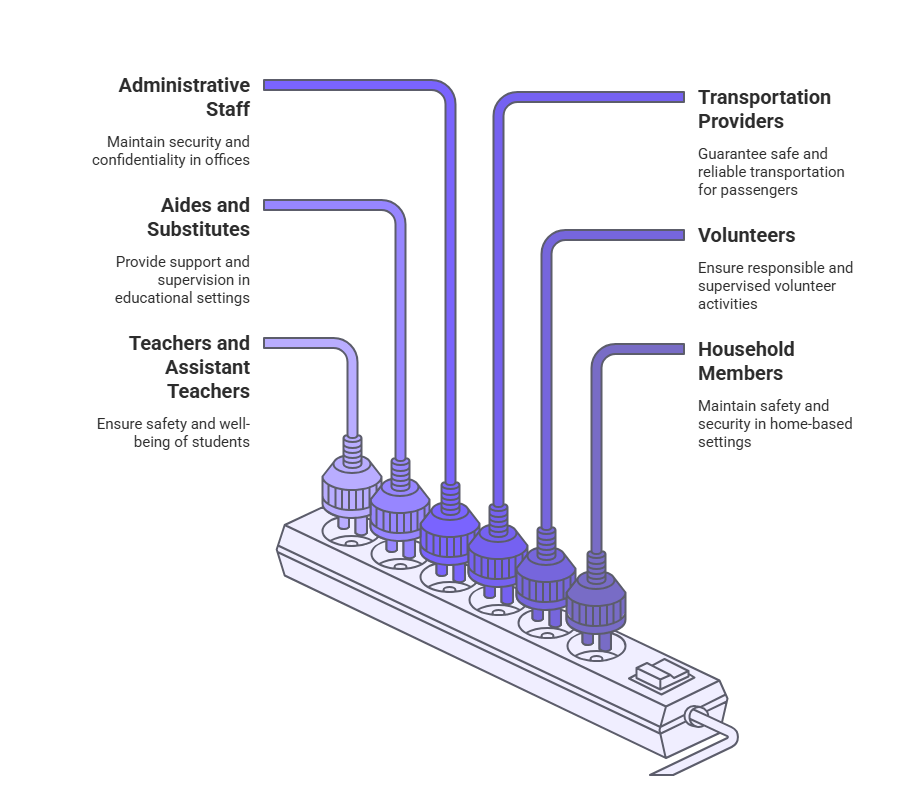
- Teachers and assistant teachers
- Aides and substitutes
- Administrative staff with unsupervised access
- Transportation providers
- Volunteers with regular, unsupervised access (state-specific)
- Household members in home-based settings (state-specific)
Renewal Requirements
The CCDBG Act does not specify how often states must renew background checks. Instead, that authority falls to the states. Nevertheless, many states adopted five-year renewal cycles as a common interval following the federal guidance.
State-by-State Variation: How Licensing Requirements Differ
While the CCDBG Act sets the federal floor, states retain authority to impose additional requirements, define disqualifying offenses, set renewal timelines, and regulate provisional employment.
| Compliance Element | Common State Variations |
| Renewal Frequency | 3 years, 5 years, one-time only, or event-triggered |
| Additional Checks | Elder abuse registries, driving records, domestic violence databases |
| Disqualifying Offenses | Automatic vs. discretionary review standards |
| Provisional Employment | Permitted with supervision, prohibited entirely, or time-limited |
| State Check Method | Fingerprint-based vs. name-based searches |
As a result, this creates a fragmented compliance landscape that requires state-specific knowledge.
Frequency of Renewal
Renewal intervals vary widely across jurisdictions. For instance, some states require re-checks every three years, while others mandate them every five years. Meanwhile, a few require checks only once unless a specific event triggers them. Therefore, operators must track these intervals individually for each employee and ensure timely completion before expiration.
Additional Check Types
Many states require searches beyond the federal minimum. For example, these may include state-specific registries for elder abuse, domestic violence offenders, or protection order registries. Similarly, some states also require driving records for staff who transport children.
Disqualifying Offenses
States define their own lists of automatic disqualification offenses and discretionary offenses. Typically, automatic disqualifications include violent crimes, child abuse, sexual offenses, and certain drug-related convictions. In contrast, discretionary offenses may include theft, fraud, or misdemeanor assault, and licensing agencies or waiver processes may review these.
Provisional Employment Rules
Some states allow new hires to begin working under supervision while background checks remain pending, provided certain conditions apply (such as completed fingerprinting). Conversely, other states prohibit any contact with children until all results arrive. Additionally, a few states permit provisional employment only for non-supervisory roles or limit it to a fixed number of days.
Home-Based Daycare vs. Center-Based Facilities: Diverging Requirements
Licensing requirements often differ for home-based (family) daycare providers compared to center-based facilities. Notably, these differences reflect the distinct risk and oversight environments of each setting.
Household Member Screening
Many states require background checks for household members over a certain age who reside in a home where childcare occurs. Specifically, the age threshold varies by state and may range from as low as 12 or 14 to 18 or older. Furthermore, some states define "household member" to include any individual with regular or unsupervised access, while others apply the requirement only to permanent residents. Therefore, operators should consult their state licensing rules to confirm the applicable age threshold and definition. In contrast, this requirement does not apply to center-based facilities, where household members are not present in the care environment.
Scope of Checks for Household Members
Some states apply the full five-check requirement to household members. Conversely, others require only a state criminal history check and sex offender registry search. Additionally, a few states require disclosure of household members but permit the licensing agency to conduct the check rather than the provider.
Licensing Thresholds
Home-based providers may not face licensing at all if they care for fewer than a specified number of children (commonly three to six, depending on state law). However, if they accept state subsidy payments (such as through the Child Care and Development Fund), they become subject to the CCDBG background check requirements even if they are otherwise exempt from licensing.
Child Abuse and Neglect Registry Checks: A Separate Compliance Layer
Child abuse and neglect registries rank among the most misunderstood components of childcare background screening. Operators frequently assume that a criminal background check will reveal prior child abuse. However, in most states, registry checks operate separately and must occur independently.
| Registry Feature | Details |
| What It Contains | Founded or indicated reports of child maltreatment (administrative findings, not criminal convictions) |
| Maintained By | State department of social services or child welfare agency |
| Access Method | Online portal, written request, or licensing agency submission |
| Processing Time | Few days to several weeks |
| Retention Period | Indefinite, or 5–10 years depending on state |
Importantly, registry records may remain even if no criminal charges resulted. Additionally, expungement or sealing processes may exist in some states, depending on the nature of the finding.
What the Registry Contains
State child abuse and neglect registries contain records of individuals who have faced a founded or indicated report of child maltreatment. Specifically, these are administrative findings that child protective services agencies make, not criminal convictions. Consequently, an individual may appear on a registry even if they never faced criminal charges or conviction.
How to Conduct a Registry Check
The process for requesting a child abuse registry check varies by state. For example, some states provide online portals where individuals can request their own records. In contrast, others require the employer to submit a written request with identifying information and a release form signed by the applicant. As a result, processing times range from a few days to several weeks.
Interstate Registry Checks
The CCDBG Act requires registry checks for any state in which the individual has resided in the past five years. However, not all states respond to out-of-state requests, and some restrict access to in-state requesters only. Therefore, when a state does not respond or denies access, operators should document the request and the state's response (or non-response). Subsequently, they should consult their state licensing agency regarding alternate verification methods, attestation forms, or acceptable documentation to demonstrate compliance efforts.
Operational Workflow: Building a Compliant Screening Process
Operators cannot achieve compliance by understanding the rules in the abstract. Instead, it requires a repeatable, documented workflow that integrates background checks into hiring, onboarding, and ongoing personnel management.
Documentation Standards
Licensing inspectors expect to see a complete file for each staff member. Specifically, this includes:
- Copies of all background check results (or confirmation letters from the issuing agency)
- Dates each check started and completed
- Signed authorization forms from the employee
- Records of any discretionary reviews or waiver applications
- Proof of re-checks or renewals
Furthermore, operators should organize files by employee and store them securely to protect confidential information.
Provisional Employment Tracking
If provisional employment receives permission, operators must track the status of pending checks. Additionally, they must ensure that provisional employees do not exceed the allowable time period or work outside the scope of permitted duties (such as working unsupervised when only supervised contact receives authorization).
Renewal Calendars
A central calendar or tracking system should list the renewal date for each employee's background check. For example, many operators use spreadsheets, HR software, or compliance management platforms to generate reminders 60 to 90 days before a check expires.
Record Retention
States typically require that operators retain background check records for a minimum period after an employee separates. Specifically, retention periods vary by state and may range from three to seven years or longer, depending on state law and record type. Therefore, operators should confirm retention requirements with their state licensing agency and apply the longest applicable standard if operating in multiple states.
Licensing Inspection Readiness: Documentation & Audit Preparation
Licensing inspections serve as the most common acute trigger for background check compliance reviews. Notably, inspectors assess not only whether operators completed checks, but whether the process demonstrates documentation, timeliness, and consistency with state rules.
What Inspectors Look For
Inspectors typically review the following:
- Presence of all required check types in each file
- Dates of completion relative to hire date or renewal deadlines
- Signed authorization forms
- Evidence that operators requested out-of-state checks for employees with prior residency elsewhere
- Consistency between personnel files and the employee roster
- Secure storage of confidential information
Common Deficiencies
Frequent findings include the following issues:
- Missing child abuse registry checks
- Expired checks that operators did not renew on time
- No documentation of out-of-state checks for employees who relocated
- Missing or unsigned authorization forms
- Incomplete files for substitutes or part-time staff
- No tracking system for renewal dates
Preparing for an Inspection
Operators should conduct an internal audit at least quarterly. During this review, they should examine each file to confirm all required checks are present and current, renewal dates receive tracking and upcoming deadlines receive flags, documentation is complete and legible, and provisional employment followed state compliance rules. Importantly, this self-audit mimics the licensing inspection process and allows operators to identify and resolve gaps proactively.
Handling Adverse Results: What Happens When an Employee Fails a Check
Adverse background check results create immediate legal, operational, and interpersonal challenges. Therefore, operators must understand their obligations under state law, federal law (if applicable), and licensing rules.
| Offense Category | Outcome | Review Available? |
| Automatic Disqualification | Immediate prohibition from childcare employment | Varies by state |
| Discretionary Offenses | Subject to licensing agency or operator review | Yes (varies by state) |
| Minor or Dated Offenses | May be waived depending on factors such as time elapsed and rehabilitation | Yes (if state permits waiver process) |
Typically, automatic disqualification offenses include murder or manslaughter, child abuse or neglect, sexual offenses involving children, kidnapping or false imprisonment, assault or battery involving serious injury, and certain drug trafficking offenses.
Automatic Disqualification Offenses
If an employee or applicant has a conviction for an offense that state law designates as an automatic disqualifier, the operator generally cannot employ them in a role involving child contact. However, some states provide no discretionary review for these offenses, while others may permit waiver processes, time-based exceptions, or case-by-case review depending on the nature of the offense and evidence of rehabilitation. Therefore, operators should consult their state licensing agency and legal counsel to determine applicable disqualification standards and available review processes.
Notice and Dispute Rights
If an adverse decision occurs based on a background check obtained through a third-party consumer reporting agency, employers must comply with the Fair Credit Reporting Act (FCRA). Specifically, this includes providing the individual with a pre-adverse action notice, a copy of the consumer report, a summary of FCRA rights, and a final adverse action notice after a reasonable period. Additionally, individuals also have rights under state law to dispute inaccurate information. Meanwhile, employers who conduct background checks directly (without using a consumer reporting agency) should consult state law and legal counsel regarding notice and procedural requirements.
Immediate Operational Steps
Upon receipt of an adverse result, the operator should take the following actions immediately. First, they should remove the individual from child contact if they are currently employed. Second, they should document the basis for the adverse decision. Third, they should notify the licensing agency if state law requires it. Fourth, they should follow internal HR policies for termination or rescission of an offer. Finally, they should secure all confidential records related to the background check.
Parent Communication & Transparency: Maintaining Trust Through Compliance
Childcare is fundamentally a trust-based service. Specifically, parents entrust their children to strangers for significant portions of the day. Therefore, background check practices represent a dimension of that trust and an opportunity to differentiate a facility in a competitive market.
What to Communicate Proactively
Operators can and should communicate the following information:
- That all staff members undergo comprehensive background checks before hire
- The types of checks operators conduct (criminal history, sex offender registry, child abuse registry)
- That operators renew checks at intervals required by state law
- That the facility complies with all state and federal screening requirements
- That household members (in home-based settings) also undergo screening
Importantly, operators can include this information in enrollment packets, post it on the facility's website, or communicate it during facility tours.
What Not to Disclose
Operators should not disclose specific details of an individual employee's background check results, the fact that a particular employee faced denial of employment or termination due to a failed check (unless state law requires it), or information about discretionary reviews or waiver applications. Notably, such disclosures may violate employee privacy rights, state confidentiality laws, or the federal FCRA.
Responding to Parent Inquiries
Some states require notification to parents if an operator removes an employee from a childcare setting due to a failed background check. Conversely, others permit but do not require such notification. Furthermore, the scope of required disclosure varies and may limit disclosure to the fact of removal without specific details of the offense. Therefore, operators should consult state law and legal counsel to ensure compliance with notification obligations while respecting employee confidentiality and privacy protections.
Using Compliance as a Competitive Differentiator
Some facilities choose to communicate that they exceed minimum requirements. For instance, they may conduct checks more frequently than required, use continuous monitoring systems, include additional check types beyond the state minimum, or provide ongoing training on safety and supervision. Importantly, operators can communicate these practices to parents as evidence of a culture of safety, provided the claims are accurate and documented.
Conclusion
Childcare continuous monitoring and recurring background check compliance require operators to integrate federal baselines, state-specific mandates, and operational realities into a sustainable, documented process. Ultimately, licensing readiness depends not only on completing the required checks, but on maintaining accessible, current files that demonstrate timely renewal and consistent application of screening standards across all staff members.
Frequently Asked Questions
How often do daycare workers need background checks?
The frequency depends on state law. Most states require operators to renew background checks every three to five years. However, some states require checks only once, while others may require more frequent renewals or use continuous monitoring as a substitute. Therefore, operators should consult their state licensing agency to confirm the applicable renewal interval.
What is the difference between a background check and continuous monitoring?
A background check is a one-time search of records at a specific point in time. In contrast, continuous monitoring is an ongoing service that notifies the employer if new criminal activity or registry entries appear after the initial check. Importantly, continuous monitoring does not replace recurring background checks unless state law explicitly permits it.
Do child abuse registry checks show up on criminal background checks?
No. Child abuse and neglect registries operate separately from criminal justice databases and require independent searches. Consequently, a criminal background check will not reveal whether an individual appears on a state child abuse registry unless the abuse resulted in a criminal conviction.
What happens if a daycare employee fails a background check?
The outcome depends on the nature of the offense and state law. Specifically, certain offenses result in automatic disqualification, meaning the operator cannot employ the individual in a childcare setting. In contrast, other offenses may undergo discretionary review or a waiver process. Regardless, the operator must immediately remove the employee from child contact pending resolution.
Are household members in a home-based daycare required to have background checks?
In most states, yes. Household members over a certain age who reside in a home where childcare occurs must undergo background checks, even if they do not work for the daycare. Notably, the age threshold and definition of "household member" vary by state. This requirement reflects the possibility of unsupervised access to children.
Can a daycare hire someone before their background check is complete?
This depends on state law. For example, some states permit provisional or conditional employment under supervision while checks remain pending. Conversely, other states prohibit any child contact until all results arrive. Therefore, operators should confirm state-specific rules and document compliance with any provisional employment conditions.
Do volunteers at a daycare need background checks?
Yes, if they have unsupervised access to children. Specifically, the CCDBG Act requires background checks for any individual whose activities involve the care or supervision of children or who has unsupervised access. However, states may define different standards for occasional or supervised volunteers.
How long do background check records need to be kept?
Retention requirements vary by state and may range from three to seven years or longer after an employee separates, depending on state law and record type. Therefore, operators should confirm retention requirements with their state licensing agency and apply the longest applicable standard if operating in multiple states.
Additional Resources
- Child Care and Development Block Grant (CCDBG) Act Background Check Requirements
https://www.acf.hhs.gov/occ/faq/background-checks - National Sex Offender Public Website (NSOPW)
https://www.nsopw.gov/ - State Licensing Requirements by State (Child Care Aware)
https://www.childcareaware.org/resources/map/ - Fair Credit Reporting Act (FCRA) Summary of Rights
https://www.consumer.ftc.gov/articles/pdf-0096-fair-credit-reporting-act.pdf

ABOUT THE CREATOR
GCheck Editorial Team
Meet the GCheck Editorial Team, your trusted source for insightful and up-to-date information in the world of employment background checks. Committed to delivering the latest trends, best practices, and industry insights, our team is dedicated to keeping you informed.
With a passion for ensuring accuracy, compliance, and efficiency in background screening, we are your go-to experts in the field. Stay tuned for our comprehensive articles, guides, and analysis, designed to empower businesses and individuals with the knowledge they need to make informed decisions.
At GCheck, we're here to guide you through the complexities of background checks, every step of the way.