



Behavioral health employee screening in 2026 operates at the intersection of workforce shortages, expanded Medicaid parity mandates, and heightened state-level regulatory scrutiny. Facilities must design screening programs that satisfy multi-layered compliance requirements while respecting recovery-informed hiring principles and managing elevated safety risks inherent to environments serving psychologically vulnerable individuals.
Key Takeaways
- Behavioral health facility screening requirements are shaped by federal funding rules, state licensing statutes, and accreditation standards that vary significantly by jurisdiction.
- Mental health facility background checks must address both clinical safety risks and the ethical complexities of recovery-informed hiring, particularly in substance use disorder treatment settings.
- Residential treatment facility employee screening programs require continuous monitoring protocols due to sustained, often unsupervised staff access to vulnerable populations.
- Disqualifying offenses for mental health workers are not uniform, most states require individualized assessments rather than blanket exclusions.
- Workforce shortages in behavioral health compound screening challenges, creating pressure to expedite hiring while maintaining compliance and safety standards.
- Multi-state operators face the challenge of reconciling divergent lookback periods, arrest versus conviction reporting rules, and disclosure requirements across jurisdictions.
- Technology-assisted screening tools must be evaluated for accuracy, bias, and compliance with FCRA and state-specific consumer protection laws.
- Effective screening programs integrate criminal history review with credential verification, reference checks, abuse registry searches, and ongoing monitoring systems.
The Operational Context of Behavioral Health Screening in 2026
Behavioral health facilities operate under a uniquely complex regulatory and ethical framework. Unlike many employment sectors where background screening serves primarily as a liability mitigation tool, behavioral health employee screening must simultaneously satisfy federal funding requirements, state licensing mandates, accreditation standards, and the field's commitment to recovery-oriented values. By 2026, these tensions have intensified due to acute workforce shortages, increased demand for mental health services, and increasing regulatory granularity at state and local levels.
The operational challenge is threefold:
- Jurisdiction-specific navigation: Facilities must understand patchwork requirements dictating what must be checked, how far back records may be reviewed, and what procedures govern adverse hiring decisions.
- Elevated risk management: Settings where staff have sustained access to individuals experiencing psychiatric crises, cognitive impairments, or acute substance use disorders demand heightened safety protocols.
- Recovery-informed reconciliation: Programs must honor the value of lived experience and avoid blanket disqualifications that could exclude qualified candidates with relevant histories.
These competing imperatives require intentional design rather than checklist compliance.
From my experience, hiring today is about more than just being quick or checking boxes. It is about being able to understand how compliance, risk, and people come together in every decision we make. The best HR organizations I have seen are those that are intentional. They don’t just check boxes or get through a process; they ensure each step in a hiring process is thoughtful, consistent, and aligned to policy and practice. When hiring is done that way, it’s not just about compliance; it’s about hiring processes that are based on trust.
Workforce Shortages and Screening Pressure
Industry reports indicate significant vacancy rates for direct care positions in behavioral health facilities, with rural and residential treatment settings often experiencing acute staffing shortages. Workforce availability varies by region and facility type. This scarcity creates pressure to accelerate hiring timelines but cannot justify compromising safety or compliance standards. Administrators must design screening workflows that are thorough yet efficient, recognizing that delays in clearance can result in candidate attrition to competing offers in a tight labor market.
Regulatory Expansion and Parity Enforcement
Federal Medicaid parity rules have expanded, requiring states to demonstrate comparable access and quality standards for behavioral health services relative to medical and surgical care. This has triggered increased scrutiny of provider qualifications, including staff screening practices. State licensing agencies have responded with more detailed personnel requirements, often specifying minimum screening components, acceptable turnaround times, and documentation standards. Facilities that fail to meet these benchmarks risk licensure sanctions, federal funding disqualification, or both.
Federal Frameworks Governing Behavioral Health Screening
Mental health facility background checks are shaped by multiple federal statutes and regulations, though none imposes a uniform national screening standard. Instead, federal law establishes baseline requirements tied to funding streams, leaving states to determine specific implementation details.
| Federal Framework | Applicability | Core Requirement |
| Medicaid/Medicare Provider Enrollment | Facilities accepting federal reimbursement | OIG and state exclusion list checks |
| SAMHSA Grant Programs | Grant-funded behavioral health services | Grant-specific requirements per program terms |
| Fair Credit Reporting Act | Employers using third-party screening vendors | Authorization, pre-adverse action notice, report disclosure |
Medicaid and Medicare Provider Enrollment Requirements
Facilities that accept Medicaid or Medicare reimbursement must comply with provider enrollment standards established under the Affordable Care Act and subsequent regulations. These include database checks against the List of Excluded Individuals and Entities maintained by the Office of Inspector General, as well as state Medicaid exclusion lists. Providers must verify that prospective employees are not barred from participating in federal health programs due to fraud, abuse, or patient harm convictions.
SAMHSA Grant-Funded Programs
Behavioral health facilities receiving grants from the Substance Abuse and Mental Health Services Administration must review grant-specific terms, which may impose additional screening requirements beyond state licensing mandates. Requirements vary by program and funding year and may include state criminal history checks, abuse registry searches, or fingerprint-based FBI checks. Facilities should consult grant agreements and SAMHSA program officers to verify applicable requirements.
Fair Credit Reporting Act Compliance
When behavioral health employers use third-party consumer reporting agencies to conduct background checks, the Fair Credit Reporting Act governs the process. Employers must obtain written authorization from applicants, provide pre-adverse action notices when negative information may influence a hiring decision, and furnish copies of reports along with summaries of consumer rights. Failure to follow FCRA procedures can result in statutory damages, even when the underlying hiring decision was legally sound.
State-Level Screening Mandates and Variations
State licensing statutes impose the most detailed and variable requirements for residential treatment facility employee screening. These laws determine which positions require checks, what records must be reviewed, how far back searches may extend, and what offenses trigger mandatory or presumptive disqualifications.
Criminal History Record Checks
Most states require criminal background checks for employees in licensed behavioral health facilities, but the scope and method vary considerably:
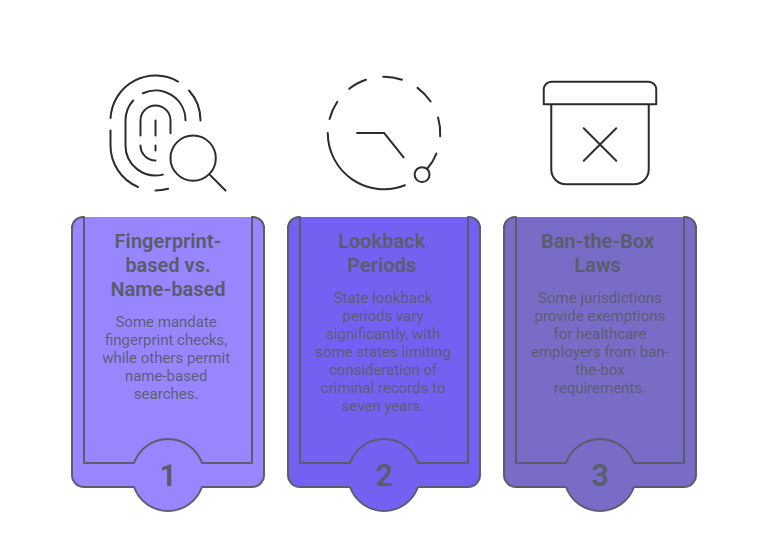
- Fingerprint-based vs. name-based: Some mandate fingerprint checks through state repositories or the FBI, while others permit name-based searches.
- Lookback periods: State lookback periods vary significantly, with some states limiting consideration of criminal records to seven years for certain positions or salary levels, while others impose no time limit. Additionally, many states restrict or prohibit use of arrest records that did not result in conviction.
- Ban-the-box laws: Some jurisdictions provide exemptions for healthcare employers from ban-the-box requirements, while others apply these laws to all employers without exception. Behavioral health facilities must verify whether their specific city, county, or state includes healthcare exemptions in ban-the-box legislation before inquiring about criminal history during the application phase.
Employers must confirm which method and timeline their jurisdiction requires.
Abuse and Neglect Registry Searches
Nearly all states maintain registries of individuals substantiated for abuse, neglect, or exploitation of vulnerable adults or children. Most require behavioral health employers to check these databases before hiring, with some states mandating ongoing monitoring. Registry structures vary, some are publicly accessible online, others require formal requests through state agencies. Interstate coordination remains inconsistent, creating gaps when candidates have worked in multiple states.
Credential and License Verification
States require verification of professional licenses for clinical staff such as psychiatrists, psychologists, nurses, social workers, and counselors. Verification must confirm that licenses are active, unrestricted, and free of disciplinary sanctions. Many states also require checks of national practitioner databases for physicians and nurses, which contain reports of malpractice payments, adverse credentialing actions, and loss of clinical privileges.
Disqualifying Offenses and Individualized Assessment Requirements
Disqualifying offenses for mental health workers are not uniform across jurisdictions:
| Approach | Characteristics | Compliance Consideration |
| Categorical bars | Automatic disqualification for specified convictions (e.g., violent felonies, sexual offenses) | Verify state statutory list |
| Individualized assessment | Case-by-case evaluation of offense nature, time elapsed, rehabilitation, job duties | Document rationale and EEOC compliance |
| Hybrid models | Certain offenses barred absolutely, others assessed individually | Distinguish mandatory from discretionary exclusions |
The Equal Employment Opportunity Commission has emphasized that blanket exclusions based on criminal history may violate Title VII of the Civil Rights Act unless demonstrably job-related and consistent with business necessity.
Screening Components for Behavioral Health Settings
Effective behavioral health employee screening extends beyond criminal history checks to encompass multiple verification and assessment layers. Each component addresses distinct risk categories and compliance obligations.
Multi-Jurisdictional Criminal Record Searches
Candidates in behavioral health often have work or residence histories spanning multiple states, necessitating searches across relevant jurisdictions:
- County-level records: Provide the most complete and current information but coverage gaps exist in states with decentralized court systems.
- Statewide repositories: Aggregate records but may lag behind county updates.
- National databases: Compiled by private vendors, offer breadth but are secondary sources that require verification against primary court records.
Employers should prioritize primary sources and verify secondary database results independently.
Federal Criminal Records
Fingerprint-based FBI checks access the National Crime Information Center database, which includes arrests and dispositions reported by federal, state, and local agencies nationwide. This method provides the most authoritative record but is available only where state law authorizes employers or facilities to request FBI checks, and requires formal submission processes through state repositories. Results typically require several weeks. Some states permit facilities to use FBI checks as a substitute for state-level searches, while others require both.
Abuse Registry Checks Across Employment History
Candidates who have worked in healthcare, education, or social services in other states may appear in those states' abuse registries. Facilities should conduct checks in all states where the candidate was previously employed in a caregiving capacity:
- Some states offer interstate registry access through reciprocal agreements.
- Many require individual state queries.
- Coverage remains inconsistent across jurisdictions.
Employers must verify which states the candidate worked in and query each relevant registry.
Professional License and Sanctions Review
Beyond verifying active licensure, employers should review disciplinary histories available through state licensing board websites and national databases. Sanctions may include reprimands, probation, practice restrictions, or revocation, any of which may indicate fitness concerns. Some disciplinary actions arise from conduct unrelated to criminal charges and would not appear in criminal background checks.
Reference Checks and Employment Verification
Contacting prior employers provides insight into job performance, interpersonal conduct, and reasons for separation. Many organizations limit disclosures to dates of employment and eligibility for rehire due to defamation concerns, but some behavioral health employers provide more detailed information when contacted by other facilities. Gaps in employment history warrant inquiry, as they may indicate unexplained terminations or professional interruptions.
Education and Credential Verification
Confirming academic degrees and professional certifications prevents credential fraud, which periodically surfaces in behavioral health settings. Verification should be obtained directly from issuing institutions or through credentialing services, not accepted from candidate-provided documents alone.
Recovery-Informed Hiring and Criminal History Considerations
The behavioral health field confronts a unique tension in applying criminal history to hiring decisions. Many substance use disorder treatment programs value staff with lived recovery experience, recognizing that personal histories of addiction and justice involvement can enhance therapeutic rapport and credibility.
Some states encourage or require facilities to consider applicants with relevant criminal histories, provided they demonstrate sustained recovery and do not pose safety risks.
Legal Framework for Individualized Assessment
Federal guidance and many state laws require employers to conduct individualized assessments before disqualifying candidates based on criminal history. This process involves evaluating:
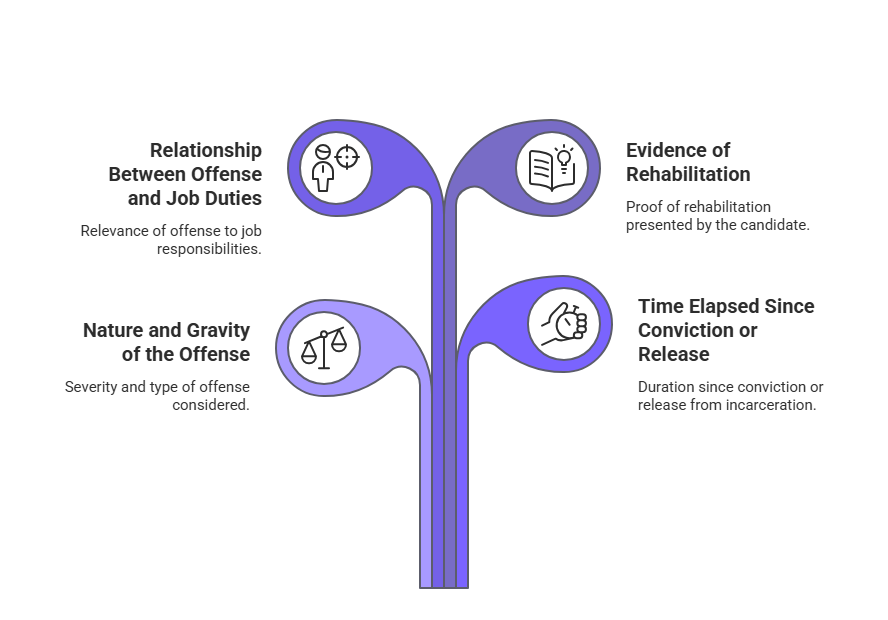
- The nature and gravity of the offense
- Time elapsed since the conviction or release from incarceration
- The relationship between the offense and job duties
- Evidence of rehabilitation presented by the candidate
Employers must provide candidates an opportunity to present evidence of rehabilitation, including completion of treatment, educational achievements, employment stability, and character references.
Balancing Safety and Inclusion
Facilities must weigh the therapeutic and operational value of recovery-informed hiring against patient safety imperatives and regulatory prohibitions:
| Criminal History Category | Typical Risk Assessment | Common Employment Outcome |
| Sexual offenses or violence against vulnerable persons | Assessed as high risk in most contexts; state law may impose categorical bars | May be subject to mandatory disqualification under state law; where not barred, individualized assessment required |
| Non-violent drug offenses during active addiction | Context-dependent, mitigated by recovery duration | May be compatible with peer support or non-clinical roles |
| Property crimes related to addiction | Assessed based on job duties and financial access | Individualized determination required |
Documentation must demonstrate compliance with all applicable legal requirements and articulate the rationale for hiring decisions.
Documentation and Transparency
When facilities hire individuals with disqualifying histories under waiver or individualized assessment processes, documentation must demonstrate compliance with all applicable legal requirements and articulate the rationale for the decision. This protects the facility in the event of regulatory audits or adverse incidents and ensures accountability for risk management decisions.
Ongoing Monitoring and Post-Hire Screening Obligations
Behavioral health employee screening does not end at hiring. Many state licensing rules require continuous monitoring of criminal history, licensure status, and registry entries throughout employment. These obligations reflect the reality that staff may face criminal charges, disciplinary actions, or registry substantiations after hire.
Continuous Criminal History Monitoring
Technology platforms now enable automated alerts when employees are arrested, charged, or convicted after hire:
- Systems monitor court records, arrest logs, and correctional databases.
- Employers receive notifications when an employee's name appears in a new record.
- Alerts must be verified independently, as automated systems generate false positives due to name matches with different individuals.
Verification against primary sources remains necessary before taking adverse action.
License and Credential Monitoring
Licensed professionals may face disciplinary actions or license suspensions that occur between initial verification and re-credentialing cycles. Employers should implement periodic re-verification schedules and encourage staff to self-report changes in licensure status. Some state licensing boards provide subscription alert services that notify employers of actions affecting their staff.
Abuse Registry Re-Checks
Employees substantiated for abuse or neglect after hire will appear in state registries, but facilities may not learn of these entries without periodic re-checks:
- Some states require annual registry searches for all staff.
- Others leave frequency to facility discretion.
- Facilities operating in multiple states must track and comply with varying re-check mandates.
Compliance requires jurisdiction-specific protocols and calendar-based tracking systems.
Technology-Assisted Screening and Compliance Considerations
Behavioral health facilities increasingly use technology platforms to streamline screening workflows, manage compliance documentation, and automate monitoring. These tools offer efficiency gains but require careful evaluation for accuracy, legal compliance, and bias mitigation.
Accuracy and Data Quality Concerns
Automated screening platforms aggregate records from thousands of data sources, but data quality varies:
- Records may be incomplete, outdated, or inaccurately attributed due to name similarity.
- Employers relying on these tools must verify flagged records against primary sources.
- Candidates must be provided an opportunity to dispute inaccuracies, as required under the Fair Credit Reporting Act.
Technology serves as a supplement to, not a replacement for, verification protocols.
Algorithmic Bias and Discrimination Risk
Some technology-assisted screening tools incorporate risk scoring or predictive analytics that may disproportionately flag candidates from communities subject to over-policing or discriminatory enforcement:
- Employers must assess whether these tools produce disparate impact on protected classes.
- Use must be justified as job-related and consistent with business necessity under Title VII.
- Ongoing monitoring for bias is necessary as algorithms evolve.
Legal review should precede adoption of any algorithmic decision support tool.
State-Specific Legal Constraints
Several states have enacted laws restricting employer use of automated decision-making tools in hiring:
- Some require human review of algorithm-generated recommendations.
- Others mandate disclosure when such tools are used.
- Behavioral health employers must ensure that technology vendors comply with applicable state consumer protection, privacy, and employment laws.
Vendor due diligence should include verification of multi-state legal compliance.
Multi-State Operations and Jurisdictional Coordination
Behavioral health organizations operating facilities in multiple states face the challenge of reconciling divergent screening requirements, documentation standards, and procedural rules. Centralized HR systems must accommodate state-specific variations while maintaining consistent risk management principles.
Jurisdiction-Specific Screening Protocols
Each state's requirements must be mapped and incorporated into hiring workflows:
- Identify which positions trigger mandatory checks.
- Determine required search scopes and lookback periods.
- Ensure timely completion before start dates.
- Track changes in state law and update protocols accordingly.
Legislative amendments occur frequently, requiring proactive monitoring systems.
Interstate License Portability and Compact Participation
Several behavioral health professions participate in interstate licensure compacts, allowing practitioners licensed in one member state to practice in others without obtaining additional licenses:
- Employers hiring compact license holders must verify the practitioner's home state license.
- Confirmation of eligibility under compact rules is required.
- Disciplinary actions in any compact state may affect eligibility across all member states, depending on the specific compact's rules regarding cross-state discipline reporting and licensure privilege suspension. Employers should verify the practitioner's status in their home state and confirm no adverse actions have been reported under compact information-sharing systems.
Compact databases provide real-time licensure and disciplinary status information.
Data Privacy and Interstate Information Sharing
Screening processes generate sensitive personal information subject to federal and state privacy laws, including FCRA disposal requirements, state Social Security number protection statutes, and data breach notification laws. Employers must ensure that data handling practices comply with applicable regulations, including restrictions on storage duration, access controls, and interstate data transfers. Some states impose stricter standards than federal baseline requirements. Facilities should consult legal counsel or privacy compliance specialists to design jurisdiction-appropriate data governance protocols.
Practical Implementation Guidance for Facility Administrators
Building a compliant and effective screening program requires deliberate design, resource allocation, and ongoing management. Administrators should approach this as a system encompassing policy, process, technology, and people.
Policy Development and Documentation
Written policies should specify:

- Which positions require screening
- What components are mandatory versus discretionary
- Timelines for completion
- Procedures for individualized assessments
- Protocols for ongoing monitoring
Policies must align with all applicable federal, state, and local requirements and should be reviewed annually or when regulatory changes occur.
Vendor Selection and Oversight
Facilities that engage consumer reporting agencies to conduct background checks must perform due diligence:
- Ensure vendor compliance with the Fair Credit Reporting Act, accuracy standards, and state-specific restrictions.
- Contracts should specify data sources, turnaround times, dispute resolution procedures, and indemnification terms.
- Employers remain legally responsible for FCRA compliance even when using third-party vendors.
Regular audits of vendor performance and legal compliance protect facilities from derivative liability.
Staff Training and Accountability
HR personnel, hiring managers, and compliance officers must understand screening requirements, legal constraints, and procedures for handling adverse information:
- Training should cover FCRA notice and authorization requirements.
- Individualized assessment protocols must be explained clearly.
- Confidentiality obligations and documentation standards require emphasis.
- Facilities should conduct periodic audits to ensure consistent adherence to policies.
Competency-based training with documentation supports regulatory defense.
Balancing Speed and Thoroughness
Workforce shortages create pressure to expedite hiring, but incomplete or non-compliant screening exposes facilities to regulatory sanctions, patient safety risks, and reputational harm:
- Administrators should identify opportunities to accelerate low-risk components, such as initiating checks upon application rather than after offers.
- High-risk areas such as criminal history and abuse registry reviews require maintained rigor.
- Parallel processing of independent screening components reduces overall timelines without compromising quality.
Efficiency gains must never compromise compliance or safety thresholds.
Conclusion
Behavioral health employee screening in 2026 requires facility administrators to navigate overlapping federal, state, and local mandates while managing acute workforce pressures and honoring recovery-informed values. Effective programs integrate multiple verification components, apply jurisdiction-specific rules accurately, and balance safety imperatives with inclusive hiring principles.
Frequently Asked Questions
What is the difference between a state criminal background check and an FBI fingerprint check for behavioral health employees?
State criminal background checks search records maintained by state-level repositories, which aggregate arrests and convictions reported by law enforcement agencies within that state. FBI fingerprint checks access the National Crime Information Center database, which includes records from federal, state, and local agencies nationwide. Some states mandate both checks for behavioral health positions, while others accept FBI checks as satisfying state-level requirements.
Are there specific disqualifying offenses that automatically bar employment in mental health facilities?
Disqualifying offenses vary by state, with some jurisdictions specifying categorical bars for convictions such as violent felonies, sexual offenses, or abuse-related crimes, while others require individualized assessments. Federal law does not establish uniform disqualifications but prohibits employment in federally funded programs for individuals excluded from Medicare or Medicaid participation. Employers must review applicable state licensing statutes to determine mandatory disqualifications.
How often should behavioral health facilities re-check employee criminal histories and abuse registries?
Re-check frequency depends on state licensing requirements, which vary significantly. Some states mandate annual criminal history and abuse registry re-checks for all staff in licensed behavioral health facilities, while others specify re-checks only upon license renewal or leave frequency to facility discretion. Facilities should review applicable state regulations to determine mandatory intervals.
Can behavioral health employers hire individuals with past substance use disorder convictions?
Many behavioral health employers, particularly in substance use disorder treatment settings, hire individuals with past SUD-related convictions, recognizing the value of lived recovery experience. Employers must conduct individualized assessments evaluating the nature and gravity of the offense, time elapsed, evidence of rehabilitation, and job duties. Some states explicitly permit or encourage such hiring, while others maintain categorical bars for certain convictions.
What are the FCRA notice requirements for background checks in behavioral health hiring?
The Fair Credit Reporting Act requires employers to obtain written authorization from applicants before procuring consumer reports, provide clear disclosure that a report may be obtained, and furnish a pre-adverse action notice if information in the report may result in denial of employment. The pre-adverse action notice must include a copy of the report and a summary of consumer rights under the FCRA. Employers must allow a reasonable period for the candidate to review the report and respond before issuing a final adverse action notice. What constitutes a reasonable period depends on the circumstances, including the complexity of the information and the candidate's opportunity to dispute inaccuracies.
How should residential treatment facilities handle gaps in applicant employment history during screening?
Gaps in employment history warrant inquiry during reference checks and interviews, as they may indicate unexplained terminations, professional interruptions, or periods of incarceration. Employers should ask applicants to account for gaps and provide verifiable information such as education, treatment participation, volunteer work, or caregiving responsibilities. Individualized assessment principles apply if gaps relate to periods of substance use disorder, incarceration, or other circumstances protected under disability or rehabilitation statutes.
Do ban-the-box laws apply to behavioral health facility hiring?
Ban-the-box laws prohibit employers from inquiring about criminal history on initial job applications, typically requiring such inquiries to occur only after a conditional offer of employment. Some jurisdictions provide exemptions for healthcare employers from ban-the-box requirements, while others apply these laws to all employers without exception. Behavioral health facilities must determine whether their specific city, county, or state includes healthcare exemptions in ban-the-box legislation before inquiring about criminal history during the application phase.
What role do abuse registry checks play in behavioral health employee screening?
Abuse registries contain names of individuals substantiated by state agencies for abuse, neglect, or exploitation of vulnerable adults or children. Most states require behavioral health facilities to check these registries before hiring employees with direct patient contact and prohibit employment of individuals listed. Facilities should conduct checks in all states where the applicant previously worked in caregiving roles, as registries are state-specific.
Additional Resources
- U.S. Equal Employment Opportunity Commission: Background Checks and Employment
https://www.eeoc.gov/laws/guidance/enforcement-guidance-consideration-arrest-and-conviction-records-employment-decisions - Federal Trade Commission: Background Checks – Fair Credit Reporting Act
https://www.ftc.gov/business-guidance/resources/using-consumer-reports-what-employers-need-know - Substance Abuse and Mental Health Services Administration: Screening and Hiring Requirements
https://www.samhsa.gov/find-help/national-helpline - U.S. Department of Health and Human Services Office of Inspector General: List of Excluded Individuals and Entities
https://oig.hhs.gov/exclusions/index.asp - National Conference of State Legislatures: Background Checks for Employment
https://www.ncsl.org/labor-and-employment/background-checks-for-employment

ABOUT THE CREATOR
GCheck Editorial Team
Meet the GCheck Editorial Team, your trusted source for insightful and up-to-date information in the world of employment background checks. Committed to delivering the latest trends, best practices, and industry insights, our team is dedicated to keeping you informed.
With a passion for ensuring accuracy, compliance, and efficiency in background screening, we are your go-to experts in the field. Stay tuned for our comprehensive articles, guides, and analysis, designed to empower businesses and individuals with the knowledge they need to make informed decisions.
At GCheck, we're here to guide you through the complexities of background checks, every step of the way.