


Ban the Box laws as of late 2025 regulate hiring practices in approximately 37 states and over 150 local jurisdictions (based on publicly available information as of late 2025; jurisdictions continue to evolve), with enforcement activity increasing throughout 2024-2025. These fair chance hiring laws restrict when and how employers can inquire about criminal history, requiring individualized assessments and jurisdiction-specific procedural compliance that varies significantly by location, making 2026 compliance preparation critical for multi-state employers.
Key Takeaways
- Ban the Box laws now regulate hiring practices in 37 states and over 150 cities, with compliance requirements continuing to expand as jurisdictions implement new provisions throughout 2025 and into 2026.
- Employers must delay criminal history inquiries until after conditional job offers in most jurisdictions, though timing requirements vary from initial application to post-interview stages depending on location.
- Individualized assessments are legally required in 32 states, meaning blanket disqualification policies based on criminal records expose employers to significant liability under fair chance laws.
- Clean slate laws in several states now automatically seal or expunge eligible records, creating a critical intersection with Ban the Box compliance where employers may face penalties for considering automatically sealed convictions.
- State enforcement agencies in California, New York, and Illinois have issued significant penalties for Ban the Box violations, based on publicly available enforcement actions and settlements, with enforcement activity increasing throughout 2024 and 2025 as agencies prioritize fair chance hiring compliance.
- Multi-jurisdiction employers must implement location-specific hiring workflows, as a one-size-fits-all approach to criminal history inquiries creates unavoidable legal violations across different state requirements.
- FCRA adverse action procedures remain mandatory even when Ban the Box laws apply, requiring employers to navigate overlapping federal and state notification requirements during the hiring process.
- Documentation of individualized assessment factors is now the primary defense in fair chance hiring audits, with compliant employers maintaining structured records of job-relatedness analysis, time elapsed since conviction, and rehabilitation evidence.
Understanding Ban the Box Laws and Fair Chance Hiring Requirements
Ban the Box laws restrict when and how employers can inquire about an applicant's criminal history during the hiring process. The term originates from removing the checkbox on job applications asking whether candidates have been convicted of a crime. These fair chance hiring laws aim to reduce employment barriers for individuals with criminal records by ensuring applicants are evaluated on qualifications before criminal history becomes part of the decision.
As of late 2025, Ban the Box legislation has evolved far beyond simply removing a checkbox. These laws now establish comprehensive frameworks governing criminal background check timing, permissible consideration factors, required assessment procedures, and specific notification obligations that vary significantly across jurisdictions. Understanding these requirements is essential for employers developing Ban the Box laws 2026 compliance strategies.
Hiring decisions shape lives on both sides of the table. I have learned that screenings are not simply an issue of compliance or risk reduction. They are an issue of trust, accountability, and providing a fair chance to those who need it while also protecting the organization. When done thoughtfully, screening becomes a bridge between opportunity and responsibility and not a barrier. The real work of the HR professional is to make it happen with empathy and integrity, every time.
The Current Legal Landscape
State-level laws generally fall into three categories based on employer coverage:
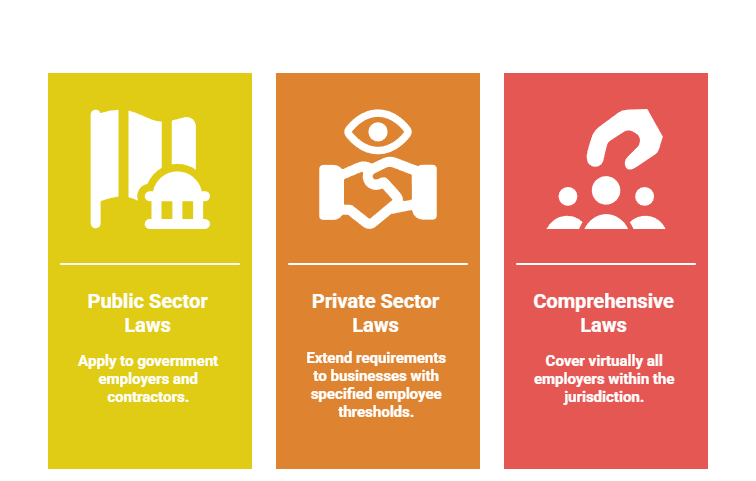
- Public sector Ban the Box laws: Apply only to government employers and contractors, with the federal government implementing requirements for federal agencies in 2016
- Private sector inclusive laws: Extend requirements to businesses meeting specified employee thresholds, typically ranging from 5 to 15 employees
- Comprehensive laws: Cover virtually all employers within the jurisdiction, regardless of size or sector
State enforcement agencies have increased focus on Ban the Box compliance verification. California's Civil Rights Department, New York enforcement agencies, and Illinois authorities have documented penalties ranging from thousands to hundreds of thousands of dollars per violation depending on case specifics and scope of non-compliance.
How Ban the Box Differs From FCRA Requirements
The Fair Credit Reporting Act establishes federal requirements for obtaining and using consumer reports, including criminal background checks. FCRA mandates written authorization before procuring reports, pre-adverse action notices when negative information may lead to rejection, and final adverse action notices with specific content requirements. However, Ban the Box laws operate alongside FCRA obligations but address different aspects of the hiring process.
While FCRA governs procedural requirements for obtaining and acting on background check information, Ban the Box laws dictate when criminal history inquiries can occur and how that information must be evaluated. Employers must satisfy both frameworks simultaneously.
State-by-State Ban the Box Requirements and Timing Restrictions
Navigating Ban the Box laws 2026 compliance requires understanding jurisdiction-specific variations in when criminal history inquiries are permitted, which employers are covered, and what records can be considered. States establish different trigger points for when criminal history inquiries become permissible.
| Timing Restriction Type | When Inquiry Permitted | Example States with This Requirement |
| Post-Application | After reviewing initial applications but before interviews | Georgia, Hawaii, and others |
| Post-Interview | After at least one face-to-face or virtual interview | Massachusetts, Rhode Island, and others |
| Conditional Offer | Only after employer extends a conditional job offer | California, Illinois, New Jersey, New York, Oregon, Vermont, Washington, among others |
Note: This table provides examples only and should not be relied upon as definitive legal guidance. Requirements change frequently and employers should verify current law in applicable jurisdictions.
The conditional offer standard creates the most substantial workflow changes for employers. Traditional hiring processes that incorporate background checks early must be restructured entirely. Employers in conditional offer jurisdictions typically extend offers contingent on satisfactory completion of background screening, then withdraw offers only after following required individualized assessment procedures.
Coverage Variations and Employer Size Thresholds
Not all Ban the Box laws apply uniformly across employer types and sizes. New York City's Fair Chance Act covers employers with four or more employees, while Illinois's law applies to employers with one or more employees for covered positions. Conversely, New Jersey's law covers employers with 15 or more employees.
Arrest Records vs. Conviction Records
A critical distinction in Ban the Box compliance involves what types of criminal history employers can consider. Most fair chance laws permit consideration of conviction records while restricting or prohibiting consideration of arrest records that did not result in conviction. The rationale is straightforwardâÂÂarrests indicate accusation, while convictions indicate established guilt through the legal process.
Eleven states including California, Hawaii, Massachusetts, New York, and Pennsylvania explicitly prohibit employers from asking about or considering arrest records that did not lead to conviction. Other states allow inquiry about arrests but restrict adverse action based solely on arrest information.
Criminal Record Lookback Period Limitations
Several states impose lookback period limits that restrict how far back employers can consider criminal history. These limitations recognize that older convictions have diminishing relevance to current employment suitability.
| State | Lookback Period | Record Type |
| California | 7 years | Most convictions |
| New York City | 7 years | Most convictions |
| Massachusetts | 3 years | Misdemeanors |
| Colorado | 7 years | Most criminal history |
State laws change frequently. Employers should consult current statutes and legal counsel to verify requirements in their specific jurisdictions.
Lookback periods interact with emerging clean slate laws that automatically seal eligible records. When records fall outside the lookback period or have been automatically sealed under state expungement provisions, employers who access or consider such information may face penalties under both fair chance hiring laws and criminal record sealing statutes.
The Individualized Assessment Requirement: Legal Standards and Implementation
Ban the Box laws in 32 states mandate individualized assessments when criminal history is discovered during the hiring process. This requirement prohibits blanket disqualification policies and demands case-by-case analysis of whether specific criminal history makes a candidate unsuitable for the particular position.
Legal Framework for Individualized Assessment
The EEOC's 2012 enforcement guidance established that blanket criminal history exclusions may create disparate impact discrimination, as criminal conviction rates differ across racial and ethnic groups. While EEOC guidance does not have force of law, courts and state agencies frequently reference it when evaluating employer practices.
Employers must evaluate multiple factors rather than applying automatic disqualification rules:
- Nature and gravity of the offense: What the criminal conduct involved and its severity level
- Time elapsed since conviction: Both time since the offense occurred and time since sentence completion, including probation or parole
- Job-relatedness: The relationship between the criminal conduct and the specific job responsibilities
California's Fair Chance Act provides detailed statutory language requiring consideration of these factors. Documentation of individualized assessments has become the primary defense in fair chance hiring audits and complaints.
Building a Compliant Assessment Framework
Implementing individualized assessments requires structured procedures that ensure consistency while allowing case-specific evaluation. Nature and gravity analysis examines what the criminal conduct involvedâÂÂa conviction for financial fraud carries different job-relatedness implications for a bookkeeping position than for a warehouse role.
Time elapsed evaluation considers both time since the offense occurred and time since sentence completion. Job-relatedness assessment represents the most critical individualized factor, requiring employers to identify specific job duties and work environment characteristics that create genuine connections between past criminal conduct and current employment risks.
Clean Slate Laws and Automatic Expungement: Critical Compliance Intersections
Clean slate laws represent an emerging area of criminal justice reform with significant implications for Ban the Box laws 2026 compliance preparation. As of late 2025, several states including Pennsylvania, Michigan, Connecticut, Delaware, Minnesota, New Jersey, and others have implemented various forms of automatic record relief that seal or expunge eligible criminal records without requiring individuals to petition courts.
Records subject to automatic sealing should not appear on commercial background check reports, and employers are generally prohibited from considering sealed information even if they somehow access it.
Compliance Challenges at the Intersection of Ban the Box and Clean Slate
An employer operating in a jurisdiction with both frameworks must navigate timing restrictions on when to conduct background checks, individualized assessment requirements for discovered convictions, and prohibitions against considering automatically sealed records.
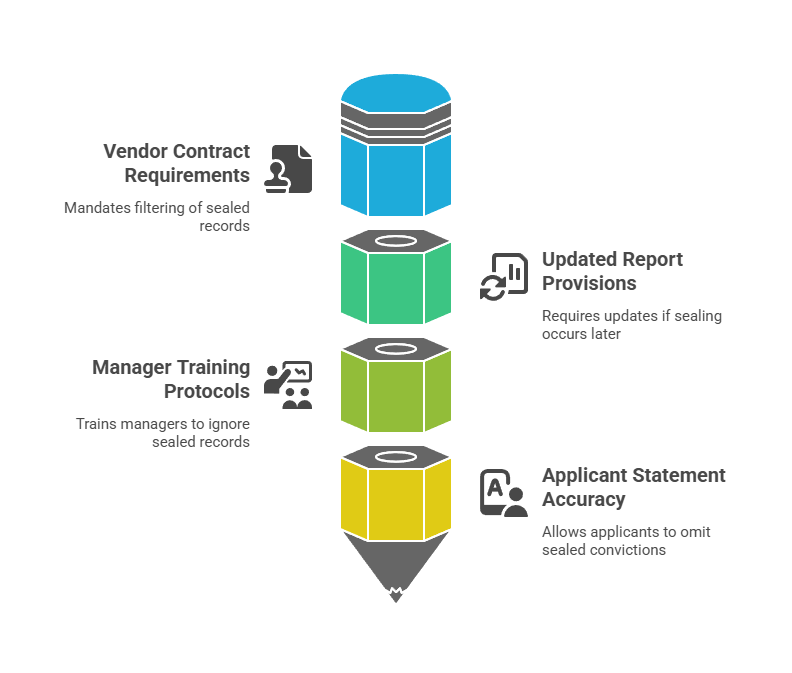
- Vendor contract requirements: Consumer reporting agencies should be contractually required to filter automatically sealed records from background check reports
- Updated report provisions: Vendors must provide updated reports if sealing occurs between the initial report date and final hiring decisions
- Manager training protocols: Hiring managers need instruction not to consider information about sealed or expunged records regardless of the source
- Applicant statement accuracy: Individuals may lawfully answer employment inquiries as though sealed convictions never occurred
Employers must treat the applicant's representation as accurate and address reporting errors with the screening vendor rather than questioning the applicant's honesty.
Multi-Jurisdiction Hiring Compliance: Decision Trees and Workflow Design
Employers hiring across multiple states face the most complex Ban the Box laws 2026 compliance challenges. Multi-jurisdiction compliance requires abandoning one-size-fits-all hiring processes in favor of location-adapted workflows.
Building Location-Specific Hiring Workflows
HR teams should develop decision trees that route applicants through appropriate procedures based on work location. The initial decision point identifies which state's or municipality's laws apply.
| Compliance Element | California Example | Massachusetts Example | Georgia Example |
| Timing Requirement | Conditional offer only | Post-interview | Post-application |
| Assessment Required | Yes, documented | Yes, documented | Recommended |
| Lookback Period | 7 years for most convictions | 3 years for misdemeanors | No statutory limit |
| Arrest Record Use | Prohibited | Prohibited | Restricted |
This table provides examples only. Employers should verify current law in applicable jurisdictions as requirements change frequently.
Documentation requirements also vary by location. Some states require specific disclosure language before conducting background checks that exceeds federal FCRA requirements.
Creating Defensible Multi-State Assessment Procedures
Employers should develop assessment templates that capture all factors required by the strictest applicable state laws, ensuring any assessment satisfies requirements regardless of location. The assessment template should document the nature and gravity of the offense with sufficient specificityâÂÂgeneric entries like "felony conviction" provide inadequate documentation.
Time-elapsed calculations should capture multiple dates: conviction date, offense date if different, sentencing completion date, and probation or parole end date. Job-relatedness analysis requires identifying specific position duties and work environment factors that create connections to the criminal conduct.
Ban the Box Compliance and FCRA Adverse Action Procedures
Fair chance hiring laws do not replace FCRA adverse action requirements. Employers must navigate both frameworks when criminal history discovered during background screening may lead to rejection.
Overlapping Notice Requirements
Before taking adverse action based on background check information, employers must provide the applicant with a pre-adverse action notice, a copy of the consumer report, and a Summary of Your Rights Under the FCRA.
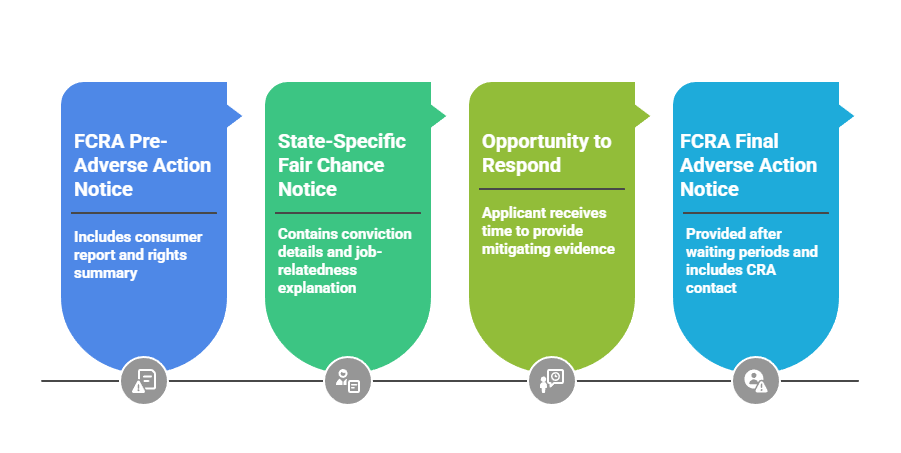
- FCRA pre-adverse action notice: Includes copy of consumer report and summary of rights
- State-specific fair chance notice: Contains disqualifying conviction details and job-relatedness explanation
- Opportunity to respond: Applicant receives time to provide mitigating evidence (typically 5-7 business days)
- FCRA final adverse action notice: Provided after all waiting periods expire and includes CRA contact information
Ban the Box laws add state-specific notification requirements. California requires a written notice including the disqualifying conviction, explanation of evidence supporting job-relatedness, applicant opportunity to provide mitigating evidence, and statement of the right to dispute conviction accuracy.
Employers must provide both FCRA-required notices and state-mandated fair chance notices. Employers should consult FCRA counsel when designing adverse action procedures that must satisfy both federal and state requirements.
Individualized Assessment During the Adverse Action Period
The pre-adverse action waiting period creates an opportunity for applicants to submit additional information or dispute report accuracy. Designated personnel should review submissions, document consideration of new information, and determine whether it changes the individualized assessment outcome.
Enforcement Trends and Building Compliance-Resistant Programs
State and municipal enforcement of Ban the Box laws has increased through 2024 and into 2025, with agencies demonstrating greater focus on compliance across multiple industries. California, New York, and Illinois have been particularly active in investigating timing violations and inadequate individualized assessment documentation, based on publicly available enforcement actions and settlements.
Common Violation Patterns
State enforcement agencies have identified recurring compliance failures:
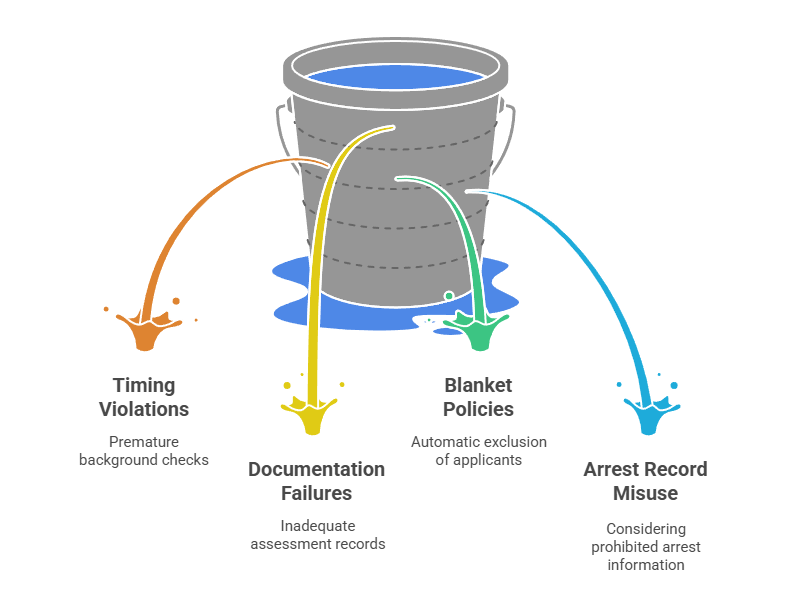
- Timing violations: Conducting criminal background checks before the jurisdiction-required stage
- Documentation failures: Inadequate records demonstrating individualized assessment considerations
- Blanket policies: Written policies automatically excluding applicants with certain conviction types
- Arrest record misuse: Considering arrest information in jurisdictions prohibiting such use
Companies maintaining written policies excluding all applicants with felony convictions face enforcement exposure when such policies are discovered.
Building Enforcement-Resistant Compliance Programs
Reducing enforcement exposure requires proactive compliance program development. Employers should conduct internal audits assessing whether current practices satisfy all applicable Ban the Box requirements, identify gaps or risks, and implement corrective measures before enforcement agencies initiate investigations.
Training programs for hiring managers, recruiters, and HR personnel must cover Ban the Box basics, individualized assessment procedures, documentation requirements, and common pitfall scenarios. Documentation systems should capture evidence of compliance at each stage of the hiring process.
Practical Implementation Guide for HR Teams

Translating legal requirements into operational hiring procedures requires systematic implementation across recruiting, background screening, and decision-making processes.
Updating Application Materials and Job Postings
Application materials should be reviewed to remove impermissible criminal history inquiries. The traditional checkbox asking about criminal convictions must be removed entirely from applications for positions in all Ban the Box jurisdictions.
Job postings should avoid language suggesting criminal history will automatically disqualify applicants. Phrases like "no felons" or "must have clean criminal record" violate fair chance hiring principles. When exemptions apply, job postings should clearly and accurately state the legal requirement necessitating criminal background clearance.
Training Interviewers and Hiring Managers
Personnel conducting interviews need clear guidance on what criminal history inquiries are prohibited during various hiring stages. Interviewers should understand that criminal history discussions before the legally required stage create violations regardless of who initiated the conversation.
Background check authorization forms must satisfy both FCRA disclosure and authorization requirements and any additional state-specific mandates. Authorization timing must align with Ban the Box requirementsâÂÂin conditional offer jurisdictions, authorization forms should not be provided until after offers are extended.
Establishing Assessment and Documentation Protocols
Standardized assessment forms guide evaluators through required analysis while creating documentation demonstrating compliance. Forms should prompt consideration of each legally required factor with space for detailed narrative responses rather than checkboxes.
Review procedures ensure assessment quality and consistency. A second reviewer or compliance officer should examine individualized assessments before final adverse actions are taken, verifying that required factors were addressed, job-relatedness is adequately supported, and documentation meets jurisdictional standards.
Conclusion
Ban the Box laws require employers to fundamentally restructure criminal background screening procedures, implement jurisdiction-specific compliance workflows, and conduct documented individualized assessments that evaluate job-relatedness rather than applying blanket disqualification policies. The intersection of fair chance hiring requirements, clean slate automatic expungement, and FCRA adverse action procedures creates complex obligations that demand proactive compliance program development, ongoing training, and careful documentation to mitigate enforcement exposure as organizations prepare for Ban the Box laws 2026 compliance requirements. This article provides general educational information and does not constitute legal adviceâÂÂemployers should consult qualified employment law counsel for jurisdiction-specific compliance guidance.
Frequently Asked Questions
The following frequently asked questions respond to common concerns, issues, and complexities discussed in the article. They have been designed to help the reader clearly understand the implications and challenges associated with the regulations.
What is the difference between Ban the Box and fair chance hiring laws?
Ban the Box specifically refers to removing the criminal history checkbox from initial applications, while fair chance hiring encompasses the full range of requirements including timing restrictions, individualized assessments, and procedural obligations. These terms are often used interchangeably. Both give applicants with criminal records a fair opportunity to be evaluated on their qualifications before criminal history influences decisions.
Can employers still conduct criminal background checks under Ban the Box laws?
Yes, Ban the Box laws do not prohibit criminal background checksâÂÂthey regulate when checks can be conducted and how discovered information must be evaluated. Employers can generally conduct background checks after reaching the jurisdiction-required stage (post-application, post-interview, or post-conditional-offer). They must perform individualized assessments rather than automatically rejecting applicants based on criminal records.
Do Ban the Box laws apply to all employers or only certain sizes?
Coverage varies significantly by jurisdiction. Some states apply Ban the Box requirements only to public sector employers and government contractors, while others extend requirements to private employers meeting specified employee thresholds, typically ranging from 5 to 15 employees. Several jurisdictions implement comprehensive coverage including nearly all employers regardless of size.
How do clean slate laws affect employer background checks?
Clean slate laws automatically seal or expunge eligible criminal records without requiring individuals to petition courts. When records are automatically sealed, they should not appear on background check reports, and employers are generally prohibited from considering sealed information even if they somehow access it. Employers must ensure background screening vendors filter automatically sealed records and must not use information about sealed convictions.
What happens if an employer violates Ban the Box laws?
Violations can result in enforcement actions by state civil rights agencies or attorneys general, leading to penalties that vary significantly by jurisdiction. Documented penalties have ranged from hundreds to hundreds of thousands of dollars per violation depending on case specifics and scope of non-compliance. Some states also provide private rights of action allowing applicants to file lawsuits, potentially resulting in compensatory damages and attorneys' fees.
Are there exemptions from Ban the Box laws for certain positions?
Most Ban the Box laws include exemptions for positions where criminal background checks are legally required by other statutes or regulations, such as certain healthcare roles, positions working with vulnerable populations, law enforcement positions, or jobs requiring specific security clearances. Employers claiming exemptions must verify that applicable statutes explicitly provide the exemption rather than assuming exemptions apply.
How should employers handle situations where applicants have criminal records in multiple states?
Individualized assessments must consider all criminal history that appears on background checks, evaluating each conviction according to required factors including nature and gravity, time elapsed, and job-relatedness. Multi-state criminal history requires analysis of whether any convictions create genuine job-relatedness concerns for the specific position. Employers should evaluate where offenses occurred, what conduct was involved, and how much time has passed.
Do Ban the Box requirements apply to internal promotions and transfers?
Requirements vary by jurisdiction. Some states explicitly extend Ban the Box protections to internal promotions and transfers, prohibiting criminal background checks on current employees until after conditional promotion offers. Other states limit coverage to initial hiring, allowing employers more flexibility with internal employment decisions. Employers should review applicable state laws to determine whether internal promotion processes must comply.
What documentation should employers maintain to demonstrate Ban the Box compliance?
Employers should maintain records showing when background checks were conducted relative to job offers or interviews, individualized assessment forms documenting consideration of required factors, copies of all notices provided to applicants, and evidence of rehabilitation or mitigating information submitted by applicants. Documentation should include final decisions with job-relatedness analysis. These records should be retained according to applicable statutes of limitations.
How do Ban the Box laws interact with industry-specific background check requirements?
When other laws require criminal background checks for specific industries or positionsâÂÂsuch as healthcare facilities, financial services, or childcare providersâÂÂthose requirements generally override Ban the Box timing restrictions. However, employers must still conduct individualized assessments when criminal history is discovered unless the other law mandates automatic disqualification. Employers should verify that claimed legal requirements actually mandate background checks rather than merely permit them.
Additional Resources
- Fair Credit Reporting Act - Federal Trade Commission Official Text
https://www.ftc.gov/legal-library/browse/statutes/fair-credit-reporting-act - Background Checks: What Employers Need to Know - EEOC Guidance
https://www.eeoc.gov/laws/guidance/background-checks-what-employers-need-know - Using Consumer Reports for Employment Purposes - FTC Business Guidance
https://www.ftc.gov/business-guidance/resources/using-consumer-reports-employment-purposes - National Inventory of Collateral Consequences of Conviction - Department of Justice
https://niccc.nationalreentryresourcecenter.org/

ABOUT THE CREATOR
GCheck Editorial Team
Meet the GCheck Editorial Team, your trusted source for insightful and up-to-date information in the world of employment background checks. Committed to delivering the latest trends, best practices, and industry insights, our team is dedicated to keeping you informed.
With a passion for ensuring accuracy, compliance, and efficiency in background screening, we are your go-to experts in the field. Stay tuned for our comprehensive articles, guides, and analysis, designed to empower businesses and individuals with the knowledge they need to make informed decisions.
At GCheck, we're here to guide you through the complexities of background checks, every step of the way.