

GLOSSARY
Understand the national criminal database and its importance in background checks, law enforcement, and legal services.
Created by

Reviewed by

If you’ve ever encountered the term “national criminal database” while applying for a job, conducting a background check, or working in law enforcement or legal services, you may wonder what exactly it entails. This glossary-style article offers a complete breakdown—from its definition and real-world importance to common misconceptions and related systems.
A national criminal database is a centralized or federated system designed to aggregate criminal history records from various jurisdictions across a country. These records include arrests, charges, convictions, warrants, and correctional data.
Rather than relying on isolated local or state databases, a national criminal database consolidates information to provide a more comprehensive picture of an individual’s criminal history. This makes it particularly useful for national-level background checks, law enforcement coordination, and government screening processes.
Working in the field of HR who has had close interaction with background screening, I recognize the true power the term “national criminal database” wields—over communities, employers, and candidates. Databases are effective tools for providing a safe and trusting environment; but tools, like databases, have imperfections. Records get delayed, may not be exhaustive, or worse, get misinterpreted, which makes context and fairness as paramount as compliance. For the human resources executive, the true responsibility is not just the accumulation of data but the discerning use thereof—managing the risk vs. compassion. After all, each record contains a name, and how each one is interpreted makes a hiring decision but touches lives. �
1. National Background Checks
Employers in sectors like defense, banking, aviation, and healthcare may require national criminal history checks to evaluate applicants who might handle sensitive data, money, or vulnerable populations.
2. Interstate Law Enforcement Investigations
When a crime spans multiple states, local authorities can access a shared database to trace the suspect’s history and coordinate actions across jurisdictions.
3. Federal Licensing and Certifications
Certain federal licenses—like those for commercial pilots, securities brokers, or medical professionals—require background checks that span beyond state lines.
4. Immigration and Border Security
Agencies like the Department of Homeland Security (DHS) use national criminal data to assess individuals applying for visas, green cards, or asylum.
5. High-Risk Employment
Jobs involving childcare, elder care, or national infrastructure often demand a national-level vetting process to minimize potential risks.
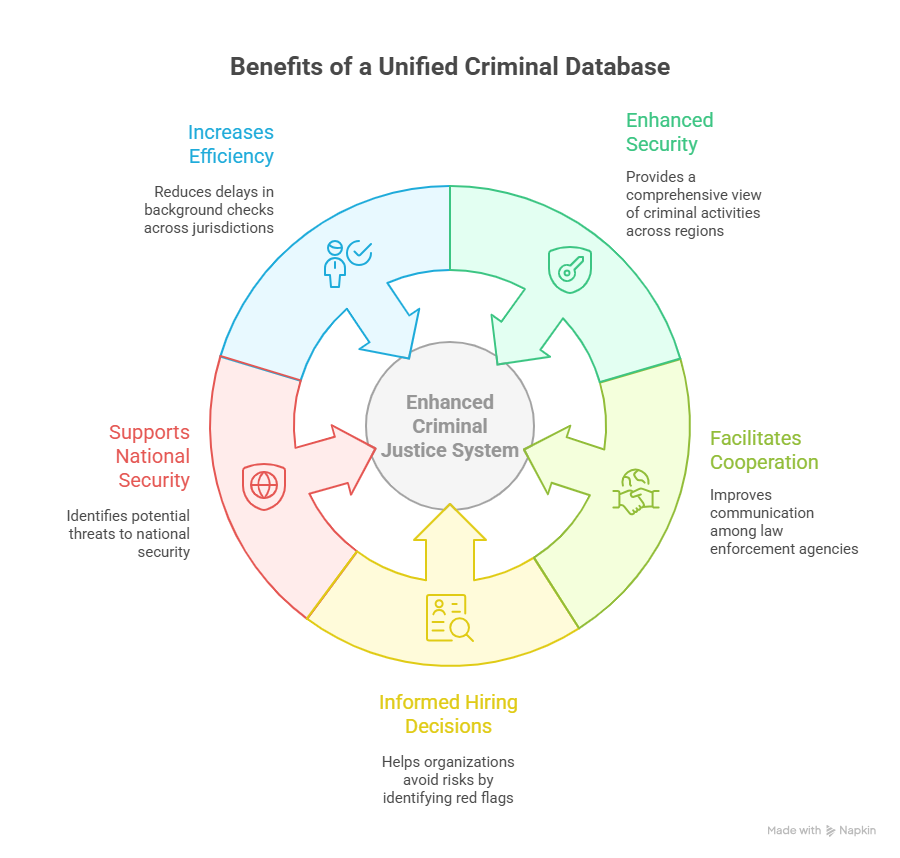
A national criminal database may be a single centralized repository or a network of interconnected systems. In most countries, it’s a federated system, where local and state agencies upload data into a shared framework (like the NCIC in the U.S.).
Typical data entries include:
Data usually comes from:
Limited access is usually given to:
Access is governed by strict privacy and legal regulations. Unauthorized access or misuse may result in legal penalties.
No system is perfect. A national criminal database must be:
Unfortunately, delayed reporting, misfiled data, or jurisdictional gaps can impact reliability.
Accessing and using data from national criminal databases must align with:
These frameworks ensure that data is used fairly and transparently, especially in employment scenarios.
Reality: Not all minor offenses, old cases, or records from jurisdictions with poor reporting practices are included. Inclusion varies by state, data-sharing policies, and available technology.
Reality: Some so-called “national” checks may only pull data from select sources or third-party aggregators. Only authorized federal checks using systems like the NCIC offer near-comprehensive coverage.
Reality: There can be lags in reporting, technical delays, or even human error. Background check reports should always be reviewed for accuracy, and individuals should have a chance to dispute incorrect information.
Reality: There’s no single portal for civilians to access all their national criminal data. Instead, individuals must often request records from state police, county courts, or the FBI using fingerprint-based identification.
Each state typically maintains its own criminal history database. These are useful for intra-state background checks, but they don’t automatically share data with other states unless connected through national systems.
The National Crime Information Center (NCIC) is a powerful database used by U.S. law enforcement. It includes:
It is not open to the public, but agencies can access it via secure systems.
The Interstate Identification Index (III) enables automated criminal record sharing between U.S. states and the federal government. It supports fingerprint-based matching and helps centralize identification even when names or aliases differ.
This term refers to the official criminal records held by state or federal agencies. It includes arrests, indictments, and disposition data.
Companies like GCheck, Checkr, Sterling, and GoodHire access data from national, state, and county sources to generate reports for employers. However, not all third-party providers have access to official federal databases, and quality may vary.
A national criminal database is a foundational tool for maintaining public safety, enforcing law across state lines, and ensuring accountability in high-risk jobs. While not flawless or fully centralized in all countries, these systems dramatically improve the efficiency and scope of criminal background checks.
Whether you’re a concerned employer, a legal professional, or just someone seeking clarity, understanding how national criminal databases work helps demystify the background check process. Always remember: the term “national” doesn’t mean “perfect” or “complete,” but when properly managed and regulated, it’s a powerful instrument for justice and safety.
Meet the GCheck Editorial Team, your trusted source for insightful and up-to-date information in the world of employment background checks. Committed to delivering the latest trends, best practices, and industry insights, our team is dedicated to keeping you informed.
With a passion for ensuring accuracy, compliance, and efficiency in background screening, we are your go-to experts in the field. Stay tuned for our comprehensive articles, guides, and analysis, designed to empower businesses and individuals with the knowledge they need to make informed decisions.
At GCheck, we're here to guide you through the complexities of background checks, every step of the way.

Contact us today for efficient, FCRA-compliant screening solutions
designed to keep your hiring process moving safely and smoothly.



LEGAL DISCLAIMER: The information provided in this article is for general informational and educational purposes only and should not be construed as legal advice or a substitute for consultation with qualified legal counsel. While we strive to ensure accuracy, employment screening laws and regulations—including but not limited to the Fair Credit Reporting Act (FCRA), Equal Employment Opportunity Commission (EEOC) guidelines, state and local ban-the-box laws, industry-specific requirements, and other applicable federal, state, and local statutes—are subject to frequent changes, varying interpretations, and jurisdiction-specific applications that may affect their implementation in your organization. Employers and screening decision-makers are solely responsible for ensuring their background check policies, procedures, and practices comply with all applicable laws and regulations relevant to their specific industry, location, and circumstances. We strongly recommend consulting with qualified employment law attorneys and compliance professionals before making hiring, tenant screening, or other decisions based on background check information.