


Construction employers manage one of the most structurally complex hiring environments in any industry, combining W-2 laborers, subcontractors, union referrals, and seasonal crews across job sites where OSHA access rules and federal contract requirements add screening pressure that generic FCRA guides never address. This article provides the operational framework that HR managers and general contractors need to run a compliant background screening program across every worker classification they hire.
Key Takeaways
- FCRA applies to any construction employer that uses a consumer reporting agency to obtain background checks for employment purposes, regardless of project type, worker classification, or job site location.
- Screening obligations differ across worker classifications. W-2 employees, independent subcontractors, and union referrals each trigger different FCRA requirements, and conflating them creates compliance gaps.
- The standalone disclosure requirement is the most commonly violated FCRA obligation in construction hiring. Bundling it with onboarding paperwork does not satisfy the statute.
- OSHA site access requirements and federal contractor screening mandates are separate from FCRA. Both may apply simultaneously, and neither replaces the other.
- The adverse action process is a two-step sequence. Compressing it under project start-date pressure is one of the most common and most litigated FCRA failures in construction programs.
- Blanket criminal disqualification policies create EEOC disparate impact exposure. Individualized assessment is required before adverse action on non-statutory findings.
- High-volume seasonal hiring creates systematic FCRA breakdown points. Process design must account for volume, not just individual hire compliance.
- Union hiring hall arrangements add a layer of FCRA complexity that most construction employer programs have not formally resolved.
Does FCRA Apply to Construction Companies?
Yes. The Fair Credit Reporting Act applies to any construction employer that obtains a background check through a consumer reporting agency for employment purposes. The statute’s employment provisions apply specifically to consumer reports obtained for employment-related decisions, as defined under 15 U.S.C. Section 1681a(h). The statute does not distinguish between industries, project types, or worker classifications. If a general contractor, subcontractor, or staffing firm uses a CRA to screen a worker for employment purposes, FCRA governs that transaction.
The four core employer obligations under FCRA are:
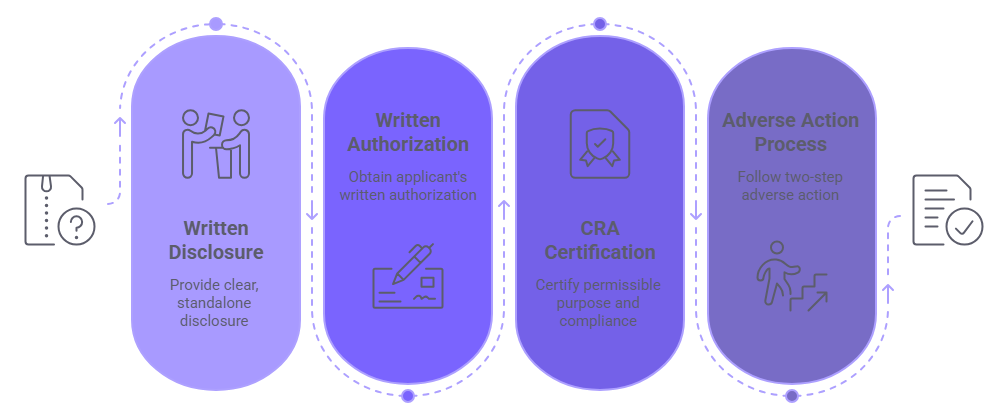
- Provide a clear, standalone written disclosure to the applicant before obtaining the report.
- Obtain the applicant’s written authorization before contacting the CRA.
- Certify to the CRA that the employer has a permissible purpose and will comply with FCRA requirements.
- Follow a two-step adverse action process if the report is a factor in a decision not to hire.
Construction employers frequently assume that state licensing requirements or OSHA site access rules govern their background check obligations. They do not. Those frameworks operate alongside FCRA, not instead of it. An employer who satisfies a federal site access requirement but skips the FCRA disclosure has violated FCRA regardless of whether the site access check was valid.
W-2 Employees vs. Subcontractors vs. Union Referrals: How Screening Obligations Differ
W-2 Employees and Direct Hires
For direct W-2 hires, FCRA obligations apply in full. The employer must provide the standalone disclosure, obtain written authorization, certify to the CRA, and complete the adverse action process if a finding affects the hire. This applies to laborers, equipment operators, foremen, and any other employee classification. A laborer hired for a three-month infrastructure project carries the same FCRA protections as a permanent employee under the statute’s standard interpretation. The temporary or seasonal nature of a hire does not reduce the employer’s obligations for arrangements that constitute employment under FCRA. Construction employers who use very short-term or day-hire arrangements should confirm with qualified legal counsel whether those specific arrangements fall within FCRA’s employment definition.
Independent Subcontractors
The FCRA classification of subcontractors depends on the nature of the relationship and how the screening is structured. Whether FCRA applies depends on whether the report is CRA-sourced, whether it informs an employment-related decision, and whether the screened individual qualifies as a consumer under the statute. These determinations are fact-specific. The employer cannot avoid FCRA obligations simply by classifying a worker as an independent contractor. For subcontracting entities rather than individual workers, the analysis differs. A GC that requires a subcontracting firm to provide evidence of its own screening program is not typically obtaining a consumer report on individuals within that firm. However, if the GC directly screens individual workers employed by a subcontractor, FCRA obligations may attach to the GC as the requesting party. Construction employers should confirm with qualified legal counsel whether their specific subcontractor screening practices fall within FCRA’s scope.
Union Hiring Hall Referrals
Union hiring hall referrals are among the most complex FCRA scenarios in construction. When a union dispatches a worker to a GC or contractor, the question of who is the employer for FCRA purposes depends on the structure of the union agreement, the nature of the work relationship, and who is making the employment decision. If the GC independently screens the referred worker through a CRA before accepting the referral, FCRA applies to that screening process regardless of any screening the union may have conducted. Union agreements may also contain provisions about consent requirements or information sharing that interact with FCRA obligations in ways that require careful review. Legal review of the applicable union agreement is the appropriate starting point for construction employers who regularly accept union hall referrals.
Construction hiring moves fast, but compliance gaps usually happen in the moments where speed overtakes process. In environments managing subcontractors, union referrals, seasonal crews, and project deadlines all at once, even small breakdowns in screening workflows can create significant risk. The strongest hiring programs are not the ones that move the fastest. They are the ones built to stay consistent even under pressure. Good process design is what turns compliance from a paperwork exercise into an operational standard. �
FCRA Disclosure and Authorization: What Construction Employers Must Get Right
The Standalone Disclosure Requirement
FCRA requires that the disclosure given to an applicant before a background check consist solely of the disclosure. No other content may appear in the same document. This is a statutory requirement under 15 U.S.C. Section 1681b(b)(2)(A), not a formatting guideline. Construction onboarding packets are typically dense, combining site safety acknowledgments, equipment use agreements, insurance forms, and employment paperwork into a single packet. This structure creates a systematic FCRA violation risk. The fix is straightforward: the FCRA disclosure must be a separate document, provided to the applicant before any CRA contact is made, and retained as an independent record.
Written Authorization and Timing
Written authorization must be obtained from the applicant before the employer contacts the CRA. The timing is specific: before contact, not concurrent with it, and not after. In fast-moving construction hiring where a site foreman may want a worker cleared within 24 hours of a job offer, the authorization step is sometimes treated as a formality completed after screening has already begun. That sequence violates FCRA regardless of the operational urgency. Authorization must precede CRA contact, and the employer must retain the signed authorization as a compliance record.
Job Site Access Requirements and Background Checks: Where OSHA and FCRA Intersect
Two Separate Frameworks Operating Simultaneously
OSHA site safety requirements, federal facility access protocols, and project-specific security clearances do not replace FCRA. They operate alongside it. A federal construction project may require that all workers pass a site access screening before beginning work. That requirement is driven by the contracting agency’s security protocols, not by FCRA. However, if the GC uses a CRA to run the background check that satisfies the site access requirement, FCRA applies to that screening transaction. Satisfying the access standard is not evidence of FCRA compliance. An employer who runs a site-required background check through a CRA without providing the standalone disclosure has violated FCRA even if the worker was cleared for site access.
Federal Contractor Screening and Davis-Bacon Projects
In most cases, a construction employer on a federal contract must comply with both the contracting agency’s requirements and FCRA independently. Neither satisfies the other when a CRA is involved in the employer’s screening process. Where the contracting agency conducts its own investigation using non-CRA resources, that investigation falls outside FCRA’s consumer report framework. The applicable scope depends on who is conducting the check and through what mechanism.
For projects involving classified facilities, critical infrastructure, or federal security zones, the access screening process may involve government-run background investigations that fall entirely outside the FCRA framework because no CRA is involved. Construction employers should confirm with qualified legal counsel and the contracting agency which screening components are government-conducted and which are employer-conducted through a CRA, so that FCRA obligations are correctly scoped.
Adverse Action Procedure for Construction Employers
The Two-Step Process
When a background check finding is a factor in a decision not to hire a construction worker, FCRA requires a specific two-step process before that decision is final. The sequence is non-negotiable and applies to every CRA-sourced report used in a hiring decision.
| Step | Action Required | Timing |
| Step 1: Pre-adverse action | Provide written notice to the applicant including a copy of the consumer report and the Summary of Rights Under the FCRA | Before any adverse decision is finalized |
| Waiting period | Allow the applicant to review the report and dispute inaccurate information | Generally at least 5 business days per CFPB and FTC guidance |
| Step 2: Final adverse action | Provide a final notice identifying the CRA, stating the CRA did not make the decision, and informing the applicant of their dispute rights | After the waiting period elapses, if the employer proceeds |
Skipping the pre-adverse action step and issuing only a final notice does not satisfy the statute and generates FCRA liability regardless of whether the underlying hiring decision was correct. Willful violations, including systematic patterns of skipping required steps, may result in statutory damages per violation in addition to actual damages and attorney’s fees. Negligent violations may result in actual damages and attorney’s fees. Construction employers managing volume hiring should treat systematic process gaps as a higher-severity exposure category.
Construction-Specific Pressure on the Adverse Action Timeline
Construction projects have start dates. When a background check returns a finding close to a project start, employers face pressure to move faster than the five-business-day waiting period allows. The waiting period is not negotiable. The operationally correct approach is to initiate background checks early enough in the hiring timeline that the waiting period does not fall on the critical path to a project start date. For rapid crew buildups in response to contract awards or weather windows, this requires a standing process that begins screening before the final crew is selected, not after.
Documentation and Retention
Every step in the adverse action process must be documented and retained. The employer must keep the pre-adverse action notice, proof of delivery, the waiting period record, and the final adverse action notice for each adverse decision. Many construction employer programs execute the adverse action steps correctly but do not retain the documentation. That gap creates an inability to demonstrate compliance when challenged. Documentation retention must be built into the program design from the start.
Individualized Assessment and Construction Hiring
When Criminal History Can and Cannot Disqualify
A construction employer who applies a blanket policy disqualifying all applicants with felony records, without documented individualized assessment, is exposed to EEOC disparate impact liability. EEOC guidance has historically identified three core assessment factors:
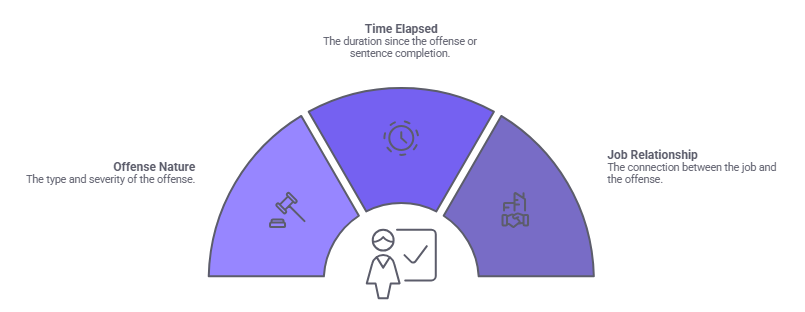
- The nature and gravity of the offense.
- The time elapsed since the offense or completion of sentence.
- The nature of the job and its relationship to the offense.
The specific guidance documents addressing these factors have been subject to revision and administrative change. Construction employers should therefore confirm the current operative framework with qualified legal counsel. The underlying Title VII obligation to conduct individual review remains in force regardless of the status of any specific agency guidance.
In construction, the nexus between specific offense types and specific roles is often relevant and legally defensible. A theft conviction on a project involving high-value materials and minimal supervision has a clear relationship to the role. A non-work-related offense from a decade ago, assessed against a general labor role, requires individualized analysis rather than automatic rejection. Worker safety, site security, and the nature of the specific work environment are all legitimate individualized assessment factors in the construction context.
Ban-the-Box in Construction Jurisdictions
Several states and municipalities have enacted ban-the-box or fair chance hiring laws that restrict when construction employers may inquire into criminal history. Most restrict inquiry to the post-conditional-offer stage. Some apply to all employers in the jurisdiction, while others exempt certain employer sizes or role types. Federal contractor obligations and union agreements add further complexity in some jurisdictions. Construction employers operating across multiple states or municipalities should confirm the applicable ban-the-box requirements in each hiring jurisdiction with qualified legal counsel, as these requirements are independent of FCRA and vary materially across locations.
High-Volume and Seasonal Construction Hiring: Staying FCRA-Compliant at Scale
Where Volume Creates Breakdown Points
Construction hiring surges, including spring and summer project ramp-ups, disaster response crew deployments, and large infrastructure contract mobilizations, create conditions where FCRA compliance breaks down not because employers do not know the rules but because the process was not designed for volume. A site foreman onboarding 40 laborers in a week under project superintendent pressure is not operating in the same environment as a single-hire HR process. The most common breakdown points under volume are as follows:
- The standalone disclosure step, where documents get bundled under time pressure.
- The authorization timing, where screening begins before written consent is collected.
- The adverse action waiting period, where project start dates compress the review timeline.
Each breakdown point is preventable through process design, not through additional legal knowledge.
Process Design for Volume
The construction employer’s FCRA compliance program must produce consistent outcomes at peak volume, not just under normal conditions. This requires pre-built disclosure and authorization documents ready to deploy before a hiring surge begins, a screening initiation workflow that handles parallel processing without compressing authorization timing, an adverse action tracking system that monitors waiting periods automatically rather than manually, and a designated compliance owner with authority to hold a start date when the adverse action process requires it. A compliance program that works for five hires per month but breaks down at fifty is not a compliant program at the scale the business actually operates.
Common FCRA Compliance Gaps in Construction: What Audits and Litigation Reveal
The Most Frequent Failure Modes
Construction employer FCRA programs fail in recognizable patterns. The table below maps the most common failure modes, their severity, and the construction-specific driver behind each.
| Failure Mode | Severity | Construction-Specific Driver |
| Standalone disclosure bundled with safety orientation or onboarding packet | High | Construction onboarding is document-heavy. Bundling is the default without explicit process controls. |
| Pre-adverse action notice skipped or compressed under project start pressure | High | Project timelines create urgency that overrides procedural steps when no system enforcement exists. |
| Subcontractors screened by GC without FCRA disclosure or authorization | High | GCs assume subcontractor classification removes FCRA obligation. It often does not. |
| Union referrals screened without consent framework aligned to the union agreement | Medium | Union agreement terms are not reviewed against FCRA requirements. Consent assumptions go unverified. |
| Adverse action documentation not retained after the hire decision is made | Medium | Construction HR teams treat adverse action as a decision, not a documented process with a retention obligation. |
| Seasonal crew hiring triggers no individualized assessment for criminal findings | High | Volume and speed produce blanket-policy application without documented review. |
Each failure mode is correctable through process redesign. Identifying and fixing them before a complaint or litigation event costs a fraction of the defense and settlement cost after.
Negligent Hiring and FCRA: Two Separate Exposures
Construction employers sometimes conflate FCRA compliance with negligent hiring liability. These are separate legal frameworks with separate requirements. FCRA governs the procedural process of obtaining and using consumer reports. Negligent hiring is a tort claim arising from an employer’s failure to exercise reasonable care in screening a worker who later causes harm to a third party or, in some circumstances, a co-worker. The availability of negligent hiring claims in the construction context varies by state, including how workers’ compensation exclusivity rules interact with tort liability. A construction employer can be FCRA-compliant and still face a negligent hiring claim if it failed to screen a worker at all, or screened inadequately for the role’s risk profile. Both risks must be managed independently, and construction employers should confirm the applicable negligent hiring exposure in each operating state with qualified legal counsel.
Conclusion
FCRA compliance for construction employers is a process design challenge, not a legal formality. The mixed-workforce structure of construction hiring, combining direct hires, subcontractors, union referrals, and seasonal crews, creates multiple FCRA obligation points that a single-employer model does not capture. Federal site access requirements, project timelines, and volume hiring pressures create specific breakdown points that generic FCRA guides never address. Construction employers who build their screening programs around the operational realities of their hiring environment, and who verify their approach with qualified legal counsel, are in a substantially stronger compliance position than those who apply a general employer FCRA checklist to a structurally distinct workforce.
Frequently Asked Questions
The following questions that are often asked focus on some of the common compliance and screening issues that arise in connection with construction employment. In light of the fact that construction hiring often requires a rapid process and numerous considerations, it is imperative to understand how FCRA requirements would apply. The following answers are intended to help create consistent hiring practices.
Do construction companies have to do background checks on employees?
No federal law requires construction employers to conduct background checks on all employees. However, specific project types, including federal contracts and secure facility projects, may require site access screening as a condition of work. When a construction employer uses a consumer reporting agency to conduct background checks, FCRA governs the process. State and local laws may impose additional requirements depending on the jurisdiction.
Does FCRA apply to subcontractors in construction?
FCRA applies when a construction employer uses a consumer reporting agency to obtain a background check on an individual for an employment-related purpose. Classifying a worker as an independent subcontractor does not automatically remove the FCRA obligation if the GC is directly screening that individual through a CRA. Whether FCRA applies is a fact-specific determination. Construction employers should confirm the applicable scope with qualified legal counsel.
Can a construction company deny employment based on criminal history?
Yes, but not automatically and not without process. FCRA requires a two-step adverse action process before a hiring decision based on a background check is finalized. EEOC guidance and many state fair chance laws require individualized assessment of the specific offense against the specific role before adverse action is taken. Blanket disqualification policies create both FCRA process liability and EEOC disparate impact exposure.
What background checks are required for federal construction projects?
Federal construction contracts and secure facility projects may require site access screening as a condition of the contract. These requirements are set by the contracting agency and are separate from FCRA. When the employer uses a CRA to satisfy the access screening requirement, FCRA applies to the transaction. Requirements vary by project, agency, and security classification.
How long does a background check take for construction workers?
Turnaround time depends on the scope of the check and the jurisdictions involved. Criminal checks requiring county court searches may take 24 to 72 hours under normal conditions. Under FCRA, the employer must allow a waiting period of generally at least five business days after the pre-adverse action notice before finalizing an adverse decision.
Are union workers subject to FCRA background checks?
FCRA applies when a construction employer uses a CRA to screen a worker, including union referrals, for an employment-related decision. The union’s own screening process does not satisfy the employer’s FCRA obligations. When a GC independently screens a union-referred worker through a CRA, the full FCRA disclosure, authorization, and adverse action process applies.
What is an adverse action notice in construction hiring?
An adverse action notice is a required FCRA communication to an applicant whose background check results were a factor in a decision not to hire. FCRA requires a two-step process: a pre-adverse action notice before the decision is finalized, a waiting period of generally at least five business days, and then a final adverse action notice if the employer proceeds. Both steps are mandatory.
What is a construction hiring compliance checklist for FCRA?
A basic FCRA compliance checklist for construction employers should include: standalone disclosure provided before CRA contact, written authorization before ordering the check, CRA certification confirming permissible purpose, pre-adverse action notice with report and federal Summary of Rights attached, a waiting period of generally at least five business days, documented individualized assessment for criminal findings, final adverse action notice if proceeding, and retention of all adverse action records. Several states impose additional notice content or delivery requirements that exceed the federal FCRA floor. Employers should confirm state-specific obligations with qualified legal counsel for each hiring jurisdiction.
Additional Resources
- FTC: Using Consumer Reports for Employment Purposes
https://www.ftc.gov/business-guidance/resources/using-consumer-reports-employment-purposes - CFPB: A Summary of Your Rights Under the Fair Credit Reporting Act
https://www.consumerfinance.gov/consumer-tools/credit-reports-and-scores/consumer-reporting-companies/fcra-summary-of-rights/ - EEOC: Employment Practices Guidance and Resources
https://www.eeoc.gov/laws/guidance - U.S. Department of Labor: Davis-Bacon and Related Acts
https://www.dol.gov/agencies/whd/government-contracts/construction - OSHA: Construction Industry Standards
https://www.osha.gov/construction - 15 U.S.C. Section 1681: Fair Credit Reporting Act Full Text
https://www.govinfo.gov/content/pkg/USCODE-2022-title15/pdf/USCODE-2022-title15-chap41-subchapIII.pdf

ABOUT THE CREATOR
Charm Paz, CHRP
Recruiter & Editor
Charm Paz is an HR professional at GCheck, specializing in background screening, fair hiring, and regulatory compliance. She holds from the Professional Background Screening Association (PBSA) and helps organizations navigate employment regulations with clarity and confidence.
With a background in Industrial and Organizational Psychology, she translates policy into practice to build ethical, compliant, human-centered hiring systems that strengthen decision-making over time.