


Manufacturing employers face a screening compliance environment shaped by workforce complexity, subsector regulation, and high-volume hiring pressure. This guide provides HR professionals, operations managers, and staffing coordinators with a structured, legally grounded framework for building or auditing a defensible background check program across direct, contract, and temporary labor channels.
Key Takeaways
- Manufacturing industry background check requirements differ substantially by workforce type, subsector, and facility classification, and no single generic policy can address them all.
- Direct hires, temp workers, and contractors each carry distinct screening obligations, and written agreements must explicitly address co-employer risk with staffing agencies.
- Regulated subsectors, including aerospace, food processing, pharmaceutical manufacturing, and defense contracting, each impose compliance layers that go beyond standard pre-employment screening.
- A standard manufacturing background check program typically includes criminal history, employment verification, identity confirmation, drug screening, and, where applicable, sanctions and watchlist checks.
- FCRA adverse action procedures are the most common compliance failure point in high-volume hourly hiring environments, and HR teams must follow them in sequence without shortcuts.
- Ban-the-box ordinances and individualized assessment requirements now apply in a growing number of states and municipalities, affecting multi-facility employers significantly.
- Screening turnaround time and hiring velocity are operationally linked, so policy design must account for both without sacrificing legal defensibility.
- HR teams should conduct a background check policy audit at minimum annually, and again following any significant change in workforce structure, labor law, or facility classification.
Why Manufacturing Requires a Differentiated Screening Approach
Background checks for manufacturing environments are not interchangeable with standard office-sector hiring screens. The workforce is more diverse in structure, and the regulatory exposure is more varied by facility type. Moreover, the operational stakes, including safety incidents, product integrity, regulatory inspections, and union contract compliance, create a liability profile that generic screening programs cannot address.
The Workforce Is Structurally Different
Manufacturing employers routinely operate with a mix of full-time direct employees, part-time hourly workers, seasonal labor, independent contractors, and workers placed through staffing agencies. Each category may carry different legal screening obligations, different contractual relationships, and different risk profiles. Specifically, role type, access level, and facility classification all influence which obligations apply.
An HR generalist who applies a single background check template across all worker types is not just being inefficient. That approach may expose the organization to legal liability, fail to meet contractual screening obligations, or apply screening more invasively than is legally defensible for a given classification.
The Risk Exposure Is Higher
Physical access to production equipment, chemicals, controlled materials, and sensitive supply chain assets creates a safety and liability exposure that most other employment categories do not share. A failure in the screening process can contribute directly to workplace injury, product contamination, or regulatory action. In certain subsectors, that failure can also carry national security implications. These stakes simply do not exist in most general office hiring contexts.
The Hiring Volume Compounds Compliance Risk
High-volume, fast-cycle hiring is common in manufacturing, particularly in food processing, consumer goods, and logistics-adjacent facilities. Operational pressure to fill roles quickly creates conditions where FCRA procedures get abbreviated, adverse action steps get skipped, or policies get applied inconsistently across cohorts. Importantly, volume does not reduce the legal obligation. Instead, it increases organizational exposure when those obligations go unmet.
One thing I have learned in HR is that manufacturing hiring cannot always follow the same screening approach used in typical office environments. The reason for this is that some factors in the manufacturing environment could be quite different from those in a regular office setting. To me, the strongest manufacturing teams are the ones that build screening programs around real operational realities instead of relying on one standard process for every role. �
Workforce Classification and Screening Obligation Mapping
One of the most underserved areas in manufacturing HR practice is the mapping of screening obligations to worker classification. The assumption that a staffing agency handles all screening for placed workers, or that independent contractors fall outside the employer’s screening authority, is a structural misconception. Consequently, it creates real compliance gaps.
Direct Employees
For workers hired directly onto the employer’s payroll, the hiring organization serves as the consumer of the background check report under the Fair Credit Reporting Act. As a result, the employer carries the full set of FCRA obligations: permissible purpose, written authorization, pre-adverse action notice, adverse action notice, and provision of the consumer report and summary of rights at the appropriate procedural steps. Employers cannot delegate these obligations to a third-party vendor and consider them discharged. Legal accountability for how the report influences the hiring decision stays with the employer.
Temporary and Staffing Agency Workers
When workers arrive through a staffing agency, the written contract between the agency and the employer must resolve the question of who owns the background check, and who bears legal responsibility if something goes wrong. Verbal understandings or informal expectations are not enforceable and do not transfer liability. Furthermore, if the client employer holds site-specific or role-specific screening standards that differ from the agency’s default program, those standards must appear explicitly in the staffing agreement.
Manufacturing employers should also consider whether a co-employment relationship affects their FCRA obligations. Where co-employment exists, both the agency and the client employer may carry independent obligations under federal and applicable state law. Legal counsel should review any arrangement where this relationship is ambiguous.
Contractors and Vendors with Facility Access
Independent contractors and vendor personnel who access manufacturing facilities present a distinct screening consideration, particularly those who enter production areas, handle chemicals, use data systems, or work with controlled materials. Their employer or contracting entity may have conducted their screening. However, manufacturers cannot obtain a consumer report on a third-party contractor’s employee without a permissible purpose. Additionally, where the report connects to employment, the individual’s written authorization is required. Therefore, facility access standards belong in vendor agreements as contractual requirements, not in a direct screening process aimed at contractor personnel.
Regulatory Context by Subsector
Pre-employment screening programs in manufacturing do not exist in a regulatory vacuum. Specific subsectors face federal oversight regimes that impose additional requirements beyond what FCRA and EEOC guidance address. Treating all manufacturing environments as equivalent is both a credibility and a compliance failure.
| Subsector | Key Regulatory Overlay | Screening Implication |
| Defense and Aerospace | ITAR (International Traffic in Arms Regulations) | Citizenship and immigration status verification for roles involving covered technical data or hardware; alignment with security clearance processes |
| Food Processing | FDA / Food Safety Modernization Act | Enhanced screening as part of food defense programs; drug testing common for direct product-contact roles |
| Pharmaceutical and Chemical | DEA registration, OSHA PSM, OIG exclusions | Sanctions and exclusions checks against federal databases, including the OIG LEIE, for facilities supplying federally funded programs |
| Transportation-Adjacent / Distribution | DOT 49 CFR Part 40 | Mandatory drug and alcohol testing for roles that trigger DOT jurisdiction; distinct from a general employer drug testing policy |
Employers should confirm which regulatory frameworks govern their specific facility and role types before finalizing their screening program. Requirements in one subsector do not transfer automatically to another. Moreover, misapplying a more restrictive standard without legal basis can itself create liability exposure.
Standard Components of a Manufacturing Background Check
A well-designed background check for manufacturing employees draws from several screening components. The applicable components depend on the facility type, the worker’s access level, applicable federal or state requirements, and the employer’s written policy.
| Screening Component | Applies To | Required vs. Standard |
| Criminal History | All direct hires; most contractor and temp roles | Industry-standard; legally required in some subsectors |
| Employment Verification | All roles where prior experience is relevant to qualification | Industry-standard |
| Identity Verification / I-9 | All employees (federal requirement) | Legally required |
| Drug Screening | Safety-sensitive roles; DOT-regulated roles | Required (DOT); industry-standard (others) |
| Sanctions / Watchlist Checks | Pharma, defense, federally adjacent roles | Required in regulated contexts; optional elsewhere |
Employers should document which components apply to which role categories in their written policy, along with the rationale for each decision. Inconsistent application across similarly situated roles creates EEOC and FCRA exposure. By contrast, a documented, role-based rationale serves as a meaningful legal defense.
Criminal History Screening
Under EEOC guidance on criminal history and Title VII, blanket exclusion policies based on criminal records carry significant enforcement risk. The EEOC’s position is that employers should conduct individualized assessments. Specifically, those assessments should consider the nature of the offense, the time elapsed, and the nature of the role. Employers should consult legal counsel regarding how courts in their jurisdiction have treated this guidance, and how it intersects with any applicable state or local law.
Identity Verification and I-9 Compliance
Identity verification is a component of onboarding compliance that is separate from, but related to, background screening. Federal Form I-9 requirements apply to all employers, and staff must complete the form within the timeframe the law specifies. Some employers also use E-Verify as an additional work authorization tool. Its use is mandatory for federal contractors and in certain states. Importantly, employers who enroll in E-Verify take on specific compliance obligations under the program’s terms and must apply it consistently. Enrollment and usage requirements warrant a review with counsel before implementation.
Sanctions and Watchlist Checks
Sanctions and exclusions databases, including the OIG List of Excluded Individuals and Entities and the OFAC Specially Designated Nationals list, may be relevant for certain regulated subsectors. These checks generally fall outside FCRA’s definition of a consumer report. As a result, they are not subject to the same authorization and adverse action procedures that govern standard background check components. Nevertheless, employers should confirm applicable legal requirements with counsel, since the broader screening program may still carry FCRA obligations for other components.
FCRA Compliance in High-Volume Hourly Hiring
The FCRA’s procedural requirements do not scale down for volume. They apply identically whether a facility hires one supervisor or one hundred seasonal line workers. In practice, high-volume manufacturing hiring environments are where FCRA adverse action procedures most often get truncated, misapplied, or skipped entirely.
The Adverse Action Sequence
When a background check report contains information the employer is considering as a basis for an adverse employment decision, FCRA requires a specific sequence:
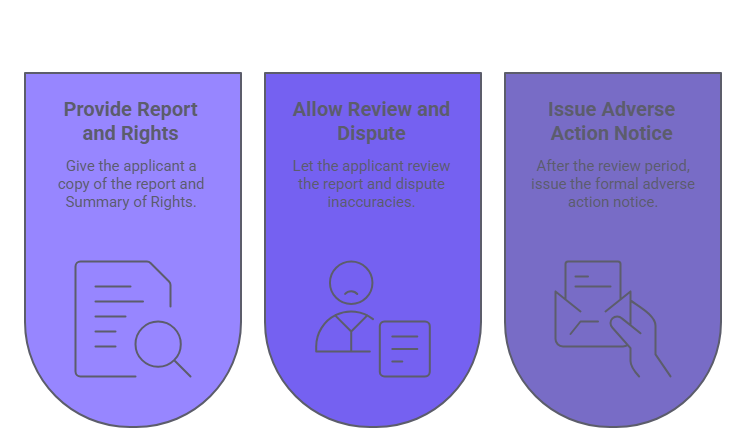
- First, provide the applicant with a copy of the report and a copy of the Summary of Rights under FCRA before taking any adverse action.
- Next, allow the applicant a reasonable period of time to review the report and dispute any inaccuracies. The FCRA does not specify a fixed number of days. What constitutes a reasonable period may vary by circumstance, so employers should consult legal counsel to establish a defensible standard for their hiring context.
- Finally, after that pre-adverse action period has elapsed without a successful dispute, issue the formal adverse action notice. That notice must include the name and contact information of the consumer reporting agency, a statement that the CRA did not make the hiring decision, and notice of the applicant’s right to obtain a free copy of the report and to dispute its accuracy.
Each step must occur in sequence. Collapsing or reversing the order, even inadvertently, creates legal exposure.
Common Failure Points in Manufacturing Contexts
In fast-paced hiring environments, recruiters most often skip or compress the pre-adverse action step. Under pressure to fill shifts, a recruiter may communicate a hiring decision before the FCRA process is complete, which constructively completes the adverse action before the applicant receives their rights. This risk grows when multiple supervisors or staffing coordinators manage the hiring workflow without training on the legal sequence. Therefore, employers should build the adverse action workflow into their applicant tracking system as a mandatory gate, not an optional step. Training for all personnel involved in the hiring decision is an operational requirement, not a best practice.
Ban-the-Box and State and Local Law Considerations
Manufacturing employers who operate in multiple states, or who hire from a geographically broad labor pool, face a patchwork of state and municipal laws governing when and how criminal history may factor into employment decisions. This complexity has grown consistently over the past decade and shows no sign of narrowing.
What Ban-the-Box Laws Require
Ban-the-box ordinances prohibit employers from asking about criminal history on a job application. Many also require that employers extend a conditional offer of employment before making any criminal history inquiry. Specific requirements vary substantially by jurisdiction. Consequently, a policy that complies in one state may create actionable liability in another. Multi-facility manufacturers must map their hiring practices against each jurisdiction in which they operate.
Individualized Assessment Requirements
A growing number of states and municipalities have enacted statutes that go beyond ban-the-box timing requirements. These laws mandate a structured individualized assessment when criminal history informs an adverse employment decision. Such assessments typically require consideration of the nature and gravity of the offense, the time elapsed since the offense or completion of sentence, and the nature of the job. Requirements vary by jurisdiction and change with some frequency. As a result, employers should confirm current obligations with qualified employment counsel for each jurisdiction in which they hire.
Turnaround Time, Operational Bottlenecks, and Hiring Velocity
Staffing agency background check responsibility often includes managing turnaround time expectations for client employers. For direct employers, the pressure to move quickly from offer to start date is a structural feature of manufacturing HR, particularly during seasonal or surge hiring periods.
Why Turnaround Time Creates Compliance Risk
When background check results are delayed, employers face a choice between holding the start date and allowing the candidate to begin work conditionally. Both options carry legal and operational risk. Starting a candidate before screening is complete may violate a written policy or a contractual obligation. Holding the start date, on the other hand, may cause the candidate to accept another offer. Employers who resolve this tension by waiving or abbreviating the screening process create a separate category of risk: inconsistent policy application. Inconsistency across similarly situated applicants creates EEOC exposure and FCRA liability.
Designing for Velocity Without Sacrificing Compliance
The most effective approach is to initiate screening as early in the hiring process as the jurisdiction’s ban-the-box requirements permit. Where a conditional offer must precede the background check inquiry, employers should extend the offer promptly and start screening immediately. The written policy should also define what happens if results do not arrive by the target start date. Specifically, it should address whether the candidate may begin in a role with restricted access while screening is pending, and under what documented conditions that is permissible. Counsel should review this framework before implementation, and HR teams should apply and audit it consistently.
Building or Auditing a Manufacturing Background Check Policy
A background check policy is not a static document. In manufacturing environments, workforce structure, regulatory obligations, and labor market conditions shift with some frequency. As a result, the policy requires active maintenance.
Elements of a Defensible Written Policy
A complete manufacturing background check policy should address each of the following:
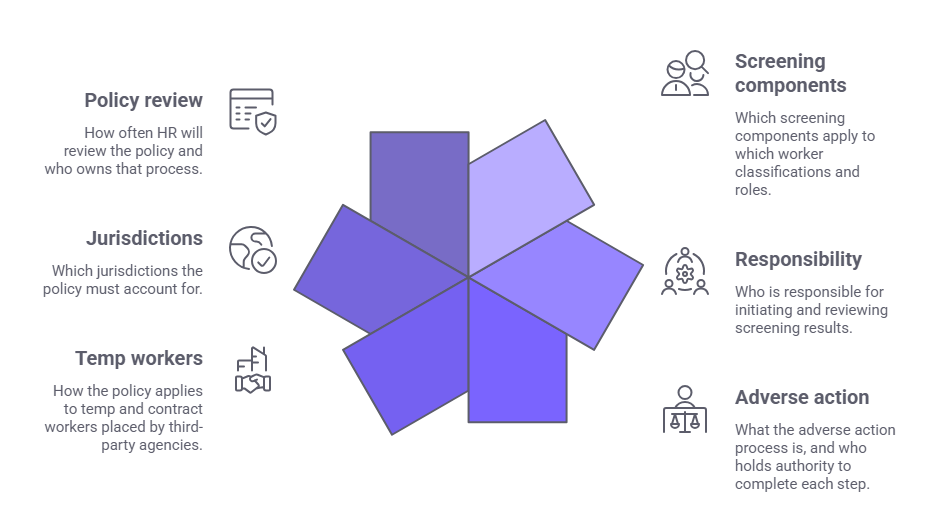
- Which screening components apply to which worker classifications and roles
- Who is responsible for initiating and reviewing screening results
- What the adverse action process is, and who holds authority to complete each step
- How the policy applies to temp and contract workers placed by third-party agencies
- Which jurisdictions the policy must account for
- How often HR will review the policy and who owns that process
The policy should also include a clear statement that it does not guarantee employment and does not supersede applicable law. Where state or local law offers applicants more protection than the employer’s policy, the law controls.
Audit Triggers and Review Cadence
HR teams should treat a background check policy audit as a scheduled operational activity, not a reactive one. Annual review is a reasonable baseline. Beyond that, additional review is warranted by geographic expansion into a new jurisdiction, a significant change in workforce mix, a workplace incident involving a screened worker, a change in applicable law, or a new contractual requirement from a client, insurer, or regulator. Audits should confirm that the written policy matches actual practice, that training records are current, that staffing agency agreements contain enforceable screening standards, and that adverse action documentation is complete and meets applicable recordkeeping requirements.
Common Mistakes and Misconceptions
Even experienced manufacturing HR professionals can operate on inherited assumptions that no longer hold, or that were never accurate. The following misconceptions represent the most consequential gaps in this sector.
Misconception: Drug Testing Substitutes for Criminal History Screening
Drug testing and criminal background screening are distinct processes with different legal frameworks, different consent requirements, and different risk functions. A drug test result does not reveal prior criminal history. Therefore, an employer who conducts drug testing but omits criminal history screening is not running a complete pre-employment screen. These components are not interchangeable, and a compliant program in most manufacturing environments will include both.
Misconception: The Staffing Agency Handles Everything
Staffing agencies may conduct their own background checks as part of their standard placement process. However, those checks do not automatically meet the employer’s legal, contractual, or operational standards. They only do so if the staffing agreement specifies those standards and the agency confirms compliance in writing. The client employer should not assume that the agency’s screening program is equivalent to their own. In practice, this assumption has led to significant liability exposure when incidents occur involving placed workers.
Misconception: All Roles in the Facility Require Identical Screening
Screening scope should reflect role-specific risk. A shipping and receiving associate, a production line operator, a maintenance technician with access to controlled chemicals, and a plant safety officer do not present identical risk profiles. Applying a more invasive screen to some roles than to others without a documented, role-based rationale can create EEOC exposure. Accordingly, the policy should define which screening components apply to which role categories and explain why.
Conclusion
Manufacturing industry background check requirements demand a program built around workforce classification, subsector regulation, and jurisdictional compliance, not a generic template applied at scale. The gap between common practice and a legally defensible program narrows through written policy, consistent application, and informed audit. This article is intended as educational guidance only and does not constitute legal advice. Employers should consult qualified employment counsel when designing or revising a screening program.
Frequently Asked Questions
What background checks are required for manufacturing employees?
No single federal law mandates specific background checks for all manufacturing employees. Required checks depend on the subsector, applicable regulations such as DOT or ITAR, the role’s access level, and state or local law. Employers should identify their regulatory profile before defining required screening components, rather than applying a uniform standard across all roles.
Who is responsible for background checks when using a staffing agency?
Responsibility depends on what the staffing agreement specifies. Staffing agencies typically conduct their own screening, but the client employer must ensure those checks meet their site-specific standards. Where co-employment exists, both parties may carry independent legal obligations. The contract, not an assumption, should define this allocation explicitly.
Do ban-the-box laws apply to manufacturing employers?
Yes, where applicable. Ban-the-box laws exist at the state and municipal level and prohibit employers from asking about criminal history before a specified point in the hiring process, typically before a conditional offer. Multi-facility manufacturers must map their hiring practices to each jurisdiction in which they operate, as requirements vary significantly.
What is the FCRA adverse action process and when does it apply?
The FCRA adverse action process applies whenever an employer takes a negative employment action based in whole or in part on a consumer background check report. It requires providing the applicant with the report and a Summary of Rights before the action, and a formal adverse action notice afterward. This process applies regardless of hiring volume and cannot be abbreviated due to operational urgency.
Does drug testing replace a criminal background check in manufacturing?
No. Drug testing and criminal history screening serve different risk management functions, operate under different legal frameworks, and require separate consent processes. They are not interchangeable. A complete pre-employment screening program in manufacturing typically includes both, though the specific components required depend on the role and applicable regulation.
How should manufacturers handle background checks for contractors and vendors?
Manufacturers cannot obtain a consumer report on a third-party contractor’s employee without a permissible purpose. Additionally, where the report connects to employment, the individual’s written authorization is required. Employers should place facility access standards in vendor agreements as contractual requirements and consult counsel when determining what screening obligations apply to non-employee facility access.
How often should a manufacturing background check policy be reviewed?
Annual review is a reasonable baseline. Additional reviews are warranted by expansion into new jurisdictions, a significant change in workforce composition, a workplace incident involving a screened worker, a change in applicable law, or a new contractual requirement from a client, insurer, or regulatory body.
What subsectors in manufacturing have the most complex screening requirements?
Defense and aerospace, pharmaceutical, food processing, and chemical manufacturing each carry regulatory overlays beyond standard FCRA and EEOC requirements. These include ITAR access restrictions, OIG exclusion checks, FDA-related food defense considerations, and DOT drug and alcohol testing for transportation-adjacent roles. Employers in these subsectors should confirm their screening program addresses both general employment law and applicable sector-specific obligations.
Additional Resources
- Fair Credit Reporting Act (Full Text)
https://www.ftc.gov/legal-library/browse/statutes/fair-credit-reporting-act - EEOC Enforcement Guidance on the Consideration of Arrest and Conviction Records in Employment Decisions
https://www.eeoc.gov/laws/guidance/enforcement-guidance-consideration-arrest-and-conviction-records-employment-decisions - DOT Drug and Alcohol Testing: 49 CFR Part 40
https://www.transportation.gov/odapc/part40 - OIG List of Excluded Individuals and Entities (LEIE)
https://oig.hhs.gov/exclusions/ - E-Verify Program (USCIS)
https://www.uscis.gov/e-verify - OFAC Specially Designated Nationals and Blocked Persons List
https://ofac.treasury.gov/specially-designated-nationals-and-blocked-persons-list-sdn-human-readable-lists - ITAR Overview (Directorate of Defense Trade Controls)
https://www.pmddtc.state.gov/ddtc_public?id=ddtc_public_portal_itar_landing

ABOUT THE CREATOR
Charm Paz, CHRP
Recruiter & Editor
Charm Paz is an HR professional at GCheck, specializing in background screening, fair hiring, and regulatory compliance. She holds from the Professional Background Screening Association (PBSA) and helps organizations navigate employment regulations with clarity and confidence.
With a background in Industrial and Organizational Psychology, she translates policy into practice to build ethical, compliant, human-centered hiring systems that strengthen decision-making over time.