

Security and PI firms operate under a compliance stack that most general-purpose ATS platforms were never designed to handle, and with 1.09 million security guards employed as of May 2024, the volume of hiring only amplifies the risk. We examine ten ATS platforms across the dimensions that matter most in this environment: integration model, FCRA workflow automation, multi-jurisdiction support, and credential verification capability. The results reveal a clear divide between platforms that reduce compliance risk at volume and those that quietly build liability with every hire.
Key Takeaways:
- The ATS integration model is the single most important compliance variable a security or PI firm controls. When screening operates outside the ATS through manual exports and separate portals, recruiters routinely skip required steps under volume pressure, turning individual oversights into systemic FCRA failures.
- FCRA compliance for security employers is a five-step sequence, and missing any single step is an independent violation. The sequence covers a standalone written disclosure, written candidate authorization, a pre-adverse action notice with the consumer report, a required waiting period, and a final adverse action notice.
- Over 150 jurisdictions prohibit asking about criminal history before a conditional offer, and state-level laws in places like California and New York City impose requirements that exceed federal FCRA. Multi-jurisdiction security firms cannot apply a single policy across all locations without creating systemic compliance exposure.
- No ATS score or native integration automatically ensures legal compliance on its own. Employers must verify through direct vendor engagement and qualified legal counsel that their specific platform setup covers the complete FCRA adverse action sequence and that multi-jurisdiction settings are configured by state, not assumed.
- For security and PI firms, the ATS is compliance infrastructure, not just a recruiting tool. Its integration model, FCRA workflow automation, and credential verification capability directly determine whether a high-volume hiring program stays within legal limits or builds liability with each hiring cycle.
ATS platforms best suited for background screening compliance in security services and private investigation hiring are those with native marketplace integrations, automated FCRA adverse action workflows, and multi-state credential support. In general, platforms built for staffing and high-volume hourly hiring consistently outperform general-purpose tools in this environment.
With 1.09 million security guards employed as of May 2024 (BLS SOC 33-9032), continuous high-volume hiring is the norm. Identity fraud and credential fraud are active risks in the sector. A guard hired on false credentials is a direct safety risk, which makes ATS-embedded screening a security must, not just an HR function.
Why Does Your ATS Choice Affect Background Check Compliance for Security Firms?
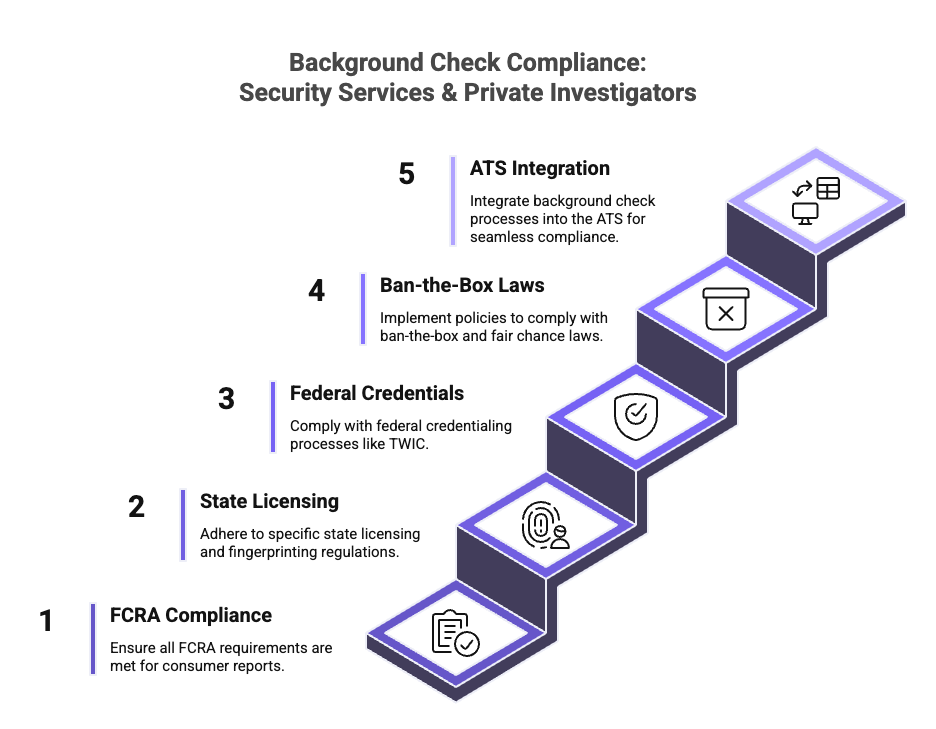
Your ATS determines whether your screening workflow meets FCRA requirements or creates legal exposure. When screening operates outside the ATS, recruiters skip steps under volume pressure. In addition, security and PI firms must manage a multi-layer compliance stack:
Layer 1: FCRA Employer Compliance requires: (1) a standalone written disclosure before obtaining a consumer report; (2) written candidate authorization; (3) a pre-adverse action notice with the consumer report copy and CFPB Summary of Rights; (4) a reasonable waiting period (generally no fewer than five business days); and (5) a final adverse action notice with CRA contact information. Missing any step is an independent FCRA violation.
Important: Individualized Assessment. Before acting on criminal history, employers must assess the nature and gravity of the offense, time elapsed, and the nature of the job. Blanket denial policies may constitute unlawful unequal impact under EEOC guidance. State and local fair chance laws in California, New York City, and New Jersey impose additional obligations. No ATS substitutes for a legally sound individualized assessment policy developed with qualified counsel.
Layer 2: State Licensing and Fingerprint Requirements. California BSIS, New York Department of State, Texas DPS, and Florida FDACS each impose distinct criminal history review timelines. These requirements operate alongside FCRA and fair chance obligations, not instead of them. Where they conflict, jurisdiction-specific legal guidance is required.
Layer 3: Federal Access Credentials. Positions requiring TWIC credentials (TSA) have their own criminal history review processes that operate separately from FCRA employer obligations.
Ban-the-Box and Fair Chance Law Compliance. Over 150 jurisdictions prohibit asking about criminal history before a conditional offer. The NYC Fair Chance Act and California AB 1008 impose requirements that exceed federal FCRA. As a result, multi-jurisdiction security firms cannot apply a single policy across all locations. Broken workflows make compliance failures systemic: forms get reused across jurisdictions, adverse action notices are sent late or not at all, and identity fraud goes undetected. The ATS integration model is, therefore, the primary variable employers control.
How Do You Choose an ATS With Strong Background Screening Capabilities?
Evaluate any ATS on its background screening integration model before any other feature. Three integration patterns determine compliance risk:
- Native marketplace or partner integration: Orders trigger from the candidate record and results return automatically. This is the lowest compliance risk. Note: native integration must still be set up correctly; it does not automatically ensure legal compliance.
- API or webhook integration: Requires technical setup but offers flexible connectivity. This is moderate risk, manageable with proper setup and IT support.
- Manual export and portal process: The recruiter exports data, logs into a separate CRA portal, and manually updates the ATS. This is the highest compliance risk at volume, since steps are routinely skipped.
Which ATS Platforms Rank Highest for Background Screening Compliance in Security Hiring?
1. Zoho Recruit
Integration Model: API/webhook with limited marketplace options.
Background Screening Features: Criminal check support via third-party CRAs; basic FCRA workflow (full adverse action automation not documented); multi-jurisdiction compliance not confirmed; identity verification, license/credential verification, and post-hire monitoring have no available data; basic audit trail.
Security Fit: Zoho Recruit handles moderate volume for mid-size firms at a competitive price point. However, it lacks documented depth for multi-state licensing or full FCRA adverse action automation. In that case, firms must manage the complete adverse action workflow and jurisdiction-specific requirements on their own.
2. Fountain
Integration Model: Native marketplace with documented CRA integrations.
Background Screening Features: Criminal check support via marketplace CRAs; FCRA disclosure and authorization workflows documented, but full adverse action automation not confirmed; multi-jurisdiction support partial; identity verification via partners (verify biometric privacy law compliance where applicable); license/credential verification and post-hire monitoring have no available data; workflow-level audit trail.
Security Fit: Fountain is purpose-built for high-volume hourly hiring and, therefore, a strong fit for contract and event security staffing surges. Credential verification for armed guard licensing is not documented. Firms must verify that the full FCRA adverse action sequence is automated or consistently managed.
3. Breezy HR
Integration Model: API/webhook; not a native marketplace.
Background Screening Features: Criminal check support via third-party integrations; FCRA workflow basic only; multi-jurisdiction compliance, identity verification, license/credential verification, and post-hire monitoring all not documented; basic audit trail.
Security Fit: Breezy HR is designed for SMBs with light hiring volume. In contrast, it lacks sufficient compliance tooling for multi-state security operations. Small PI firms with simple, low-volume hiring may find it adequate as a starting point only if all FCRA and state compliance requirements are managed separately.
4. Bullhorn
Integration Model: Native marketplace with documented staffing-industry CRA integrations.
Background Screening Features: Criminal check support via marketplace CRAs; FCRA workflow automation documented, though full adverse action step automation must be verified directly with Bullhorn; robust multi-jurisdiction compliance; identity verification via partners (verify biometric privacy compliance); partial credential tracking; post-hire monitoring not documented; strong audit trail.
Security Fit: Bullhorn is the dominant ATS in staffing and, as a result, well-suited for high-volume, multi-location security guard hiring. Firms must confirm through direct vendor engagement that the full FCRA adverse action sequence and state-specific workflows are properly set up.
5. Teamtailor
Integration Model: API/webhook; not a native marketplace.
Background Screening Features: Criminal check support via third-party integrations; FCRA adverse action automation not documented (compliance tooling reflects GDPR, not FCRA); U.S. multi-jurisdiction and ban-the-box support not confirmed; identity verification, license/credential verification, and post-hire monitoring not documented; GDPR-focused audit logging.
Security Fit: Teamtailor presents a major compliance gap for U.S. security firms. In particular, security operations with any multi-state footprint should evaluate alternative platforms. Firms that select Teamtailor must manage all FCRA and U.S. state and local compliance requirements on their own.
6. UKG Pro
Integration Model: Native marketplace with documented connections to multiple CRAs.
Background Screening Features: Criminal check support via multiple CRA integrations; strong FCRA adverse action workflow automation, disclosure management, and authorization tracking (verify pre-adverse notice delivery and waiting period setup directly with UKG); robust multi-jurisdiction compliance; identity verification via partners (verify biometric privacy compliance); partial credential tracking within the HCM suite; partial post-hire monitoring (legal counsel required before use); enterprise-grade audit trail.
Security Fit: UKG Pro is the strongest enterprise option for large security firms and executive protection providers. Furthermore, FCRA workflow automation and review audit features meaningfully reduce adverse action liability. Smaller firms, however, may find the setup cost too large for their scale.
7. Manatal
Integration Model: API/webhook; no native CRA marketplace documented.
Background Screening Features: Criminal check support via API only; FCRA compliance workflow, multi-jurisdiction compliance, identity verification, license/credential verification, and post-hire monitoring all not documented; basic audit trail.
Security Fit: Manatal is a general-purpose AI-powered ATS with among the thinnest screening options reviewed. As a result, security and PI firms with meaningful compliance complexity should not rely on Manatal as primary hiring infrastructure.
8. Avionté
Integration Model: Native marketplace built for staffing agencies with direct CRA integrations.
Background Screening Features: Criminal check support via native marketplace; staffing-industry adverse action sequencing documented (verify full pre-adverse notice and waiting period management directly with Avionté); partial multi-jurisdiction support; identity verification via partners (verify biometric privacy compliance); partial credential tracking; post-hire monitoring has no available data; strong staffing compliance audit trail.
Security Fit: Avionté is a strong option for security staffing agencies placing guards across multiple client sites. In staffing arrangements, FCRA obligations may apply to both the agency and the client employer; legal counsel should clarify duty allocation before use.
9. Recruitee
Integration Model: API/webhook; no native CRA marketplace documented.
Background Screening Features: Criminal check support via third-party integrations; FCRA compliance workflow, multi-jurisdiction compliance, identity verification, license/credential verification, and post-hire monitoring all not documented; basic audit trail.
Security Fit: Recruitee is a capable SMB ATS for general recruiting that lacks compliance depth for security or PI hiring. Private investigation firms with simple, low-volume hiring may find it functional as a starting point, only if the full FCRA adverse action sequence and all state requirements are managed outside the platform.
10. TalentReef
Integration Model: Native marketplace designed for the hourly workforce.
Background Screening Features: Criminal check support via native marketplace; hourly workforce FCRA disclosure and authorization workflows documented (verify pre-adverse notice delivery and waiting period management directly with TalentReef); partial multi-jurisdiction support; identity verification via partners (verify biometric privacy compliance); license/credential verification and post-hire monitoring have no available data; hourly compliance audit trail.
Security Fit: TalentReef is well-suited for contract security firms with high-volume, recurring guard hiring. Its hourly design translates directly to event and patrol staffing. However, armed guard credential verification is not documented, which limits its fit for firms with large armed programs.
Which ATS Platforms Should Security and PI Firms Prioritize for Background Screening Compliance?
UKG Pro (9/10), Bullhorn (8/10), and Fountain, Avionté, and TalentReef (each at 7/10) lead the field. UKG Pro delivers the most complete enterprise compliance setup; Bullhorn is strongest for staffing-model security operations; Fountain, Avionté, and TalentReef each serve distinct hiring profiles by firm size and model.
| ATS Platform | Score | Integration Model | FCRA Workflow Support | Multi-Jurisdiction / Credential | Best Fit For |
| UKG Pro | 9/10 | Native marketplace | Strong | Robust | Large enterprise security firms |
| Bullhorn | 8/10 | Native marketplace | Partial to strong | Robust | Contract security and staffing |
| Fountain | 7/10 | Native marketplace | Partial | Partial | High-volume hourly guard hiring |
| Avionté | 7/10 | Native marketplace | Partial to strong | Partial | Security staffing agencies |
| TalentReef | 7/10 | Native marketplace | Partial to strong | Partial | Event and patrol security |
| Zoho Recruit | 5/10 | API/webhook | Basic | Partial | Small to mid-size firms |
| Breezy HR | 4/10 | API/webhook | Basic | Not documented | Very small PI firms |
| Teamtailor | 4/10 | API/webhook | Basic | Not documented | Not recommended for U.S. security |
| Manatal | 3/10 | API/webhook | Not documented | Not documented | Not recommended for security |
| Recruitee | 3/10 | API/webhook | Not documented | Not documented | Not recommended for security |
The top-ranked platforms share one key advantage: native marketplace integration removes the manual export step that causes FCRA failures at volume. No ATS score alone ensures legal compliance, however. Employers must verify through direct vendor engagement that their specific setup covers the complete FCRA adverse action sequence, and that multi-jurisdiction settings are configured by state, not assumed. Firms considering post-hire monitoring must, in addition, involve legal counsel before use to address FCRA permissible purpose requirements and jurisdiction-specific arrest record restrictions.
The Bottom Line: Background Check Compliance in Security Hiring Starts With the Right ATS and the Right Legal Foundation
For security and PI firms, the ATS is compliance infrastructure. Its integration model, FCRA workflow automation, and credential verification ability directly determine whether a high-volume hiring program stays within legal limits or builds up liability with each hiring cycle. To that end, evaluate any ATS on its screening integration model first, before careers page design, reporting dashboards, or candidate experience features. Then verify through direct vendor engagement and qualified legal counsel that the platform’s setup reflects the full compliance requirements of every jurisdiction in which you hire. The ATS is the tool. The legal framework is the guardrail. Both are required.
Disclaimer: This article is for informational purposes only and does not constitute legal advice. Background screening compliance requirements vary significantly by jurisdiction and are subject to change. Employers should consult qualified employment law counsel before implementing or modifying background screening programs. Background Screening Ecosystem Scores are editorial assessments based on publicly documented platform features as of the date of publication. They are not regulatory certifications, legal compliance certifications, or audit results. Readers must independently verify current platform features and compliance capabilities directly with vendors.
References
- U.S. Bureau of Labor Statistics, Occupational Employment and Wage Statistics, Security Guards (SOC 33-9032), May 2024 — https://www.bls.gov/oes/current/oes339032.htm
- U.S. Bureau of Labor Statistics, Occupational Employment and Wage Statistics, Private Detectives and Investigators (SOC 33-9021), May 2024 — https://www.bls.gov/oes/current/oes339021.htm
- Federal Trade Commission, Using Consumer Reports: What Employers Need to Know — https://www.ftc.gov/business-guidance/resources/using-consumer-reports-what-employers-need-know
- Transportation Security Administration, TWIC Program — https://www.tsa.gov/for-industry/twic
- New York City Commission on Human Rights, Fair Chance Act — https://www.nyc.gov/site/cchr/law/fair-chance-act.page
- Fair Credit Reporting Act, 15 U.S.C. § 1681 et seq. —https://www.ftc.gov/legal-library/browse/statutes/fair-credit-reporting-act

ABOUT THE CREATOR
Charm Paz, CHRP
Recruiter & Editor
Charm Paz is an HR professional at GCheck, specializing in background screening, fair hiring, and regulatory compliance. She holds from the Professional Background Screening Association (PBSA) and helps organizations navigate employment regulations with clarity and confidence.
With a background in Industrial and Organizational Psychology, she translates policy into practice to build ethical, compliant, human-centered hiring systems that strengthen decision-making over time.