


Special education settings require enhanced screening protocols that extend beyond standard K-12 background checks due to heightened duty of care obligations for vulnerable populations. Administrators must navigate complex intersections of federal law, state-specific registry requirements, and role-based credential verification while maintaining ADA compliance throughout the screening process.
Key Takeaways
- Special education screening requirements often exceed general education standards due to increased vulnerability of the student population and corresponding legal obligations.
- Federal frameworks including IDEA, FCRA, and ADA create overlapping compliance requirements that must be reconciled during screening program design.
- State licensing boards frequently mandate child abuse registry checks, vulnerable adult registry checks, and enhanced criminal background verification for special education personnel.
- Role-specific screening protocols vary significantly across certified teachers, paraprofessionals, therapy providers, behavioral staff, and personal care assistants.
- Child abuse and neglect registry checks represent a distinct requirement separate from criminal background checks in most jurisdictions.
- ADA compliance requires individualized assessment of criminal history rather than categorical disqualification policies, particularly when screening staff who serve individuals with disabilities.
- Contracted service providers require verification that their employing agency has completed compliant screening rather than assumption of adequate vetting.
- Documented screening policies with role-specific matrices and annual review cycles provide essential protection during audits and licensing reviews.
Understanding Special Education Settings and Their Screening Obligations
The term “special education setting” encompasses diverse educational environments serving students with disabilities under the Individuals with Disabilities Education Act (IDEA). These include public school special education programs, specialized private schools, alternative education facilities, residential treatment centers with educational components, educational cooperatives, therapy centers providing school-based services, and transition programs for students aged 18-21.
Each environment carries distinct regulatory obligations that affect special education school screening requirements. Public school programs operate under state education agency oversight and must comply with both general education screening mandates and additional requirements specific to special education personnel. Private specialized schools may hold separate licensure from therapeutic or residential facility licenses, each carrying independent screening standards. Residential facilities often fall under dual jurisdiction of education and health or social services agencies, creating layered compliance requirements.
Determining Applicability of Enhanced Requirements
Enhanced background checks for special education staff typically apply based on three factors:
- The licensure category of the facility
- The documented vulnerability level of the student population
- The degree of unsupervised access staff have to students
Programs serving students with significant cognitive disabilities, limited verbal communication abilities, or intensive behavioral or medical needs generally face heightened screening expectations from licensing authorities and liability insurers.
The employment relationship also affects screening obligations. Direct employees clearly fall under the employer’s screening policy. Contracted service providers, including occupational therapists, speech-language pathologists, and behavioral analysts employed by external agencies, present more complex scenarios. The educational entity retains responsibility for verifying that contracted providers have undergone screening equivalent to what would be required for direct employees.
Volunteers and student teachers working in special education settings typically require the same criminal background and registry checks as paid employees, though some states permit abbreviated processes for short-term observers with continuous direct supervision.
In my experience, hiring in sensitive environments requires more than just completing a checklist. It’s a matter of really understanding how all of these different levels of compliance, from federal down to state, really interact with each other. I have come to understand that good HR departments don’t just focus on one kind of check; they consider the whole picture, including the level of risk associated with the role and the level of care that’s needed for the people they’re serving. The key is to be consistent, to ask better questions, and to make sure we’re being intentional in all we do. When we do this, we’re not just meeting compliance; we’re creating a safer and more trustworthy environment. �
The Legal Foundation: Why Special Education Screening Standards Differ
Courts and regulatory agencies apply a heightened duty of care standard when evaluating whether educational institutions adequately screened personnel working with vulnerable populations. This legal principle recognizes that students with certain disabilities may face increased risk of abuse or neglect and may have limited ability to report mistreatment or advocate for themselves.
| Legal Source | Screening Impact | Enforcement Mechanism |
| Negligent hiring case law | Evaluates screening adequacy based on foreseeability and vulnerability | Civil liability and damages |
| State education agency licensing standards | Sets minimum screening requirements for facility approval | License denial, suspension, or revocation |
| Accreditation requirements | Establishes screening expectations for specialized schools | Loss of accreditation status |
| Liability insurance policy conditions | Defines screening practices required for coverage | Denial of claims or policy cancellation |
The heightened duty of care creates corresponding obligations for employers. Standard screening protocols sufficient for general education settings may be deemed inadequate when applied to special education environments.
Negligent Hiring Liability in Special Education Contexts
Negligent hiring claims arise when an employee harms a student and the employer failed to conduct screening that would have revealed relevant risk factors. Courts evaluate whether the employer’s screening process was reasonable given the foreseeability of harm and the vulnerability of the population served.
Several factors influence whether a court will find screening adequate:
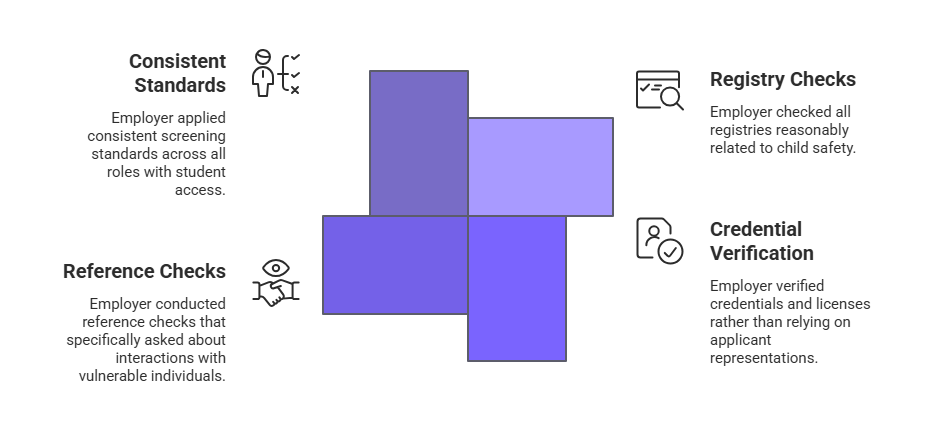
- Whether the employer checked all registries reasonably related to child safety
- Whether the employer verified credentials and licenses rather than relying on applicant representations
- Whether the employer conducted reference checks that specifically asked about interactions with vulnerable individuals
- Whether the employer applied consistent screening standards across all roles with student access
The consequences of inadequate screening extend beyond individual lawsuits. State licensing agencies may impose sanctions, probationary status, or license revocation for screening failures. Federal Office for Civil Rights investigations may examine screening policies as part of evaluating whether a school provides a safe environment required under IDEA.
Federal Regulatory Framework Governing Special Education Screening
Three federal statutes create overlapping obligations that administrators must reconcile when designing screening programs: the Individuals with Disabilities Education Act, the Fair Credit Reporting Act, and the Americans with Disabilities Act.
IDEA and Safe Educational Environments
IDEA requires states to ensure that children with disabilities receive a free appropriate public education in the least restrictive environment. While IDEA does not contain specific screening mandates, the statute’s requirement that schools provide educational benefit and maintain safe learning environments creates an implicit obligation to appropriately vet personnel.
State education agencies implementing IDEA have authority to establish screening requirements as part of their systems. Many states use this authority to mandate enhanced screening for personnel in approved special education programs, particularly residential placements and alternative settings.
FCRA Compliance in the Screening Process
The Fair Credit Reporting Act regulates how employers obtain and use consumer reports, including criminal background checks and other screening reports prepared by third-party consumer reporting agencies.
Required FCRA steps include:
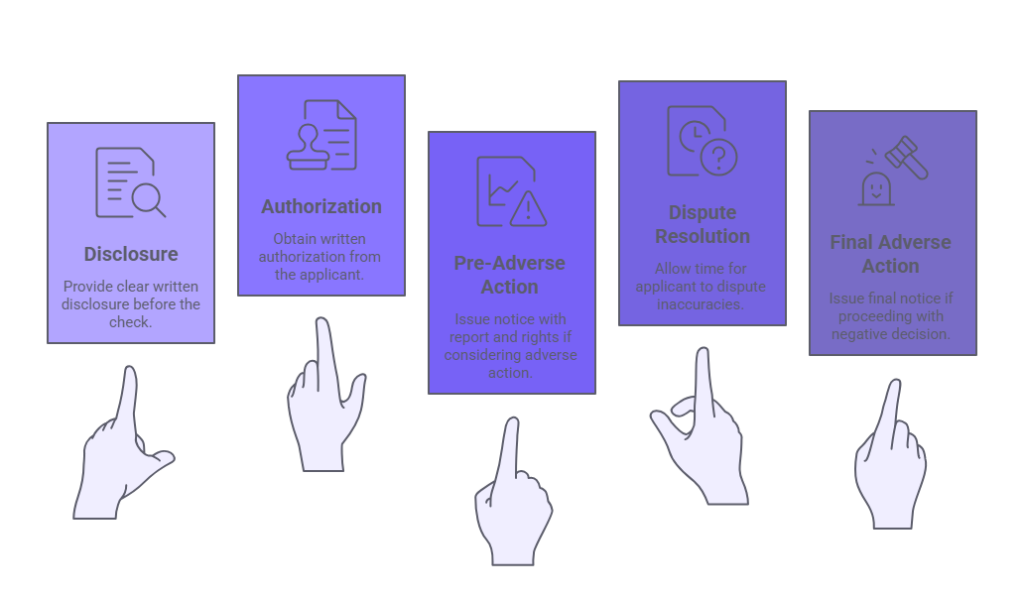
- Providing clear and conspicuous written disclosure in a standalone document before obtaining a background check
- Obtaining written authorization from the applicant
- Providing pre-adverse action notice including a copy of the report and Summary of Rights if adverse action is being considered
- Allowing reasonable time for the applicant to dispute inaccurate information
- Providing final adverse action notice if proceeding with the negative employment decision
If an employer intends to take adverse action based on information in a consumer report, the employer must provide the applicant with a copy of the report, a copy of the FTC’s Summary of Rights, and a reasonable opportunity to dispute inaccurate information before making a final decision. If the employer proceeds with the adverse action after allowing time for response, a final adverse action notice must be provided.
ADA Constraints on Using Screening Results
The Americans with Disabilities Act limits when and how employers can make disability-related inquiries and conduct medical examinations. Employers cannot ask applicants whether they have disabilities or require medical examinations before making a conditional job offer. Criminal background checks and registry checks are generally permissible pre-offer because they are not considered medical examinations.
After making a conditional offer, employers may ask disability-related questions and require medical examinations if they do so for all entering employees in the same job category. When evaluating criminal history or registry findings, ADA requires individualized assessment rather than categorical exclusions. Employers must consider the nature and gravity of the offense, the time elapsed since the offense or completion of sentence, and the nature of the job.
State-Level Variation in Special Education Screening Requirements
State requirements for background checks for special education staff vary significantly in scope, depth, and populations covered. Administrators operating in multiple states or hiring employees who work across state lines must identify applicable requirements for each jurisdiction.
Criminal Background Check Mandates
All states require criminal background checks for school employees, but the specific components vary:
| Check Component | State Variation |
| Geographic scope | In-state only vs. multi-state vs. national checks |
| FBI fingerprint requirement | Required for all positions vs. certain roles only vs. optional |
| Disqualifying offenses | Any felony vs. specific categories vs. individualized assessment |
| Lookback periods | Lifetime vs. 7-10 years vs. offense-specific timeframes |
| Arrest vs. conviction | Convictions only vs. pending charges included |
States vary in their requirements for criminal background checks. Administrators should consult their state education agency licensing division and applicable statutes to determine which framework applies in their jurisdiction.
Child Abuse and Neglect Registry Requirements
Child abuse and neglect registries are state-maintained databases of individuals who have been determined through administrative or judicial processes to have abused or neglected children. These registries exist separately from criminal background checks and often contain individuals with no criminal convictions.
Many states explicitly require child abuse registry checks for school employees, though the specific positions covered and the statutory frameworks vary significantly by jurisdiction. The process for obtaining registry checks varies substantially. Some states provide online portals where employers can submit requests and receive results electronically. Others require paper applications, notarized forms, or fingerprint cards. Processing times range from immediate to several weeks.
Interstate registry checks present challenges. Most state registries only contain records from that state. An applicant who lived in multiple states may appear clear in one registry but have findings in another. Thorough screening requires determining which states an applicant has lived in and requesting checks from each relevant jurisdiction.
Vulnerable Adult Abuse Registry Checks
Some states maintain separate registries of individuals found to have abused, neglected, or exploited vulnerable adults. Where special education programs are licensed as residential care facilities or provide services regulated under adult protective services statutes, vulnerable adult registry checks may be legally required. Programs serving students aged 18-21 should verify whether their licensing category triggers these requirements.
State-Specific Professional License Verification
Beyond criminal and registry checks, many states require verification that applicants hold valid, unencumbered professional licenses or certifications. For special education settings, verification typically includes teaching licenses with special education endorsements, paraprofessional certifications, therapy licenses, board certification for behavior analysts, and specialized credentials.
License verification confirms that the applicant meets minimum qualifications established by the state licensing board, reveals any disciplinary actions, restrictions, or conditions placed on the license, and identifies licenses that are expired, suspended, or revoked.
Enhanced Screening Components Beyond Standard Criminal Checks
Standard criminal background checks form the foundation of school screening programs, but special education school screening requirements often include additional components that address the specific vulnerabilities of the student population.
Child Abuse and Neglect Registry Checks as Distinct Requirements
Child abuse registries capture information that criminal background checks miss. Individuals may be listed on registries based on administrative findings by child protective services even if no criminal charges were filed. Most registries use a “preponderance of evidence” standard, meaning it is more likely than not that abuse occurred. This lower threshold captures individuals who pose risk but were not convicted due to insufficient evidence for the “beyond a reasonable doubt” criminal standard.
Registry check results may include pending investigations, indicated reports (credible evidence of abuse but not meeting substantiation thresholds), or substantiated reports (sufficient evidence to conclude abuse occurred).
Sex Offender Registry Verification
Sex offender registries provide publicly accessible information about individuals convicted of qualifying sex offenses. While sex offender registries are public, incorporating registry checks into formal screening processes ensures systematic verification.
| Registry Information | Screening Application |
| Current address and physical description | Identity confirmation |
| Photograph | Visual verification at interview |
| Offense details | Risk assessment relevance |
| Tier classification | Severity evaluation where available |
Many jurisdictions impose statutory prohibitions on employing individuals listed on sex offender registries in positions involving student contact. Where such statutory bars exist, they generally supersede individualized assessment requirements. Where disqualification is based on employer policy rather than statute, administrators should verify that policies comply with ADA individualized assessment requirements and any applicable fair chance hiring laws.
FBI Fingerprint-Based Background Checks
Fingerprint-based background checks query the FBI’s Integrated Automated Fingerprint Identification System, which contains criminal history records from federal agencies and participating state and local jurisdictions. These checks provide more accurate results than name-based checks because fingerprints definitively identify an individual.
Many states require fingerprint-based FBI checks for school employees, particularly those working in special education or with vulnerable populations. The completeness of FBI criminal history records depends on whether jurisdictions have reported offenses to federal databases. Reporting practices vary, and some older or minor offenses may not appear in national records.
Reference Checks with Vulnerability-Specific Inquiry
Reference checks provide qualitative information that criminal and registry checks cannot capture. Effective reference protocols include questions about the applicant’s experience managing behavioral challenges, ability to maintain appropriate boundaries with students, and patience when working with students who have communication difficulties.
Some states have enacted laws providing limited legal protections for employers who provide truthful, good-faith references about former employees. These protections vary by jurisdiction and typically require adherence to specific procedural requirements. Employers should consult legal counsel regarding applicable protections before providing detailed reference information.
Continuing Exclusion List and Medicaid Sanctions
For special education settings that bill Medicaid for services, verification against federal and state exclusion lists is necessary. The Department of Health and Human Services Office of Inspector General maintains the List of Excluded Individuals and Entities (LEIE), which includes individuals and entities excluded from participating in federal healthcare programs.
Schools must verify all applicable employees against the LEIE before hire and establish a reasonable periodic verification schedule during employment. Many compliance programs conduct monthly checks to minimize the period during which an excluded individual might deliver or supervise reimbursable services.
Role-Specific Screening Requirements in Special Education Settings
Different personnel categories within special education environments carry distinct screening requirements based on licensure, scope of practice, and student interaction levels.
Certified Special Education Teachers
Special education teachers require verification of teaching licenses with appropriate special education endorsements. License verification should confirm endorsement areas match the population the teacher will serve, no conditions or restrictions are placed on the license, and no previous disciplinary actions exist including reprimands, suspensions, or prior revocations in other states.
Paraprofessionals and Instructional Assistants
Paraprofessionals work under teacher supervision providing instructional support, behavioral assistance, personal care, and other direct services to students. Screening requirements for paraprofessional background check requirements typically mirror teacher requirements for criminal background and registry checks. The heightened vulnerability of students requiring paraprofessional support justifies equivalent screening depth despite different credential levels.
Related Service Providers: OTs, PTs, and SLPs
Occupational therapists, physical therapists, and speech-language pathologists providing services in special education settings must hold state professional licenses. Related service providers are frequently employed by contract agencies rather than directly by schools. This arrangement does not eliminate the school’s responsibility to verify adequate screening. Contracts with therapy agencies should include provisions requiring compliant background checks, registry verifications, and license confirmations.
Board Certified Behavior Analysts and Behavioral Support Staff
Behavior analysts work extensively with students with autism and other developmental disabilities. These professionals implement behavioral interventions that may include physical prompting, reinforcement systems, and response to challenging behaviors.
| Position | Credential Verification | Key Screening Focus |
| BCBA | BACB certification + state license where required | Disciplinary history, boundary maintenance |
| BCaBA | BACB certification + state license where required | Supervision compliance, professional conduct |
| RBT | BACB RBT certification | Direct student contact protocols |
Behavioral technicians or registered behavior technicians (RBTs) work under BCBA supervision implementing behavior intervention plans. These positions involve intensive direct contact with students and typically require the same criminal background and registry checks as paraprofessionals.
Personal Care Assistants and Nursing Staff
Students with significant medical needs or intensive personal care requirements may receive services from personal care assistants or nursing staff. Personal care assistants may be regulated under home health aide or personal care aide licensing systems administered by health or human services agencies. Screening requirements established by health agencies often exceed education sector standards.
Transportation Personnel
School bus drivers and transportation aides who serve special education students require specialized screening. Transportation screening typically includes commercial driver’s license verification with appropriate endorsements, motor vehicle record checks, criminal background checks, and CPR and first aid certification where required.
ADA Compliance in Special Education Screening
Screening staff who will work with students with disabilities must itself comply with disability discrimination protections.
Pre-Offer Limitations on Disability-Related Inquiries
Before making a conditional job offer, ADA prohibits employers from asking whether an applicant has a disability, the nature or severity of a disability, or whether the applicant will need reasonable accommodation. Criminal background checks and registry checks can generally be conducted pre-offer because they are not considered disability-related inquiries or medical examinations.
Individualized Assessment of Criminal History
ADA requires individualized assessment when considering criminal history rather than categorical exclusion policies. The Equal Employment Opportunity Commission’s guidance explains that blanket policies excluding all individuals with criminal history may violate ADA if the policy disproportionately excludes individuals with disabilities.
Individualized assessment framework:
| Factor | Evaluation Requirement |
| Nature and gravity of offense | Assess relevance to specific job duties |
| Time elapsed | Consider rehabilitation period since offense or sentence completion |
| Nature of the job | Analyze direct relationship between criminal conduct and position responsibilities |
Mental health conditions and substance use disorders are disabilities under ADA. Criminal history related to these conditions may reflect disability status. This individualized approach is particularly important in special education contexts where categorical policies might exclude applicants with lived experience of disability.
Conditional Offer Medical Screening Parameters
After making a conditional offer, employers may require medical examinations and ask disability-related questions if they do so for all entering employees in the same job category. Medical screening must be job-related and consistent with business necessity. Requirements should be based on documented essential functions of the position.
Reasonable Accommodation During the Screening Process
ADA requires reasonable accommodation during the application and screening process. Common accommodations include extended deadlines for submitting paperwork, accessible fingerprinting locations, modified interview formats, and alternative methods for completing forms for individuals with limited literacy or visual impairments.
Building and Maintaining a Screening Policy for Special Education Settings
A documented screening policy provides operational guidance for HR personnel, establishes defensible standards for compliance reviews, and ensures consistent application of requirements across all hiring decisions.
Essential Policy Components
Comprehensive screening policies should identify which positions require which types of checks. A matrix format organizing positions by level of student contact and screening requirements provides clarity.
Sample screening requirements matrix:
| Position Category | Criminal Check | Child Abuse Registry | Vulnerable Adult Registry | License Verification | Fingerprint Required |
| Special education teacher | ✓ | ✓ | Varies by state | ✓ | ✓ |
| Paraprofessional | ✓ | ✓ | Varies by state | If certified | ✓ |
| Related service provider | ✓ | ✓ | Varies by setting | ✓ | ✓ |
| Behavior analyst | ✓ | ✓ | For 18-21 programs | ✓ | ✓ |
| Personal care assistant | ✓ | ✓ | ✓ | Where licensed | ✓ |
Timing requirements should specify when checks must be initiated, when results must be received before employment begins, and what supervision restrictions apply if employment starts before all results are complete.
Contracted Service Provider Verification
Schools frequently contract with agencies that provide therapists, behavioral staff, nursing personnel, or other specialized positions. Contract language should specify that the contracting agency is responsible for conducting background checks, registry checks, and credential verification meeting or exceeding the standards the school would apply to direct employees.
Ongoing Monitoring and Rechecking
Initial screening at time of hire does not address events occurring after employment begins. States vary in their requirements for periodic rechecking. Some mandate criminal background rechecks for school employees every three to five years, while others have no statutory recheck requirements.
Employees should be required to self-report arrests or convictions occurring during employment. Policies should specify the timeframe for reporting, what types of offenses must be reported, and whether reports go to HR, a supervisor, or another designated individual.
Training and Implementation
Screening policies are effective only when implemented consistently. HR personnel responsible for conducting screening should receive training on applicable legal requirements, policy procedures, documentation standards, and confidentiality obligations.
Training should address FCRA compliance procedures, including disclosure and authorization forms, pre-adverse action requirements, and final adverse action notice timing. Decision-makers who evaluate borderline cases should receive specialized training on ADA individualized assessment requirements and relevant state and local fair chance hiring laws.
Common Misconceptions and Compliance Gaps
Several persistent misunderstandings create compliance risk in special education screening programs. These gaps often result from the application of standard practices without due consideration of special education settings’ specific needs. This may eventually result in a weakened screening program due to the inconsistency that develops over time.
Misconception: Contracted Staff Are Screened by Their Agency
Schools often assume that therapists, behavior analysts, or other personnel employed by contracting agencies have been appropriately screened. Contracting agencies may apply screening standards meeting general business requirements but not education-specific mandates. The school retains legal responsibility for ensuring that individuals with student access have been appropriately vetted.
Misconception: Clean Criminal Check Means Registry Checks Are Unnecessary
Criminal background checks and abuse registry checks serve different functions and query different databases. An individual with no criminal convictions may appear on child abuse or vulnerable adult registries based on administrative findings. Registry checks frequently identify individuals who would not be captured by criminal history searches.
Misconception: General Education Screening Requirements Automatically Apply
State laws often establish screening requirements for “school employees” or “teachers” without distinguishing special education positions. In many states, however, licensing standards for specialized programs exceed general statutory minimums. Administrators should review applicable licensing regulations, not only general education statutes.
Misconception: “Enhanced Screening” Has a Universal Definition
Terms like “enhanced screening” or “comprehensive background checks” lack standard legal definitions. Policies should specify exactly which checks are conducted rather than using vague labels. When regulations or contracts require “enhanced” or “comprehensive” screening, administrators should seek clarification about specific components expected.
Misconception: Fingerprint Checks Cover All Criminal History
FBI fingerprint-based checks provide more complete criminal history than name-based searches but are not exhaustive. The completeness of FBI criminal history records depends on whether jurisdictions have reported offenses to federal databases. Comprehensive screening combines fingerprint-based checks with in-state criminal history searches and sex offender registry verification.
Misconception: Licenses Verified During Hiring Remain Valid
Professional licenses can be suspended, revoked, or subjected to conditions at any time. Verification conducted at hiring does not ensure continued validity. Policies should require periodic license reverification, typically annually.
Conclusion
Special education school screening requirements demand systematic, multi-layered programs that address both regulatory mandates and heightened duty of care obligations. Administrators must verify that their policies incorporate role-specific requirements, state and federal compliance standards, and procedures for ongoing monitoring, creating documented frameworks that withstand audit scrutiny while supporting safe educational environments for vulnerable student populations.
Frequently Asked Questions
What is the difference between a criminal background check and a child abuse registry check?
Criminal background checks query law enforcement databases for arrest and conviction records. Child abuse registry checks query state child protective services databases for substantiated or indicated findings of child maltreatment determined through administrative investigations. An individual may appear on an abuse registry without any criminal convictions, making both checks necessary for comprehensive screening.
Do special education paraprofessionals require the same background checks as teachers?
Most states apply equivalent criminal background and registry check requirements to paraprofessionals and teachers when both have direct student contact. The heightened vulnerability of students requiring paraprofessional support justifies comparable screening depth despite different credential levels. Specific requirements vary by state.
How do we verify that contracted therapy providers have been properly screened?
Schools should include explicit screening requirements in contracts with therapy agencies, specifying which background checks, registry checks, and credential verifications must be completed. Before contracted staff begin service delivery, the school should obtain written certification from the agency confirming compliant screening.
Can we use criminal history to disqualify all applicants with any conviction?
Categorical disqualification policies excluding all individuals with criminal history may violate the Americans with Disabilities Act if the policy disproportionately excludes individuals with disabilities. ADA requires individualized assessment considering the nature and gravity of the offense, time elapsed, and relevance to the specific position.
Are fingerprint-based FBI checks sufficient, or do we need additional criminal searches?
Fingerprint-based FBI checks provide comprehensive national criminal history but have limitations. Some jurisdictions do not report all offenses to federal databases. Best practice combines fingerprint-based checks with in-state criminal history searches, verification against sex offender registries, and child abuse registry checks.
What screening is required for employees who work in the building but have no direct student contact?
Screening requirements for employees without direct student contact vary by state. Some states require criminal background checks for all individuals with building access regardless of student interaction. Licensing standards may establish broader screening expectations than statutory minimums.
How often should we recheck backgrounds for current employees?
Some states mandate periodic rechecking, typically every three to five years. Many schools conduct criminal background rechecks every five years as a best practice. License and certification verifications should occur annually. Policies should also require employee self-reporting of arrests or convictions occurring between scheduled rechecks.
Do volunteers working with special education students need the same screening as employees?
Most states require volunteers with unsupervised student access to undergo the same criminal background and registry checks as employees. The key distinction is the nature and duration of access rather than compensation status. Short-term visitors with continuous supervision may be exempt from full screening requirements.
Additional Resources
- IDEA Statute and Regulations
https://sites.ed.gov/idea/ - EEOC Guidance on Arrest and Conviction Records
https://www.eeoc.gov/laws/guidance/arrest-and-conviction-records - FTC Fair Credit Reporting Act Overview
https://www.ftc.gov/legal-library/browse/statutes/fair-credit-reporting-act - U.S. Department of Education Office for Civil Rights
https://www2.ed.gov/about/offices/list/ocr/index.html - HHS Office of Inspector General LEIE Exclusion Database
https://oig.hhs.gov/exclusions/ - National Center on Safe Supportive Learning Environments
https://safesupportivelearning.ed.gov/

ABOUT THE CREATOR
GCheck Editorial Team
Meet the GCheck Editorial Team, your trusted source for insightful and up-to-date information in the world of employment background checks. Committed to delivering the latest trends, best practices, and industry insights, our team is dedicated to keeping you informed.
With a passion for ensuring accuracy, compliance, and efficiency in background screening, we are your go-to experts in the field. Stay tuned for our comprehensive articles, guides, and analysis, designed to empower businesses and individuals with the knowledge they need to make informed decisions.
At GCheck, we're here to guide you through the complexities of background checks, every step of the way.