

A 2026 national survey of 1,500 U.S. workers reveals that 65.9% of recent job seekers simultaneously misrepresented their qualifications, acknowledged that doing so creates employer risk, and expressed support for ongoing background screening. Understanding why this contradiction exists, and what it signals about the structure of the hiring market, is now a strategic priority for HR and People Operations leaders.
Key Takeaways
- 65.9% of recent job seekers simultaneously embellished their qualifications, acknowledged the risk to employers, and supported ongoing background screening.
- This population reflects a market incentive failure, not a character failure.
- 79.1% of this group cited competitive market pressure as the primary driver of their embellishment behavior.
- 41.8% experienced stress or anxiety after being hired based on overstated qualifications.
- 83.3% self-censored their social media activity out of concern about employer judgment.
- 52.7% avoided applying to jobs specifically because of anxiety about what screening might reveal.
- 84.1% of this group want employers to clearly explain what will be verified before they apply.
- 81.5% want human review of screening findings rather than fully automated decision-making.
Defining the Dissonant Majority
Who They Are and How Researchers Identified Them
The 2026 Trust in Hiring Report surveyed 1,500 U.S. adults who actively applied for at least one job in the prior 18 months. Researchers identified a statistically distinct population through a three-condition cross-tabulation. To qualify as part of the dissonant majority, a respondent had to meet all three of the following criteria at once:
- They had engaged in at least one form of resume misrepresentation or embellishment.
- They acknowledged that candidate misrepresentation puts businesses at risk.
- They expressed support for ongoing or periodic background screening.
65.9% of all respondents, representing 989 individuals in the sample, met all three conditions simultaneously. This figure differs meaningfully from the survey's headline finding that 93% of recent job seekers engaged in at least one form of embellishment. The dissonant majority is a more precisely defined group. Specifically, it covers those who not only embellish, but do so while holding a clear-eyed view of the consequences and, at the same time, expressing a preference for the very verification mechanisms that could catch them.
A Behaviorally Active, Self-Aware Population
The dissonant majority is not a group of marginal embellishers making small, inconsequential adjustments to their applications. Within this population, the average number of distinct resume misrepresentation behaviors was 5.7 out of 13 measured types. The table below illustrates the range of behaviors the survey captured.
| Misrepresentation Type | Category |
| Exaggerating expertise | Inflation |
| Inflating role scope | Inflation |
| Adjusting employment dates | Concealment |
| Listing unperformable skills | Fabrication |
| Altering performance metrics | Fabrication |
| Inventing interview stories | Fabrication |
| Listing fake references | Fabrication |
In short, this is not a population that rounded up a job title once. Instead, it executes a systematic, multi-behavior strategy while remaining fully aware that the cumulative effect on hiring organizations is harmful.
Why the Hypocrisy Frame Fails
The instinctive interpretation of this finding is that these workers are hypocrites: they cheat the system while claiming to support its integrity. That reading is both analytically imprecise and strategically unhelpful. A more accurate frame, supported by the surrounding data, is that this population behaves rationally within a broken incentive structure. They are not comfortable with what they are doing, and they are not unaware of its consequences. Rather, they do it because the market, as currently structured, gives them little viable alternative.
The Incentive Structure That Produces This Behavior
Competitive Pressure as the Primary Driver
When researchers asked members of the dissonant majority why they embellished, the responses pointed decisively toward structural pressure rather than opportunism or indifference.
| Driver | % Citing |
| Competitive market pressure | 79.1% |
| Minor exaggeration felt necessary to stay competitive | 71.0% |
| Would not have been hired if fully accurate | 60.0% |
| Assumed other candidates were doing the same | 57.0% |
Clearly, these are not the responses of a population that embellishes because it can. Instead, they reflect a population that embellishes because, from its vantage point, the cost of not doing so is disqualification.
The Verification Feedback Loop
The structural mechanism sustaining this behavior is not simply pressure. It is also the rational calculation that embellishment is unlikely to surface. Only 26% of those who embellished reported believing that a discrepancy was identified and flagged. Only 28% reported losing an opportunity they attributed to a detected exaggeration. When candidates perceive the probability of detection to be that low, and the cost of not embellishing appears to be competitive exclusion, the rational decision is not difficult to predict.
As a result, this creates a self-reinforcing loop. Weak verification produces the expectation of weak verification, which normalizes embellishment, which further reduces the signal value of credentials and references. The dissonant majority did not create this loop. They are operating inside it.
The Honesty Tax
The report identifies a structural pattern it labels the Honesty Tax. In practice, this is the tendency for accurate, realistic candidates to fall out of hiring pipelines while embellished or AI-enhanced profiles move forward. Skills described with precision lose to inflated expert claims. Furthermore, employment gaps face penalties relative to constructed narratives, and realistic salary expectations reduce negotiating leverage. Consequently, the dissonant majority is not gaming the system out of dishonesty. They are responding, rationally, to a system that penalizes accuracy.
Market Failure, Not Character Failure
Why the Structural Explanation Matters
The distinction between a character failure explanation and a market failure explanation is not merely semantic. It determines what responses are appropriate and who must carry them out. If the dissonant majority behaves dishonestly because of individual character, the implied response is enforcement and deterrence. However, if it behaves dishonestly because the system incentivizes it, the response must be structural: redesign the verification environment so that honest candidates can compete on equal footing. The data supports the structural explanation. Notably, 57% of embellishers assumed other candidates were doing the same, a finding consistent with a market in which embellishment has become a perceived baseline rather than a deviation.
What Rational Actors Do in Broken Markets
The dissonant majority's behavior follows a logic that is well documented in economics and behavioral research: when individuals operate in systems with misaligned incentives and low enforcement probability, the individually rational action often diverges from the collectively optimal one. Each candidate who embellishes makes a rational individual decision. Together, the aggregate result is a hiring market in which credential inflation becomes the norm, reference checks carry reduced signal value, and organizations absorb the downstream costs of skill mismatch and misaligned hires. Treating this as a character problem leads to responses that address the symptom. Treating it as a market failure leads to responses that address the root cause.
The Post-Hire Cost of Embellishment
Candidates Are Already Paying a Price
One of the most significant findings in the dissonant majority profile is that these workers do not escape the consequences of their own behavior. The outcomes they reported after embellishment-based hires are concrete and measurable.
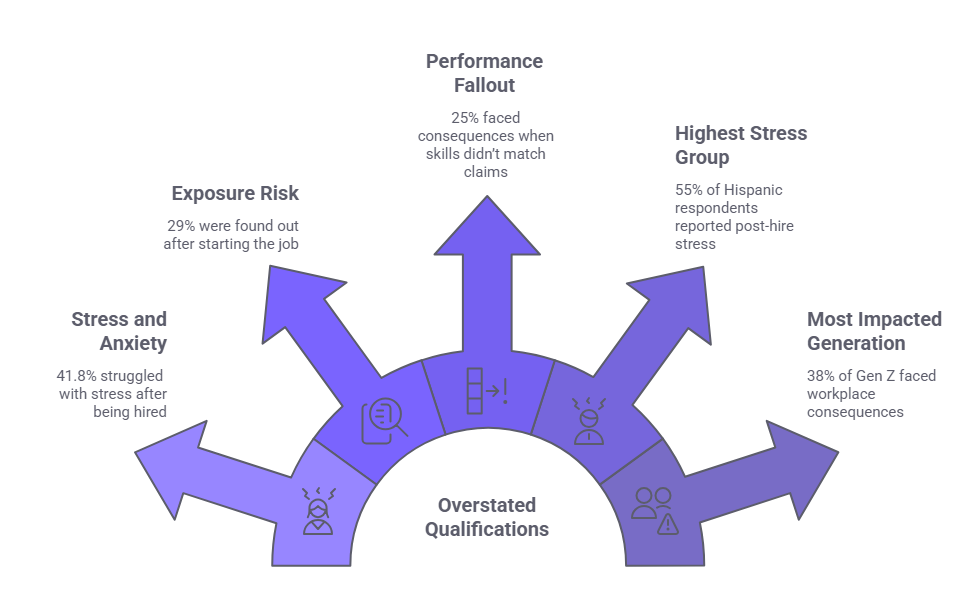
- 41.8% experienced stress or anxiety after employers hired them on the basis of overstated qualifications.
- 29% said their overstatement became apparent after they started the role.
- 25% faced negative workplace consequences because their actual skills did not match their resume.
- Hispanic respondents reported the highest post-hire stress rate at 55%.
- Gen Z faced the highest rate of negative workplace consequences at 38%.
Together, these findings describe workers who enter roles under credential misrepresentation, anticipate discovery, and manage the professional and psychological cost of that gap. In other words, the dissonant majority is not getting away with anything cleanly. They carry the cost of the incentive structure they operate within.
The Organizational Mirror
The same pattern that produces post-hire stress for individual workers also produces organizational risk for employers. When a candidate's skills do not match their represented qualifications, the organization absorbs the cost through underperformance, extended onboarding, early attrition, and, in some cases, direct operational failure. In fact, 88% of all survey respondents, including the dissonant majority, acknowledged that candidate misrepresentation puts businesses at some level of risk, and 28% characterized that risk as significant. At some level, the dissonant majority understands that the behavior it engages in creates a cost it must then perform against.
Social Media Self-Censorship as a Parallel System
The Anxiety Extends Beyond the Resume
The dissonant majority's management of employer perception does not end with application materials. 83.3% of this population reported self-censoring their social media activity out of concern about employer scrutiny, reflecting a widespread perception of review regardless of what any individual employer's practices may be. This behavior represents a parallel, ongoing performance of candidate identity that mirrors the embellishment occurring in formal application materials, yet it operates across a different channel and without any formal mechanism for verification or appeal. The specific behaviors within this self-censorship pattern reveal the full scope of the anxiety.
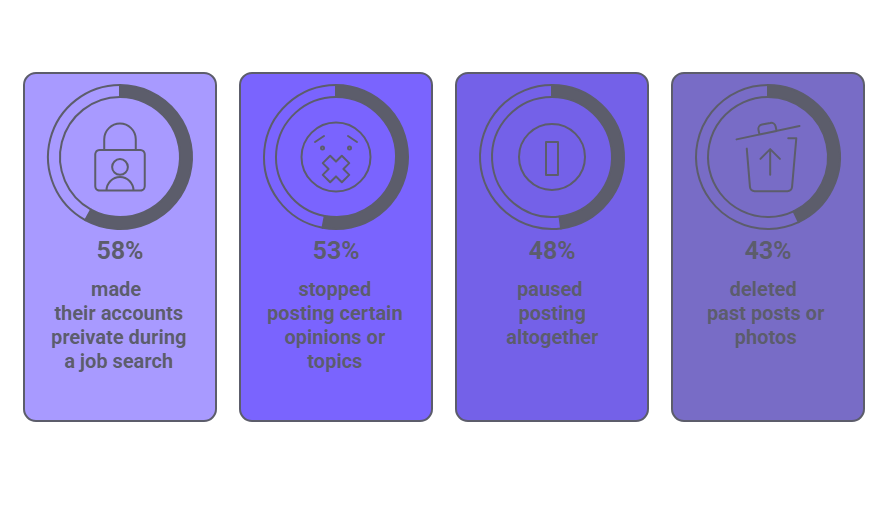
These are not passive choices. Rather, they are active identity management decisions driven by the same concern that produces resume embellishment: the belief that honest self-presentation carries competitive risk.
Job Avoidance as a System Cost
Perhaps the most consequential finding in this area is that 52.7% of the dissonant majority avoided applying to certain jobs specifically because of anxiety about what background screening might reveal. This is not simply a finding about individual risk aversion. More broadly, it reflects how screening processes, when they are opaque and unpredictable, suppress the participation of qualified candidates who might otherwise apply. As a result, the opacity that candidates perceive in current screening processes produces a self-censorship and avoidance dynamic that works against the interests of employers as much as it works against candidates.
What the Dissonant Majority Is Actually Asking For
The dissonant majority's simultaneous embellishment and support for screening is not a contradiction to be resolved. Instead, it is a signal to be read. These workers are not asking to avoid scrutiny. They are asking for screening that is transparent, consistent, and human-reviewed.
| Trust-Building Feature | % Wanting It |
| Clear explanation of what will be verified | 84.1% |
| Human review rather than fully automated outcomes | 81.5% |
| Ability to review or dispute findings | 77.0% |
| Secure data storage and deletion | 76.0% |
| Consistent screening standards for all candidates | 75.0% |
| Transparency about AI use in screening | 74.0% |
Transparency as a Deterrent, Not Just a Courtesy
The 84.1% preference for a clear screening explanation carries an operational implication that goes well beyond candidate experience. When candidates do not know what employers can verify, they calibrate their embellishment against a perceived floor of verification rigor. That perceived floor, based on the 26% detection rate the survey identified, is very low. By contrast, organizations that communicate their verification scope clearly before the application process begins shift that calculation before embellishment decisions occur. In effect, the dissonant majority is telling employers, through their stated preferences, that transparency is the most cost-effective deterrent available.
Human Review as a Trust Mechanism
The 81.5% preference for human review over fully automated screening decisions reflects a concern that automated systems produce outcomes that are inaccurate, stripped of context, or impossible to challenge. Importantly, this preference is not anti-technology. It is pro-accountability. The dissonant majority wants a system in which the consequences of verification are proportionate, explainable, and open to human judgment. That is a reasonable ask, and it aligns directly with the interests of organizations seeking to reduce post-hire risk and attrition.
Structural Implications for Hiring Practice
Reorienting the Verification Framework
The dissonant majority's data profile points toward a specific shift in how organizations approach employment verification. The current framework, in which employers conduct verification after application submission with scope and standards largely hidden from candidates, produces the exact conditions that sustain embellishment. By contrast, a framework designed to disrupt those conditions would operate differently at each of those points. For example, proactive disclosure of verification scope, communicated at the job posting stage rather than after an offer, shifts the rational calculation for candidates before they make embellishment decisions. Similarly, consistent, standardized screening criteria applied uniformly across candidate pools reduce the perception, and the reality, that different candidates face different levels of scrutiny.
The Candidate Experience as a Strategic Variable
52.7% of the dissonant majority avoided applying to jobs because of screening anxiety. That figure represents a real suppression of candidate pipeline participation that stems directly from how screening is perceived, not necessarily from how employers conduct it. Therefore, organizations that invest in making their verification processes transparent and predictable are not simply improving candidate experience. They are also expanding the pool of qualified candidates who choose to apply, and they are selecting for the portion of that pool that values integrity enough to compete under genuine scrutiny.
The Incentive Structure Is the Intervention Target
Ultimately, the dissonant majority is not the problem to be solved. The incentive structure that produces the dissonant majority is the problem. 65.9% of the workforce behaves in ways that they themselves describe as risky, stressful, and contrary to the conditions they would prefer. Organizations that redesign their verification environments to make honesty viable, through transparency, consistency, and human-centered review, are not being permissive. They are being structurally intelligent.
Conclusion
The dissonant majority is not the enemy of better hiring. They are its most clearly articulated constituency. Through their stated preferences and behavioral patterns, they have described exactly what a verification environment that rewards honesty would require. The 2026 Trust in Hiring Report does not present a workforce indifferent to integrity. It presents a workforce that has concluded, under reasonable market conditions, that integrity is currently a competitive disadvantage. Changing that conclusion requires changing the structure, not the people inside it.
About the 2026 Trust in Hiring Report
The 2026 Trust in Hiring Report is a proprietary research study published by GCheck, based on a national survey of 1,500 U.S. adults employed full-time who actively applied for at least one job in the past 18 months. Fielded February 14-22, 2026 via Pollfish, the study examines how Careerfishing, AI-assisted deception, identity concealment, and broken verification expectations are reshaping the employer-candidate trust gap. The report introduced the Careerfishing framework and documented that 93% of recent job seekers have engaged in at least one form of resume embellishment or misrepresentation. The full report, including methodology, demographic breakdowns, and the Compliance for Good framework for rebuilding trust in hiring, is available at gcheck.com/whitepapers/trust-in-hiring-report/.
Frequently Asked Questions
Why do candidates lie on resumes if they know it creates risk?
The 2026 Trust in Hiring Report found that 79.1% of embellishers cited competitive market pressure as the primary driver, and 60% believed they would not have been hired if fully accurate. Most embellishment does not stem from indifference to risk. It reflects a rational calculation that the cost of honesty outweighs the low probability of detection, given that only 26% of those who embellished reported that a discrepancy was identified and flagged.
What is the "dissonant majority" in the context of hiring research?
The dissonant majority describes the 65.9% of recent job seekers who simultaneously misrepresented their qualifications, acknowledged that doing so creates employer risk, and expressed support for ongoing background screening. It is a cross-tabulation finding, distinct from the 93% overall embellishment rate. It identifies workers whose behavior and stated preferences appear contradictory but are better explained by structural market incentives than by individual dishonesty.
What post-hire consequences do candidates who embellish actually face?
According to the 2026 survey, 41.8% of the dissonant majority experienced stress or anxiety after employers hired them on the basis of overstated qualifications. Additionally, 29% said their overstatement became apparent on the job, and 25% faced negative workplace consequences because their skills did not match their resume. Hispanic respondents reported the highest post-hire stress rate at 55%, and Gen Z faced the highest rate of negative workplace consequences at 38%.
Do job seekers actually support background screening?
Yes, with conditions. 80% of all survey respondents said ongoing or periodic background screening is important. However, their support is tied to specific process features: 84.1% want a clear explanation of what will be verified, 81.5% want human review rather than fully automated outcomes, and 77% want the ability to review or dispute findings. Support for screening is strong but depends on transparency, consistency, and human oversight.
How does social media monitoring factor into candidate behavior?
83.3% of the dissonant majority self-censored their social media activity out of concern about employer scrutiny, reflecting a widespread perception of review regardless of what any individual employer's practices may be. Specific behaviors included making accounts private, stopping posts on certain topics, pausing posting altogether, and deleting past content. This represents a parallel identity management system driven by the same concern that honest self-presentation carries competitive risk.
Does screening anxiety actually affect candidate pipeline participation?
The data suggests it does. 52.7% of the dissonant majority avoided applying to certain jobs because of anxiety about what background screening might reveal. When candidates do not understand what employers will check, many assume the worst and remove themselves from consideration entirely. This dynamic suppresses candidate pool participation in ways that affect organizations, not just individual applicants.
What do candidates want from background screening that would build their trust?
The six factors most widely cited in the 2026 survey were: a clear explanation of what will be checked (84.1%), human review of findings rather than fully automated decisions (81.5%), the ability to review or dispute findings (77%), secure data storage and deletion (76%), consistent screening standards for all candidates (75%), and transparency about how AI is used in screening (74%). Together, these preferences describe a verification environment built on visibility, fairness, and accountability.
Is candidate embellishment a generational or demographic issue?
The data does not support a demographic explanation. Embellishment rates were high across every measured group: 97% among Baby Boomers, 96% among Gen Z, 93% among Millennials, and 91% among Gen X. Gender differences were similarly modest, at 95% for men and 91% for women. Taken together, the consistency across demographics points toward a structural market condition rather than any population-specific tendency. As the report concludes, embellishment is a market problem, not a demographic one.
Additional Resources
- Federal Trade Commission, Fair Credit Reporting Act (FCRA) summary and compliance resources
https://www.ftc.gov/legal-library/browse/statutes/fair-credit-reporting-act - U.S. Equal Employment Opportunity Commission, Enforcement Guidance on Consideration of Arrest and Conviction Records
https://www.eeoc.gov/laws/guidance/enforcement-guidance-consideration-arrest-and-conviction-records-employment-decisions - Consumer Financial Protection Bureau, Summary of Consumer Rights (FCRA)
https://www.consumerfinance.gov/consumer-tools/credit-reports-and-scores/

ABOUT THE CREATOR
Charm Paz, CHRP
Recruiter & Editor
Charm Paz is an HR and compliance professional at GCheck, working at the intersection of background screening, fair hiring, and regulatory compliance. She holds both FCRA Core and FCRA Advanced certifications through the Professional Background Screening Association (PBSA) and supports organizations in navigating complex employment regulations with clarity and confidence.
With a background in Industrial and Organizational Psychology and hands-on experience translating policy into practice, Charm focuses on building ethical, compliant, and human-centered hiring systems that strengthen decision-making and support long-term organizational health.