

A home health aide background check typically includes criminal record searches at county, state, and federal levels, sex offender registry verification, abuse registry searches, identity verification, employment history confirmation, professional license validation (where applicable), and exclusion list screenings against databases like the OIG LEIE and GSA SAM. Screening components vary by state regulations, funding source requirements, and employer policies. Some states mandate fingerprint-based FBI checks, while others accept name-based searches.
Key Takeaways
- Criminal history checks form the foundation of home health aide screening. These checks cover county, state, and sometimes federal searches that typically review 7 years of records. However, some states require or permit longer lookback periods depending on the conviction type.
- Healthcare-specific registry checks are mandatory in most states. These include searches of adult abuse registries, child abuse registries, nurse aide registries, and state caregiver misconduct databases. Registry searches track substantiated allegations of patient harm or neglect.
- Federal exclusion list screening is legally required for Medicare/Medicaid-funded care. Employers face severe penalties for hiring individuals listed on the Office of Inspector General List of Excluded Individuals/Entities (OIG LEIE) or the System for Award Management (SAM) exclusion database.
- Identity verification prevents credential fraud and ensures accurate screening results. This typically involves Social Security Number validation, address history confirmation, and comparison against identity theft indicators. These checks flag inconsistencies requiring further investigation.
- State-specific requirements create significant compliance complexity. Regulations differ dramatically regarding mandatory fingerprinting, acceptable criminal record consideration, required registry searches, and screening timelines. Employers must navigate these requirements based on service location.
- Continuous monitoring and re-screening protocols are increasingly adopted across the industry. Leading agencies implement ongoing criminal record monitoring, annual registry re-checks, and periodic employment verification updates. These programs extend beyond pre-employment screening.
- Failure rates for home health aide background checks range from 3-8% nationally. The most common disqualifying factors include undisclosed criminal convictions, registry matches indicating previous patient care violations, federal exclusion list appearances, and employment history discrepancies.
Understanding the Home Health Aide Screening Process
The home health screening process represents one of the most thorough employment vetting protocols in any industry. This rigor reflects the vulnerable patient population and unsupervised care environment. Unlike traditional healthcare facilities with multiple staff oversight, home health aides often work alone. They provide care to elderly, disabled, or medically fragile individuals, creating heightened risks.
Home health agencies face unique liability exposures. Consequently, extensive screening requirements have become standard practice. According to state healthcare quality boards, agencies experiencing patient harm incidents face significant costs. Average litigation expenses exceed $250,000 per case. Additionally, reputational damage impacts referral networks. License sanctions can threaten business viability, making thorough background verification essential for risk management.
Criminal History Verification Components
Criminal background checks constitute the primary screening element for home health aide positions. Specific requirements vary based on state law, agency policy, and funding source mandates. Understanding these checks helps employers make informed decisions. Similarly, candidates can better anticipate what information will surface during screening.
County and State Criminal Record Searches
County criminal court searches form the foundation of most screening protocols. The majority of criminal cases are prosecuted at the county level. These searches involve direct queries of county court databases or clerk of court records. They reveal several key categories:
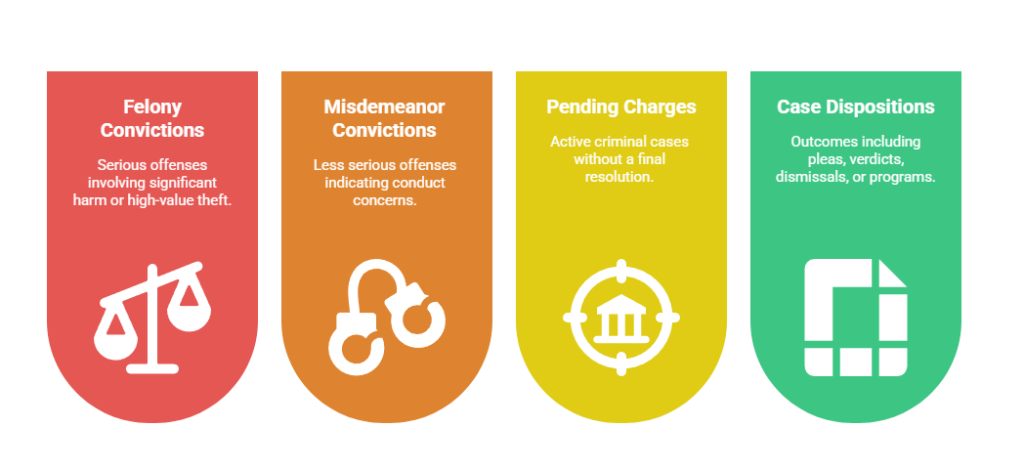
- Felony convictions: Serious criminal offenses involving significant harm or high-value theft
- Misdemeanor convictions: Less serious offenses that still indicate conduct concerns
- Pending charges: Active criminal cases without disposition yet
- Case dispositions: Outcomes including guilty pleas, trial verdicts, dismissals, or diversionary programs
State-level criminal database checks query the central repository maintained by state law enforcement. These databases aggregate records from courts throughout the state. They provide broader coverage than county searches alone. However, they have recognized limitations. Reporting delays mean recent charges may not appear for weeks or months. Furthermore, not all counties report consistently to state systems.
Federal Criminal Record Checks
Federal criminal background checks reveal offenses prosecuted in federal court systems. These include drug trafficking across state lines, federal firearms violations, healthcare fraud, and immigration offenses. Additionally, crimes committed on federal property appear in these searches. They are particularly relevant for home health positions. Medicare and Medicaid fraud prosecutions appear in federal rather than state records.
FBI fingerprint-based criminal history checks provide the most comprehensive federal search option. These checks reveal records from all jurisdictions submitting data to the FBI's system. Several states mandate FBI fingerprint checks for home health aide positions. This requirement applies particularly when employees provide care to vulnerable adults or children. The fingerprint requirement extends background check timelines. FBI processing typically takes 3-5 business days for electronic submissions. State agency review time follows.
Understanding Criminal Record Lookback Periods
The timeframe covered by criminal background checks significantly impacts what information surfaces. Most states apply a seven-year lookback period for criminal convictions. This follows Fair Credit Reporting Act (FCRA) guidelines. Convictions older than seven years from disposition or release are excluded from reports.
| Lookback Period | Applies To | Exceptions |
| 7 Years | Most positions under FCRA | Positions paying $75,000+ annually |
| 10-15 Years | Some state healthcare roles | Varies by jurisdiction and offense type |
| Lifetime | Certain vulnerable population positions | When state law requires or permits |
Important exceptions apply to this seven-year rule. First, positions with salaries exceeding $75,000 annually are exempt. These allow reporting of older convictions. Second, some states have enacted laws extending or eliminating lookback periods. These laws apply to healthcare positions involving vulnerable populations. They permit lifetime criminal record reviews.
Healthcare-Specific Registry and Database Searches
Beyond general criminal records, home health aide background checks must include specialized database searches. These registries track individuals with substantiated histories of patient abuse, neglect, or misconduct. They capture information that may not appear in criminal databases. This is particularly true when incidents resulted in administrative rather than criminal sanctions.
Adult Abuse and Neglect Registries
State adult protective services registries maintain records of substantiated abuse, neglect, or exploitation. Vulnerable adults are typically defined as individuals aged 60 or older or adults with disabilities. These databases track findings from investigations conducted by state protective services. They include cases that did not result in criminal prosecution.
Registry matches indicate that an individual was the subject of a founded complaint. The complaint involved harm to an adult in their care. Most states prohibit hiring individuals listed in adult abuse registries. This prohibition applies to positions involving direct patient care. Violations can result in agency licensure sanctions.
Nurse Aide Registry Verification
Federal regulations require states to maintain nurse aide registries. These track individuals who completed approved training programs and competency evaluations. The registries also include findings of abuse, neglect, or misappropriation of patient property. Registry entries noting substantiated findings create permanent employment bars. These bars apply to certified nursing facilities and most home health settings.
These findings may appear in nurse aide registries even without criminal charges. Therefore, registry checks are essential screening components. Verification also confirms whether an individual's certification remains active. It prevents credential fraud and reveals undisclosed employment terminations.
State-Specific Caregiver Background Check Programs
Many states have established comprehensive caregiver background check programs. These consolidate multiple screening components into unified clearance processes. Typically, programs combine criminal record checks, abuse registry searches, and other verification elements. They generate clearance certificates valid across multiple healthcare employers.
State caregiver background check programs offer standardized criteria. They provide streamlined processing for candidates seeking multiple positions. Centralized tracking prevents individuals with disqualifying histories from moving between agencies undetected. However, employers remain responsible for ensuring state program clearances meet federal requirements.
Federal Exclusion List Screening Requirements
Federal law prohibits healthcare organizations receiving Medicare or Medicaid reimbursement from employing excluded individuals. Exclusion list screening represents a non-negotiable compliance requirement. Severe penalties apply for violations. These checks are essential components of home health aide background screening.
Office of Inspector General Exclusion List (OIG LEIE)
The Office of Inspector General List of Excluded Individuals and Entities (OIG LEIE) contains barred individuals and organizations. Exclusions result from convictions for Medicare/Medicaid fraud, patient abuse, or licensing board sanctions. Employment of a listed individual in any capacity violates federal law.
Organizations employing excluded individuals face severe consequences. First, they face denial of payment for all services provided by that employee. Second, civil monetary penalties reach up to $10,000 per excluded individual per day. Third, the organization itself may face exclusion from federal healthcare programs. The OIG LEIE database is publicly accessible at no cost. Employers can conduct instant searches by name, specialty, address, or identifier.
System for Award Management (SAM) Exclusion Records
The System for Award Management (SAM) maintains a separate federal exclusion database. It tracks individuals and entities barred from receiving federal contracts and benefits. While SAM exclusions stem primarily from contracting violations, prohibited individuals cannot work in federally funded positions.
SAM exclusion screening complements OIG LEIE checks. It captures individuals excluded for reasons unrelated to healthcare fraud. Examples include federal contracting violations, grant fraud, or debarment actions. Home health agencies receiving any federal funding should include SAM searches in protocols.
Monthly Re-Screening and Ongoing Monitoring
Federal exclusion screening cannot be limited to pre-employment checks. Individuals may be added to exclusion lists at any time. This occurs due to new convictions, licensing sanctions, or administrative actions. Consequently, the OIG explicitly recommends monthly re-screening. This applies to all employees, contractors, and volunteers involved in federal healthcare programs.
Automated monitoring services provide monthly alerts. These notify employers when current employees match newly added exclusion list entries. Organizations can also implement manual monthly screening processes. Documentation of screening activities is essential for demonstrating compliance during audits.
Identity and Credential Verification
Confirming that background check results pertain to the actual candidate requires robust identity verification. Credential fraud and identity misrepresentation pose significant risks in healthcare hiring. Therefore, identity confirmation forms a critical screening foundation. It ensures accuracy and prevents impostor employment.
Social Security Number Validation and Trace
Social Security Number verification confirms that the SSN provided was legitimately issued. It identifies the name and approximate year associated with the number. Additionally, it reveals address history linked to that SSN. This process detects fraudulent SSNs, identity theft, and undisclosed name variations.
| SSN Verification Component | Purpose | What It Reveals |
| Legitimacy Check | Confirms valid issuance | Whether SSN was issued by Social Security Administration |
| Name Match | Validates identity | Name associated with SSN at issuance |
| Address History | Guides criminal searches | Jurisdictions where candidate lived over time |
| Death Master File | Prevents fraud | Whether SSN belongs to deceased individual |
SSN trace results typically include multi-year address history. This shows locations where the candidate lived. The information informs the geographic scope of criminal record searches. It reveals jurisdictions that should be included in county-level background checks.
Professional License and Certification Verification
For positions requiring state licensure or national certification, direct verification with issuing authorities is essential. This confirms credentials are active, unrestricted, and held in the provided name. License verification also reveals disciplinary history and practice restrictions. These may not appear in other background check components.
State professional licensing boards maintain public databases. These show licensee names, license numbers, issue and expiration dates, and disciplinary actions. Employers should search these databases directly. They should not rely solely on candidate-provided documentation. Fraudulent certificates and expired credentials are common in healthcare hiring.
State-Specific Requirement Variations
Home health aide background check requirements vary dramatically across states. This creates compliance complexity for agencies operating in multiple jurisdictions. Understanding state-specific mandates is essential. Employers must develop screening protocols that meet all applicable legal requirements while supporting efficient hiring processes.
Fingerprint-Based FBI Background Check Mandates
Some states require fingerprint-based FBI background checks for home health aide positions. These provide the most comprehensive criminal history screening available. They search the FBI's centralized database of criminal records from all reporting jurisdictions. Fingerprint checks offer superior accuracy compared to name-based searches. They definitively link records to the individual whose prints were submitted.
States mandating fingerprint-based checks typically require candidates to complete fingerprinting at approved locations. Electronic capture systems transmit prints to the FBI for processing. Results are returned to the state agency overseeing home health licensing. Subsequently, the agency provides clearance to the employer or candidate.
Ban-the-Box and Fair Chance Hiring Laws
Over 35 states and numerous localities have enacted ban-the-box or fair chance hiring laws. These restrict how employers inquire about and use criminal history information. Typically, laws prohibit criminal history questions on initial applications. They require individualized assessments rather than blanket exclusions. Additionally, they mandate specific procedures before taking adverse action.
Home health agencies must navigate the tension between fair chance hiring mandates and state healthcare regulations. Individualized assessment processes involve considering several factors. These include the nature and gravity of the offense, time elapsed since conviction, and relevance to the position. Documentation of this analysis is essential for demonstrating compliance.
State-Mandated Disqualifying Offenses
Many states specify particular criminal offenses that disqualify individuals from home health aide employment. Common disqualifying offenses include violent crimes, sexual offenses, and abuse or neglect of vulnerable populations. Theft, fraud, and drug trafficking convictions also typically appear. However, specific lists vary across jurisdictions.
| Offense Category | Typical Disqualification Period | Examples |
| Violent Crimes | Permanent or 10+ years | Assault, homicide, domestic violence |
| Sexual Offenses | Permanent | Sexual assault, indecent exposure, exploitation |
| Patient Abuse | Permanent | Abuse of vulnerable adults or children in care settings |
| Theft/Fraud | 5-15 years | Theft from patients, Medicaid fraud, embezzlement |
| Drug Trafficking | 5-10 years | Distribution, manufacturing, large-scale possession |
Some states distinguish between permanent disqualifications and temporary restrictions. Permanent bars apply to offenses deemed categorically incompatible with patient care. Temporary restrictions expire after specified periods. Employers must ensure their screening protocols align with state-specific disqualification lists. Hiring individuals with prohibited convictions can result in agency license sanctions.
What Job Seekers Should Know
Understanding what shows up on home health aide background checks helps job candidates prepare. Transparency and accuracy in application materials significantly improve outcomes. This is especially true when background issues exist. Addressing potential concerns proactively avoids surprises. These surprises could derail employment opportunities.
Candidates with criminal histories should understand that disclosure is typically required. Concealing convictions often results in automatic disqualification. Many agencies are willing to consider candidates with certain types of criminal histories. This is particularly true when convictions are dated or unrelated to patient care. Demonstrating rehabilitation through treatment programs, community service, or sustained law-abiding behavior improves outcomes.
Candidates should ensure all information provided on applications matches official records exactly. This prevents complications during identity verification. Name variations, maiden names, nicknames, or previous names should be disclosed proactively. Any identity theft history should be explained with supporting documentation. This clarifies residential history and prevents confusion during SSN trace reviews.
Implementing Effective Screening Programs

Home health agencies must design background check programs that balance thoroughness with efficiency. Compliance with all applicable regulations is essential. Strategic program design considers components to include, timing and process flow, and technology use. Ongoing monitoring protocols protect vulnerable patients and organizational interests.
At minimum, home health aide screening must include several components. Criminal background checks covering relevant jurisdictions and time periods are essential. Adult abuse registry searches, OIG and SAM exclusion list verification, identity confirmation, and employment verification are also required. Additional components depend on state requirements and position characteristics. These may include fingerprint-based FBI checks, education verification, and credit checks.
Efficient background check processes balance speed with thoroughness. Lengthy screening delays create recruitment challenges. However, rushing investigations compromises quality. Conditional offer approaches provide candidates with commitment. These extend employment offers contingent on successful background check completion. They preserve employer flexibility to rescind offers if disqualifying information emerges. Additionally, they comply with ban-the-box requirements.
Leading home health agencies implement ongoing monitoring. This extends beyond pre-employment screening. Continuous monitoring detects changes in employee background status. Such changes could create compliance or safety concerns. Programs typically include monthly OIG and SAM exclusion list re-screening. License and certification verification updates are also standard. Criminal record monitoring alerts employers when current employees are arrested or convicted.
Conclusion
Home health aide background checks encompass comprehensive screening elements. They verify criminal history across multiple jurisdictions. Healthcare-specific registries track patient care violations. Federal exclusion lists confirm program eligibility. Identity and credential validation ensures accuracy. Employment history reviews identify patterns of concern. Employers must navigate complex regulatory frameworks that vary by state. Implementing thorough screening protocols supports quality hiring decisions and protects vulnerable patients.
Frequently Asked Questions
What specific criminal convictions automatically disqualify someone from home health aide employment?
Disqualifying convictions vary by state law. However, they commonly include violent crimes such as assault, sexual offenses, and abuse or neglect of vulnerable adults or children. Patient abuse in healthcare settings, theft or fraud, and certain drug trafficking offenses also typically disqualify candidates. Some states create permanent bars for specific offense categories. Others impose temporary restrictions (often 5-15 years) for other convictions.
How far back do home health aide background checks typically look?
Most criminal background checks cover seven years from the date of conviction or release. This follows Fair Credit Reporting Act provisions. However, significant exceptions apply based on state law. Some jurisdictions require or permit lifetime criminal record reviews for healthcare positions involving vulnerable populations. Registry checks including adult abuse registries typically reveal all substantiated findings regardless of age.
Are home health agencies required to check the FBI fingerprint database?
FBI fingerprint-based background check requirements vary by state. Some jurisdictions mandate fingerprint checks while others accept name-based searches. States requiring fingerprint checks for home health workers include Florida, Texas, Pennsylvania, and Michigan. Even when state law does not mandate FBI checks, agencies providing Medicare or Medicaid services must comply with any FBI check requirements.
What happens if someone is listed on the OIG exclusion list?
Individuals appearing on the Office of Inspector General List of Excluded Individuals and Entities cannot work for healthcare organizations receiving federal reimbursement. Employment of an excluded individual results in denial of payment for all services furnished by that person. Civil monetary penalties reach up to $10,000 per excluded individual per day. The employing organization may also face exclusion from federal healthcare programs.
Can home health aides be denied employment based solely on an arrest without conviction?
Using arrests without convictions as the sole basis for employment denial violates Fair Credit Reporting Act standards. It also violates equal employment opportunity principles. The Equal Employment Opportunity Commission guidance clarifies that arrest records may only be considered when the underlying conduct makes the individual unfit. Employers must investigate circumstances rather than rejecting candidates based on arrest records alone.
Do home health aide background checks include credit reports?
Credit reports are not standard components of home health aide background checks. They are generally not recommended unless specific job duties involve financial responsibilities. The Fair Credit Reporting Act requires employers to demonstrate legitimate business necessity before obtaining credit reports. Several states restrict employment credit checks to positions with substantial financial duties.
How long does the home health aide background check process typically take?
Background check timelines vary from 3-5 business days for expedited screenings to 4-8 weeks in jurisdictions requiring fingerprint-based FBI checks. States with online registry systems process faster. Written registry verifications take longer. Factors affecting timeline include the number of jurisdictions searched, registry verification methods, FBI processing speed, and court access limitations.
What should I do if I find an error in my home health aide background check?
Candidates who identify inaccurate information should immediately notify the employer and the consumer reporting agency. Formal dispute letters must include specific identification of inaccurate information. They should explain why it is incorrect and include supporting documentation. The consumer reporting agency must investigate disputes within 30 days. They must correct or delete information that cannot be verified.
Are there positions in home health care available to people with criminal records?
Employment opportunities for individuals with criminal records depend on several factors. These include the nature of convictions, time elapsed, state-specific disqualification lists, and position duties. Many agencies will consider candidates with non-violent misdemeanors. Offenses unrelated to patient care and convictions followed by demonstrated rehabilitation also improve prospects. Positions not involving direct patient care may be available.
Do home health aide background checks vary between Medicare-certified agencies and private pay companies?
Medicare-certified agencies must comply with federal Conditions of Participation. These establish minimum background check standards. Private pay companies not accepting Medicare or Medicaid are not subject to federal Conditions. However, they must comply with state licensure requirements. These typically mandate background checks comparable to or more strict than federal standards.
Additional Resources
- Medicare and Medicaid Programs: Application and Enforcement of the Criminal Background Check Requirements for Long-Term Care Facilities
https://www.govinfo.gov/content/pkg/FR-2024-05-10/pdf/2024-09955.pdf - Office of Inspector General List of Excluded Individuals and Entities
https://oig.hhs.gov/exclusions/ - System for Award Management Exclusions
https://sam.gov/content/exclusions - Equal Employment Opportunity Commission Enforcement Guidance on the Consideration of Arrest and Conviction Records
https://www.eeoc.gov/laws/guidance/arrest_conviction.cfm - Fair Credit Reporting Act Full Text
https://www.ftc.gov/legal-library/browse/statutes/fair-credit-reporting-act

ABOUT THE CREATOR
GCheck Editorial Team
Meet the GCheck Editorial Team, your trusted source for insightful and up-to-date information in the world of employment background checks. Committed to delivering the latest trends, best practices, and industry insights, our team is dedicated to keeping you informed.
With a passion for ensuring accuracy, compliance, and efficiency in background screening, we are your go-to experts in the field. Stay tuned for our comprehensive articles, guides, and analysis, designed to empower businesses and individuals with the knowledge they need to make informed decisions.
At GCheck, we're here to guide you through the complexities of background checks, every step of the way.