

Texas education background checks are governed by strict Texas Education Agency (TEA) requirements and Texas Education Code mandates. These rules apply to all school employees, contractors, and volunteers with unsupervised student access. Compliance requires FBI fingerprinting, state criminal history reviews, and ongoing monitoring to maintain educator certification and institutional eligibility for state funding.
Key Takeaways
- Texas education background checks are legally required for all school employees, substitute teachers, contractors, and volunteers with direct student access under Texas Education Code §22.0834 and §22.083.
- The Texas Education Agency mandates FBI fingerprint-based criminal history checks processed through the Department of Public Safety (DPS) for all certified and non-certified education personnel.
- School districts must complete background screening before an individual's first day of employment or volunteer service, with no provisional start dates permitted for unsupervised roles.
- Texas educators face automatic disqualification for certain felony convictions, including offenses involving moral turpitude, violence, or crimes against children, as specified in Texas Education Code §22.085.
- Continuing disclosure obligations require current employees to report arrests and charges within seven days, creating ongoing compliance responsibilities beyond initial hiring.
- Charter schools, private schools accepting state funding, and education service centers must follow the same TEA background check protocols as traditional public school districts.
- Out-of-state educator candidates must obtain FBI fingerprint clearances and may face additional scrutiny for gaps in employment history or incomplete criminal records from previous jurisdictions.
- Non-compliance with Texas education sector background screening requirements can result in loss of state funding, TEA sanctions, individual criminal penalties, and civil liability for negligent hiring.
Understanding Texas Education Background Check Legal Framework
Statutory Foundation and TEA Authority
The Texas Education Agency operates under delegated authority from the Texas Legislature. This authority allows TEA to establish and enforce background screening standards for all education sector employees. Texas Education Code Chapter 22, Subchapter C creates the legal infrastructure for criminal history reviews, disqualification standards, and ongoing monitoring requirements. These mandates apply across public school districts, charter schools, and state-funded educational institutions throughout the state.
School districts function as both employers and state actors responsible for student safety. This dual role creates heightened legal obligations beyond typical private sector hiring. The TEA framework mandates specific procedural steps, designated screening vendors, and standardized disqualification criteria. These requirements ensure consistency across Texas's 1,200+ independent school districts and charter systems.
Texas education background checks differ fundamentally from commercial employment screening in three critical ways:
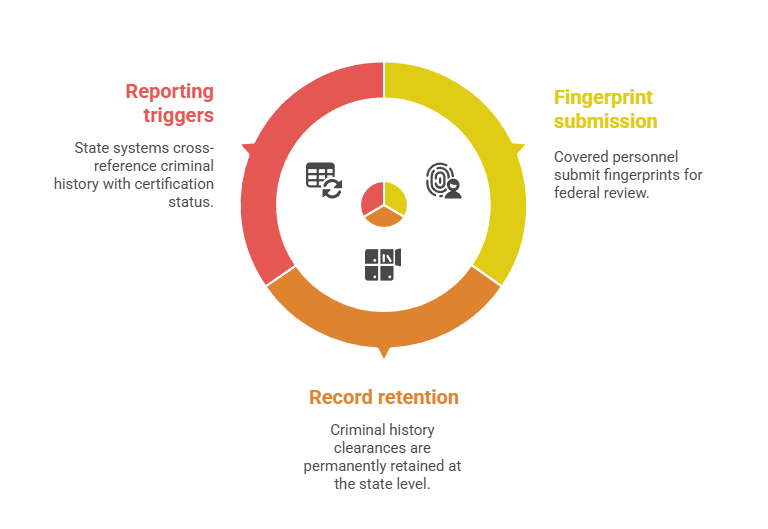
- Mandatory FBI fingerprint submission: All covered personnel must submit fingerprints through DPS-approved channels for federal database review.
- Permanent record retention at the state level: Criminal history clearances become part of permanent state education employment records accessible to TEA.
- Automatic reporting triggers tied to educator certification databases: State systems cross-reference criminal history with certification status to identify ongoing eligibility concerns.
Who Must Complete Background Screening
Texas law requires criminal history checks for any individual who will have continuing duties related to school district operations and direct contact with students. This statutory language extends background check obligations far beyond traditional classroom teachers. Coverage includes administrators, counselors, librarians, coaches, bus drivers, cafeteria workers, maintenance staff with building access, and contracted service providers.
| Position Category | Background Check Required | Processing Method |
| Certified Teachers | Yes - Mandatory | FBI Fingerprint via DPS |
| Substitute Teachers | Yes - Mandatory | FBI Fingerprint via DPS |
| School Administrators | Yes - Mandatory | FBI Fingerprint via DPS |
| Coaches (Paid/Volunteer) | Yes - Mandatory | FBI Fingerprint via DPS |
| Cafeteria Workers | Yes - If Student Contact | FBI Fingerprint via DPS |
| Maintenance Staff | Yes - If Building Access | FBI Fingerprint via DPS |
| One-Time Event Volunteers | No - If Supervised | Not Required |
| Contractors (After Hours) | Varies - District Policy | Case-by-Case Review |
Volunteers require background screening when their duties involve regular unsupervised contact with students or access to sensitive student information. One-time event chaperones accompanied by school employees throughout an activity typically fall outside mandatory screening requirements. However, districts retain the freedom to implement broader volunteer background check policies that exceed statutory minimums.
Texas Education Code Disqualification Standards
Texas Education Code §22.085 establishes automatic disqualification categories. These prevent individuals from education employment regardless of rehabilitation evidence, time elapsed, or mitigating circumstances. Convictions for offenses involving moral turpitude create permanent barriers to education sector employment in Texas. Similarly, felonies under Title 5 of the Penal Code (offenses against the person) and any sexually motivated crimes also create permanent employment barriers.
The statute distinguishes between convictions that mandate absolute disqualification and offenses subject to individualized assessment. Districts may consider factors including offense severity, time elapsed, rehabilitation evidence, and job duties for certain offenses. Misdemeanor assault convictions, theft offenses, and drug-related charges may allow employment consideration under specific circumstances.
Deferred adjudication presents particular complexity in Texas education background checks. The legal status of deferred adjudication orders changed following legislative amendments. Individuals should understand that deferred adjudication for offenses listed under disqualification statutes may still prevent education employment. This prohibition applies even when criminal records indicate successful probation completion and case dismissal.
National criminal database searches cannot substitute for fingerprint-based FBI checks in the Texas education sector. School districts risk significant compliance violations when relying on commercial background screening that omits mandatory state-processed fingerprint submissions. The TEA specifically requires routing all education background checks through the Texas Department of Public Safety. Districts must use approved fingerprint collection methods and standardized applicant information forms.
FBI Fingerprinting Requirements for Texas Educators
Mandatory Fingerprint Submission Process
Texas school districts must obtain FBI fingerprint-based criminal history checks for every employee and covered volunteer. Processing occurs through the Texas Department of Public Safety's fingerprint submission system. The process requires live scan electronic fingerprinting or traditional ink card submissions accompanied by completed applicant information. Required data elements include full legal name, date of birth, Social Security number, and position-specific role codes designated by the TEA.
Fingerprints submitted for education sector screening receive enhanced review. This review includes comparison against federal databases maintained by the FBI, Department of Homeland Security, and other agencies. Standard state criminal history repositories provide limited coverage compared to this multi-jurisdictional review. Enhanced screening identifies out-of-state convictions, federal offenses, and records from military justice systems. These records would not appear in Texas-only criminal history searches.
The fingerprint clearance timeline typically spans 10 to 15 business days under normal processing conditions:
- Initial submission: Live scan or ink card fingerprints submitted to DPS within 3 business days of conditional offer
- DPS processing: State-level criminal history review completed within 3-5 business days
- FBI review: Federal database comparison requires 5-10 business days depending on match volumes
- Result delivery: Final clearance or disqualification notice sent to hiring district electronically
- Employment authorization: Districts may proceed with onboarding only after receiving final clearance confirmation
However, delays occur when fingerprint quality requires resubmission or when federal database matches require additional verification. School districts cannot authorize employment start dates for positions requiring fingerprint clearance until receiving final disposition results from DPS.
Continuing Duty to Report Subsequent Arrests
Texas educators and school employees face ongoing obligations to report arrests, charges, and convictions to their employing district. Reports must be submitted within seven business days of the occurrence. These continuing disclosure requirements extend throughout employment tenure. The statutory reporting obligation applies regardless of charge severity, disposition status, or whether the incident relates to job duties. Failure to report constitutes independent grounds for termination and potential certification sanctions.
School districts must establish clear internal policies communicating reporting requirements to all employees subject to background check mandates. Additionally, districts should create confidential reporting channels that protect employee privacy while ensuring compliance documentation. Human resources departments should implement annual training refreshers covering reporting obligations. Written acknowledgment forms should evidence employee understanding of these continuing duties.
Criminal charges reported under continuing disclosure obligations do not automatically result in termination or removal from duty. However, they trigger district-level review processes. Districts must assess whether interim restrictions on duties, suspension pending case resolution, or immediate termination align with legal requirements and student safety priorities. Districts should consult legal counsel before making adverse employment decisions based on pending charges. This ensures compliance with due process requirements and helps avoid wrongful termination liability.
Certification-Specific Background Check Requirements
Educator Certification and Criminal History Reviews
The State Board for Educator Certification (SBEC) maintains separate criminal history review requirements. These requirements tie to initial certification, certification renewal, and ongoing eligibility to hold teaching credentials in Texas. Individuals applying for their first Texas educator certificate must complete fingerprint submissions. Processing occurs through the TEA's educator certification division. This creates a parallel background check process distinct from district-level employment screening.
Certified educators renewing credentials face criminal history reverification requirements. These identify convictions, pending charges, or arrests occurring since initial certification or previous renewal. The SBEC reviews reported criminal history against certification eligibility standards that may differ from district employment disqualification rules. This potentially creates scenarios where an individual remains employed by a school district but loses state certification necessary to perform teaching duties.
Out-of-state educators seeking Texas certification must provide criminal history documentation from all states where they previously held licensure or resided for 12 consecutive months during adulthood:
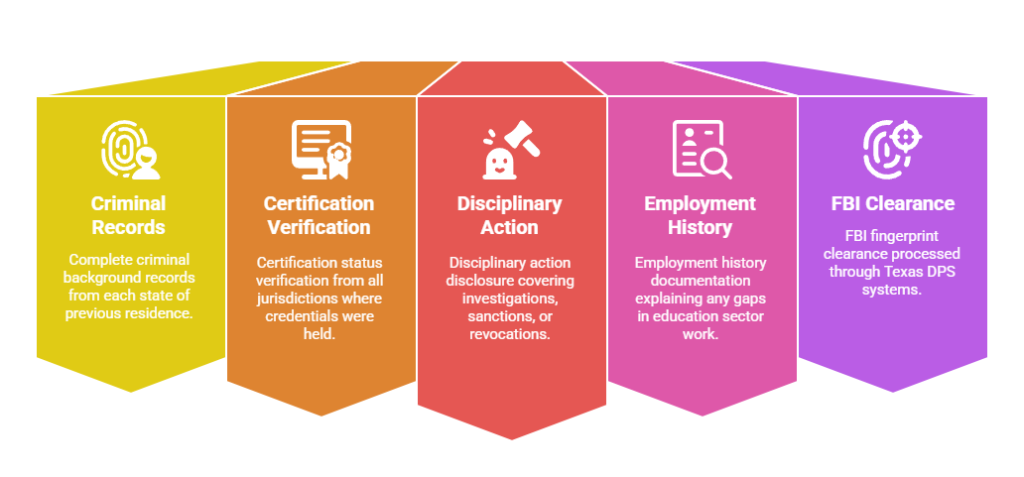
- Complete criminal background records from each state of previous residence
- Certification status verification from all jurisdictions where credentials were held
- Disciplinary action disclosure covering investigations, sanctions, or revocations
- Employment history documentation explaining any gaps in education sector work
- FBI fingerprint clearance processed through Texas DPS systems regardless of recent out-of-state clearances
The TEA maintains the Educator Certification Online System (ECOS). Applicants use ECOS to track certification status, submit required documentation, and receive notifications. Alerts notify applicants about criminal history clearance issues requiring additional information or explanation. Delays in certification issuance frequently result from incomplete out-of-state criminal history documentation or fingerprint quality issues requiring resubmission.
Certification Sanctions and Criminal Convictions
Certain criminal convictions trigger mandatory educator certification revocation. This occurs regardless of employment status or district support for continued credential eligibility. The SBEC reviews all reported convictions against statutory disqualification standards and regulatory provisions. These provisions define unfitness for education duties. Decisions are documented in public orders that become part of permanent certification records accessible through the TEA's online verification system.
| Offense Category | Certification Impact | Eligibility for Reinstatement |
| Felony Crimes Against Children | Permanent Revocation | Never Eligible |
| Sexual Misconduct Offenses | Permanent Revocation | Never Eligible |
| Title 5 Violent Felonies | Permanent Revocation | Never Eligible |
| Drug Distribution Felonies | Temporary Ineligibility | Possible After 5-10 Years |
| Theft/Fraud Misdemeanors | Case-by-Case Review | Possible With Rehabilitation Evidence |
| DWI/DUI Offenses | Suspension or Probation | Usually Eligible With Conditions |
Educators may request administrative hearings to contest proposed certification sanctions. Hearings are available when they believe reported criminal history information is inaccurate. They are also available when legal conclusions about offense classification are incorrect or mitigating circumstances warrant deviation from standard sanction guidelines. These hearings follow administrative law procedures with formal evidence presentation and legal representation. Final decisions are subject to judicial review through state district court appeals.
Charter Schools and Private School Compliance Obligations
Charter School Background Check Requirements
Texas charter schools operate under identical background check mandates as traditional public school districts. No exemptions or modified standards exist despite their designation as independent educational entities. Charter operators must implement fingerprint-based FBI criminal history reviews for all employees, contractors, and volunteers meeting statutory coverage definitions. Processing occurs through the same Texas DPS systems required for conventional school districts.
The TEA conducts compliance audits of charter school background screening programs as part of broader accountability monitoring. Findings are documented in public reports that may impact charter renewal decisions and expansion applications. Charter schools demonstrating systematic background check compliance failures face corrective action plans and financial penalties. Potential charter revocation may occur in cases of egregious or repeated violations that create student safety risks.
Charter school networks operating multiple campuses must establish centralized background screening protocols. These protocols ensure consistent application of legal requirements across all locations. Simultaneously, these networks must maintain campus-level documentation necessary for TEA review. Human resources departments serving multi-campus charter organizations should implement digital tracking systems. These systems provide real-time visibility into clearance status for all personnel. Additionally, they flag upcoming reverification deadlines or reported criminal history requiring review.
Private School Considerations
Private schools accepting state funding, participating in state voucher programs, or employing educators holding TEA certification must comply with Texas education background check statutes. Compliance requirements apply based on their specific operational characteristics. Private schools entirely independent of state funding and employing no TEA-certified educators retain freedom to establish institutional background screening policies. They face no mandatory TEA compliance requirements. Nevertheless, they remain subject to general negligent hiring liability standards.
Private schools choosing to exceed minimum statutory requirements by voluntarily implementing TEA-compliant background screening gain procedural benefits:
- Access to state fingerprint processing systems: Ability to use DPS-approved live scan vendors and standardized submission protocols
- Standardized disqualification guidance: Clear statutory frameworks for making employment eligibility determinations
- Defensible screening protocols: Court-recognized procedures that reduce negligent hiring liability exposure
- Consistency with public school standards: Enhanced community confidence through alignment with well-established safety protocols
Voluntary adoption of TEA standards creates institutional policies that must be consistently applied. Inconsistent application may lead to discrimination claims or arbitrary treatment allegations.
Private school employees transitioning to public school employment must complete full fingerprint-based background checks. This requirement applies regardless of screening completed at private institutions. Private school clearances do not satisfy TEA requirements even when they include FBI fingerprinting. Educators must anticipate full fingerprint submission and DPS processing when transitioning to public schools. Processing follows standard 10-15 business day schedules without expedited options for previously cleared individuals.
Implementation Best Practices for Texas School Districts
Developing Compliant Screening Protocols
School districts should establish written background screening policies. These policies document procedures for fingerprint collection, result review, disqualification determinations, appeal processes, and recordkeeping requirements. Written policies create consistent application standards across hiring departments. Additionally, they provide legal defensibility when screening decisions face challenges from applicants or regulatory agencies. Effective screening protocols designate specific personnel responsible for each compliance step, from initial fingerprint scheduling through final hiring authorization.
Pre-employment conditional offer timing proves critical in Texas education sector hiring. Fingerprint submissions require applicant cooperation that typically occurs after position acceptance but before employment authorization. Districts should structure offer letters to clearly communicate that employment is conditional upon satisfactory background check completion. Additionally, offer letters should establish expected timelines for fingerprint submission, processing, and final clearance. These timelines allow planning for alternative candidates if disqualifying information emerges.
Automated tracking systems integrated with applicant tracking software reduce compliance failures. These systems flag missing clearances, trigger reverification requirements based on programmed timelines, and generate management reports. Reports identify compliance gaps across the district. Technology investments in background screening administration typically provide strong return through reduced compliance violations. Additional benefits include improved hiring cycle efficiency and decreased administrative burden on HR personnel managing manual tracking processes.
Adverse Action Procedures and Applicant Rights
School districts must provide procedural due process before making adverse employment decisions based on criminal history information. Required procedures include opportunities for applicants to review reported information, present mitigating evidence, and receive written explanation of disqualification rationales. These due process obligations arise from both constitutional requirements applicable to governmental employers and practical risk management considerations. Proper procedures reduce wrongful termination liability exposure.
Applicants should receive copies of criminal history reports forming the basis for potential disqualification. They should also receive clear written explanation of their right to dispute record accuracy through established challenge procedures:
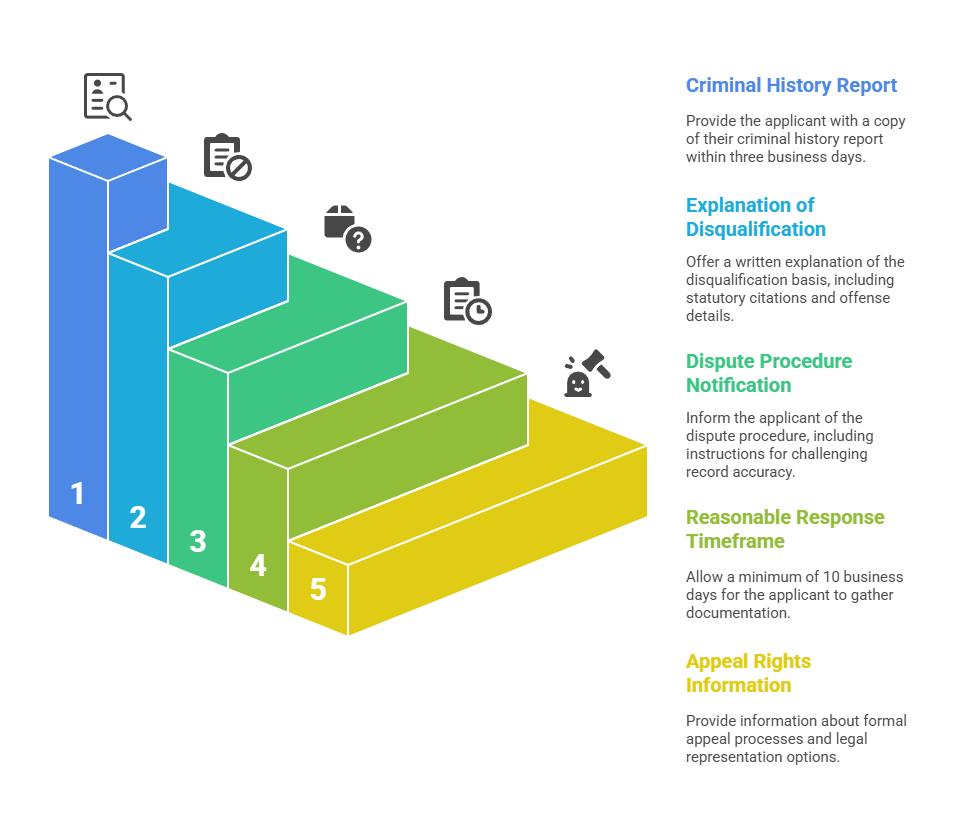
- Criminal history report copies: Provided within three business days of district receipt from DPS
- Written explanation of disqualification basis: Specific statutory citation and offense details supporting adverse decision
- Dispute procedure notification: Clear instructions for challenging record accuracy or presenting mitigating evidence
- Reasonable response timeframe: Minimum 10 business days to gather documentation before final decision
- Appeal rights: Information about formal appeal processes and legal representation options
Maintaining confidentiality of criminal history information obtained through TEA-mandated background checks protects both applicant privacy rights and district legal compliance. Unauthorized disclosure of criminal history records may violate state confidentiality statutes. Human resources staff should implement strict access controls limiting criminal history record review to personnel with legitimate need to know. Staff should also prohibit informal discussion of applicant criminal backgrounds beyond formal decision-making channels.
Ongoing Monitoring and Reverification Requirements

Continuing Surveillance Obligations
Texas school districts must maintain ongoing awareness of employee criminal history. This occurs through continuing disclosure reporting, periodic reverification protocols, and participation in state-operated monitoring systems. These systems provide automated notifications of arrests or convictions involving current employees. These ongoing obligations recognize that initial clearance at hiring represents a single point-in-time assessment requiring supplementation through employment tenure. The DPS operates rap back services that provide automated notifications to subscribing school districts. Notifications occur when employees with fingerprints on file experience subsequent arrests, charges, or convictions recorded in state or federal criminal justice databases.
| Monitoring Method | Implementation Requirement | Notification Timeline | District Action Required |
| Employee Self-Reporting | Mandatory Under State Law | Within 7 Business Days | Review and Investigation |
| DPS Rap Back Service | Optional District Enrollment | Real-Time Upon Arrest | Immediate Assessment |
| Periodic Reverification | District Policy Discretion | 3-5 Year Intervals | Full Rescreening Process |
| Certification Status Monitoring | Automatic TEA System | Upon SBEC Action | Employment Eligibility Review |
Substitute teachers and contract employees require special attention in ongoing monitoring programs. Their periodic engagement patterns may allow extended gaps between district assignments. Criminal history events could occur during these gaps without district awareness. Districts should implement return-to-service protocols that verify clearance currency before authorizing assignment resumption following extended absences.
Managing Reported Criminal Incidents
Human resources departments should establish standardized response protocols for employee-reported arrests or criminal charges. These protocols balance legal obligations for investigation with employee rights to due process and presumption of innocence. Immediate suspension pending investigation may be appropriate for charges involving violence, sexual misconduct, or crimes against children. Conversely, less severe offenses may warrant monitoring without duty restrictions pending case resolution.
Districts must evaluate whether reported criminal charges create continuing employment eligibility under disqualification statutes. They must also determine if charges pose unacceptable student safety risks. This evaluation requires consideration of charge specifics, employee duties, student exposure levels, and likelihood of conviction based on available information. Preferably, evaluation should be conducted with legal counsel guidance to navigate complex statutory interpretation questions.
Documentation of all steps taken in response to reported criminal history events creates essential records. These records help defend potential wrongful termination claims, unemployment benefit challenges, or certification sanction appeals where district actions may face scrutiny. HR files should include copies of criminal history reports, written summaries of information considered, analysis of disqualification statute applicability, and contemporaneous notes from meetings with affected employees.
Specialized Scenarios and Complex Compliance Questions
Out-of-State Educator Transitions
Educators relocating to Texas from other states must complete full FBI fingerprint-based background checks through Texas DPS systems. This requirement applies despite having obtained clearances in previous employment states. No reciprocity agreements or clearance portability mechanisms exist that allow educators to transfer background check results between states. Consequently, new Texas residents must anticipate complete rescreening before beginning employment.
The National Association of State Directors of Teacher Education and Certification operates a clearinghouse for educator discipline information. Texas uses this clearinghouse to identify certification sanctions, revocations, or investigations in other states. These may impact Texas certification eligibility. Out-of-state applicants should disclose all previous educator licenses held and any disciplinary actions or investigations occurring in other jurisdictions. This disclosure helps avoid adverse inferences from information that emerges during TEA verification processes.
Employment gaps in educator work histories receive heightened scrutiny during Texas certification background reviews. Unexplained absences from education employment may indicate periods of certification ineligibility or undisclosed disciplinary situations:
- Career interruptions for family obligations: Document childcare responsibilities, eldercare duties, or spousal relocation with supporting evidence.
- Credential advancement periods: Provide enrollment verification from degree programs, internship documentation, or professional development certificates.
- Career changes outside education: Supply employment verification letters from non-education employers and explanation of return to the education sector.
- Medical or personal leave: Furnish healthcare provider statements (without protected health information) or personal affidavits explaining absence reasons.
Volunteer and Extracurricular Program Compliance
Volunteer coaches for school-sponsored athletic programs require background screening under the same standards as paid employees. This applies when their duties include unsupervised contact with student athletes during practices, games, or travel. School districts cannot create exemptions for volunteer coaches based on parent status, community reputation, or previous volunteer service without background clearance. Statutory requirements make no distinction between paid and unpaid personnel in covered positions.
Booster club officers, parent-teacher organization leaders, and other volunteer organization officials may require background screening. Requirements depend on their access to students, school facilities, and sensitive student information. Districts should evaluate specific volunteer duties rather than organizational titles when determining background check applicability. Focus should be on unsupervised student contact and building access levels that create safeguarding concerns.
Guest speakers, career day presenters, and other one-time school visitors typically do not require formal background screening. This applies when school employees supervise all student interactions and visitors lack independent campus access. Districts should establish clear supervision protocols ensuring that unscreened visitors remain accompanied by cleared employees throughout their campus presence. Implementation of sign-in procedures maintains records of visitor identities and visit purposes.
Consequences of Non-Compliance and Enforcement Actions
Institutional Penalties and TEA Sanctions
School districts failing to maintain compliant background screening programs face TEA enforcement actions. These range from corrective action plans requiring specific remediation steps to financial penalties calculated based on violation severity. Calculations also consider student enrollment affected by compliance failures. The most severe institutional consequences include loss of accreditation status, ineligibility for state funding, and potential conservatorship or closure. Charter schools demonstrating persistent compliance failures face the greatest risk of these severe consequences.
TEA compliance investigations typically originate from complaints submitted by employees, parents, or community members alleging screening deficiencies. Routine monitoring and audit processes also identify systemic compliance gaps requiring corrective intervention. Districts should implement internal compliance auditing that proactively identifies and remediates screening gaps. This approach prevents escalation to formal TEA enforcement proceedings that create public disclosure and reputational consequences.
Public reporting of background check compliance violations occurs through TEA accountability systems. These systems document enforcement actions, corrective requirements, and resolution status in publicly accessible databases. These public records may influence parent enrollment decisions, employee recruitment effectiveness, and community confidence in district operations. Consequently, indirect consequences extend beyond formal penalties and broaden enforcement impact.
Districts should maintain legal counsel relationships that provide rapid response capabilities when TEA compliance concerns emerge. Early intervention during preliminary inquiry stages often prevents escalation to formal enforcement proceedings. Documented good faith compliance efforts, prompt violation remediation, and transparent cooperation with TEA reviewers typically result in less severe sanctions. Defensive postures or delayed corrective responses tend to result in harsher penalties.
Individual Criminal and Civil Liability
School employees who intentionally circumvent background check requirements or falsify screening documentation face potential criminal prosecution. Texas Penal Code provisions address official misconduct, tampering with governmental records, and forgery. Convictions for screening-related criminal offenses result in employment termination, educator certification revocation, and potential incarceration. Penalties depend on offense severity and harm caused by compliance violations.
Civil liability for negligent hiring may attach to school districts and responsible administrators. This occurs when inadequate background screening allows individuals with disqualifying criminal histories to obtain positions where they subsequently harm students. Negligent hiring claims require demonstrating that reasonable screening would have revealed disqualifying information. Claims also require showing that the failure to conduct adequate screening proximately caused plaintiff injuries. This creates significant damage exposure for compliance failures.
Individual administrators responsible for hiring decisions may face personal liability exposure. This occurs when their deliberate disregard of background check requirements or falsification of compliance documentation falls outside the scope of qualified immunity protections. Qualified immunity is available to government officials in limited circumstances. Personal liability typically requires showing intentional misconduct or reckless disregard of legal obligations rather than mere negligence. However, the severity of student harm in educational settings may lower thresholds for individual accountability.
Insurance coverage for negligent hiring claims and employment practices liability should include specific consideration of background screening compliance failures. Standard general liability policies may contain exclusions for employment-related claims or intentional acts. These exclusions may preclude coverage for certain violation scenarios. Districts should review insurance programs with brokers knowledgeable about education sector exposures. This ensures adequate protection against screening-related liability risks.
Conclusion
Texas education background checks represent complex compliance obligations requiring systematic protocols, ongoing monitoring, and careful attention to evolving TEA requirements. School districts must implement comprehensive screening programs that address fingerprinting mandates, disqualification standards, and continuing disclosure obligations while protecting applicant rights and maintaining operational efficiency.
Frequently Asked Questions
How long does the Texas education background check process take?
FBI fingerprint-based background checks processed through Texas DPS typically require 10 to 15 business days under normal conditions. Timeline variations occur based on fingerprint quality, database match volumes, and federal processing backlogs. School districts cannot authorize employment start dates until receiving final clearance results.
Do Texas teachers need new background checks when changing school districts?
Yes, educators moving between Texas school districts must complete new fingerprint-based background checks for the hiring district. This applies even when they recently obtained clearances from previous employers. Background check results do not transfer between districts because ongoing monitoring systems operate at the institutional level.
What criminal convictions disqualify someone from Texas education employment?
Texas Education Code §22.085 creates automatic disqualification for convictions involving moral turpitude, felonies under Title 5 of the Texas Penal Code (crimes against persons), any sexually motivated offenses, and crimes against children. Additional offenses may result in disqualification based on individualized assessment.
Are volunteer coaches required to complete background checks in Texas schools?
Volunteer coaches who have unsupervised contact with students during practices, competitions, or team travel must complete fingerprint-based background checks identical to those required for paid employees. Texas law makes no distinction between paid and volunteer personnel when determining background check requirements.
How do deferred adjudication cases affect Texas educator certification?
The State Board for Educator Certification evaluates deferred adjudication based on the underlying offense charged rather than final disposition status. Charges involving moral turpitude, violence, or crimes against children may result in certification denial or sanctions even when deferred adjudication results in case dismissal.
What should Texas educators do after being arrested for any offense?
Texas educators must report arrests and criminal charges to their employing school district within seven business days of the occurrence. This applies regardless of charge severity or expected case outcome. Educators should provide written notification to designated HR personnel describing the charge, arrest date, and jurisdiction.
Do private schools in Texas have to follow TEA background check requirements?
Private schools accepting state funding, participating in voucher programs, or employing TEA-certified educators must comply with applicable portions of Texas education background check statutes. Entirely independent private schools without state funding or TEA-certified staff retain freedom to establish institutional screening policies.
Can school districts hire someone with pending criminal charges?
School districts may hire individuals with pending charges that do not fall within automatic disqualification categories. However, they must carefully evaluate student safety risks and position appropriateness while charges remain unresolved. Best practice guidance suggests implementing interim restrictions on duties involving unsupervised student contact or sensitive responsibilities.
How often must Texas school employees renew background checks?
Texas statutes do not mandate specific reverification intervals for current employees who obtained initial clearances meeting statutory requirements. However, school districts may implement periodic rescreening policies based on institutional risk assessments. Best practices suggest considering reverification at three-to-five-year intervals for high-contact positions.
What background check records must Texas school districts retain?
School districts should maintain background check documentation throughout employment tenure and for periods following separation. Retention should align with general personnel record retention schedules under Texas local government records retention requirements. Retention periods typically span three to five years post-separation for most personnel records.
Additional Resources
- Texas Education Agency Educator Background Checks
https://tea.texas.gov/texas-educators/investigations/educator-background-checks - Texas Education Code Chapter 22 - Educators
https://statutes.capitol.texas.gov/Docs/ED/htm/ED.22.htm - Texas Department of Public Safety Fingerprint Services
https://www.dps.texas.gov/section/crime-records/fingerprint-services - State Board for Educator Certification
https://tea.texas.gov/texas-educators/certification - FBI Criminal Justice Information Services
https://www.fbi.gov/services/cjis

ABOUT THE CREATOR
GCheck Editorial Team
Meet the GCheck Editorial Team, your trusted source for insightful and up-to-date information in the world of employment background checks. Committed to delivering the latest trends, best practices, and industry insights, our team is dedicated to keeping you informed.
With a passion for ensuring accuracy, compliance, and efficiency in background screening, we are your go-to experts in the field. Stay tuned for our comprehensive articles, guides, and analysis, designed to empower businesses and individuals with the knowledge they need to make informed decisions.
At GCheck, we're here to guide you through the complexities of background checks, every step of the way.