

INDUSTRY GUIDES

Compare the best ATS platforms for staffing agencies in terms of their background check ecosystems. Find the one that fits your needs.
Created by

Staffing agencies carry FCRA compliance duties that most standard employers do not, and the growing complexity of clean slate laws, CFPB enforcement, and local automated decision tool oversight is making the right ATS choice more consequential than ever. We walk through how three different integration models between an ATS and a background screening provider determine whether critical compliance steps are built into the hiring process or left to recruiter follow-through at the worst possible moment. We then score 10 leading ATS platforms across the criteria that matter most for high-volume, multi-jurisdiction staffing operations, and share a practical framework for evaluating any platform before your next contract renewal.
Staffing agencies face a core compliance problem that most standard employers do not. Every placement involves three parties: the worker, the agency, and the client employer. Under the Fair Credit Reporting Act (FCRA), the agency carries "user of consumer reports" duties regardless of which party the worker ultimately reports to. In particular, adverse action records, consent timing, audit trail quality, and data handling duties belong to the agency, not the client.
That responsibility continues to grow. A large and increasing number of states have enacted clean slate laws, including Pennsylvania, Michigan, Utah, Connecticut, Delaware, Colorado, New Jersey, and Minnesota, among others. The EEOC's 2012 Enforcement Guidance strongly recommends case-by-case review before ruling out applicants based on criminal history, and multiple states have written this requirement into binding law. The CFPB continues to expand background screening accuracy enforcement, and New York City's Local Law 144 extends oversight of automated employment decision tools directly to employment agencies. In addition, agencies should consult current NCSL tracking data and qualified legal counsel to identify applicable laws in each area where they place workers. The ATS a staffing firm uses determines whether these duties are managed in a set way or pieced together from memory after a complaint arrives. Selecting the right ATS is a compliance support decision, not a compliance solution.
The integration model between an ATS and a background screening provider directly determines whether FCRA compliance steps are automated or manual. For staffing agencies running high-volume, multi-area placements, this is a compliance risk factor, not a minor technical detail. Three models exist across the ATS market:
For an agency placing candidates across multiple states and clients at the same time, the difference between these models is the difference between a set compliance support system and reactive damage control.
Data security note: Candidate PII sent between ATS platforms and screening providers must be protected through encryption and secure transfer methods. Agencies should verify that both vendors maintain adequate data security standards, are required by contract to provide breach notice consistent with applicable state laws, and support candidate consent for PII transfer in the disclosure and consent records.
"Technology can support compliance, but technology can never replace accountability." With regard to staffing, the agency has the legal weight of the screening process, regardless of which client the worker ultimately supports. My advice is to select an ATS that does more than simply move information from point A to point B. It should assist with consent, adverse actions, and documentation in a manner that supports your team during high-volume placements. When screening is structured and built into the workflow, compliance becomes a system, not a scramble.
The following reviews focus on screening integration design, FCRA compliance process support, and fit for staffing agencies. Capability reviews are based on publicly available records as of the publication date and should be verified independently with each vendor.
Workday Marketplace provides pre-vetted, certified screening partners with direct data exchange and status callbacks. Adjustable FCRA disclosure and consent steps are available within the hiring process, along with enterprise-level audit logging. Adverse action process support varies by integration partner and must be verified. Best suited for large-scale staffing operations; smaller firms may find the platform over-built for their scale.
Integration Model: Native Marketplace
Screening connections rely on Zoho Flow or Zapier-style connectors; there is no native pre-certified screening marketplace. FCRA-specific adverse action tools are not listed platform features, and all compliance records depend entirely on how the agency sets up its automation. Widely used by small and mid-size staffing firms due to accessible pricing, but this represents a meaningful gap for U.S. FCRA compliance.
Integration Model: Manual Portal / Zapier-style connector
iCIMS Marketplace lists verified screening partners with pre-built, two-way integrations supporting consent collection, order triggering, and status return. Adjustable FCRA compliance steps and candidate-level audit logs are available. Pre-adverse action process depth should be confirmed with the specific integration partner. Well-suited to mid-market and enterprise staffing firms running high-volume, parallel placement models.
Integration Model: Native Marketplace
Background check connections are largely portal-based or manual; status updates do not return to the candidate record on their own. FCRA adverse action tools are not listed platform features, and all compliance steps must be built and maintained externally. Effective for general small business recruiting, but this creates a material process gap for compliance-heavy U.S. placements.
Integration Model: Manual Portal
Purpose-built for staffing agencies, Bullhorn Marketplace offers pre-built, two-way screening integrations that fit the three-party placement model. FCRA disclosure and consent steps are adjustable within the placement process, and audit trail features are available at the candidate record level. The dominant ATS among North American commercial staffing firms.
Integration Model: Native Marketplace
Screening connections are available through API setup but without a pre-certified, compliance-structured marketplace. FCRA-specific adverse action tools and area-aware features are not listed. Designed for internal talent teams at technology companies, not for multi-client staffing operations. As a result, all FCRA compliance setup must be built externally.
Integration Model: API/Webhook
Greenhouse maintains a curated, reviewed screening partner marketplace with direct data transfer, consent handling, and status management within the hiring process. Robust audit logging is available at the candidate and role level. Pre-adverse action process depth should be verified with each partner integration. Growing use among compliance-focused agencies handling skilled and technical placements.
Integration Model: Native Marketplace
Screening connections are typically manual or basic API, with no native pre-certified marketplace. FCRA process steps, consent capture, and adverse action timing are not embedded in the platform. In fact, Manatal's compliance features are oriented toward APAC and global markets, not U.S. FCRA requirements. Agencies placing workers in U.S. areas must build all compliance processes externally.
Integration Model: Manual Portal / Basic API
UKG Marketplace supports listed partner connections for candidate data transfer, consent management, and status updates within the process. FCRA disclosure and consent steps are included in the HCM hiring process suite, and enterprise-level audit trail features are robust. The strongest choice for agencies already operating within a broader UKG HCM setting.
Integration Model: Native Marketplace / API
Screening connections are manual-portal based or self-set API, with no listed native pre-certified marketplace. Compliance features are oriented toward GDPR rather than U.S. FCRA requirements; adverse action records, pre-adverse notice timing, and waiting period tracking are not platform-supported steps. Teamtailor's GDPR focus also raises data storage questions for U.S. placements that should be reviewed with legal counsel.
Integration Model: Manual Portal / Self-Configured API
Scores are weighted editorial reviews based on publicly available records. Background screening integration and FCRA process automation account for 60% of the total; staffing agency fit, 25%; multi-area awareness, 15%. These are not certificates of legal compliance. All features must be verified with vendors.
| ATS Platform | Integration Model | FCRA Workflow Support | Adverse Action Automation | Multi-Jurisdiction Awareness | Staffing Agency Fit | Overall Score (/10) |
| Workday | Native Marketplace | High | Partial | Yes | High | 8.5 |
| Zoho Recruit | Manual / Zapier | Low | No | No | Medium | 4.0 |
| iCIMS | Native Marketplace | High | Yes | Partial | High | 8.8 |
| Breezy HR | Manual Portal | Low | No | No | Low | 3.5 |
| Bullhorn | Native Marketplace | High | Yes | Yes | High | 9.2 |
| Ashby | API/Webhook | Medium | No | No | Low | 4.5 |
| Greenhouse | Native Marketplace | High | Partial | Partial | Medium | 8.0 |
| Manatal | Manual / Basic API | Low | No | No | Medium | 4.0 |
| UKG Pro | Native Marketplace / API | High | Partial | Partial | High | 8.3 |
| Teamtailor | Manual / Self-Config | Low | No | No | Low | 3.8 |
In summary, Bullhorn, iCIMS, and Workday score highest. Bullhorn's design is purpose-built for the three-party staffing placement model. iCIMS delivers one of the most structured screening partner marketplaces in the North American ATS market, with listed technical review requirements for integration partners. Workday's enterprise setup supports large-scale operations where audit trail quality and multi-area setup are day-to-day requirements. Furthermore, all three support end-to-end screening compliance records within a single process, which reduces the risk of timing errors, consent gaps, and missing audit items during high-volume placement cycles.
Greenhouse and UKG Pro are strong options. On one hand, Greenhouse suits agencies focused on skilled and technical placements, where structured hiring methods and detailed audit features add value beyond baseline compliance. On the other hand, UKG Pro is the best choice for agencies already within a UKG HCM setting, where merging the screening process into an existing system reduces integration complexity.
Zoho Recruit, Breezy HR, Ashby, Manatal, and Teamtailor each serve valid use cases in general recruiting. However, any U.S. staffing agency using these platforms for FCRA-regulated placements should plan for meaningful investment in added compliance setup, including external adverse action management, area-specific screening setup, and data privacy compliance processes. That added setup brings cost and complexity that native, structured screening integration systems are designed to reduce.
One additional compliance point: under the FCRA, each use of a consumer report must be tied to a listed, allowed purpose. Reusing a background check from one placement for a later placement with a different client employer may be a FCRA violation. Agencies should consult legal counsel before reusing consumer reports across clients or roles, as some state laws impose added consent requirements that further limit reuse.
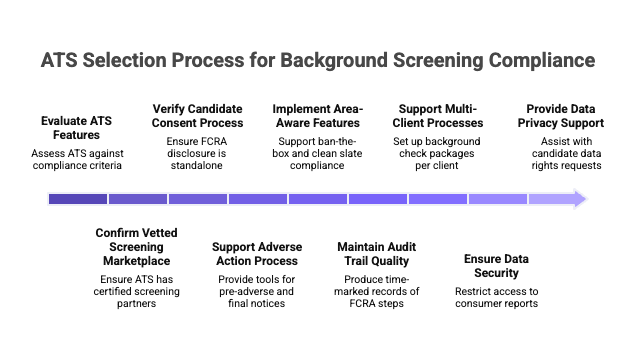
General feature demos rarely surface compliance process depth. To that end, evaluate any platform against these criteria before signing a contract:
ATS platforms vary significantly in background screening integration quality, and for staffing agencies, that variance carries direct compliance and legal consequences. FCRA adverse action failures carry per-violation legal damages and lawsuit exposure. Clean slate law complexity, ban-the-box limits, and case-by-case review requirements across dozens of areas cannot be managed reliably through manual workarounds. Platforms that automate FCRA records within a structured screening integration reduce error exposure and improve your ability to defend your practices when a compliance review occurs.
Platform selection is the beginning of a compliance program, not the end of one. Before your next ATS renewal or review, audit your current platform's screening integration against the criteria above and ensure your compliance program addresses the area-specific, privacy, and data handling duties that no ATS vendor can fulfill on your behalf.
Disclaimer: This article is intended for informational purposes only and does not constitute legal advice. Background check compliance duties under federal, state, and local law are highly area-specific and subject to ongoing legal and regulatory change. Staffing agencies should consult qualified employment law counsel before making compliance decisions. No ATS platform, screening integration, or process automation tool constitutes legal compliance with the FCRA or applicable state and local laws. Legal duties rest with the staffing agency as the user of consumer reports, not with the technology platform.
Recruiter & Editor
Charm Paz is an HR and compliance professional at GCheck, working at the intersection of background screening, fair hiring, and regulatory compliance. She holds both FCRA Core and FCRA Advanced certifications through the Professional Background Screening Association (PBSA) and supports organizations in navigating complex employment regulations with clarity and confidence.
With a background in Industrial and Organizational Psychology and hands-on experience translating policy into practice, Charm focuses on building ethical, compliant, and human-centered hiring systems that strengthen decision-making and support long-term organizational health.

Contact us today for efficient, FCRA-compliant screening solutions
designed to keep your hiring process moving safely and smoothly.



LEGAL DISCLAIMER: The information provided in this article is for general informational and educational purposes only and should not be construed as legal advice or a substitute for consultation with qualified legal counsel. While we strive to ensure accuracy, employment screening laws and regulations—including but not limited to the Fair Credit Reporting Act (FCRA), Equal Employment Opportunity Commission (EEOC) guidelines, state and local ban-the-box laws, industry-specific requirements, and other applicable federal, state, and local statutes—are subject to frequent changes, varying interpretations, and jurisdiction-specific applications that may affect their implementation in your organization. Employers and screening decision-makers are solely responsible for ensuring their background check policies, procedures, and practices comply with all applicable laws and regulations relevant to their specific industry, location, and circumstances. We strongly recommend consulting with qualified employment law attorneys and compliance professionals before making hiring, tenant screening, or other decisions based on background check information.