Oklahoma Oil Field Background Checks: Navigating Multi-Jurisdictional Compliance in Energy Operations

Oklahoma oil field background checks require specialized knowledge of overlapping regulatory frameworks. Therefore, energy companies must navigate state Corporation Commission requirements, federal pipeline security mandates, and tribal sovereignty considerations across one of the nation's most complex energy landscapes.
Key Takeaways
- Oklahoma energy company screening operates within overlapping jurisdictions including state Corporation Commission oversight, federal Transportation Security Administration pipeline security requirements, and tribal nation sovereignty affecting background check processes across 39 federally recognized tribes.
- Petroleum industry employee screening requirements vary significantly based on work location. Additionally, tribal lands require extra authorization processes and documentation beyond standard state employment verification, creating compliance complexity for companies operating multi-jurisdictional projects.
- Pipeline worker background checks must address Transportation Worker Identification Credential requirements for personnel accessing critical infrastructure facilities, maritime terminals, and interstate pipeline systems regulated under federal security mandates.
- Oklahoma's concentration of tribal energy resources requires understanding of Indian Country jurisdiction. Moreover, tribal employment preference laws, sovereign immunity considerations, and separate tribal regulatory frameworks affect screening protocol design and implementation.
- Risk mitigation strategies for Oklahoma oil field operations require documented screening policies addressing the complete hiring lifecycle. Consequently, these include initial applicant evaluation through periodic reverification, incident-triggered rescreening, and contractor management across production, midstream, and downstream operations.
- Organizations operating in Oklahoma's petroleum sector face unique screening challenges stemming from the state's position as the fifth-largest oil producer, extensive tribal jurisdiction covering 43% of land area, and critical infrastructure requiring heightened security protocols.
- Energy infrastructure designation as critical under Presidential Policy Directive 21 subjects certain facilities and personnel to heightened security protocols requiring thorough background verification programs.
- Comprehensive background verification for Oklahoma energy operations addresses multiple information sources providing distinct risk assessment data through criminal history, motor vehicle records, employment verification, and professional credential confirmation.
Understanding Oklahoma's Unique Energy Sector Screening Environment
Oklahoma's energy industry operates within regulatory and geographic contexts creating screening complexity beyond typical employment verification. Additionally, the convergence of state authority, federal security requirements, and tribal sovereignty establishes multi-layered compliance requirements. These factors affect workforce management strategies across all operational segments.
Oklahoma's Position in Domestic Energy Production
Oklahoma ranks among the nation's top energy-producing states with distinct characteristics. Currently, over 130,000 active oil and gas wells support approximately 70,000 direct industry jobs as of 2025. Furthermore, the state's petroleum infrastructure includes extensive gathering systems, processing facilities, and interstate pipeline networks connecting production operations to national markets.
This operational scale creates significant screening volume requirements as companies manage diverse workforces. Therefore, organizations must adjust verification procedures to position-specific risk profiles rather than applying uniform standards. As a result, energy sector operations span drilling operations, production maintenance, pipeline construction, and facility management.
Tribal Land Jurisdiction and Employment Implications
Tribal nations exercise governmental authority over approximately 43% of Oklahoma land area following the U.S. Supreme Court decision in McGirt v. Oklahoma. Consequently, this jurisdictional reality affects employment practices as companies operate facilities within reservation boundaries. In addition, energy operations must navigate tribal sovereignty while maintaining workforce compliance.
Employment rights ordinances establish tiered preference systems prioritizing tribal members for job opportunities. As a result, organizations operating within tribal reservation boundaries should review applicable employment ordinances to determine preference requirements. Moreover, background screening procedures should account for tribal preference verification, enrollment documentation review, and coordination with tribal employment offices before finalizing hiring decisions.
Tribal regulatory frameworks may impose screening requirements beyond state standards. For example, some include separate licensing systems for contractors, independent background verification mandates, or enhanced security clearances for energy operations on tribal lands.
Federal Security Requirements for Critical Infrastructure
Energy infrastructure designation as critical under Presidential Policy Directive 21 subjects certain facilities to heightened security protocols. Specifically, TSA administers Transportation Worker Identification Credential programs requiring background checks for workers accessing maritime facilities. Therefore, personnel need these credentials for certain pipeline operations and restricted energy infrastructure access.
TWIC requirements apply to individuals requiring unescorted access to secure areas of facilities regulated under MTSA provisions. Additionally, pipeline security under TSA Pipeline Security Guidelines establishes voluntary security recommendations that many operators adopt. These best practices address personnel surety including background screening for employees with access to critical pipeline control systems and operational information.
Oklahoma Corporation Commission Screening Standards
The Oklahoma Corporation Commission exercises regulatory authority over oil and gas operations through multiple divisions. Subsequently, these divisions address conservation, transportation, and safety requirements. Understanding Commission requirements provides the foundation for compliant screening program development.
Conservation Division Requirements
The Conservation Division regulates drilling, completion, and production operations through permitting systems. These systems address well construction, production reporting, and environmental protection standards. However, while the Commission does not mandate specific background checks for field personnel, regulatory violations create operational consequences.
Organizations should develop screening policies addressing roles with regulatory compliance responsibility:
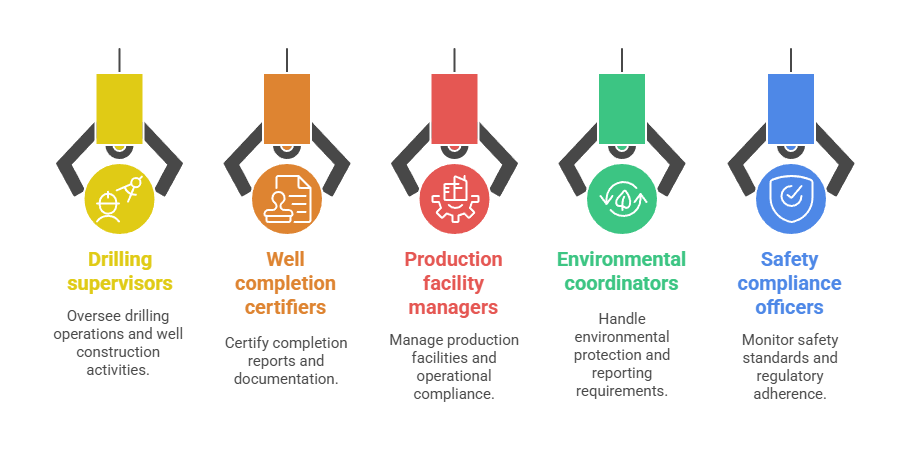
- Drilling supervisors: Personnel overseeing drilling operations and well construction activities
- Well completion certifiers: Individuals responsible for certifying completion reports and documentation
- Production facility managers: Employees managing production facilities and operational compliance
- Environmental coordinators: Staff handling environmental protection and reporting requirements
- Safety compliance officers: Personnel monitoring safety standards and regulatory adherence
Background verification for these positions should examine prior regulatory violations and professional license discipline. In addition, companies should also review environmental compliance history relevant to Oklahoma energy operations.
Transportation Division Pipeline Safety Programs
The Transportation Division enforces federal and state pipeline safety regulations under delegation from PHMSA. Furthermore, personnel working on pipeline construction, operation, and maintenance face qualification requirements under federal Operator Qualification rules. These rules establish competency standards for covered tasks throughout the pipeline lifecycle.
| Verification Component | Scope |
| Operator Qualification Programs | Documentation of employee training, evaluation, and qualification for specific pipeline activities |
| Pre-Employment Verification | Confirmation of applicant claims about prior qualifications before employment starts |
| Drug and Alcohol Testing | Substance abuse history under DOT regulations applying to pipeline operations |
| Marijuana Testing Policy | Consultation with legal counsel regarding Oklahoma's medical marijuana program and federal drug-free workplace requirements |
Organizations should integrate OQ verification into hiring processes for pipeline positions. Consequently, this ensures compliance with federal competency standards before authorizing independent work.
Public Utility Division Safety Standards
The Public Utility Division regulates natural gas distribution systems serving Oklahoma communities. Meanwhile, safety regulations under OCC Rule 165 address personnel qualifications, training documentation, and supervision requirements. Workers performing covered tasks on gas distribution systems must meet specific standards.
Organizations operating gas distribution systems should incorporate verification elements into hiring processes:
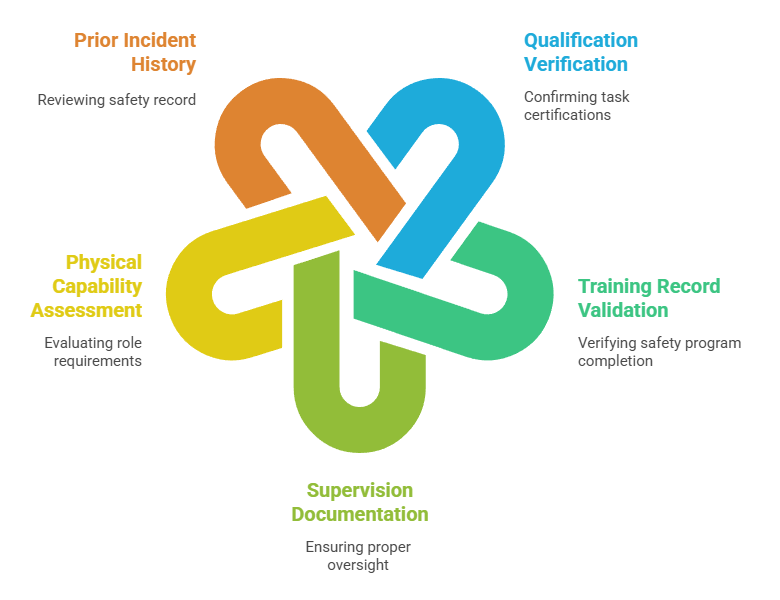
- Qualification verification: Confirming covered task certifications for distribution system work
- Training record validation: Verifying completion of required safety programs and ongoing education
- Supervision documentation: Ensuring proper oversight for trainee activities and skill development
- Physical capability assessment: Evaluating safety-sensitive role requirements post-conditional offer
- Prior incident history: Reviewing position-relevant incident involvement and safety record
Field operations personnel should meet regulatory qualification standards before receiving independent work authorization. Therefore, this approach protects operational integrity and worker safety.
Petroleum Industry Employee Screening Components
Comprehensive background verification for Oklahoma energy operations addresses multiple information sources. Specifically, each source provides distinct risk assessment data for hiring decisions. Effective programs integrate these components into unified evaluation frameworks that support consistent decision-making.
Criminal History Verification Standards
Criminal background checks form the foundation of energy sector screening programs across all operational segments. Additionally, Oklahoma provides criminal record access through the Oklahoma State Bureau of Investigation, which maintains databases of state arrests, charges, and convictions. Organizations should conduct OSBI checks for all positions involving site access, equipment operation, or unsupervised work in field locations.
| Record Type | Coverage | Application |
| State Criminal Records | Oklahoma arrests, charges, convictions | All field positions with site access |
| Federal Criminal Records | National criminal history through FBI databases | Applicants with out-of-state work history |
| Tribal Court Records | Convictions under tribal judicial systems | Positions within tribal reservation boundaries |
Organizations should establish written policies defining disqualifying offenses through individual assessment. Therefore, consider offense relationship to position duties, time elapsed since conviction, and evidence of rehabilitation. Common risk factors include violent offenses, theft-related convictions, substance-related crimes, and driving violations for vehicle operation roles.
Motor Vehicle Record Evaluation
Motor vehicle record verification addresses safety considerations for positions requiring vehicle operation in field environments. In particular, Oklahoma energy operations frequently require workers to drive personal or company vehicles to well sites, pipeline locations, and remote facilities. The Oklahoma Department of Public Safety maintains driving records documenting violations, suspensions, and accident involvement.
Organizations should obtain MVR reports for positions involving regular driving while establishing evaluation criteria. Specifically, assessment factors include violation severity, frequency patterns, and recency of incidents. Moreover, commercial driver's license verification applies to positions operating heavy equipment, tanker trucks, and specialized vehicles requiring CDL credentials with appropriate endorsements.
Employment History and Reference Verification
Prior employment verification confirms applicant-provided work history accuracy while identifying performance concerns. Furthermore, energy industry employment verification should address previous oil and gas experience, reasons for leaving prior positions, and eligibility for rehire. Safety incident involvement requires particular attention given the high-risk nature of field operations.
Organizations should develop structured reference inquiry procedures addressing key risk indicators:
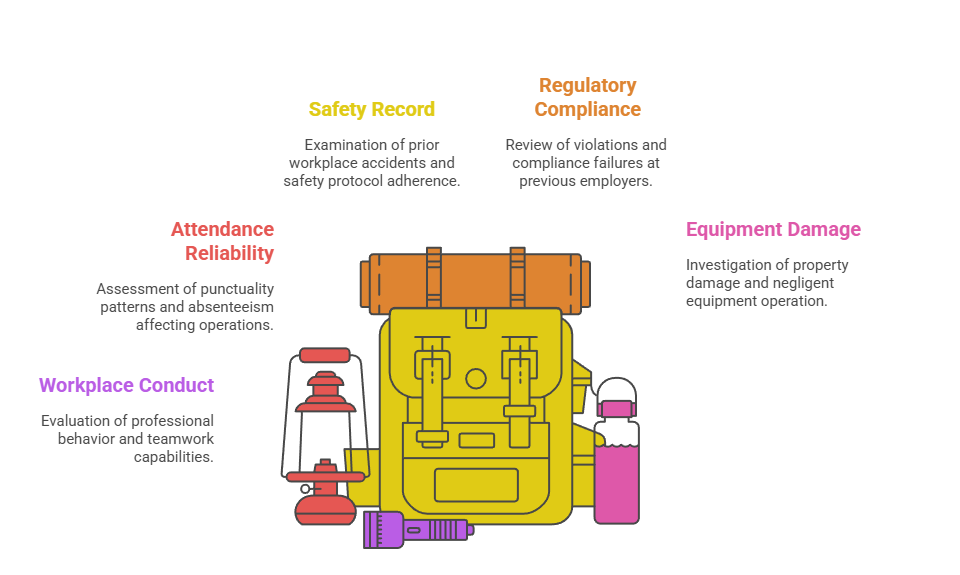
- Safety record: Examination of prior workplace accidents, near-miss incidents, and safety protocol adherence
- Regulatory compliance history: Review of violations, citations, or compliance failures at previous employers
- Attendance reliability: Assessment of punctuality patterns and absenteeism affecting operational continuity
- Equipment damage incidents: Investigation of property damage, tool misuse, or negligent equipment operation
- Workplace conduct: Evaluation of professional behavior, teamwork capabilities, and supervisory relationships
Reference sources should include direct supervisors familiar with applicant performance. In contrast, human resources contacts typically provide only dates and titles without substantive performance insights.
Pipeline Worker Background Checks and TWIC Requirements
Pipeline operations face specialized screening requirements reflecting critical infrastructure protection mandates. Consequently, organizations operating gathering systems, transmission pipelines, and processing facilities must navigate enhanced verification requirements. Federal security protocols establish baseline standards across interstate operations.
Transportation Worker Identification Credential Process
TWIC cards provide biometric credentials enabling access to secure maritime facilities and certain pipeline locations under TSA jurisdiction. Therefore, the credential system ensures consistent security standards across critical infrastructure sites. Personnel requiring unescorted access to TWIC-regulated facilities must complete TSA background checks addressing criminal history, immigration status, and terrorism-related concerns.
The application process requires specific steps and documentation:
- Fingerprint submission: Biometric data collection at authorized centers for identity verification
- Personal information disclosure: Complete personal history including residence, employment, and travel records
- Fee payment: Application costs covering background check processing and credential issuance
- Processing period: Application review typically requiring 4-6 weeks from application to credential receipt
- Renewal tracking: Five-year validity requiring systems to monitor expiration dates and start timely renewals
TSA maintains specific disqualifying factors for TWIC eligibility including certain criminal convictions and immigration violations. Therefore, organizations should consult current TSA guidance and legal counsel as criteria change through regulatory updates.
Critical Infrastructure Protection Standards
Energy facilities designated as critical infrastructure face enhanced security expectations under federal guidelines. In particular, TSA Pipeline Security Guidelines recommend personnel security programs addressing background screening, insider threat detection, and access control. These voluntary standards have become industry best practices for major operators.
Organizations should assess which facilities fall within critical infrastructure classifications. Subsequently, risk-based screening protocols must address identified vulnerabilities specific to each operation. Documentation of security program implementation shows regulatory compliance and operational commitment to infrastructure protection.
Interstate Pipeline Operations Coordination
Pipeline systems crossing state boundaries create multi-jurisdictional screening challenges for workforce management. As a result, organizations must employ workers in Oklahoma and neighboring states while maintaining consistent standards. Companies should establish standardized screening protocols applicable across operational territories for all personnel.
| Verification Element | Multi-State Requirement |
| Criminal History | National databases covering all states where applicant resided or worked |
| Driving Records | MVR reports from each state where employees will operate vehicles |
| Employment Verification | Confirmation regardless of prior employer location or jurisdiction |
| Marijuana Testing | Legal counsel consultation regarding varying state approaches and federal requirements |
Marijuana testing policies require particular attention given varying state medical and recreational programs. Consequently, organizations should establish clear policies for positions subject to federal regulations versus those governed solely by state law.
Natural Gas Worker Background Checks and Safety Clearances
Natural gas operations include production, gathering, processing, and distribution activities with distinct characteristics. Additionally, each operational segment presents unique safety risks requiring appropriate personnel screening approaches. Understanding these operational differences enables risk-appropriate verification program design tailored to specific hazards.
High-Pressure Systems and Compressor Stations
Personnel working on high-pressure natural gas systems require specialized training given catastrophic failure risks. Therefore, organizations should screen for prior safety violations, accident involvement, and regulatory non-compliance in applicant backgrounds. Reference checks should specifically explore safety record and willingness to follow established procedures.
Substance abuse screening takes particular importance for high-pressure system operators. Specifically, impairment risks require complete drug and alcohol testing programs addressing pre-employment screening and random testing. Organizations must also implement post-accident protocols for incident investigation and safety assurance.
Hydrogen Sulfide Safety Considerations
Sour gas operations containing hydrogen sulfide require personnel trained in H2S hazards and emergency response. Consequently, background verification for sour gas operations should confirm completion of H2S safety training. Prior experience in sour gas environments shows familiarity with unique hazards and emergency procedures.
Organizations should review applicant history for safety violations and failure to follow procedures. Furthermore, terminations related to safety non-compliance indicate potential risks unsuitable for H2S environments. Emergency response capability assessment ensures personnel can react appropriately during exposure incidents.
Processing Plant Operations
Natural gas processing facilities combine high-pressure systems, flammable materials, and sophisticated equipment. Therefore, these multi-hazard environments require qualified operators with proven competency. Screening for processing plant positions should address technical competency, safety record, and abnormal situation response.
Verification components include prior processing experience claims, training credential confirmation, and performance history evaluation:
- Technical certification validation: Confirming process technology training and specialized equipment qualifications
- Safety performance review: Examining incident rates, near-miss reporting, and emergency response participation
- Operational competency assessment: Evaluating understanding of process control, equipment monitoring, and troubleshooting capabilities
Previous facilities provide performance history revealing operational judgment and decision-making abilities under pressure situations.
Tribal Nation Compliance and Sovereignty Considerations
Oklahoma's tribal nations exercise governmental authority affecting employment practices and regulatory compliance. As a result, energy companies must navigate tribal sovereignty while maintaining consistent screening standards. This balance requires understanding of unique legal frameworks and cultural sensitivity.
Understanding Tribal Employment Rights Ordinances
Many Oklahoma tribes maintain employment rights ordinances establishing tiered preference systems. Specifically, these systems prioritize tribal members for employment opportunities within reservation boundaries. Organizations operating within tribal reservation boundaries should review applicable tribal employment ordinances to determine whether preference requirements affect recruitment processes.
Screening procedures should accommodate tribal preference while maintaining consistent evaluation standards:
- Identical background check criteria: Applying the same verification standards to all applicants regardless of tribal enrollment status
- Tribal enrollment confirmation: Verifying applicant claims about preference eligibility through proper documentation channels
- Tribal employment office coordination: Establishing communication regarding preference procedures and compliance requirements
- Selection documentation: Demonstrating compliance with tribal ordinances when choosing among qualified candidates meeting screening standards
Legal counsel should guide policy development addressing tribal preference integration. Therefore, this ensures consistent screening standards while respecting tribal sovereignty and employment rights.
Tribal Regulatory Frameworks
Tribal nations may establish separate regulatory systems governing energy operations on tribal lands. Furthermore, these systems include permitting requirements, environmental standards, and employment regulations distinct from state oversight. Some tribes maintain independent background check requirements for contractors and vendors operating within their jurisdictions.
| Tribal Requirement | Compliance Action |
| Tribal Police Clearances | Coordination with tribal law enforcement for background verification |
| Tribal Court Record Searches | Enhanced verification procedures addressing tribal judicial records |
| Tribal Business Licensing | Contractor authorization processes beyond state licensing requirements |
| Tribal Employment Preference | Documentation of preference compliance in hiring decisions |
Organizations should coordinate with tribal regulatory offices to understand specific requirements. Subsequently, incorporating tribal verification into standard screening workflows ensures consistent compliance across all operational territories.
Coordination with Tribal Employment Offices
Tribal employment offices serve multiple functions including job placement assistance and compliance monitoring. In addition, these offices support tribal workforce development programs and oversee preference implementation. Energy companies should establish working relationships with tribal employment staff to facilitate effective coordination.
Dispute resolution regarding tribal employment issues should involve tribal employment offices as primary contacts. Moreover, legal counsel familiar with Indian Country jurisdiction provides additional guidance for complex situations. This collaborative approach respects tribal sovereignty while maintaining operational requirements and hiring standards.
Risk Mitigation Strategies for Oklahoma Energy Operations
Effective background screening supports broader risk management goals addressing safety and regulatory compliance. Furthermore, strategic screening program design integrates verification into complete frameworks. These frameworks address the complete employment lifecycle from hiring through separation.
Incident-Triggered Rescreening Procedures
Organizations should establish protocols defining incidents warranting rescreening to ensure consistent application. Subsequently, rescreening following incidents should address criminal history updates, motor vehicle record changes, and substance abuse screening where circumstances suggest impairment. Legal counsel should review rescreening policies before implementation given discrimination concerns and privacy rights.
Event-triggered rescreening maintains workforce integrity after significant incidents:
- Workplace accidents: Major incidents involving injury, property damage, or environmental release requiring investigation
- Safety violations: Serious procedural non-compliance showing disregard for established safety protocols
- Equipment damage: Significant property damage suggesting negligence, impairment, or competency concerns
- Regulatory citations: Violations resulting in agency enforcement actions or operational restrictions
- Security breaches: Unauthorized access, credential violations, or other security protocol failures
Adverse action procedures must follow FCRA requirements when rescreening reveals disqualifying information. Therefore, consistent application across similar positions protects against discrimination claims.
Contractor and Vendor Management
Energy operations extensively utilize contractors for drilling, construction, maintenance, and specialized services. Additionally, contractors create similar risks to direct employees requiring equivalent screening standards. Organizations should extend screening requirements to contractor personnel through contractual provisions and verification protocols.
| Contract Element | Requirement |
| Master Service Agreements | Background screening requirements specifying criminal history checks, drug testing, and MVR verification |
| Qualification Confirmation | Professional licensing and technical certification verification before site access authorization |
| Documentation Maintenance | Contractor obligation to maintain screening records and provide verification upon request |
| Personnel Standards | Prompt remediation for personnel failing to meet standards including site removal or reassignment |
Verification protocols should mirror internal employee standards. Consequently, this ensures consistent risk management across direct and contract workforces.
Continuous Monitoring Programs
Traditional background checks provide point-in-time verification at hiring. However, post-hire developments may include new criminal charges, license suspensions, or regulatory violations. Continuous monitoring programs require careful legal review addressing employee notification and consent requirements under federal and state law.
Organizations should consult legal counsel regarding continuous monitoring program design before implementation. Therefore, obtain appropriate employee consent through reviewed disclosure documents complying with FCRA standards. Apply monitoring consistently across positions with similar risk profiles to avoid discrimination concerns and ensure fair treatment.
Creating Comprehensive Screening Policies
Documented policies provide operational guidance and support consistent application across hiring decisions. In addition, effective policies address screening scope, disqualifying criteria, evaluation procedures, and recordkeeping requirements. These written standards establish defensible practices during legal challenges and regulatory audits.
Policy components should include covered positions, verification components, disqualifying factors, and evaluation procedures:
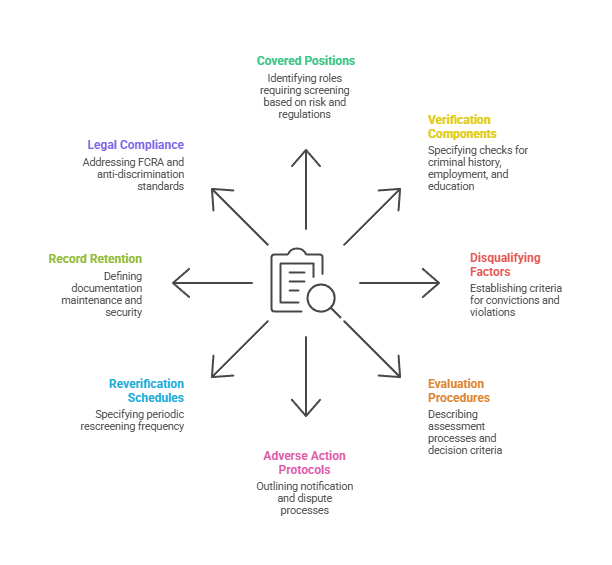
- Covered positions: Defining which roles require background screening based on risk assessment and regulatory requirements
- Verification components: Specifying criminal history checks, employment verification, education confirmation, credential validation, and MVR checks
- Disqualifying factors: Establishing individual assessment frameworks for convictions, violations, and discrepancies considering position relationship, time elapsed, and rehabilitation evidence
- Evaluation procedures: Describing individual assessment processes, decision criteria, and documentation standards
- Adverse action protocols: Outlining applicant notification procedures, dispute processes, and decision documentation requirements
- Reverification schedules: Specifying periodic rescreening frequency and events triggering additional verification
- Record retention: Defining documentation maintenance periods and storage security measures
- Legal compliance: Addressing FCRA requirements, state background check laws, and anti-discrimination standards
Policies should undergo legal counsel review ensuring compliance with federal Fair Credit Reporting Act and Oklahoma statutes. Additionally, tribal regulations apply where operations occur within reservation boundaries.
Conclusion
Oklahoma oil field background checks require specialized knowledge navigating complex regulatory frameworks. Therefore, organizations implementing thorough screening programs addressing criminal history, motor vehicle records, employment verification, and credential confirmation position themselves for regulatory adherence and workforce safety. These practices ensure operational integrity across Oklahoma's unique energy landscape.
Frequently Asked Questions
What background check components do Oklahoma energy companies typically require for field positions?
Oklahoma petroleum industry screening generally includes Oklahoma State Bureau of Investigation criminal history checks and motor vehicle record verification for driving positions. Additionally, employment history confirmation covering previous oil and gas experience and drug testing addressing DOT requirements where applicable are standard. Furthermore, verification may include professional license confirmation for specialized positions.
How do tribal employment preferences affect background screening procedures?
Tribal employment rights ordinances establish preference systems prioritizing tribal citizens within reservation boundaries at the candidate selection stage. Therefore, organizations should apply identical background check criteria to all applicants regardless of tribal enrollment status. Moreover, background verification should include tribal enrollment confirmation for applicants claiming preference eligibility with coordination through tribal employment offices.
What are TWIC requirements for Oklahoma pipeline workers?
Transportation Worker Identification Credential requirements apply to personnel needing unescorted access to secure maritime facilities and certain pipeline locations. Specifically, TWIC application involves TSA background checks addressing criminal history, immigration status, and terrorism-related concerns with processing typically requiring 4-6 weeks. Additionally, TWIC credentials require renewal every five years with organizations needing tracking systems to prevent access lapses.
How should organizations handle marijuana testing given Oklahoma's medical marijuana program?
Positions subject to Department of Transportation regulations must maintain marijuana testing regardless of state medical authorization given federal safety requirements. However, non-DOT positions allow greater employer discretion, though organizations may maintain testing policies based on safety considerations. Therefore, organizations should establish clear written policies and consult legal counsel regarding evolving marijuana law implications.
What criminal history factors typically disqualify applicants from Oklahoma energy positions?
Organizations should establish written policies defining disqualifying offenses through individual assessment considering offense relationship to duties and time elapsed. Specifically, common risk factors include violent offenses, theft-related convictions, substance-related crimes, and driving violations for vehicle operation positions. Additionally, legal counsel should review exclusion criteria for anti-discrimination compliance.
Do background check requirements differ between drilling and pipeline operations?
Background screening requirements vary based on operational segment and position responsibilities rather than categorical distinctions. For example, drilling operations may emphasize well operator license verification and motor vehicle records. In contrast, pipeline positions require enhanced focus on DOT operator qualification confirmation and potential TWIC credential needs with documented justification for verification scope variations.
How frequently should organizations conduct reverification for current employees?
Reverification frequency depends on position risk profile and regulatory requirements with professional license positions benefiting from annual verification. Meanwhile, general field positions may warrant reverification every 3-5 years absent triggering events. Therefore, organizations should establish documented reverification policies balancing compliance assurance against administrative burden with legal counsel review.
Additional References
- Oklahoma Corporation Commission Oil and Gas Conservation Division
https://www.occeweb.com/og/ogindex.html - Pipeline and Hazardous Materials Safety Administration - Oklahoma Program
https://www.phmsa.dot.gov/state-programs/oklahoma - Transportation Security Administration - TWIC Program
https://www.tsa.gov/for-industry/twic - SHRM Background Screening for Energy Sector Employers
https://www.shrm.org/topics-tools/employment-law-compliance/background-screening-energy-sector - Oklahoma Indian Affairs Commission - Tribal Directory
https://oklahoma.gov/oiac.html
Still have questions?
Get in touch with our team today for a personalized demo and discover how our tailored volume pricing and packages can drive results for your business!
How useful was this page?*
Note: your comments are anonymous. We use them to improve the website. Do not include any personal details.
Visit our FCRA Compliance Tool or leave a message here if you need a response.
Credits

From the blog Explore the GCheck Content Hub

What Shows Up on a Home Health Aide Background Check: A Complete Compliance Guide for Employers and Job Seekers
4 Dec, 2025 • 18 min read
Hospital Volunteer Background Check: Complete Compliance Guide for Healthcare Facilities
4 Dec, 2025 • 20 min read
Florida MVR Check: Complete Guide to Driving Record Screening for Employers
4 Dec, 2025 • 16 min readThe information provided in this article is for general informational and educational purposes only and should not be construed as legal advice or a substitute for consultation with qualified legal counsel. While we strive to ensure accuracy, employment screening laws and regulations—including but not limited to the Fair Credit Reporting Act (FCRA), Equal Employment Opportunity Commission (EEOC) guidelines, state and local ban-the-box laws, industry-specific requirements, and other applicable federal, state, and local statutes—are subject to frequent changes, varying interpretations, and jurisdiction-specific applications that may affect their implementation in your organization. Employers and screening decision-makers are solely responsible for ensuring their background check policies, procedures, and practices comply with all applicable laws and regulations relevant to their specific industry, location, and circumstances. We strongly recommend consulting with qualified employment law attorneys and compliance professionals before making hiring, tenant screening, or other decisions based on background check information.