


New York's education background check process operates across three separate jurisdictional systems: DCJS for state criminal history, FBI for national records, and NYSED for certification clearance, with NYC DOE maintaining distinct protocols. Understanding the procedural sequencing, conditional hiring limitations, and realistic processing timelines in 2026 is essential for maintaining compliant hiring workflows while managing operational pressures.
Key Takeaways
- New York requires separate criminal history submissions to both DCJS and FBI, with NYSED processing certification eligibility independently of criminal clearances.
- NYC DOE operates a parallel fingerprint clearance system that does not automatically transfer to other New York districts or private schools.
- Conditional employment prior to full clearance carries significant legal risk and requires documented written authorization under specific statutory provisions.
- Processing timelines in 2026 vary substantially between digital livescan submissions (typically 3-7 business days) and ink-based card systems (often 4-8 weeks or longer).
- NYSED fingerprint clearance for certification purposes follows separate timelines and procedures from employment-specific criminal history checks.
- Interstate candidates with existing clearances from other states must complete New York's full process, as reciprocity does not extend to background screening requirements.
- Private and charter schools face identical fingerprinting mandates as public district schools when employing individuals in direct student contact roles.
- Audit-ready documentation requires maintaining proof of submission, receipt dates, and written clearance confirmation for every covered position.
Understanding New York's Layered Background Check Architecture
The New York education background check process differs fundamentally from single-clearance systems used in many other states. Rather than one unified screening, New York mandates parallel submissions to multiple agencies, each serving distinct statutory purposes. Employers must navigate DCJS requirements under Executive Law Section 837, FBI protocols governed by federal statute, and NYSED certification processes established under Education Law Section 305.
Criminal history screening focuses on identifying disqualifying convictions rather than evaluating all criminal justice contacts. This distinction matters operationally, as arrest records without dispositions, sealed records, and non-conviction data face strict usage limitations. Employers cannot rely solely on information provided through one channel, assuming comprehensive coverage.
| Agency | Primary Function | Geographic Scope | Statutory Basis |
| DCJS | State criminal history records | New York State convictions | Executive Law § 837 |
| FBI | Federal and interstate criminal records | National via Interstate Identification Index | Federal statute |
| NYSED | Certification eligibility and professional fitness | Professional conduct (all jurisdictions) | Education Law § 305 |
New York teacher background checks incorporate employment history verification, professional reference review, and credential authentication beyond criminal records. Education Law Section 3035 establishes requirements for contacting prior educational employers to verify employment history, including inquiry into reasons for separation and eligibility for rehire where such information is available. These employment verification components operate independently of fingerprint-based criminal checks, requiring separate documentation and compliance tracking.
Jurisdictional Authority and Scope
DCJS maintains New York State criminal history records and coordinates with law enforcement agencies statewide for conviction data. This system captures state-level prosecutions but does not automatically include federal convictions or out-of-state criminal records without interstate data sharing. FBI National Criminal History Checks provide broader geographic coverage through the Interstate Identification Index, though reporting completeness depends on contributing agencies' submission practices.
NYSED exercises regulatory authority over certification eligibility and moral character determinations for licensed educators. This authority extends beyond criminal history analysis to include professional misconduct findings, licensure discipline from other states, and substantiated allegations of inappropriate conduct with minors. An individual may possess clean criminal records while facing NYSED certification denial based on professional conduct history.
When I consider the education screening process that New York has in place, I am reminded of how multi-faceted and deliberate the process of compliance is in this arena. It is not merely a background check but an entire process that involves timelines, documents, and agencies. While it can be an operationally intensive process, it is also an important reflection of the gravity of protecting children and upholding public trust. I have found that it is an approach that fundamentally changes the HR mindset from speed to convenience to stewardship to accountability. In education, the screening process is not about the efficiency of the process itself but about living up to the duty that comes with every new hire.
Private School Background Check Requirements
Private schools in New York face identical fingerprinting mandates for covered positions, despite common misconceptions about regulatory exemptions. Education Law Section 305(30) requires nonpublic schools to fingerprint employees or prospective employees in positions involving direct and unsupervised contact with students. Religious or independent school status does not create exceptions to this requirement.
The definition of "direct and unsupervised contact" creates practical compliance questions. Positions clearly requiring fingerprinting include:
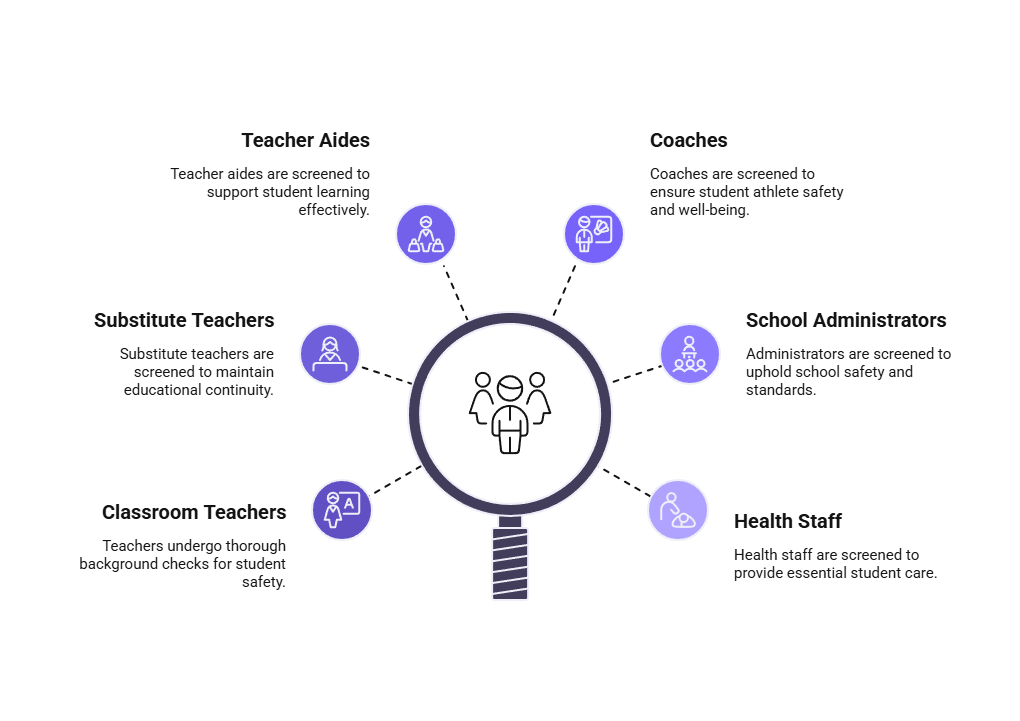
- Classroom teachers and substitute teachers
- Teacher aides and paraprofessionals
- Coaches and athletic staff
- Student activity supervisors and club advisors
- Principals, assistant principals, and guidance counselors
- School nurses and health office staff
Administrative roles with only incidental or supervised student contact may fall outside mandatory fingerprinting, but conservative interpretation favors inclusion when uncertainty exists. Private school background checks in New York follow the same submission procedures as public school screenings, using identical LiveScan technology or ink-based fingerprint card systems.
NYSED Fingerprint Clearance: Process and Timeline Realities
How long does NYSED fingerprint clearance take? As of 2026, digital submissions through LiveScan typically process within three to seven business days when no criminal history requires additional review, though processing times may vary based on submission volume and agency capacity. This timeline reflects the electronic transmission of fingerprint data to DCJS and FBI, automated searching against criminal history databases, and return transmission of results to NYSED and the employing entity.
Complications extend this baseline timeline significantly. When fingerprint submissions generate criminal history matches, manual review processes begin. DCJS and FBI staff must verify identity matches, confirm disposition accuracy, and determine reporting obligations under applicable statutes. This secondary review can extend processing by several weeks, particularly during peak hiring periods when submission volumes strain available personnel resources.
LiveScan vs. Ink-Based Submission Systems
| Method | Typical Processing Time | Image Quality Issues | Geographic Availability |
| LiveScan (digital) | 3–7 business days | Minimal rejections | Metropolitan areas (widespread) |
| Ink-based cards | 4–8 weeks | Common rejections requiring resubmission | Rural areas (limited alternatives) |
LiveScan technology captures fingerprints digitally at approved scanning locations and transmits data electronically to processing agencies. This method reduces image quality problems that commonly cause rejection of ink-based cards, and eliminates physical mail delays. Most metropolitan areas in New York maintain multiple LiveScan locations, though rural areas may offer limited access requiring travel or reliance on ink-based alternatives.
Ink-based fingerprint cards require physical completion by trained technicians, mail submission to processing agencies, and manual entry of data into electronic systems. Total processing time for ink-based submissions often reaches four to eight weeks, with additional delays when card quality issues require resubmission.
Conditional Hiring and Legal Exposure
Conditional employment prior to complete fingerprint clearance may be permissible under Education Law Section 3035(2-a) for certain positions, subject to strict written authorization and documentation requirements. Employers must document the conditional nature of employment in writing, specify that continuation depends on satisfactory clearance results, and maintain proof that fingerprint submissions occurred prior to the employee beginning work. Failure to meet these documentation requirements can create liability exposure if negative information later emerges.
The business pressure to begin employment before clearances arrive is substantial, particularly during August hiring for September school openings. However, conditional hiring creates risk that criminal history results will require employment termination after students and families have formed relationships with the employee.
Some positions face absolute prohibitions on conditional employment:
- School bus drivers cannot begin transporting students under any conditional arrangement
- Positions involving handling of controlled substances or medications
- Roles with access to sensitive student records or confidential information
- Security personnel and school resource officers
NYC DOE Clearance: A Separate Compliance Track
NYC DOE fingerprint clearance operates through the Office of Personnel Investigation (OPI), which maintains separate submission portals, processing timelines, and clearance documentation. Candidates offered employment in NYC public schools receive specific instructions for scheduling fingerprint appointments through NYC-designated facilities. Attempting to substitute NYSED or another district's clearance for NYC DOE requirements results in processing delays and potential offer rescission.
Processing timelines for NYC DOE clearances typically align with statewide averages during normal periods but can extend substantially during peak hiring. The decentralized nature of hiring across more than 1,800 schools creates volume surges that strain centralized clearance operations.
| NYC DOE Clearance Component | Processing Entity | Transfer to Other Districts |
| Fingerprint/criminal history | Office of Personnel Investigation (OPI) | Does not transfer |
| Prior NYC employment verification | Internal personnel database | N/A |
| Historical disciplinary review | NYC DOE records system | Does not transfer |
NYC DOE maintains additional screening requirements beyond fingerprint clearance, including employment verification through previous NYC DOE service and review of prior disciplinary history within the system. These internal database checks occur simultaneously with criminal history screening but follow separate approval chains.
Charter School Clearance Requirements
Charter schools authorized by entities other than NYC DOE do not utilize the OPI clearance system, even when physically located within New York City boundaries. SUNY-authorized charter schools, Board of Regents charter schools, and those authorized by other approved entities submit fingerprints through standard NYSED channels. This creates potential confusion when charter schools recruit candidates from NYC DOE, as existing clearances do not transfer automatically.
Charter school background checks in New York must meet identical statutory standards as traditional public schools regarding fingerprinting, criminal history review, and employment verification. Charter authorizers may impose additional screening requirements as conditions of charter approval, creating school-specific obligations beyond baseline statutory mandates.
Interstate Candidates and Prior Clearance Limitations
Candidates holding current teaching licenses and background clearances from other states commonly ask whether existing clearances satisfy New York requirements. The answer is uniformly no. New York requires completion of its full fingerprint submission and clearance process regardless of how recently another state completed comparable screening.
No reciprocity exists for background check purposes, even when license reciprocity provisions allow expedited certification. This lack of reciprocity reflects differences in state criminal history databases, variations in disqualifying offense definitions, and distinct legal standards for professional fitness determinations.
Federal database checks through the FBI present another complexity. While the FBI maintains national criminal history data, access to this information depends on state-authorized submissions. An FBI check completed for Pennsylvania employment purposes cannot be shared with New York employers, even if only weeks old. Privacy laws restrict re-disclosure of criminal history information beyond the authorized purpose, requiring fresh submissions for each new employment relationship.
Military and Federal Employment History
Candidates transitioning from military service or federal employment face identical New York fingerprint requirements despite existing security clearances. Department of Defense background investigations, even at Secret or Top Secret levels, do not satisfy state education employment screening mandates. The legal basis for accessing information differs, creating separate authorization and disclosure requirements.
Military personnel records and federal employment history may contain relevant information for hiring decisions but require separate verification processes. Complete compliance requires treating military and federal candidates identically to civilian applicants without prior clearances.
Managing Multi-Candidate Pipelines Under Time Constraints
School administrators managing hiring for multiple vacancies face operational pressure to process candidates quickly while maintaining complete compliance. Developing systematic workflows that separate candidate phases by clearance status helps prevent errors and documentation gaps.
Recommended workflow stages include:
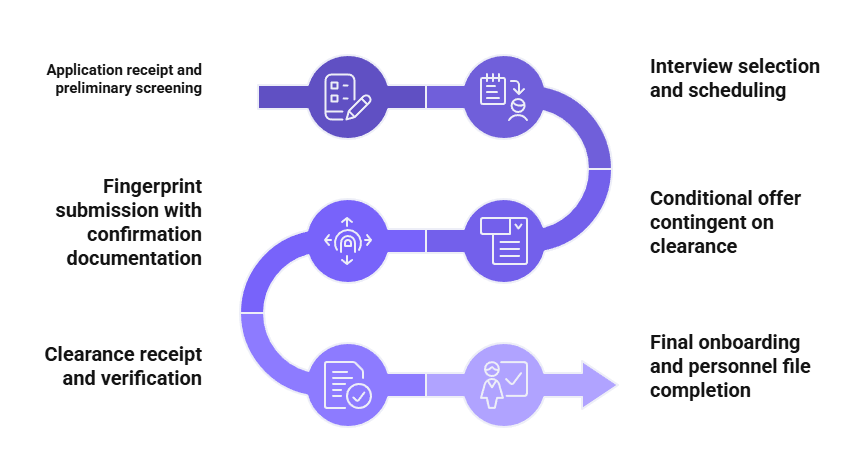
- Application receipt and preliminary screening
- Interview selection and scheduling
- Conditional offer contingent on clearance
- Fingerprint submission with confirmation documentation
- Clearance receipt and verification
- Final onboarding and personnel file completion
Tracking systems should capture submission dates, LiveScan or ink-based method used, confirmation numbers from DCJS and FBI, and actual clearance receipt dates. This documentation serves dual purposes: operational tracking to avoid losing candidates to competing offers, and audit evidence demonstrating compliance with mandatory screening requirements.
Peak Hiring Period Planning
August hiring for September start dates creates predictable processing delays as submission volumes overwhelm available capacity. HR administrators should initiate recruitment cycles earlier in spring rather than relying on summer hiring timelines.
| Hiring Timeline | Fingerprint Submission Window | Risk Level |
| May/June offers for September start | June/July (off-peak processing) | Low |
| July offers for September start | Late July/August (peak volume) | Moderate |
| August offers for September start | August/early September (severe delays) | High |
For positions known to turn over regularly, maintaining continuous recruitment pipelines with fingerprint submissions occurring in off-peak months reduces time pressure when vacancies arise. This approach requires careful communication about the conditional nature of offers and potential for rescission if clearances do not arrive or reveal disqualifying information.
Substitute teacher pools require particular attention to clearance timing. Schools generally cannot utilize substitute teachers, even in emergency situations, without completed clearances, as conditional employment provisions require documentation completed before work begins. Building substantial cleared substitute pools before the school year begins avoids situations where no cleared coverage exists for absent teachers.
Employment History Verification Beyond Criminal Records
New York teacher background checks must include contact with all previous educational employers for references addressing candidate performance, reasons for separation, and eligibility for rehire. Education Law Section 3035 establishes immunity protections for former employers providing reference information in good faith, removing common barriers to substantive reference discussions.
The mandatory nature of education employment verification means that candidate preferences not to contact certain employers do not excuse compliance obligations. When candidates request that specific employers not be contacted, employers face a decision point: proceed with contact despite objections and risk losing the candidate, or decline to continue the hiring process due to inability to complete required screening.
Employment verification should address specific behavioral indicators relevant to student safety and instructional effectiveness:
- Quality of interactions with students and families
- Response to supervision and constructive feedback
- Specific reasons for separation from employment
- Eligibility for rehire and any restrictions
- Performance in areas related to position responsibilities
Former employers cannot be compelled to provide detailed references, but thorough inquiry attempts must occur and be documented.
Professional Reference Quality Assessment
References provided by candidates vary substantially in quality and relevance. Personal references from non-professional contacts hold minimal value for employment decision-making, while references from supervisors with direct observation of candidate performance in educational settings provide meaningful insight.
Employers should specify required reference types in application materials, requesting contact information for direct supervisors rather than colleagues or subordinates. When previous educational employers decline to provide substantive references beyond employment date confirmation, employers face judgment calls about proceeding with hiring.
Technology-Assisted Screening and Ongoing Monitoring
Some school districts and private schools implement ongoing criminal record monitoring systems that flag new arrests or convictions of current employees between initial hiring and employment termination. These systems use name-based searches against public court databases and incarceration records, generating alerts when new criminal justice system contacts appear.
Implementation of continuous monitoring systems requires careful policy development addressing how alerts will be reviewed, what confirmation steps occur before employment action, and how false positive matches will be resolved. Automated systems commonly generate matches based on name similarities without conclusive identity verification.
Ongoing monitoring does not replace initial fingerprint-based screening but may supplement it by identifying post-hire criminal conduct. The value proposition depends on position risk levels, budget availability for system costs, and organizational capacity to manage alert workflows.
Disqualifying Offenses and Individualized Assessment
New York law establishes categorical disqualifications for certain convictions while requiring individualized assessment for others. Convictions for violent or serious felonies create automatic barriers to employment in educational settings involving student contact. Sex offense convictions universally disqualify candidates from school employment.
However, many conviction types require case-by-case analysis considering offense nature, time elapsed, rehabilitation evidence, and relationship to job responsibilities. Education Law Section 296(16) prohibits employment discrimination based on criminal history unless a direct relationship exists between the conviction and the job, or employment would create unreasonable risk to property or safety of individuals.
Factors for individualized assessment include:
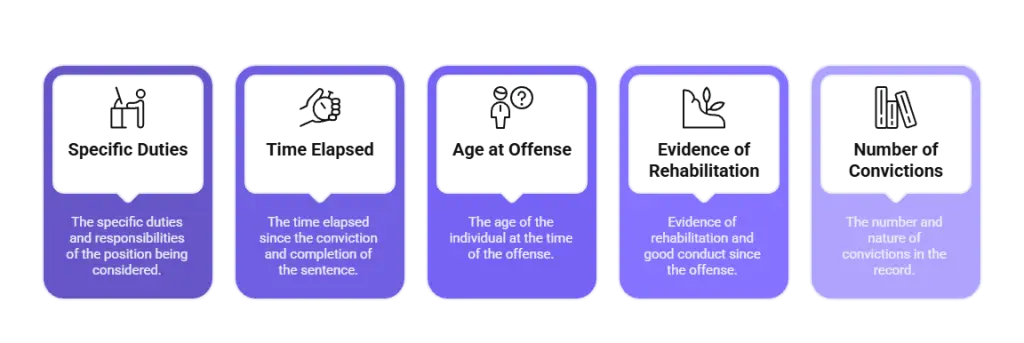
- Specific duties and responsibilities of the position
- Time elapsed since conviction and completion of sentence
- Age of the individual at the time of offense
- Evidence of rehabilitation and good conduct
- Number and nature of convictions in the record
The individualized assessment requirement creates documentation obligations when criminal history appears on screening results. Employers should memorialize the analysis conducted, factors considered, weight given to various elements, and reasoning supporting the hiring decision or adverse action.
FCRA Pre-Adverse Action Requirements
When criminal history information obtained through background screening leads to a decision not to hire or to terminate employment, federal Fair Credit Reporting Act requirements apply. Employers must provide the candidate with a pre-adverse action notice including a copy of the background check report and a written summary of rights under the FCRA.
| FCRA Step | Timing | Required Content |
| Pre-adverse action notice | Before final decision | Copy of report + summary of rights |
| Waiting period | Reasonable time (typically 5–7 business days) | Candidate opportunity to dispute |
| Final adverse action notice | After decision finalized | Source identification + dispute rights |
Following pre-adverse action notice, employers must allow reasonable time for the candidate to review information and dispute inaccuracies before finalizing the adverse decision. After the candidate has an opportunity to respond, employers taking final adverse action must provide additional notice identifying that the decision is now final.
Audit Preparation and Documentation Retention
Education department audits and certification reviews examine background check compliance as a standard component. Auditors verify that fingerprint clearances exist for all covered positions, that submissions occurred prior to employment commencement, and that documentation demonstrates timely completion of required processes.
Missing clearance documentation for even a small percentage of employees can trigger findings requiring corrective action and potential fiscal consequences. Documentation retention policies should preserve fingerprint submission confirmations, clearance result letters, and employment verification records for the duration of employment plus minimum seven years post-separation.
Audit-ready systems maintain organized documentation indexed by employee name, position, hire date, and clearance dates. Attempting to reconstruct clearance documentation years later when original records were not preserved often proves impossible, as agencies do not maintain indefinite historical confirmation records readily accessible to employers.
Third-Party Vendor Compliance
Schools utilizing third-party vendors for services involving student contact must ensure that vendor employees possess required clearances. This obligation extends to contractor staff such as bus companies, food service workers, custodial service providers, and educational consultants with building access.
Contracts should specify clearance requirements and obligate vendors to maintain documentation proving compliance. Verification of vendor compliance cannot rely solely on contractual representations. Periodic audit of vendor clearance files, with documented proof that each individual working in the school possesses valid fingerprint clearance, demonstrates diligence if questions later arise.
Conclusion
New York's education background check process requires navigation of multiple agency systems, strict attention to timing and documentation, and consistent application of individualized assessment standards. Compliance in 2026 depends on understanding that DCJS, FBI, and NYSED serve distinct functions requiring separate submissions and tracking. Employers who build systematic workflows, maintain comprehensive documentation, and allow realistic processing timelines achieve both legal compliance and effective hiring outcomes. In practice, this means that the process of background screening is treated as an integral part of compliance, rather than merely as an end-of-process administrative step. A well-structured process is not only essential in limiting regulatory risks but also in building trust within an institution in every hiring decision.
Frequently Asked Questions
What is the difference between DCJS clearance and NYSED fingerprint clearance?
DCJS clearance refers to criminal history results from New York State criminal justice databases, while NYSED fingerprint clearance incorporates both DCJS and FBI results into certification eligibility and employment suitability determinations. NYSED reviews criminal history in the context of professional fitness standards that extend beyond simple conviction reporting. Both are required but serve different regulatory purposes.
Can private schools in New York hire teachers without fingerprint background checks?
No. Education Law Section 305(30) requires private schools to fingerprint employees in positions involving direct and unsupervised contact with students. Religious or independent school status does not create exemptions from this requirement. Private school background checks in New York follow the same submission and clearance processes as public school screenings.
How long does the New York education background check process take in 2026?
LiveScan digital submissions typically process within three to seven business days when no criminal history requires review, though processing times may vary based on submission volume and agency capacity. Ink-based fingerprint card submissions often require four to eight weeks. Criminal history matches requiring manual review, peak hiring period volume, or card quality problems can extend timelines substantially beyond these ranges.
Do NYC DOE clearances transfer to other New York school districts?
No. NYC DOE fingerprint clearances do not satisfy requirements for employment in other districts, charter schools, or private schools. Each employer must complete separate fingerprint submissions and receive distinct clearance confirmations. Charter schools not authorized by NYC DOE follow NYSED procedures rather than OPI clearance systems.
Can schools begin employment before fingerprint clearances arrive?
Conditional employment may be permissible under Education Law Section 3035(2-a) for certain positions if documented in writing before the employee begins work, fingerprint submission occurred prior to start date, and the employer specifies that continuation depends on satisfactory results. However, some positions face absolute prohibitions on conditional employment, and operational risks make this practice appropriate only when unavoidable.
What happens if a current employee is arrested for a crime?
Employers are not automatically notified of employee arrests or convictions occurring after hire. Some districts implement ongoing monitoring systems that flag new criminal justice contacts, but no statutory requirement mandates such systems. When employers learn of arrests, individualized assessment is required before employment action, considering the nature of charges, relationship to job duties, and presumption of innocence.
Do out-of-state teaching licenses reduce New York background check requirements?
No. Candidates holding current licenses and clearances from other states must complete New York's full fingerprint submission and clearance process. No reciprocity exists for background screening purposes, even when certification reciprocity provisions allow expedited licensing. Prior clearances from other states do not satisfy New York requirements or support conditional hiring decisions.
What criminal convictions automatically disqualify candidates from school employment?
Convictions for violent felonies and sex offenses create categorical barriers to employment in positions involving student contact. Many other conviction types require individualized assessment under Education Law Section 296(16), evaluating the relationship between the conviction and job responsibilities, time elapsed, rehabilitation evidence, and risk to students or property. Blanket disqualification policies for non-violent convictions may violate anti-discrimination provisions.
Additional Resources
- DCJS Fingerprinting Information for Education Employers
https://www.criminaljustice.ny.gov/ojis/fingerprinting.htm - NYSED Fingerprint Clearance Requirements
https://www.nysed.gov/fingerprinting - FBI Criminal History Information Services
https://www.fbi.gov/services/cjis - FTC Summary of Fair Credit Reporting Act Rights
https://www.consumer.ftc.gov/articles/pdf-0096-fair-credit-reporting-act.pdf - New York State Education Law Section 3035
https://www.nysenate.gov/legislation/laws/EDN/3035

ABOUT THE CREATOR
GCheck Editorial Team
Meet the GCheck Editorial Team, your trusted source for insightful and up-to-date information in the world of employment background checks. Committed to delivering the latest trends, best practices, and industry insights, our team is dedicated to keeping you informed.
With a passion for ensuring accuracy, compliance, and efficiency in background screening, we are your go-to experts in the field. Stay tuned for our comprehensive articles, guides, and analysis, designed to empower businesses and individuals with the knowledge they need to make informed decisions.
At GCheck, we're here to guide you through the complexities of background checks, every step of the way.