

The Credibility Crisis Has a Gender Dimension
Resume embellishment is not a fringe behavior. In GCheck's 2026 Trust in Hiring Report, a national survey of 1,500 U.S. adults who recently applied for jobs, 93 percent admitted to at least one form of misrepresentation. The sheer scale means that lying on a resume is no longer an outlier risk. It is a market condition.
But the headline number obscures a more revealing pattern. When the data is broken down by gender, men and women both engage in hiring deception at very high rates, yet they do not do it the same way. Men's patterns skew toward aggressive, multi-front inflation: more resume misrepresentation, more AI-assisted tactics, more reference manipulation, and more job title embellishment. Women's patterns skew toward something different: protective concealment, particularly around caregiving and identity.
That distinction matters. It suggests the hiring system is not simply dealing with dishonest candidates. It is dealing with different forms of pressure that produce different strategic responses. Three core takeaways emerge from the data:
- Men engage in broader, more performance-oriented forms of deception across more categories simultaneously.
- Women are more likely to hide identity and caregiving details, reflecting adaptation to anticipated bias rather than pure opportunism.
- Both genders overwhelmingly want more transparent, human-reviewed screening, suggesting the demand for fairness transcends the gendered patterns of deception.
Men's Pattern Is Broader, Louder, and Easier to Spot
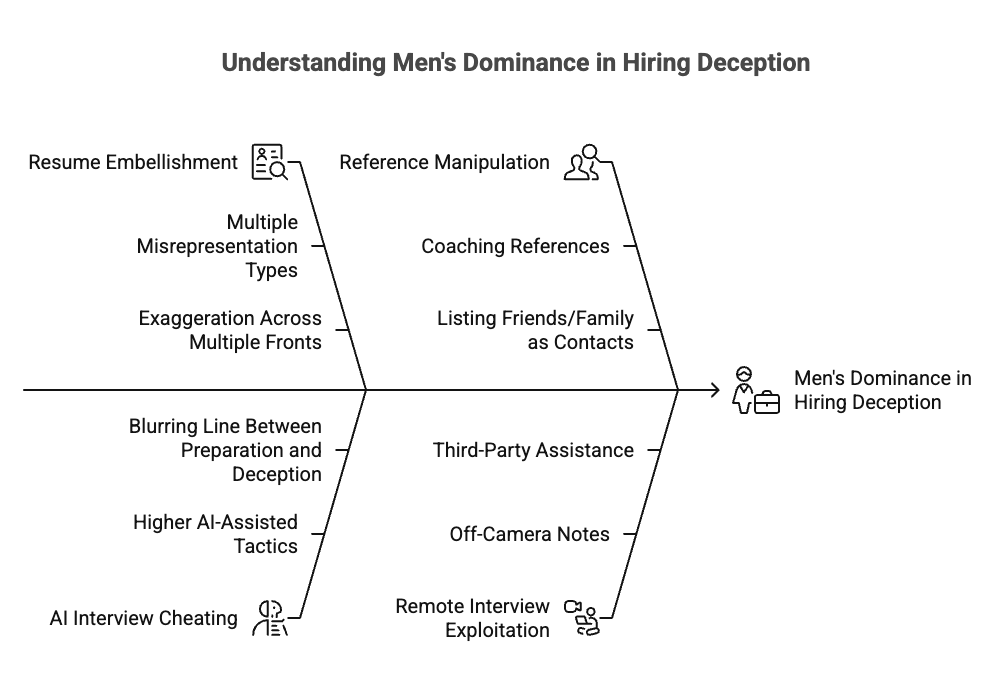
Men dominate nearly every category of overt hiring deception measured in the report. Among male respondents, 95.0 percent reported some form of resume misrepresentation, compared to 90.7 percent of women. The gap widens in specific behaviors:
- Resume embellishment at scale. Men reported an average of 5.7 misrepresentation types out of 13 measured, compared to 4.6 for women. The pattern is not limited to a single exaggeration. It spans multiple fronts.
- AI interview cheating. Men used more AI-assisted tactics on average (4.1 versus 3.5), including real-time answer generation and AI-completed assessments. The line between AI-assisted preparation and AI-assisted deception is blurring faster for male candidates.
- Reference manipulation. 71.9 percent of men reported manipulating their references, compared to 61.1 percent of women. This includes coaching references on what to say, listing friends or family as professional contacts, and asking coworkers to pose as supervisors. When traditional reference check questions are designed around the assumption that references are authentic, these tactics undermine the entire signal.
- Job title inflation. Men were nearly twice as likely to inflate their job title through identity-editing tactics: 38.3 percent versus 24.7 percent for women. Job title verification becomes critical when the gap between claimed and actual seniority is this wide.
- Remote interview exploitation. 81.2 percent of men reported exploiting remote interview conditions, versus 72.1 percent of women. Off-camera notes, real-time coaching from another person, and third-party assistance with technical assessments all featured prominently.
What these behaviors share is a strategy of amplification. Men's deception pattern reads less like isolated dishonesty and more like a competitive performance calibrated to weak verification expectations. The hiring culture rewards polished projection, and these findings suggest men are more aggressively optimizing for it.
Women's Pattern Is More Protective Than Expansive
Women's deception pattern tells a different story. While women engaged in identity editing at a slightly higher overall rate than men (82.8 percent versus 81.7 percent), the composition of that editing diverges sharply.
The most significant finding: women were more likely to hide caregiving responsibilities during the hiring process, at 38.9 percent compared to 31.9 percent of men. This is not a trivial gap, and it should not be interpreted the same way as inflating a job title or coaching a reference. Concealing caregiving status is a defensive response to a well-documented structural problem.
The motherhood penalty in hiring is one of the most replicated findings in employment research. Studies have consistently shown that mothers face lower callback rates, lower salary offers, and harsher competence judgments compared to equally qualified women without children and compared to fathers. A landmark study by Correll, Benard, and Paik (2007) found that mothers were recommended for hire at significantly lower rates and offered substantially lower starting salaries than non-mothers, while fathers faced no equivalent penalty. The EEOC has published specific enforcement guidance recognizing that caregiver discrimination, while not a standalone federal protected class, can violate Title VII and the ADA when it intersects with sex, disability, or other protected characteristics.
When nearly four in ten women in the GCheck survey chose to hide caregiving details, what signals is that about the hiring environment? Several things:
- Candidates perceive that disclosing caregiving status carries a tangible penalty, regardless of whether a specific employer intends to penalize it.
- The concealment is preemptive. It happens before any formal screening or background check, driven by expectation rather than experience with a particular employer.
- Unlike inflating a job title or fabricating a reference, hiding caregiving is not an attempt to claim something false. It is an attempt to prevent something true from being used unfairly.
The distinction between overt inflation and protective concealment is not just semantic. It points to a structural flaw in how hiring systems handle personal information, and it suggests that some forms of candidate "deception" are better understood as adaptations to bias.
Social Media Screening Has Expanded the Theater of Self-Presentation
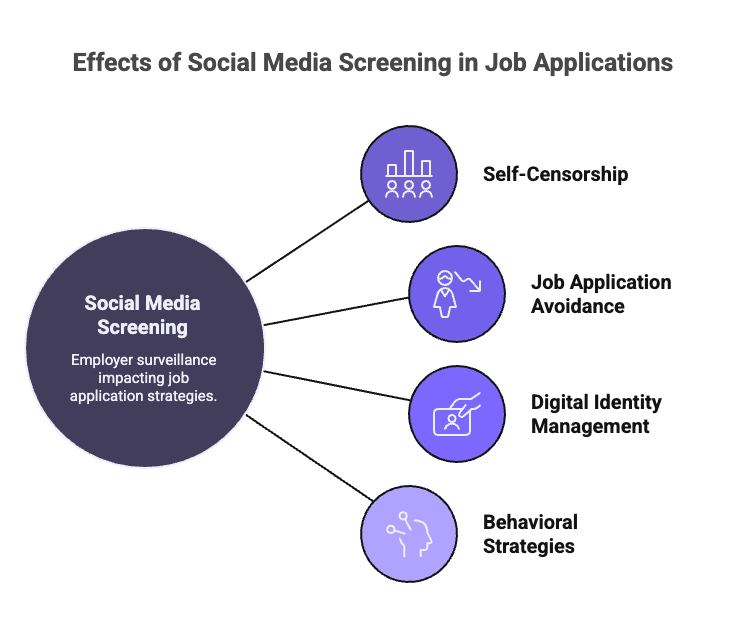
The trust problem extends well beyond resumes and interviews. Social media screening, whether formal or informal, has created an ambient layer of employer surveillance that candidates now manage preemptively.
Men reported higher rates of social media self-censorship (83.4 percent versus 76.8 percent) and were significantly more concerned about past social media content being judged by employers (60.4 percent versus 43.2 percent). Men were also far more likely to avoid applying to jobs because of screening fears: 52.4 percent versus 35.0 percent of women.
The behavioral consequences of perceived social media scrutiny go beyond the formal social media background check that an employer might run during a hiring process. Candidates are now managing their digital identities continuously:
- Making accounts private during job searches (58 percent of all respondents).
- Stopping posting on certain topics to avoid employer interpretation (53 percent).
- Pausing posting altogether while actively looking for work (48 percent).
- Deleting past posts or photos preemptively (43 percent).
The implication for employers is important: social media screening does not simply surface existing information. It changes the information that exists. Candidates who believe they are being watched curate a searchable self that may be less authentic than the resume sitting in the ATS. Employers relying on social media signals should factor in the degree to which those signals have already been shaped by the expectation of surveillance.
This Is No Longer Just About Lying on Resumes
The phrase "lying on a resume" still dominates the public conversation about hiring integrity. But the GCheck data reveals a trust problem that has grown far beyond a single document. Hiring deception now spans AI tools, remote interview environments, reference networks, digital identities, and self-reported credentials in ways that traditional verification was never designed to catch.
Several assumptions that once anchored the hiring process no longer hold:
- References validate the candidate's story. With over 70 percent of men and 61 percent of women reporting reference manipulation, reference check questions that assume an uncoached, authentic source are often checking a curated narrative, not an independent signal.
- Job titles on a resume reflect actual roles. When men inflate job titles at nearly twice the rate of women, job title verification through direct employer confirmation becomes essential. Self-reported titles are increasingly unreliable as standalone evidence of seniority or scope.
- Remote interviews test the candidate in front of the screen. With more than 80 percent of men and 72 percent of women reporting some form of remote interview exploitation, the assumption that the person on camera is performing independently is no longer safe.
- AI helps candidates prepare, not misrepresent. AI interview cheating now includes real-time answer generation during live interviews (27 percent of all respondents) and AI-completed take-home assignments (48 percent). The distinction between AI-assisted preparation and AI-driven fabrication has collapsed for a significant share of candidates.
The core issue is not that candidates are more dishonest than they used to be. It is that the tools and environments available to candidates have outpaced the verification methods most employers still rely on.
The Employer Lesson Is Not to Get Harder. It Is to Get Clearer.
The gendered patterns in this data do not call for gender-specific screening. Screening men more aggressively or scrutinizing women's personal disclosures would create legal exposure, reinforce bias, and violate the foundational principles of fair hiring. What the data calls for instead is better process design that addresses both overt inflation and protective concealment through the same structural improvements.
Practical steps for HR and talent acquisition leaders:
- Communicate what will be verified, upfront. 82 percent of respondents in the GCheck survey said they want a clear explanation of what is being checked. Proactive disclosure of screening scope in job postings and early-process communications disrupts the verification feedback loop that incentivizes embellishment.
- Verify employment history and credentials independently. Do not rely solely on self-reported titles, dates, or education claims. Direct source verification catches the inflation that job title verification through resume review alone cannot.
- Strengthen reference check discipline. Move beyond generic reference check questions. Use structured, role-specific questions. Verify that the reference's relationship to the candidate matches what was claimed. Cross-check reference information against employment verification data.
- Standardize screening criteria by role, not by candidate. Role-based verification ensures that the same checks apply to every candidate for a given position, reducing the opportunity for unconscious bias to influence which candidates receive more scrutiny. This is especially important for reducing the risk of caregiver discrimination, where inconsistent screening practices can disproportionately penalize candidates who disclose caregiving status.
- Require human review of screening findings. 81 percent of respondents want human review rather than fully automated decisions. Automated screening tools can surface information efficiently, but trained human reviewers add the context, nuance, and judgment that algorithms lack, particularly for findings that may intersect with protected characteristics.
- Audit social media screening practices for consistency and legal compliance. If an organization uses social media screening, it should apply consistent criteria, document the rationale, and ensure the process complies with applicable federal, state, and local laws, including FCRA requirements when using third-party screening providers.
These steps are not about catching more candidates. They are about building a hiring process where the incentives to embellish are weaker, the penalties for honesty are lower, and the screening itself does not become a new source of bias.
The Deeper Signal
The surface story of this data is that men fake more and women hide more. The deeper story is that these patterns reflect a hiring system that rewards self-promotion unevenly, penalizes vulnerability selectively, and leaves candidates to calculate their own risk-reward calculus in the absence of clear, trustworthy processes.
The strongest hiring systems will not be the ones that catch the most deception. They will be the ones that reduce the pressure that produces it. Transparent screening criteria, consistent verification, and human-reviewed decisions do not just improve compliance. They change the calculation for candidates on both sides of the gender line, making honesty a less risky strategy and concealment a less necessary one.
What is the motherhood penalty in hiring?
The motherhood penalty refers to the well-documented pattern in which mothers face lower callback rates, lower salary offers, and harsher competence evaluations compared to equally qualified women without children and compared to fathers. Research by Correll, Benard, and Paik (2007) demonstrated these effects experimentally, and subsequent studies have replicated the findings across industries. In GCheck's 2026 survey, women were more likely than men to hide caregiving responsibilities during the hiring process (38.9 percent versus 31.9 percent), suggesting that candidates are aware of and strategically responding to this penalty.
Can employers use social media screening legally?
Social media screening is legal in the United States, but it is subject to significant constraints. When an employer uses a third-party provider to conduct a social media background check, the process is generally governed by the Fair Credit Reporting Act (FCRA), which requires candidate consent, adverse action procedures, and accuracy obligations. Several states and municipalities also have laws restricting what employers can ask about or access on social media. Employers should apply social media screening criteria consistently across all candidates for a given role and document the job-related basis for any criteria used, to reduce the risk of discrimination claims.
How can employers catch resume embellishment without introducing bias?
The most effective approach is to standardize verification by role rather than by candidate. This means defining which checks apply to each position in advance, verifying employment history and credentials through direct source confirmation rather than relying on self-reported claims, using structured and role-specific reference check questions, and ensuring that all screening findings are reviewed by trained human reviewers who can assess context. Consistency is the key safeguard. When every candidate for a role goes through the same process, the risk of bias influencing which candidates receive extra scrutiny drops significantly.
Additional Resources
- U.S. Equal Employment Opportunity Commission. "Enforcement Guidance: Unlawful Disparate Treatment of Workers with Caregiving Responsibilities." https://www.eeoc.gov/laws/guidance/enforcement-guidance-unlawful-disparate-treatment-workers-caregiving-responsibilities
- Correll, S. J., Benard, S., & Paik, I. (2007). "Getting a Job: Is There a Motherhood Penalty?" American Journal of Sociology, 112(5), 1297–1338. https://gap.hks.harvard.edu/getting-job-there-motherhood-penalty
- Federal Trade Commission. "Using Consumer Reports: What Employers Need to Know."https://www.ftc.gov/business-guidance/resources/using-consumer-reports-what-employers-need-know

ABOUT THE CREATOR
Charm Paz, CHRP
Recruiter & Editor
Charm Paz is an HR and compliance professional at GCheck, working at the intersection of background screening, fair hiring, and regulatory compliance. She holds both FCRA Core and FCRA Advanced certifications through the Professional Background Screening Association (PBSA) and supports organizations in navigating complex employment regulations with clarity and confidence.
With a background in Industrial and Organizational Psychology and hands-on experience translating policy into practice, Charm focuses on building ethical, compliant, and human-centered hiring systems that strengthen decision-making and support long-term organizational health.